Gorgeous video by Hans Christian Klüver. It's a multitrack nose flute recording called White Nose. Indeed, some flutes whistle with a kind of "ghost sound" effect. Greatly done!

Dec 17, 2012


Dec 15, 2012
Christmas Gift Exchange Party
A Christmas little ceremony in Japan, gathering friends of the Hanshin hanabue association, on the Oyaji channel. It's a funny gift exchange party during which the participants play the Ode to Joy.
Billie Jean, low tech
Funny multitrack video by Suffsausage. Billie Jean, with guitar back tapping, humming, kazooing and nose fluting!
Dec 14, 2012
Christmas Egg!
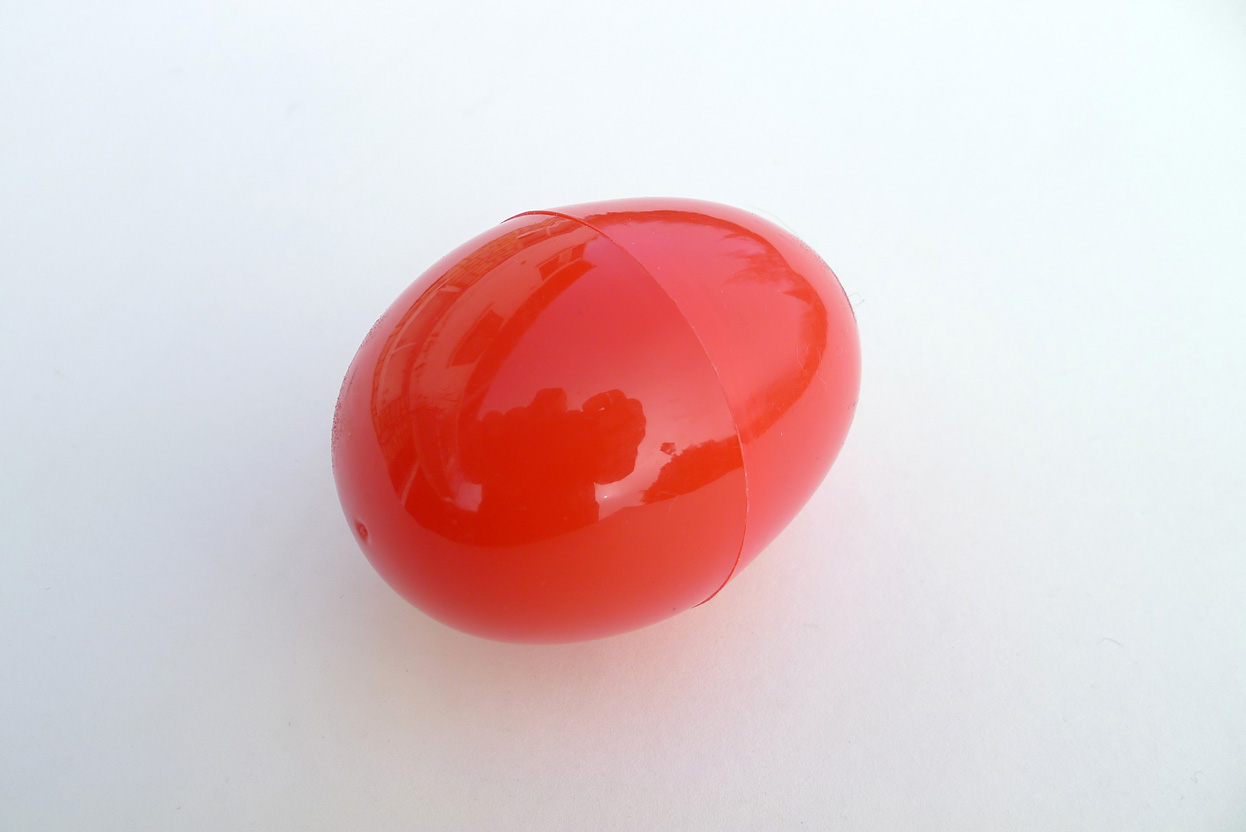
Generally, eggs pop out in your garden at Easter. But it's for Christmas that our friend Harm Linsen from the Hetherlands, sent us a beautiful red egg.

And in the egg, there was a nose whistle made by Harm and etched with my name!

Harm sent also a file with pictures of the making:
So, Mr. Linsen used simple referee metal whistle and transformed them by inserting their nose is a brass plate, in order to build a nose saddle, and cutting a part of the belly, to create a labium.


The 2-colors result is funny and very comfortable. The nose saddle is well dimensioned and Harm filed a little scoop for the "western nose cartilage": well done!

Then Harm Linsen etched my name on the nose shield, and filled the letters with a silver coloured marker:

The labium cut in the whistle belly is rather large:

The result is a very comfortable nose whistle, medium-bass oriented, easy to play and with a loud sound. A success! Thank you Harm!
Here is a sound sample:
And in the egg, there was a nose whistle made by Harm and etched with my name!

Harm sent also a file with pictures of the making:
 |  |
 |  |


The 2-colors result is funny and very comfortable. The nose saddle is well dimensioned and Harm filed a little scoop for the "western nose cartilage": well done!

Then Harm Linsen etched my name on the nose shield, and filled the letters with a silver coloured marker:

The labium cut in the whistle belly is rather large:

The result is a very comfortable nose whistle, medium-bass oriented, easy to play and with a loud sound. A success! Thank you Harm!
Here is a sound sample:
Dec 12, 2012
Nose flute and musical saw
Two recent pictures of Mr. Kato Hideo playing the musical saw and a clay Bocarina™ together. We would have liked to attend this event!
 |  |
Dec 11, 2012
Nose Flute Pioneers: Charles M. Berry
With the "Nose Flute Pioneers" series, Noseflute.org enters a little cycle of research. I hope it won't be too arid for a blog, but I really think that the facts I found have to be published. The sources : Google patents, US Census and an access to newspaper archives. But also, depending on the topic, correspondence by e-mail with descendants. Let's better say : internet searching tools available for a Frenchie not able to access US real paper archives.
---
Nose Flute Pioneers: Charles M. Berry
This notice about Charles M. Berry will be short. Indeed, there were so many homonyms that it is very difficult to distinguish what archive is appropriate or not to the right person. I prefered to expose only those I can ascertain as being proper to "our" Charles Berry.
We know Charles M. Berry through the patent US 2,197,993, filed for the « Vocamonica » Mar. 19, 1938, and registered Apr. 23, 1940. As stated in the patent description, Berry was living then in Inglewood (South/West of Los Angeles), California.
--
Charles M. Berry was born in Indiana Feb. 15, 1864. What he did during his 50 first years is a mystery, but it seems that Charles became an engineer and an inventor specialized in airplane parts.
In 1915, Berry filed a patent for a propeller (US 1,228,874, fil. Jul. 31, 1915 and reg. Jun. 5, 1917) that is supposed not to be affectable by climate changes (contrarywise to wooden ones). The Berry propeller is made of metal sheet shaped in a manual mould, then coated with carbon.
At this time, Charles Berry was living in New York, NY. I was able to track him 15 years later, already in Inglewood, CA. In the 1930 census sheet excerpt shown below, it is clearly stated that Charles' occupation is "Inventor" specialized in "Airplane parts".
Charles is married with Pearl A., 50, born in NY. Plase notice that their neighbours are the McDowells, and that John A. is "Mechanical engineer", working in the "patents" business... Are Berry and McDowell associated in some way?

In 1938, Berry, 74, patented the Vocamonica. It's a nose flute with a movable blade in the labium, in order to set the instrument tonality.

Two years earlier, Oscar Cobia had filed a patent for a nose flute with a set of exchangeable labiums, but the Berry's patent is the first, as far as I know, to propose a variable fipple. Berry names it a toner gate.


A detail is very interesting in this patent:

Yes! Berry's attorney is his own neighbour John McDowell!
Indeed, in the 1940 census sheet, McDowell occupation has changed from "Mechanical engineer/patents" to "Patent attorney/law".

In 1940, Berry is apparently retired (he's 76) and both him and John McDowell, only 44 though, are widowed.
Charles M. Berry died Jun. 6, 1959, at the age of 95.

-----
On the same topic :
- Nose Flute Pioneers: William G. Carter - Part I
- Nose Flute Pioneers: William G. Carter - Part II
- Nose Flute Pioneers: William G. Carter - Part III
- Nose Flute Pioneers: Ernest W. Davis - Part I
- Nose Flute Pioneers: Ernest W. Davis - Part II
- Nose Flute Pioneers: Nelson Ronsheim
- Nose Flute Pioneers: Garrett J. Couchois
- Nose Flute Pioneers: The Stivers - Part I
- Nose Flute Pioneers: The Stivers - Part II
- Nose Flute Pioneers: The Stivers - Part III
- Nose Flute Pioneers: The Stivers - Part IV
- Nose Flute Pioneers: The Stivers - Part V
- Nose Flute Pioneers: Aurion Villa Chevers
- Nose Flute Pioneers: Charles M. Berry
----
---
Nose Flute Pioneers: Charles M. Berry
This notice about Charles M. Berry will be short. Indeed, there were so many homonyms that it is very difficult to distinguish what archive is appropriate or not to the right person. I prefered to expose only those I can ascertain as being proper to "our" Charles Berry.
We know Charles M. Berry through the patent US 2,197,993, filed for the « Vocamonica » Mar. 19, 1938, and registered Apr. 23, 1940. As stated in the patent description, Berry was living then in Inglewood (South/West of Los Angeles), California.
--
Charles M. Berry was born in Indiana Feb. 15, 1864. What he did during his 50 first years is a mystery, but it seems that Charles became an engineer and an inventor specialized in airplane parts.
In 1915, Berry filed a patent for a propeller (US 1,228,874, fil. Jul. 31, 1915 and reg. Jun. 5, 1917) that is supposed not to be affectable by climate changes (contrarywise to wooden ones). The Berry propeller is made of metal sheet shaped in a manual mould, then coated with carbon.
 |  |
Charles is married with Pearl A., 50, born in NY. Plase notice that their neighbours are the McDowells, and that John A. is "Mechanical engineer", working in the "patents" business... Are Berry and McDowell associated in some way?

In 1938, Berry, 74, patented the Vocamonica. It's a nose flute with a movable blade in the labium, in order to set the instrument tonality.

Two years earlier, Oscar Cobia had filed a patent for a nose flute with a set of exchangeable labiums, but the Berry's patent is the first, as far as I know, to propose a variable fipple. Berry names it a toner gate.


A detail is very interesting in this patent:

Yes! Berry's attorney is his own neighbour John McDowell!
Indeed, in the 1940 census sheet, McDowell occupation has changed from "Mechanical engineer/patents" to "Patent attorney/law".

In 1940, Berry is apparently retired (he's 76) and both him and John McDowell, only 44 though, are widowed.
Charles M. Berry died Jun. 6, 1959, at the age of 95.

-----
On the same topic :
- Nose Flute Pioneers: William G. Carter - Part I
- Nose Flute Pioneers: William G. Carter - Part II
- Nose Flute Pioneers: William G. Carter - Part III
- Nose Flute Pioneers: Ernest W. Davis - Part I
- Nose Flute Pioneers: Ernest W. Davis - Part II
- Nose Flute Pioneers: Nelson Ronsheim
- Nose Flute Pioneers: Garrett J. Couchois
- Nose Flute Pioneers: The Stivers - Part I
- Nose Flute Pioneers: The Stivers - Part II
- Nose Flute Pioneers: The Stivers - Part III
- Nose Flute Pioneers: The Stivers - Part IV
- Nose Flute Pioneers: The Stivers - Part V
- Nose Flute Pioneers: Aurion Villa Chevers
- Nose Flute Pioneers: Charles M. Berry
----
Dec 10, 2012
Ray C. Clarke, long timer humanatonist
Here are two newspaper articles. The first one dates of Mar. 31, 1927 (Lebanon Daily News) and the second was published Mar. 25, 1937 (Abilene Morning News). Both deals with Mr. Ray C. Clarke, the « King of Humanatone ».
In 1927, Clarke is presented as amember of the American Humanatone Company of New York. Was this company a corporate band managed by Humanatone Co., as the brand Zobo did by founding The First Zobo Band of New York?

Anyway, ten years later, Mr. Clarke was still playing the Humanatone, was broadcast on the radio KRBC, and according to the paper, was very active in flute performing.
Doesn't this deserve a NF Hall of Fame nomination?


In 1927, Clarke is presented as amember of the American Humanatone Company of New York. Was this company a corporate band managed by Humanatone Co., as the brand Zobo did by founding The First Zobo Band of New York?

Anyway, ten years later, Mr. Clarke was still playing the Humanatone, was broadcast on the radio KRBC, and according to the paper, was very active in flute performing.
Doesn't this deserve a NF Hall of Fame nomination?


Dec 8, 2012
Historic Nose Flutes - Grierson's Whistle: Review
Some historic nose flutes have totally disappear or haven't even been produced or commercialized. Our goal, here, is to reconstruct them, as close as possible to the original, with the help of the patent drawings and descriptions.
[Sequel of the posts Grierson's Whistle: Drawing a template and Building the flute ]
Last step before the review, I nickel plated the Grierson's whistle. My replica was far from being perfect, and my electroplating is in accordance: a bit unveven :)

Here is the nose flute:


The Grierson's whistle is a huge piece. It is heavy and tall, which is rather unusual for a nose flute of the 1920's. But it also shows other singularities.
The large "hollow" front face has never been seen before, and will never feature again on another instrument.
But the most interesting novelty is the flute "elephant profile", with a rounded heel that need to be inserted in the mouth, just behind the lower lip. It is not uncomfortable, but it doesn't help "freeing" the mouth for sound effects, or even to reach sharp notes.


The Grierson has also an upper lip rest, with a more classical shape but rounded. I carefully sanded mine not to wound my lip, but one can reasonably wonder how harmful it could have been, stamped from the mouth hole, when (whether) industrially produced...

Despite these two lip rests, the Grierson is not a handsfree nose flute. It is too heavy and needs a hand or a rubber band to be retained tightly under the nose.
The front is hollow because Grierson wanted to create a amplification effect: indeed, the air duct top and the rounded base of the flute form a kind of horn shape, like a ear trumpet.

I am not sure that this feature is really efficient, and I must admit that the Grierson whistle is not a good nose flute.
The tonality range is rather limited and the sound is weak. I may have not been precise enough when building it, or have not respected the specifications... but anyway, there is no beveled labium but just a flat blade to split the air, like on the metal Humanatone. And we know this is not a performance solution. More, I really think that the bottom curves of the horn amp is a bad solution. At the "heel" (lower lip rest) place, they shape a front double chamber...
Finally, because of the air entrance design, half of the air blown leaks.
But as an historic item, the Grierson whistle is very interesting, particularly by it's design and shapes.

Here is a short sample in which you can notice the weakness, dullness and windiness of the sound.
[Sequel of the posts Grierson's Whistle: Drawing a template and Building the flute ]
Last step before the review, I nickel plated the Grierson's whistle. My replica was far from being perfect, and my electroplating is in accordance: a bit unveven :)

Here is the nose flute:

 |  |

 |  |
The large "hollow" front face has never been seen before, and will never feature again on another instrument.
But the most interesting novelty is the flute "elephant profile", with a rounded heel that need to be inserted in the mouth, just behind the lower lip. It is not uncomfortable, but it doesn't help "freeing" the mouth for sound effects, or even to reach sharp notes.


The Grierson has also an upper lip rest, with a more classical shape but rounded. I carefully sanded mine not to wound my lip, but one can reasonably wonder how harmful it could have been, stamped from the mouth hole, when (whether) industrially produced...

Despite these two lip rests, the Grierson is not a handsfree nose flute. It is too heavy and needs a hand or a rubber band to be retained tightly under the nose.
The front is hollow because Grierson wanted to create a amplification effect: indeed, the air duct top and the rounded base of the flute form a kind of horn shape, like a ear trumpet.

 |  |
The tonality range is rather limited and the sound is weak. I may have not been precise enough when building it, or have not respected the specifications... but anyway, there is no beveled labium but just a flat blade to split the air, like on the metal Humanatone. And we know this is not a performance solution. More, I really think that the bottom curves of the horn amp is a bad solution. At the "heel" (lower lip rest) place, they shape a front double chamber...
Finally, because of the air entrance design, half of the air blown leaks.
But as an historic item, the Grierson whistle is very interesting, particularly by it's design and shapes.

Here is a short sample in which you can notice the weakness, dullness and windiness of the sound.
Dec 6, 2012
Historic Nose Flutes - Grierson's Whistle: Building
Some historic nose flutes have totally disappear or haven't even been produced or commercialized. Our goal, here, is to reconstruct them, as close as possible to the original, with the help of the patent drawings and descriptions.
[Sequel of the post Grierson's Whistle: drawing a template]
In his patent, Alexander Roxburgh Grierson specified his whistle was made of metal sheet. So I used (again) a 0.5mm thick tin plate, and glued my template.

I roughly cut the piece with a pair of shears, and began by the easiest: rounding the upper lip rest around a pencil :) Whether it had been manufactured, the Grierson's whistle would have been stamped, and this lip rest would have been the the "positive" of the mouth hole. I'm not able to stamp tin sheets, so I cut a separate part that I will solder at the right position.

Then I shaped the parts more precisely with a file. I also used a metal punch to cut the narrow curve of the wings, and also to remove metal from the mouth and nose holes, before finishing them with the file.

And I got all my parts ready for bending...

Bending the longest part was a very difficult task. I used pencils and rods of different diameters.


Then I began the soldering, and noticed 1mm was lacking at the very end of the curves. I had suspected that those curves would have "eaten" some length, but my cardboard model was made of a thinner material than the tin sheet, and I made this little mistake...


Finally, I soldered the upper lip rest.

Then I filed and sanded the instrument. It is far from being perfect... But it's been the most difficult replica I made so far. And I'm not proud of the quality of my solderings...

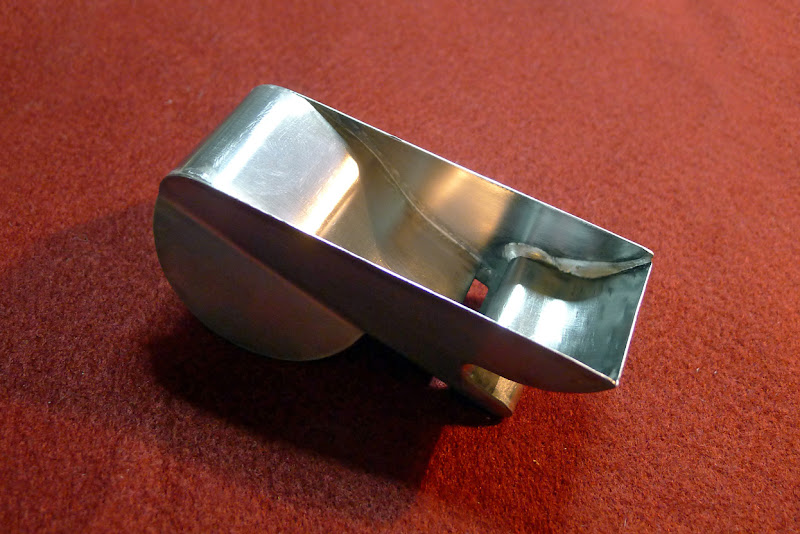
To be continued!
---
On the same topic :
- Historic Nose Flutes - The Nasalette: Template
- Historic Nose Flutes - The Nasalette: Building
- Historic Nose Flutes - The Nasalette: Review
- Historic Nose Flutes - Couchois' Whistle: Template
- Historic Nose Flutes - Couchois' Whistle: Building
- Historic Nose Flutes - Couchois' Whistle: Review
- Historic Nose Flutes - Grierson's Whistle: Template
- Historic Nose Flutes - Grierson's Whistle: Building
- Historic Nose Flutes - Grierson's Whistle: Review
---
[Sequel of the post Grierson's Whistle: drawing a template]
In his patent, Alexander Roxburgh Grierson specified his whistle was made of metal sheet. So I used (again) a 0.5mm thick tin plate, and glued my template.

I roughly cut the piece with a pair of shears, and began by the easiest: rounding the upper lip rest around a pencil :) Whether it had been manufactured, the Grierson's whistle would have been stamped, and this lip rest would have been the the "positive" of the mouth hole. I'm not able to stamp tin sheets, so I cut a separate part that I will solder at the right position.

Then I shaped the parts more precisely with a file. I also used a metal punch to cut the narrow curve of the wings, and also to remove metal from the mouth and nose holes, before finishing them with the file.

 |  |

Bending the longest part was a very difficult task. I used pencils and rods of different diameters.

 |  |


Then I began the soldering, and noticed 1mm was lacking at the very end of the curves. I had suspected that those curves would have "eaten" some length, but my cardboard model was made of a thinner material than the tin sheet, and I made this little mistake...


Finally, I soldered the upper lip rest.

Then I filed and sanded the instrument. It is far from being perfect... But it's been the most difficult replica I made so far. And I'm not proud of the quality of my solderings...

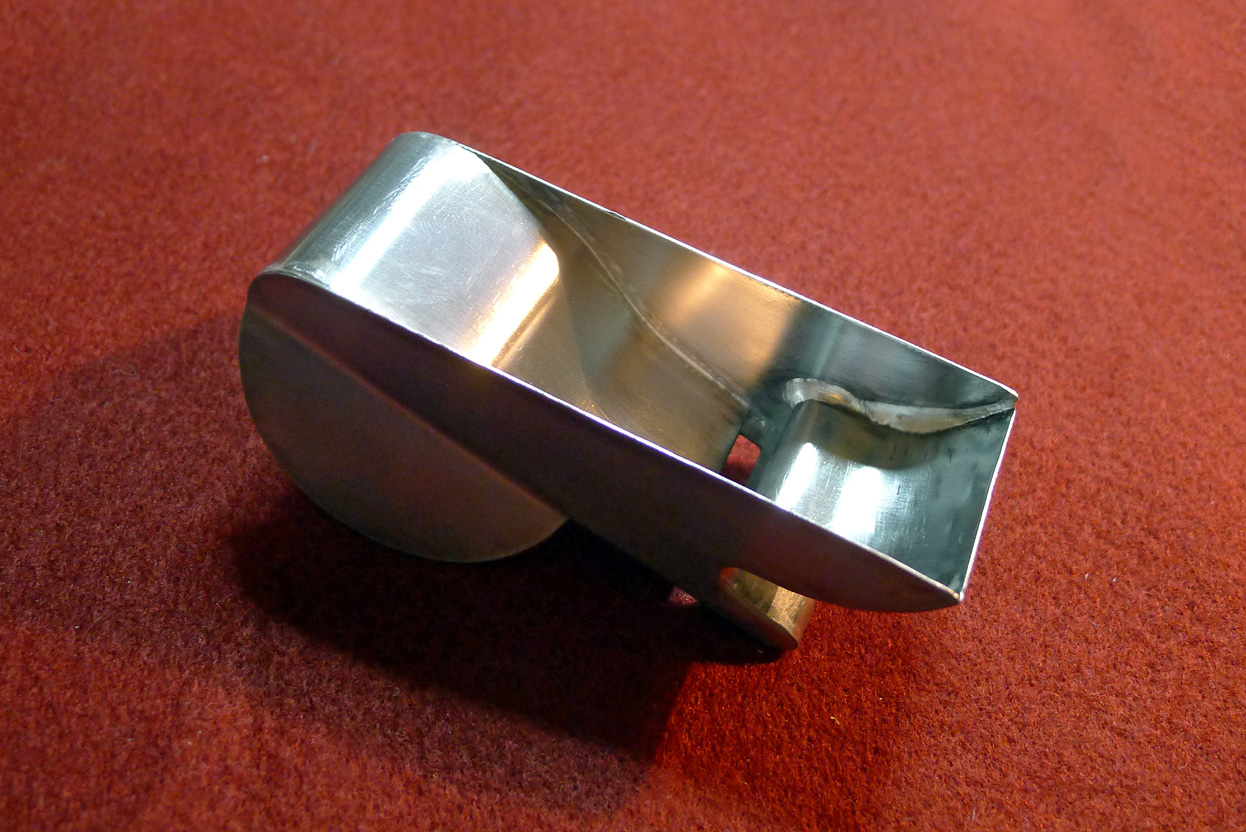
To be continued!
---
On the same topic :
- Historic Nose Flutes - The Nasalette: Template
- Historic Nose Flutes - The Nasalette: Building
- Historic Nose Flutes - The Nasalette: Review
- Historic Nose Flutes - Couchois' Whistle: Template
- Historic Nose Flutes - Couchois' Whistle: Building
- Historic Nose Flutes - Couchois' Whistle: Review
- Historic Nose Flutes - Grierson's Whistle: Template
- Historic Nose Flutes - Grierson's Whistle: Building
- Historic Nose Flutes - Grierson's Whistle: Review
---
Subscribe to:
Posts (Atom)