This blog is dedicated to the sublime instruments called nose flutes and which produce the most divine sound ever. We have chosen to discard all the native models from S. Pacific and Asia, for they need fingering to be played. We'll concentrate on "buccal cavity driven" nose flutes : the well patented and trademarked metal or plastic ones, plus, by a condemnable indulgence, some wooden craft or home-made productions.
Showing posts with label Trophy Music Co.. Show all posts

Jun 10, 2016

75th Anniversary of the plastic Humanatone!

Filed Jan. 22, 1940 by Ernest W. Davis (NFHoF), the patent of what became the plastic Humanatone (in 1943) was registered on 10th of June, 1941, exactly 75 years ago!


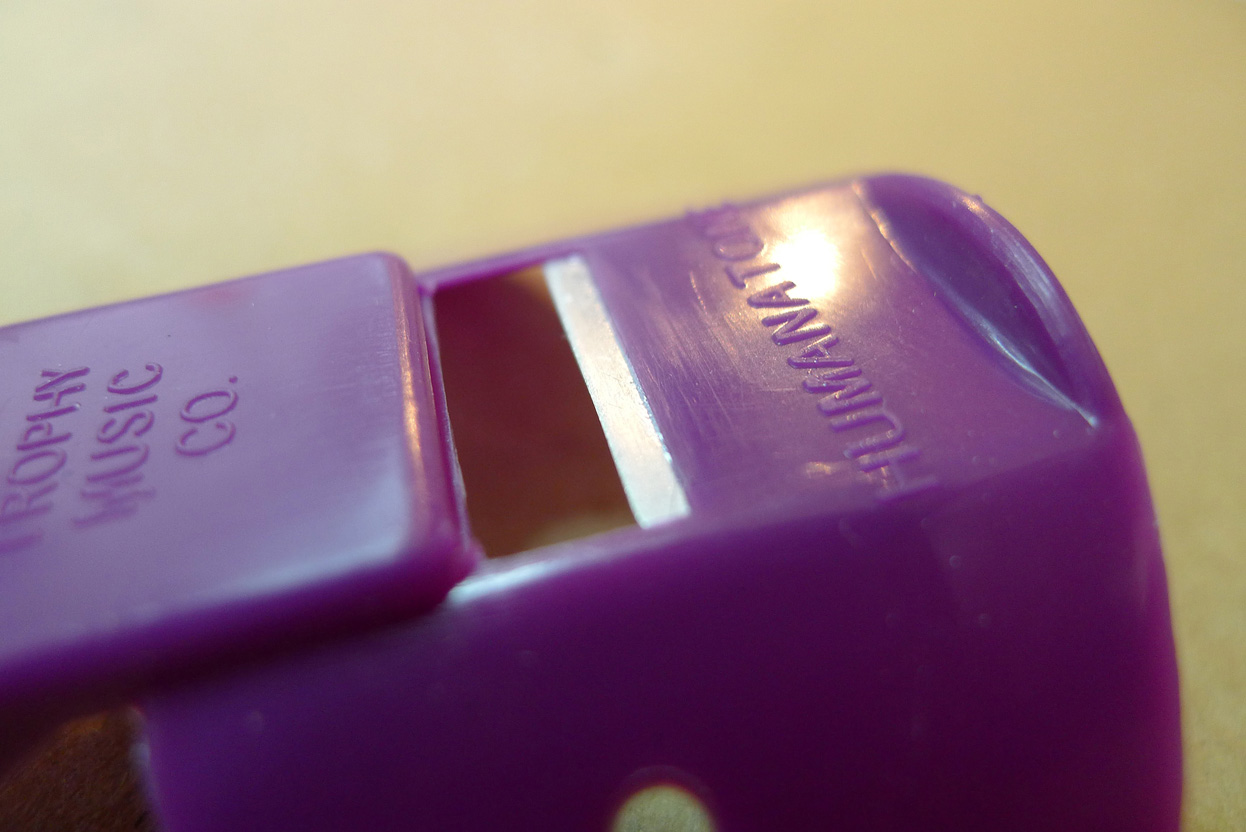
We all know that the 'Hum' is not the best nose flute – could I dare to say it is the worst mass produced one – but it has been much better by the past. The plastics used have evolved in a bad way: whether the 1943+ models were roughly injected in a low grade plastic (celluloid?), the Fred Gretsch Mfg Co. quickly turned to a nice polystyren, stiff and crispy, yet light, nicely sounding. But on the turn of the 1980-90s, Trophy Music Co. bought the brand and began a production in a cheap, soft and dull sounding PVC (not from the beginning however, there were polystyren Trophy Music versions, then translucent red ones, then only the PVC).

The original shape evolved a bit at the early stages: the nose scoop got sharper, the 'true tremolo' hole stopped to been chamfered, the wingspan was reduced a bit while the mouth hole made bigger, and a heal was added to the bottom of the mouth shield. All by Grestch, on their late models.

Besides the bad quality of the plastic, we all know that the main feature that turns the Humanatone to a cheap toy is the very broad mouth hole: clog the bottom third of this hole by a piece of bristol (or better: a piece of aluminium), and the Hum immediately sounds better (but sharper). This is maybe the reason of its success: a sturdy, sharp and loud instrument would have frightened the parents! Better buy a barely sounding toy, more 'windy-woody' than sharp and crisp, and better, that the kido will break after an afternoon of use.

However, in the 1940s, the Humanatone was also specially packaged to be sent to the 'buoys' fighting in the Pacific. No more dedicated to concertists, as the original metal one was, but to kids and soldiers.


The early models were incredibly psychedelic, with swirled and marbled colours! But Gretsch rationalized its catalogue and began to produce only plain color Humanatones. Red, yellow, blue, brown, black. Then Trophy Music froze the range to the current 6 tones: yellow, orange, red, purple, navy blue and green.


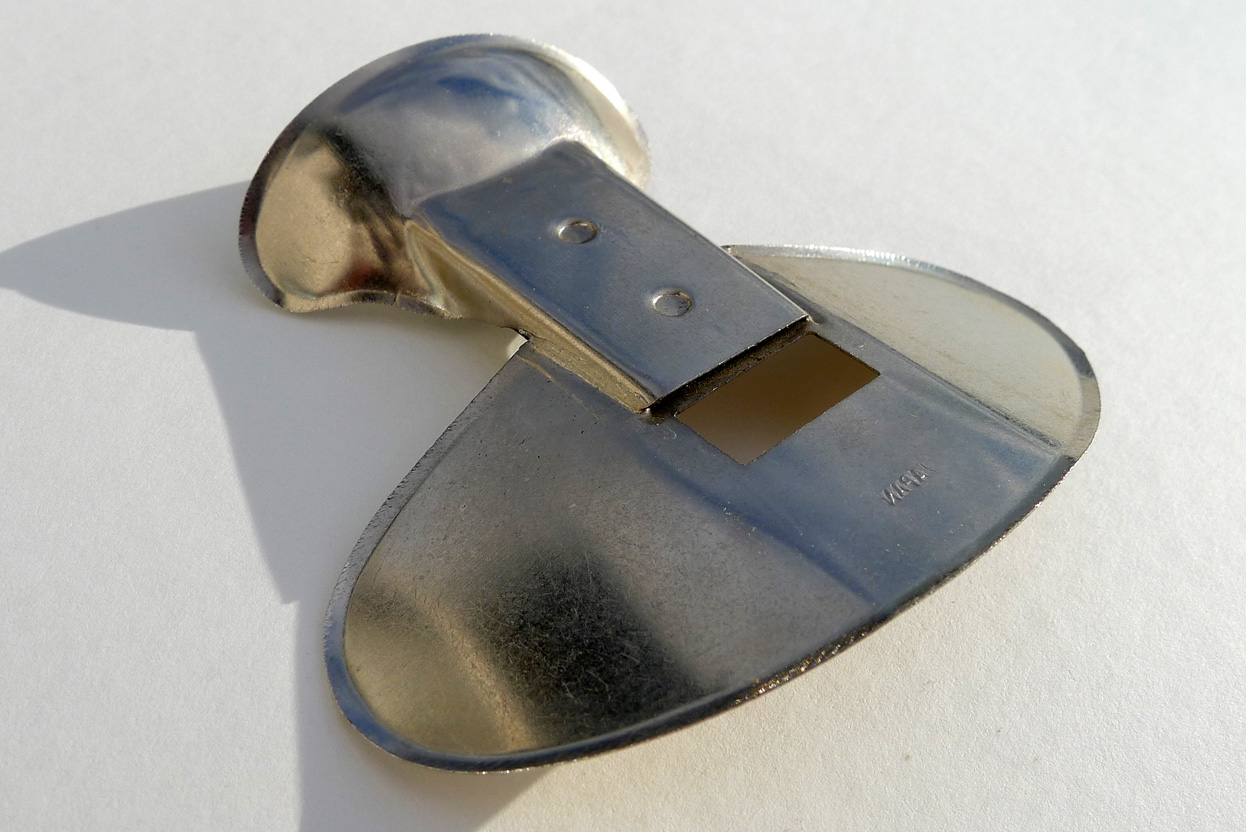
In the 1950-60, the Humanatone was also produced in a tin version, made in Japan.
The Hum was copied. By the Hum-a-Tune, produced in Hong-Kong in 1969, rebranded into 'Bullwinkle's Hum-a-Tune', but also by an anonymous chinese production, in the 90s. But the Humanatone continued its road, sold under different disguises, like the Topps Nose Flute version in the 1960s, the Dr. B. B. Bumpstead's Musical Respirator, the Amazing Nose Flute in 2005, or even by Trophy Music itself with the 1st Note Nose flute. It was even used as a promotional toy for a nasal spray!

The Humanatone was also the object of all my affection in my very first video, very first post of this blog on 9th of August, 2011:


---

So, despite your numerous flaws, your cheap make, your deep crappiness, you're the one with the biggest success and longevity, and this must necessarily mean something…

Happy birthday, Grandma!


Sep 25, 2014

Another Transitional Humanatone

We recently published the pictures of a very early Gretsch plastic Humanatone, which appeared to be a transitional product between the famous metal nose flute and the plastic model designed by Ernest Davis (please check this post). Here is the other end of the Gretsch era: another transitional Humanatone.

Indeed, the instrument is (still) branded by Gretsch, but the user manual is printed by Trophy Music Co. So, we can state that Trophy bought from Gretsch not only the brand and moulds, but also the current stock, exactly as Gretsch had done some ±25 years before with the Humanatone Co. products. This instrument is one one the last Gretsch nose flutes.

Aug 29, 2014

Trophy Concert Nose Flute

Trophy Music Co, subsidiary of Grover, is the producer/distributor of the famous plastic Humanatone. The company mostly sells them in bulks of units wrapped in cellophane. But there is also a department called 1st Note which distributes the Humanatone with a better packaging, with the name "1st Note Nose Flute".

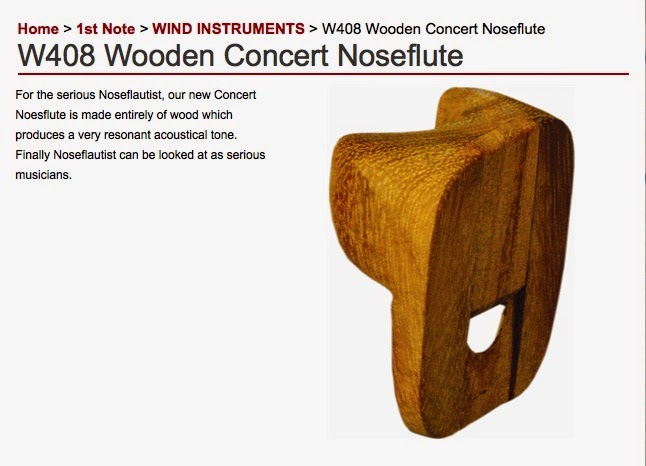
What's more unusual, is to find a wooden nose flute branded by Trophy Music... That's what I found, and with the help of my friend UkesterBrown, famous ukulele player, I was able to acquire it (the seller didn't want to sell out of USA ...!). Thank you David!

It is named "Concert Nose Flute", and is a "regular vietnamese nose flute" - I mean: not really an interesting wooden nose flute (badly and quickly made). What is interesting is the fact that Trophy distributed it. The back is printed with an "humorous" user manual, and the graphics looks like dedicated to an April Fool's Day use.


I checked the barcode (UPC-A : 0 82562 08423 0), in which 82562 refers to Trophy Music Co. and 08423 to the specific product itself, and found no occurrence, meaning that the product has been discontinued. However, the reference W408 still exist for a wooden nose flute in Trophy Music catalog, but apparently with no packaging (they probably understood that the laughing man was not compatible with their assertion Finally Noseflautist can be looked at as serious musicians (sic). So, it is not possible for me to date this nose flute, but I think it is from the 1990s. The "laughing bow tie man" graphics is the same that the former designed used to package the 1st Note Nose Flute (Humanatone).


Here are the former and the current graphics of the 1st Note Nose Flute:

Jan 16, 2014

A pack of early Grover-Trophy Humanatones

I found a pack of 12 red humanatones, probably dating of the late 60's. They were still made of injected polystyrene, and not yet moulded polypropylene, as they are nowadays. They are made of a translucent material (in fact they are the exact model shown here)


But these nose flutes are already "Trophy USA" branded (not "Gretsch" anymore, and not "Trophy Music Co." yet). They belong to the first series of Grover-Trophy Humanatones. On the back side, they mention the patent number, but no "Made in USA" as they have been doing since.

(Left: the 60's model, Right: current one):

Look and feel the different qualities of plastic :


and hear it: first the polypropylene falling on my desk, then the polystyrene :


In the bag, there were also a dozen of user manuals:


What is interesting there, is that the user manual is very similar to another red Humanatone I have, which is... a Gretsch one, with a "Trophy Music" user manual — meaning it was a transitional model (made by Gretsch, but sold by Grover) – and thus, the 12-pack is very likely from the first productions by Trophy, as stated above.

(Left: the Gretsch user manual, Right: the Trophy one):

The only differences lay in:
- the font used for the title and address lines
- the change of "take care to have the MOUTH WELL OPEN" for "
keep the MOUTH WELL OPEN"

On the nose flute side, both late Gretsch and early Trophy are identical, both in polystyrene (the Gretsch is not translucent), same font for the patent number mention, no "Made in USA"... And the only difference lays on the duct cover with a "Gretsch" mention on one hand, and "Trophy USA" on the other.


Feb 5, 2013

Intermediate plastic Humanatone

Look at these pictures from the norwegian Digitalt Museum... it's a translucent plastic Humanatone! The current Humanatones are stamped on the front with "Trophy Music Co.". Here, you can read "Trophy U.S.A.". The plastic looks like polystyrene, and not polyvinyl chloride, as it is used now.


I suppose this is an intermediate model, between the Gretsch ones and the current Grover-Trophy production. When does it date of? Difficult to say, but probably early. Indeed, the nose flutes sold by the Dr. B. B. Bumstead in the 1990's were already made in PVC and stamped "Trophy Music Co." Since I don't know when Gretsch sold the rights to Grover, I can't be much more precise. Is this nose flute from the 70's?

Jun 15, 2012

The Topps nose flute

The Topps Chewing Gum Company was founded in 1938, and from 1951, began to sell baseball cards that become its specialty. But the company continued to produce candies, and also some toys. Here is a Topps nose flute, found on The Topps Archives blog. According to the keeper of this blog and Wikipedia, the flute can be dated "after 1965", since the header card mentions Duryea as location for the company.


This nose flute clearly is a Humanatone, although I don't think it is stamped with this brand, which was still owned by the Fred Gretsch Mfg. Co. at this time (I cannot read what written on the flute itself...). However, it looks of a much better fabrication than the contemporary (end of the 60s) spin-off "Hum-a-tune" and its branded version Bullwinkle's Hum-a-Tune (1969), which were produced in Hong-Kong.

The Topps nose flute presents 2 features from the Humanatone that do not appear on the Hum-a-Tune : the small "true tremolo" hole on the right wing, and the lip-rest heel at the bottom (as did the late Gretsch Humanatones). The (yellow) plastic of this Topps looks more like the new Humanatones (consistent and not marbled).

I guess I can read on the header: « ©TOPPS CHEWING GUM, INC. / DURYEA, PA. 18642 / MADE & PRTD. IN U.S.A. » and I suppose this model was a "real Humanatone" by Gretsch (or already by Grover ?), but specially branded for the Topps Co. A physical examination would be necessary to be certain.

Apr 21, 2012

A Humanatone and clones chronology

In order to clarify my previous post, I attempted to depict a chronology of the Humanatone and its clones : old and modern shapes, that is, metal and plastic. The zones in plain color are "sure", and the ones filled with gradations represent uncertain dates.


----

About metal Humanatones, check :

- Humanatone - part I : the metallic era
- New Humanatone ads
- The Two metal Humanatones
- Another metal Humanatone
- Humanatone boxes
- Another Humanatone box
- Humanatone: A very early user manual
- The Magic (Nose) Flute: only questions... .
- A Humanatone and clones chronology
- A Humanatone in 1892 ?
- Humanatone: Early promotional demos
- Another Humanatone archive
- Huma... something
- Rectification: Humanatone appearance date
- Great paper from 1903
- Nose Flute Pioneers: The Stivers - Part I
- Nose Flute Pioneers: The Stivers - Part II
- Nose Flute Pioneers: The Stivers - Part III
- Nose Flute Pioneers: The Stivers - Part IV
- Nose Flute Pioneers: The Stivers - Part V
- A Humanatone as a scientific tool
- Two other Humanatone Ads

And on later Humanatones :

- Humanatone - Part II : the Gretsch plastic era
- Humanatone - Part III : the Gretsch metal era

-----

Mar 30, 2012

Enhance your flute - Part I : The Humanatone

By the past, the Humanatone nose flute, which was sold by the Fred Gretsch Mfg. Co., was made with injected polystyrene, a hard and breakable plastic. The shape was designed in accordance of this resonant polymer, and so were the technical specs. Why did Grover-Trophy Music change to a softer plastic ? I don't know... generally this happen for cost reducing.
Anyway, when they began the production with this softer and bad quality plastic material (PVC?), they didn't modify the moulds. And the air duct and labium specifications which were adapted to the hard and vibrant polystyrene, went off the "best setting range".

The most usual criticisms against the current Humanatone is that it produces a weak and hoarse whistling. Some other players don't like it's tone range. This is mostly attributed to its too broad mouth hole, too thick air duct, and the absence of a real "blade fipple". Some Japanese players made experiments with cellotape in order to reduce the mouth hole, and it gave some correct results (see here and there).

What we present here is a more significant modification, more permanent, yet made in less than one hour. The idea was to improve the power, the range, the precision and the clarity of the sound.

First I cut a little piece of aluminium in a 2mm thick plate, and filed a bevel. Then I filed the rear side of this future blade in order to create a little step just besides the part of the labium that was designed to inset the mouth hole. I just glued the new aluminium fipple with a bi-component glue.

Then, I cut a peice of cardboard fitting the air duct and stuck it on the "front internal side" of the flute. This was made in order to gently narrow the air duct (the cardboard could have even been thicker), and thus increase the air pressure on the labium and the power of the sound.

The result is a enhanced Humanatone. The new sound is clearer, louder, more precise and with a better attack.


Here is a little sound sample of a regular Humanatone immediately followed by the same excerpt with the improved flute. The recording conditions were absolutely the same and I took care of trying to blow with the same strength (the improvement is patent, thus not totally palpable with this mp3).


---

On the same topic, please visit :

- Enhance your flute - Part II : The Swan flute
- Enhance your flute - Part III : The Bocarina

---

Dec 22, 2011

Humanatone - Part III : the Gretsch metal era

Sequel of the posts :
Humanatone - part I : the metallic era
Humanatone - part II : the Gretsch plastic era


One of the rarest industrial nose flute to be seeked by the collector is undoubtedly the japanese Humanatone. It surely was a Gretsch Mfg Co. instrument, according to the packaging design and the fact the owner of the brand was Gretsch, but it was produced in Japan and there is no mention of another brand that « Humanatone ». It probably dates from the 50s and/or the 60s.

The instrument is a Humanatone made in plated tin, with a shape quite similar to the american plastic one, but with some light differences, partly due to the way of producing it.
The packaging used the exact graphic chart of its american cousin, but was simply inserted on a card, and not packed in a box.


The instrument in itself is absolutely gorgeous. It is made of nickel or chrome plated tin. The way it was produced is interesting. Two plates had been stamped and cut, corresponding to the shield on one hand, and the nose cap and duct cover on the other. Then both pieces were soldered together, and nickel/chrome plated. What's interesting is the way the instrument is cut in 2 parts : with the antique nose flutes, the nose cap was part of the shield plate. Here, the nose cap is the continuation of the air duct cover.

The japanese Humanatone is deprived of "true tremolo" hole, and has a shape lightly different from the plastic 50s model and, for sure, from the current plastic production by Trophy Music Co., notably by a smaller mouth hole.


---

About metal Humanatones, check :

Humanatone - part I : the metallic era
New Humanatone ads
The Two metal Humanatones
Another metal Humanatone
Humanatone boxes
Another Humanatone box
Humanatone: A very early user manual
A Humanatone and clones chronology
A Humanatone in 1892 ?
Rectification: Humanatone appearance date


And on later Humanatones :
Humanatone - Part II : the Gretsch plastic era
Humanatone - Part III : the Gretsch metal era

---