This blog is dedicated to the sublime instruments called nose flutes and which produce the most divine sound ever. We have chosen to discard all the native models from S. Pacific and Asia, for they need fingering to be played. We'll concentrate on "buccal cavity driven" nose flutes : the well patented and trademarked metal or plastic ones, plus, by a condemnable indulgence, some wooden craft or home-made productions.
Showing posts with label Swan logo. Show all posts

May 16, 2016

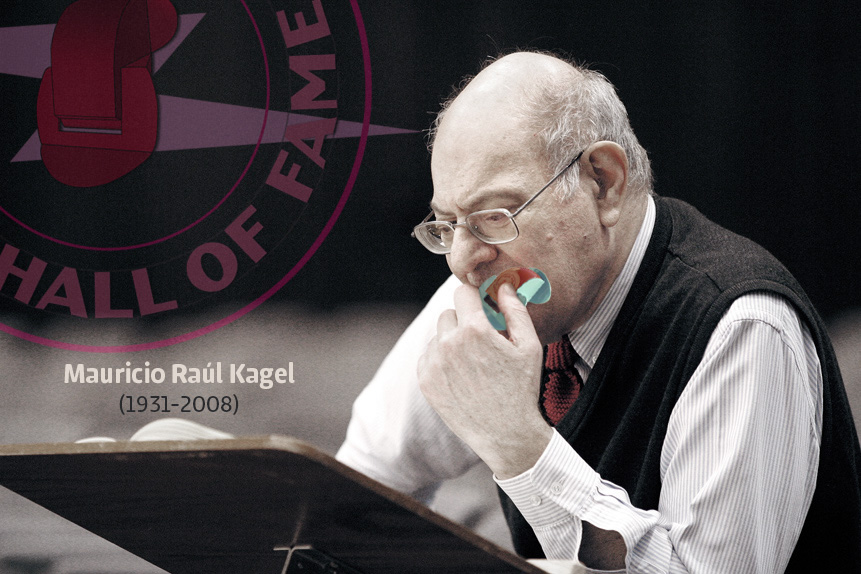
Mauricio Kagel (1931-2008) : Hall of Fame!

Born in Buenos Aires in 1931, Mauricio Kagel moved to Cologne, Germany, in 1957 where he became one of the greatest post-second world war avant garde composers.

« Among the contemporary composers Mauricio Kagel more than any other explored the instrument concept and expanded it. Especially in the sixties and seventies, he created works in which in addition to conventional musical instruments, vacuum cleaners, rubber tubes, walkie-talkies and turntables were used. » [source: Der Schall, Mauricio Kagels Instrumentarium, PFAU, 2008]

Mauricio Kagel in 1968 and 1985:


Among his prolific work, one piece of 1968 particularly retained our attention: Der Shall ('The Sound'). Indeed, and as you can imagine, it contains some nosefluting. Der Schall is a ±40 minutes long piece, written for 54 instruments, played by 5 musicians. [You can listen to the whole piece here, or go directly to the nose flute part here.]

Here is the text written by M. Kagel and printed on the back cover of the LP. You can notice that the nose flute is part of the instruments of group V, played originally by Christoph Caskel:


And here, the front cover, and a portrait of the percussionist Christoph Caskel, who played the Nasenflöte on the record:


In 2007, the Music R&D dept. of the University of Basel (Switzerland), 'reactivated' the original sound objects (kept at Basel Historical Museum) or some replicas in a performance in which the musicians recreated Der Schall. They recorded their experiment, and the CD was published along with the book Der Schall, Mauricio Kagels Instrumentarium, PFAU, 2008. This books contains lots of info and reproductions of original documents.

The font cover already shows a Nasenflöte in a box (rather well hidden though :):


The books is subtitled 'Mauricio Kagels Intrumentarium', and is an opportunity to show in detail the list of the instruments originally used (and preserved at Basel museum). They are categorized in several sections: Conventional Instruments, Historic Instruments, Extra-European/Exotic Instruments, Special/Non Classical Instruments, Percussion/Home Made Instruments and Signal Instruments.

That's among the Special Instruments that one can find a nice paragraph (p.81) about the nose flute…


… which says something like (edited Google translation):

« The nose flute perhaps constitutes the most striking example of the aforementioned contrast between the modern Western European form and the Asian or South American forms of the same instruments. While the variants from Southeast Asia, Oceania and Polynesia are usually whistle-like tubes made of natural materials that are blown with air from one nostril, the breath of the nasal air has a special symbolic meaning as the bearer of the soul, the Western European Nasenflöte is a quaint, almost funny-looking structure made of plastic (see photo inventory p.98). It is found to be extremely effective in many toy stores music, hardly anyone knows then, however, how the nose flute has to be played. The upper gap is for nose air entrance, while the lower opening stands for the lips, so that the pitch and timbre can be determined by the opening of the mouth and tongue. The nose flute can therefore be quite compared with the Jew's harp, with the difference that the pitch is changed freely and the sound is similar to a whistle. The plastic nose flute therefore requires a radical reconsidering of wind instrument players for unfamiliar tongue-mouth-acrobatics. Like the cuckoo clock Kagel gives a solo passage in which come the special capabilities of the instrument to bear. »

And page 98, between a tortoise shell and a straight mute:


Well, well well... Look at the bright and shiny red on this Schwan... This definitely is not the original Kagel's Nasenflöte, but a new one (the reference # begins by 2005...). I suppose the vintage one has not been preserved in Basel museum... Schade!

The book also offers lots of copies or original notes and execution sheets in which the Nasenflöte part is specified:


We can also find some great pictures of the 2007 'musical happening', and see the Schwan nose flute on the right desk of Matthias Würsch, the percussionist in charge of section V:

---

Now, it is very interesting to compare the 1968 and the 2007 interpretations and recordings. I isolated the two 2 minutes nose flute parts:

1968 excerpt:


2007 excerpt:


Which one do you prefer ?

---

It is very rare to find some nose flute in the work of a serious composer, that is, used as a real instrument, and not regarded as a carnival toy.

For having included a nose flute as a real instrument in his 1968 composition Der Schall, Mauricio Kagel has been inducted to the Nose Flute Hall of Fame, in the 'Promoters' section!


May 6, 2016

The Australian Magic Flute - Part V

This post is the sequel of The Australian Magic Flute - Part IV


What's the link between AC/DC and the Australian nose flute? You'll know it by reading this post!

---

When I got the the shiny unstamped Magic Flute, I wrote to the seller that if she found other nose flutes, I might be interested. She immediately answered: « Oh in the basement of the lady where I found this metal one, there were also plactic ones. I will make pictures for you ». I thought they were probably plastic Humanatones, but who knows, maybe would they be swirled color Gretsch ones... SOme days later, the lady sent me a picture of two green nose flutes, that definitely were not Humanatones... No, they were Weidlich und Lohse... a bit special.


Yes, my friends! A perfect Schwan, with no Swan logo, a … Magic Flute! Look at these babies:

As you can see, this Magic Flute has really the same characteristics than an early Weidlich und Lohse:

There are just a few differences, not able to discard a German make at Göttingen... Or at least a production from an original mould adapted for another branding.


1 - Venting points

The Magic Flute shows four venting points, while the Schwan has only two. they are convex, like on a intermediate Schwan production, but they are a bit wider in diameter:

2 - Contoured lips

Whilst the Schwan has a flat and regular surface around the mouth hole, the Magic Flute has weird contoured lips surrounding it:

3 - Labium pimples

The Magic Flute is free of labium pimples (there are different "patterns" on the Schwan, according to the moulds or production series...):

4 - Embossed logo

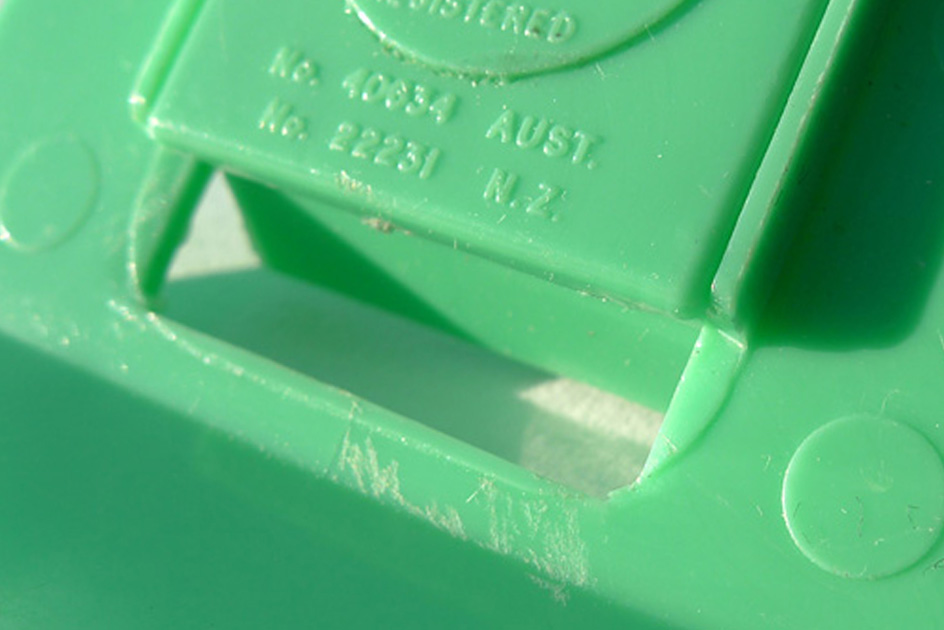
Whilst the Schwan logo was made as a bas-relief, the Magic Flute emblem is moulded over a salient little disk. This may be an evidence for the hypothesis of a modified mould (Schwan logo removed and replaced):

The Trademark


Regarding the Magic Flute logo... In fact, this is the trademark of J. Albert & Son Pty. It represent a lyra, but its design is constructed by 5 fancy boomerangs (what else!) as the frame mounted with 7 strings. It was filed as a trademark Dec. 8, 1932, accepted on June 22, 1933 and registered May 8, 1934. Then, as this record shows, renewed Dec. 8, 1960, and finally removed from register Sep. 5, 1974.


Some fourty years of use... Indeed, I found it on many items, notably on the records, royalty stamps, instrument labels, music sheets, and so on.


The last traces of the logo I found were in 1969. But at this time, remember, Frank Albert has passed away (†1962), and his son Alexis (1904-1996) is already 65 and has been long time in charge. Anyway, 1963 is the year of the creations of Albert Productions, lead by Alexis' son, Edward Frank 'Ted' Albert (1930-1990). Ted had been associated to Albert & Son since the mid to late 50s

« Frank and Alexis, around 1925, and Ted (early 60s?)»


« Albert Productions, founded in 1963, was one of Australia's first independent record production companies. It is a subsidiary of the venerable family-owned Sydney publishing company J. Albert & Son Pty Ltd, the oldest independent music publishing house in Australia. Albert Productions was originally established as an independent record production company but in 1970 they launched their own Albert Productions record label and in 1973 they established their own recording studio. » [source].

Ted became a great record entrepreneur and music producer.

« During the 1970s and the early 1980s Albert Studios became one of Sydney's preeminent recording studios for recording contemporary music for artists, including pop artist William Shakespeare through to The Angels, Rose Tattoo, Heroes, Cheetah, Choirboys and internationally renowned band AC/DC. In addition the studios were much in demand by rock bands such as Cold Chisel and Midnight Oil or by blues music acts such as Graham Lowndes and for the recording of commercial radio jingles. » [source]

Got the connexion ?:) The link between AC/DC and the aussie nose flute is that AC/DC's discoverer was the grandson and great grandson of the guys who invaded Australia with the Magic flute! :)

Well. Who is at the origin of the plastic Magic Flute ? What date ?


Dating

We know that Weidlich and Lohse began the Schwan production at the end of 1954. As we will see in Part VI, the Magic Flute sales were continuous from 1905 to (at least) the end of 1955 (with an interruption during WWII however). But it is unlikely that Weidlich and Lohse immediately sold a rebranded version of their Nasenflöte. I suppose it took some time for it to become a good seller (if it ever did).

So, let's say a possible earliest launch time for the aussie version at the end of the 1950s. The latest branch of the fork should be 1969, let's say end of the 1960s, when the boomerang-lyra stopped to be used.

Now, who ?

Frank Albert was certainly sentimentally attached to the (metal) Magic Flute, since he developed their 50 years long market. But Frank died in 1962 at the age of 88.

Sir (yes!) Alexis was around 60 when the plastic flute appeared. Would a sexagenarian multi-millionaire, member of the board of a huge music company decide to launch a nose flute? Nothing impossible, but not likely. At least, his marketing director could have, and that's a serious hypothesis.

Ted ? Well, Ted is 20 to 30 during the late-50s to late-60s period of time. He loves rock'n'roll... He is the head of Albert Productions from its foundation in 1963. The company has its own logo, but conjointly uses it together with the old trademark, at least until 1969. But ted was not in the musical instrument business. And if he had produced a "marketing toy" for the launch of Albert Prod., he would probably have preferably used the new logo, not the old trademark. But who nose ?


>> Access Part VI

---

Related links :

- The Australian Magic Flute - Part I
- The Australian Magic Flute - Part II
- The Australian Magic Flute - Part III
- The Australian Magic Flute - Part IV
- The Australian Magic Flute - Part V
- The Australian Magic Flute - Part VI
- The Australian Magic Flute - Part VII

---


Feb 24, 2015

Happy 60th Birthday, Schwan!

On February 24, 1955, the Weidlich & Lohse Musikwarenfabrik from Göttingen (DE), sent the file for a patent on a Nasenflöte aus Plastik mit biegsamen Oberteil (please check this post). This German nose flute was launched the same year, knew a great commercial success, and is still selling by batches under the popular name "the Schwan Nasenflöte", nickname coming from the logo showing a swan.


So, today is the 60th birthday of the "legal existence" of the Swan! And to celebrate this, we publish today a new collection of special color Schwans that has been discovered, then offered to us by the Nosy Diva herself! How did she find the nest ?

All are from current Chinese production, and let's remember that the so-called special colors are either intermediate production artefacts (when they change the color in the injectors), theoretically discarded from commercialization (but in fact given as goodies/bonuses to major resellers), or very limited color tests. All in all, it is very difficult to put the hand on them.


Now, let's take a look at some samples of this collection, particularly the ones with very colors...

Several specimens show a very bright petroleum blue, almost turquoise :


Another color that is present in several flutes is this rather translucent deep purple (very different from the regular pink-purple). Ths one also got a beige air cover:


Here is a chocolate brown one:


Even rarer and beautiful, two marbleized samples:


And last but not least, some silver specimens, with different silver hue (dark to light)!


Great collection, uh? And imagine it gathered with this one...

Thank you Nosy Diva!!!

---

I discovered a new "production stigmata" on several of these collector babies... It is particularly visible on the silver body one, and looks like the inside of the nose shield was vertically torn. But there is no contour, the "tear" is plain and smooth, filled with translucent plastic. On the swirled grey flute, the "tear" just cut the marbling waves. The silver one also shows tiny cracks around the horizontal stigmata, as smooth and "unreal" than the big tear. Strange...