This blog is dedicated to the sublime instruments called nose flutes and which produce the most divine sound ever. We have chosen to discard all the native models from S. Pacific and Asia, for they need fingering to be played. We'll concentrate on "buccal cavity driven" nose flutes : the well patented and trademarked metal or plastic ones, plus, by a condemnable indulgence, some wooden craft or home-made productions.
Incidentally, I found a news in Brooklyn Daily Eagle, dated of July 6, 1890, and relating the invention of a nose flute in Italy, by il Signor Filippo Atô of Bari! What ? A nose flute in 1890, one year before William Carter filed his patent, and two before its registration ??
Brooklyn Daily Eagle, July 6, 1890:
A nose flute, maybe, but maybe not "our" type of nose flute, since the "urban type" of nose flutes would not allow to smoke a cigar while playing, but who knows... Maybe a narrow cigarillo could be inserted in the mouth hole, and a musician could alternatively smoke and play... I needed to find more.
I found more.
The Republican Watchman (Monticello, NY), July 25, 1890 and the McIvor Times and Rodney Advertiser (Heathcote, Victoria, AU), August 7, 1890:
…and even earlier, in June:
Il Friul (IT), June 27, 1890 and West Somerset Free Press (UK), June 21, 1890:
So, not only Mr. Filippo Atô was able to smoke a cigar while playing his nose flute, but also to eat, to drink and to sing. This sounded weird, and impossible to do with a buccal pitched nose flute.
However two points are interesting. First, the journalist at Somerset Free Press immediately imagines an anti-snoring use for the instrument. But more important: the news had quite a big repercussion and was diffused in many countries (Italy, for sure, but also United Kingdom, USA and Australia).
We also learn that the news is originated from the Musical World, the most reknown (if not the only) musical newspaper in the world at this time. It was based in London.
After many searches, I finally found the right issue of the Musical World, dated of 14th of june, 1890. What a coincidence! it is the 14Th of June... 1892 – two years later to the day – that Carter's patent was registered!
The Musical World (UK), June 14, 1890:
No doubt possible anymore! Filippo Atô's instrument is trumpet shaped! It was definitely not a "urban type" nose flute, and was very certainly pitched by the fingers.
But one thing stays very interesting. We never had any clue about what gave to William Carter the idea of inventing the nose flute... This might be the answer. Indeed, the news was spread all over the world, and I found it in two newspapers published in the NY state. In the NY newspapers, there are no much more details than an instrument played with the nose, the mouth being thus left free. With no drawing, nothing evoking the trumpet shape, and this, just one year before Carter filed his patent...
May we set the hypothesis that Carter got aware of this instrument and decided to invent his own ?
Marco Stagnaro, a.k.a. Mirko, is an italian hunter from Sestri Levante (Genova), who practices the Ars Venandi, 'La caccia con il chioccolo': hunting with bird calls. He even wrote a huge book (700p) on the topic ('U và cun à ciocciua - La caccia con il chioccolo'), and publishes many videos (check here).
I am not interested in hunting (I even have personal reasons to dislike it), but I like bird calls. Marco Stagnaro builds himself his 'chioccoli', and they are as beautiful as some are complex or creative.
Mirko began to build them in 1990, as a hobby, with passion. Among them stands the 'RM61', a multi-sound instrument, on the base of a brass nose flute. The whistle can imitate the little owl, the long-eared and the tawny owls, the black bird, the jay, the buzzard and even shrill meowings!
From Mirko's description (automatic translation from Italian):
« The idea is born from studying the use of nasal flute. Continuing always the search of being able to do more sounds (imitation) to attract animals without the use of the hands. (...) The tool that I present today to you (RM 61) is composed of: the flute where nasal breath performs very well the sound of the owl, the chioccolo connected to the nasal flute and the owl in the vicinity of the nozzle of the chioccolo. Everything is held tight to the mouth and the nose by a rubber band.
(...) 05/18/2015 »
Now, look at this sophisticated beauty…
All pictures by Marco Stagnaro, all rights reserved:
All Mirko's creations are unique and numbered, not for sale (Alas..!)
In 2011, we published the patent WO2011/007978 (KR2010/004383), filed in Korea by Mr. Kwang Hyun Jang [please see this post] in 2009/2010. That patent was claiming the invention of a sliding air way cover, allowing to change the global pitch (tessitura) of a nose flute.
On Dec. 30, 2104 and Jul. 6, 2015, the same inventor filed two other patents, rather similar but not identical, that both were registered on 19th of August, 2015, with the numbers KR1015458230000 and KR1015458350000
The first drawing of each patent[click on the images to magnify]:
Here are both abstracts:
So, both patents claim for a 'relatively long sound path' or a 'relatively long acoustic passage', as source of a 'wide bandwidth'/'wide acoustic band'.
Top drawings: 1st patent, bottom drawings: 2nd patent [click on the images to magnify]:
As far as I understand, the first of these patents exposes a system rather similar to the 2009 one, excepted that the sliding piece has been include into the body of the nose flute. It is not a sliding airway cober, but a piece which destination is to reduce the mouth hole, and that you adjust from a hole on the top of the flute body.
The second patent deals with a more complex system, still dedicated to set the fipple size. Here, there is a whole hollow insert in the lower part of the nose flute.
The author explains that 'conventional nose flutes' include a body in which « the throttle 120 [on the 1st patent drawings] is coupled slidably to 117 to depression introduced into inlet hole (111a)» [according to Google translate...].
In order to improve que sound quality of the model presented in the first of this pair of patents, Mr. Kwang Hyun Jang proposes the version described the second one. However, I must say I don't understand how it works. This insert is bezeled and cannot slide. The Google translation of the description is total gibberish:
« Nose flutes is improved sound quality according to the present invention for achieving the above object, the rear upper portion has the first discharge which is a part of the inflow kotbaram ball the inlet exhaust and the inlet holes formed in close contact with the nose portion, the rear lower portion the ball body is formed in close contact with the mouth area; The inside is provided on the front of the body and guide so that a portion of kotbaram introduced through the inlet hole is discharged to the lower surface outside of the body, and guide so that the other part of the kotbaram is discharged into a ball of the first discharge, yet the kotbaram the other part includes a passage member passage is formed to guide to discharge toward the front of the body, said passage member and the passage top (上端 部) is in the lower end surface (下 端面) of said inlet ball and communicates and lower end of the body communicating with the outer and middle portions may be respectively communicated with the front outer side of the first exhaust hole and the body. »
If someone can explain to me, I would appreciate a lot.
Cross sections of both patents: [click on the images to magnify]:
The 'ambiance' images do not help much, besides the second patent offers a system to carry the instrument:
« Nose flutes 100 according to this embodiment is easily to carry, and to the engaging side of the front upper end of the body (110), (110b) can be formed, engaging with (110b) has latching sphere (50) ( It may be a lower portion of FIG. 5) to be inserted.»
'Ambiance' views in both paents [click on the images to magnify]:
---
Another question...
« Conventional nose flute includes a body 110 and the throttle 120. »
Have you noticed the use of the word 'conventional' ? Have you ever seen so many nose flutes with such a sliding system ? OK, there were the ones by Cornelius Degen or some old patents, but were they really 'conventional' ?
We will get the answer to this question in the Part II !
Leonard Solomon is a musician and performer, but before all, he's the inventor of the Bellowphone. «In 1983, in his Cambridge basement, Len built the Majestic Bellowphone, and he took it to the streets along with his 5-ball juggling routine, taking his place among the ranks of classic Harvard Square street acts. » The Bellowphone is a multi-instrument, being composed of many single wind and percussion instruments and activated by a foot pump, the bellow. It is a beaufitul and funny organ. Great job, Len! We love the Bellowphone!
In this video, "Stars and Stripes Forever", Len majestically plays the Bellowphone. A kazoo drives the melody in the first part, but from 1'54 you can hear a few nose flute notes (as explained at 0'15). [Visit the Bellowphone YT channel with many other great videos]
Master Katada also sent me three other nose flutes, very peculiar models of his invention: one Direct Nose Flute (ダイレクト鼻笛), and a couple of the Kunimaru Nose Flute (くにまるの鼻笛). All are made in bamboo.
3 - The Direct Nose Flute (ダイレクト鼻笛)
The Direct Hanafue is one of the many ancestors of the Kunimaru (see below for history), and was an intermediate completion for a project initiated much earlier. I guess this version dates of 2014.
This instrument is stunning, totally aside the generic shape of known nose flutes. It is a kind of a skeleton of a nose flute, having (almost) all the unnecessary material removed. The air way is piece of straw and the air collector is a small plastic bottle (the kind you get filled with soy sauce with a couple of sushis) that the player inserts in one of his nostrils! When Kunio Katada imagined this system, he wrote on his blog « 難儀!!挿入型鼻笛 » («Affliction!! Insertion type nose flute!»).
As you can see on the pictures, the flute is made of a bamboo tube with a mouth hole, ridged by a contoured flat ring — a lip plate – as done on the western concert flutes. In fact, the rod has been cut longitudinally, and a flat piece of bamboo, where the fipple is cut, has been glued to close the tube back up. The air trickle is projected on the fipple sideways! Indeed, the fipple itself has been cut horizontally, and in the inside of the bamboo rod. The blown air is driven from the nostril insert to through a pair of coupled tubes, the longest one becoming sharper where it reaches the body, accelerating the blown air towards the labium.
The main plate is 11cm (4"⅓) long and 1.3cm broad
Both ends of the bamboo rod are open, and if you clog them with your fingers, you get a lower note (± 1 tone, depending on the pitch).
Ki Kanban sent the Direct Nose Flute with some accessoires: spare straws, a spare "soy bottle", and another nostril plug, more complex (less pure in its shape), but conical, and thus more ergonomic. But I must say that the regular "soy bottle" insert doesn't hurt at all. About having to insert the collector in your nose, Master Katada wrote on his blog: « However, to play this whistle in public, because of the embarrassment of the plug in the nose, we need courage to a great extent! ». We are very courageous. Well, no, but we are a western punk.
We made a little recording to show you this nose flute is more than playable!:
4 - The Kunimaru Nose Flute (くにまるの鼻笛)
Now, my friends, we're going to touch the sublime. The Kunimaru Nose Flute (くにまるの鼻笛) is not only brilliant and beautiful, but it is also a great nose flute. It is the achievement of a process Master Katada began in December 2008. The first « Kunimaru no habanue » dates of November 2015, but the final model (narrow plate model) of January 2016. More than seven years to reach the perfection.
くにまるの鼻笛 means Nose Flute of Kunimaru. Whether Kunimaru was a famous Japanese engraver, we are prone to think (thanks to my friend Fritz for his help!) that here, Kunimaru (くにまる or 邦 with a circle [maru]) means the country, better, homeland, the Japan. くにまるの鼻笛 is the Homeland Nose Flute. But one should also notice that the sign 邦 (kuni) with a O (circle) is a rebus with « Kuni - O », which obviously is read « Kunio », like Mr. Katada's first name.
Kunio Katada sent me two of these beautiful babies: one has the main plate totally flat, while the other shows a bamboo node at one end, marking like a place where to grab the instrument. Besides that, no difference between the flutes.
The Kunimaru no hanabue is built on the same principle as the Direct Nose Flute, but reduced to the extreme. Here, no bamboo rod with a lip plate: just a fine and narrow flat piece, barely broader than an ice cream stick. Was more simplicity possible?
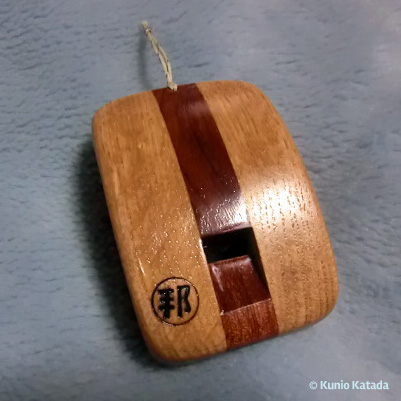
The main plate is 11cm (4"⅓) long and 1.3cm (0"½) broad. It is super thin (±1mm), but is doubled from where the fipple is carved and to this end. On one end, a small hole to pass a cord, and on the other, the beautiful Kunimaru branding iron mark. This brand appeared far earlier than 2016, since Master Katada used it already in 2011, on a wooden nose flute.
The rest of the Kunimaru nose flute is the same than on its predecessor the Direct nose flute: a little soy sauce bottle as an breath collector, an elbow straw, and the coupled double bamboo rod to drive the air flow.
The Kunimaru nose flute is really a stunning instrument. It is a stripped bare nose flute, simple yet efficient. It is super light (5.5g!). But most of all, it is a real zen beauty.
Here is a short sound sample:
5 - Genesis of the Kunimaru nose flute
As written above, the Kunimaru hanabue was completed last January, but the idea came to Master Katada much earlier. We went through the numerous pages of his blog « Ki_Kanban » in order to paint the chronology of this project.
All the pictures below are copyrighted. All rights reserved to Mr. Kunio Katada.
2008-12: The Uguisu Fue -「うぐいす笛」- The Nightingale whistle
All started with a double nose flute Mr. Katada built, with a double air entrance (nostril inserts). This appeared not convincing, and Kunio-san made another prototype with straws, and superposed fipples. Finally, the craftsman decided to separate the double flute and work on one fipple driven by a straw. he called it the Nightingale whistle.
2009-01/02: The Kantan Uguisu Fue -「かんたん鼻うぐいす笛」- The Simple Nightingale whistle
Two months later, Kunio-san followed on developing his idea of a single fipple fed by a straw, asking to himself « これも鼻笛?? » (« Is this also nose flute??»). Rather immediately, having been hurt by the bamboo inserts, Mr. Katada found the soy sauce bottle solution. He produced then a series of the Nightingale, then discovered he could also use ear buds. In the same series of experiments, he tried a bigger shield, round vs. square embouchures, other material than bamboo, but finally came back to bamboo rods and soy sauce bottles. The last batch dates of June 2009.
2011-02: Sonyugata Hanabue - 挿入型鼻笛 - Insertion type nose flute
Silence on the project during almost two years, then, in February 2011, Master Katada wrote in his blog « 難儀!!挿入型鼻笛 » (« Affliction!! Insertion type nose flute »). The picture shows that Kunio-san was working on the lip plate.
2014-05: Hanabue (Sonyugata)? - 鼻笛(挿入型)? - Nose flute(Insertion type)?
More than three years again before the project starts again. This time, it seems that different rod sizes and fipple shapes were tested.
2015-10: Dairekuto Hanabue - ダイレクト鼻笛 - Direct Nose flute
One and a half more year, and finally the work was put back on the bench. New tests, new shapes, new sizes, lip plate size tests... and finally a nice bunch of what is called now the Direct Nose Flute
2015-11: Dairekuto Take Hanabue - ダイレクト竹鼻笛 - Direct Bamboo Nose Flute
And finally, once month later, the Kunimaru nose flute appeared with its ironed branding. The blog still calls it « Direct Bamboo Nose Flute », but the logo is there. This shape is not totally the final one: if you look carefully, the main bamboo plane is broader than the definitive one.
In December, Master Katada created a plastic version.
2016-01: Kunimaru no Hanabue - くにまるの鼻笛 - Kunimaru Nose Flute
Last January, Kunio-san completed the Kunimaru no Hanabue, with a narrowest possible stick, and reaching a pure zen elegance. A new model of soy sauce bottle — The first batch of the finalized Kunimaru was produced, packed, sold and sent!
--
We want to thank a lot Mr. Katada for his generosity. We love the Kunimaru Nose Flute, and are very glad to be a fortunate owner of some of these early samples. Noseflute.org wishes a great destiny to this beautiful instrument.