This blog is dedicated to the sublime instruments called nose flutes and which produce the most divine sound ever. We have chosen to discard all the native models from S. Pacific and Asia, for they need fingering to be played. We'll concentrate on "buccal cavity driven" nose flutes : the well patented and trademarked metal or plastic ones, plus, by a condemnable indulgence, some wooden craft or home-made productions.
Showing posts with label Ireland. Show all posts

Aug 15, 2014

Tim Flood inducted in the NFoF!


Mr. Tim Flood passed away on 3rd of July, and many people are plunged into mourning. Indeed, Timothy Flood had several lives, and many people knew him through the different facets of his gifted personality.

Tim Flood (8 January 1927 – 3 July 2014) was an Irish celebrity. He was famous for having been six times an Irish National Champion of Hurling, a typical Irish sport, kind of a Gaelic field Hockey.

Flood first excelled at hurling in his youth. He arrived on the inter-county scene at the age of twenty two when he first linked up with the Wexford senior team. He made his senior debut in the 1947-48 National Hurling League. Flood went on to play a key part for Limerick during a golden age for the team, and won three All-Ireland medals, six Leinster medals and two National Hurling League medals.[2] He was an All-Ireland runner-up on three occasions. Wikipedia.

Besides his successful sportive carreer, Tim was a musician, and particularly a tenor banjo player (you can hear him playing with his son in this video)

Tim Flood played music all his life and was the mainstay of the well known Castleboro Céili Band. He, along with Larry Harrington, Larry Joyce, Bill Simpson, Jack Nolan, Noel and Ramie (Buzzer) Ryan and Paddy Joyce and later with Jim Murphy, Knoxtown kept the flag flying for Irish Music in our parish and outside it. He played and competed at all the fleadh ceoils around the country and sometimes adjudicated at competitions all over Wexford and beyond. Cloughbawngaa.

But what does interest us here, is Tim Flood's third career. Indeed, after his retirement, Tim became again a multiple champion in ... sheepdog trials! Tim was one of those handlers who use a nose flute as a shepherd tool.

Since his retirement from hurling Tim has been heavily involved in sheepdog trials, and he has represented Cloughbawn, Wexford, Leinster & Ireland on numerous occasions, on TV shows such as 'One Man And His Dog' and has travelled the world in his interest in this discipline. Cloughbawngaa.

In his book "One Man's Way... The Interviews" (WSN publications - York, UK, 2006), Austin Bennett interviews famous sheepdog handlers, and notably Tim Flood. In the excerpt below, we learn that the instrument was made by late Owen Humphreys, Talysarn, Wales.
(You can get the book here : allsheepdogs.com)


And, for our biggest pleasure, several pictures showing Mr. Flood with his nose whistle hanging around the neck (please notice on the last picture, that his left neighbour also carries a nose whistle around the neck).

Copyrighted pictures by Austin Bennett and Barbara Collins (no infringement intended):
It is very difficult to see the details of this nose flute on the pictures. However, I found a precious footage in which the instrument is closely shown. The interviewer, John Jude Doyle was the local pub owner.


As you can see, the nose flute - full brass - is from "Humanatone type", but has a huge air hole in the nose shield and has a flat mouth shield (no bending there). It is difficult to be affirmative, but it also looks like having a double wall nose shield, (as on Bernard Visser's vintage flute)

I also found an interesting RTÉ radio program (Farmweek - July 27, 2007). In the first part, Tim Flood mostly talks about his dogs, but from 3'23 till the end, we can hear the "herding nose flute" and From 4'46 until the end, Tim deals about the nose flute itself:


May Mr. Timothy Flood rest in peace.


---

For having used and promoted the nose flute as a herding tool, Tim Flood is inducted to the Nose Flute Hall of Fame, in the "Promoters" section!
-

Sep 19, 2012

Nose Flute Pioneers : William G. Carter - Part III

With the "Nose Flute Pioneers" series, Noseflute.org enters a little cycle of research. I hope it won't be too arid for a blog, but I really think that the facts I found have to be published. The sources : Google patents, US Census and an access to newspaper archives. But also, depending on the topic, correspondence by e-mail with descendants. Let's better say : internet searching tools available for a Frenchie not able to access US real paper archives.

---

Nose Flute Pioneers : William Carter - Part III

William Carter : Last years and descent


[sequel of Part I and Part II]

In 1909, the Carters move to Rochester, NY, in the S-W part of the city, near the Genesee river. Rochester is a big city, just 35 miles East from Albion and with 220.000 inhabitants.

Rochester downtown :


They rent a flat at 101 Bartlett street. Elizabeth is still milliner (does she also rent the shop just below?) and William, on his side, has (finally!) a workshop. It is located... exactly across the street. Both are noted as "Emp." on the 1915 census sheet.
In 1915, James Adelbert (20) is "shipping clerk" at the "Gerenal Ry Signal Co.", Mary Louise (17) is "billing clerk" and Mabel Elizabeth (15) is still at school.


1915 census :


On the other side of the street, the workshop has been skimmed over since...

In 1917, Adelbert (22 yrs old) is called to serve the USA for their participation in the WWI. Was he sent to Europe?


So, we learn that Adelbert is short and stout, has got blue eyes and black hair.

The 1918 city directory is quite informative : The carters have moved to 8 Day place (half of the house shown below, if it dates from that time). James A. is still serving the USA, but the girls have disappeared (Mabel is freshly married but not Louise...) Is William retired? We know he should have been already sick... Whatever the answer, he has no workshop anymore.


Indeed, in the 1919 city directory, we can read that William died March 10, 1919., at the age of 72 or 73.


According to Richard O'Brien, who's probably a descendant of Elizabeth's family and who let this notice about Carter, William died of a « Cirrhosis (explanation was influenza ». Besides the wrong year of his death, and after asking some specialist, influenza cannot be the cause of a cirrhosis.


However, besides alcoholism, a cirrhosis can find its origin in a viral hepatitis or a metabolic syndrom, or even some other toxic causes, for instance heavy metals... (for a tinsmith, spending his time welding, this could be imaginable).

--

In 1923, the Carters have moved from #8 to #27, Day place, and in 1924 are located at 97, Chamberlain. They rent a room to a bookbinder, Winslow Russel.


In 1927, Mabel married Leo John McGahan. They live in Springfield, MA., and
have one son the same year, John Joseph (Feb.5, 1927).

Elizabeth, James A. and M. Louise moved to 1 Salina St.

The same year, James Adelbert married Rena B. (born in 1895 in Nova Scotia). They first move to 23 Delmar St., then to Syracuse, 1803 Colvin St. They will have 2 twin children, James Blair and Nancy Jane.


In 1929 or 30, it's the turn of Mary Louise to marry, and Elizabeth, probably feeling alone, begins a work as social worker, and moves to 4 Porthsmouth terrace.
Also, the McGahans have a daughter, Mary C.

In 1931, a new daughter is born in James & Rena's home, Shirley Elizabeth. Before 1935, Elizabeth has stopped to work and has moved to 7 Thorndale terrace: she is hosted by James and Rena.

In the 1940 census sheet we learn that in 1935, James Adelbert Carter had moved to Buffalo, NY. Leo and Mabel lives in Grand Island, NY. But later in the 30s, they are back to Rochester. Leo John is "sales and head manager in Heating", and has earned $1400 in 1939) and in 1940, they host Elizabeth:


In 1940, James A. and his family are back to Rochester too., 248 Sherwood ave. James Adelbert has become "machinery salesman" and earned $3900 (in 1939).


In 1947, the McGahans and Elizabeth M., moved to 122 Warwick ave.

1949 is the last apparition of Elizabeth M. in the city directory, and she doesn't appear in the 1950 census sheet. It is quite obvious she had passed away, at the age of 87.


---

- I have lost the trace of James  Adelbert Carter, and don't know when he died [William's son].
- Mary Louise died in 1969 [William's daughter].
- Mabel Elizabeth passed away in 1984. [William's daughter]

- I lost the trace of James Blair from 1940 [William's grandson, who might have inherited of William's papers].
- John Joseph McGahan died Nov. 3, 1993. [William's grandson]

- Mary C. (born McGahan) is still alive (she's 83) [William's granddaughter]
- John Joseph had 1 daughter and 3 sons (names unknown), and they are all alive [William's great-grand-children].


William G. Carter is elected, with no discussion, to The Nose Flute Hall of Fame, as with Honorary degree!


-----

On the same topic :

- Nose Flute Pioneers: William G. Carter - Part I
- Nose Flute Pioneers: William G. Carter - Part II
- Nose Flute Pioneers: William G. Carter - Part III
- Nose Flute Pioneers: Ernest W. Davis - Part I
- Nose Flute Pioneers: Ernest W. Davis - Part II
- Nose Flute Pioneers: Nelson Ronsheim
- Nose Flute Pioneers: Garrett J. Couchois

-----

Sep 17, 2012

Nose Flute Pioneers: William G. Carter - Part II

With the "Nose Flute Pioneers" series, Noseflute.org enters a little cycle of research. I hope it won't be too arid for a blog, but I really think that the facts I found have to be published. The sources : Google patents, US Census and an access to newspaper archives. But also, depending on the topic, correspondence by e-mail with descendants. Let's better say : internet searching tools available for a Frenchie not able to access US real paper archives.

---

Nose Flute Pioneers: William Carter - Part II

William Carter: Tinsmith and Family Head


[sequel of Part I]

With his new money, Carter, on his mid fourties, probably felt he was ready to get married, and in 1895, William G. Carter wedded Elizabeth M. O'Brien.

Elizabeth was born around 1862 (she's 16 years younger than William), in the State of New York, from irish immigrants [Jeremiah O'Brien (1835-1880) and Mary D. Donovan (1822-1901)], who married in Albion (Dec 5, 1858). "Lizzie" is milliner.


That is also in 1895 (4th of July), that William and Elizabeth have a son : James Adelbert [this mean the child was conceived before marriage :) ]

Elizabeth has one brother, Daniel F. O'Brien (oct 1859 (Albion)-09/20/1915), who is a butcher, settled in Albion too. This is also in 1895 that Daniel marries his wife Bridget (they will have a son, Daniel, in 1903).

In 1898, William and Elizabeth have a second child : Mary Louise, born on 21st of July.
And in 1900, another daughter, Mabel Elizabeth, born on 1st of June.


The 1900 census sheet is interesting, because we learn that the Carters live in Main street. Albion Main street is - as it indicated by its name - the biggest and longest street of the town. However, 2 families before having made the survey at the Carters, the enquirer was in Liberty Street, and 5 families later, he is in Orchard street.
This helps to locate the Carters' home at the very North end of Main street, near the Erie Canal.

The following map dates of 1880, and in 1900, almost any building of this very part of Main street has been skimmed over and rebuilt in the 1880s. However, the environment stayed the same :


In 1905, the census sheet notes that William Carter is Tinsmith (at home) and in the type of activity box, adds (o.a.). I suppose it means "own activity". So, Carter works on his own and at his home. He has no shop, and I assume he is a kind of subcontractor of one or several shops/craftsmen in Albion.
Also, the census shows that Elizabeth is also milliner at home, but in the activity box, we can read Emp., meaning that Mrs Carter works for a clothing shop.


1908 is a very informative year for us. Indeed, the only Albion City directory available in the archives dates of that year, and it is also more or less the year that several postcards of Albion were published.

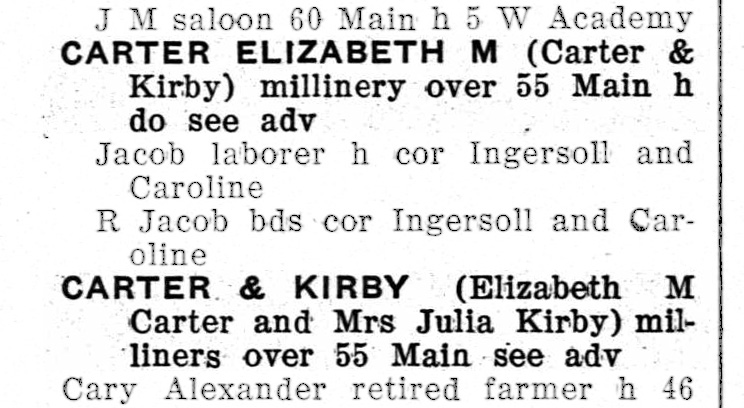
What is bizarre in the directory, is that William doesn't appear anywhere. Contrarywise, Elizabeth is listed twice in the regular list, as a milliner, but also through the advertisment she published! She is associated with Mrs. Julia Kirby, and their shop is located at the 1st floor of the 55 Main Street.


Elizabeth appears a fourth time in the directory, as 1st Vice-President of the St Joseph lodge. St Joseph is the cathotlic parish and is lead by the Rev. Francis Sullivan. On the postcard below, we even can see the Rev. Sullivan on the flight of steps of his parsonage, and the building on the left is (probably) the school of the Carter's children.


It is not immediately possible to locate the 55 main street on a current Albion map, since the street numbers have totally changed since. But I checked any line of the directory (!) and crossing it with the Street directory page, a "souvenir book" dating of 1905 and some postcards, I have been able to draw this 1908 map, with the shops and their owner/tenant.


So, the Carter living and working at the 55 (the ground level being occupied by Peter H. Peters, a harness maker), it became possible to show you their place. The first floor probably for Elizabeth's millinery shop (with the 2 white shades), and the second for William's workshop and Carter's home (currently the #125).


In the City Directory, we also learn that Daniel O'Brien's (Elizabeth's brother) shop, the Meat Market, is located 121 Main St., that is, exactly next to the Hotel McMann (probably the one where William was living when bachelor, and invented the Nasalette).


The Hotel McMann, now The Gurney's Olde Coach Inn, in which the Nose Flute may have been invented (just besides the small Meat Market of Carter's future brother-in-law):


Another interesting fact (for obsessed people like me) is this one : On an early picture, not dated but probably around 1900 or maybe earlier), we can see the shop located at 98 Main St. This shop is hold by Mr Eugene W. Wilcox, and is a hardware store.


Mr. Wilcox is an eminent member of the Executive Comittee of the Albion Chamber of Commerce, and is not all a tinsmith or a craftsman. He is a merchant. Here in 1905 :


Now, in 1907-08, the front of the shop has changed. E.W. Wilcox is still the owner, but an extra sign has been added. With just a little effort, we can read "TINSMITH" on it.


So, in 1908, Wilcox is able to accept orders of tincraft. And being not himself a tinsmith, he certainly had to subcontract the business... You see my point?

The shop still exists, and is still a hardware shop:


In 1909, the Carters moved to Rochester.


>> Access Part III


-----

On the same topic :

- Nose Flute Pioneers: William G. Carter - Part I
- Nose Flute Pioneers: William G. Carter - Part II
- Nose Flute Pioneers: William G. Carter - Part III
- Nose Flute Pioneers: Ernest W. Davis - Part I
- Nose Flute Pioneers: Ernest W. Davis - Part II
- Nose Flute Pioneers: Nelson Ronsheim
- Nose Flute Pioneers: Garrett J. Couchois

-----

Sep 15, 2012

Nose Flute Pioneers: William G. Carter - Part I

With the "Nose Flute Pioneers" series, Noseflute.org enters a little cycle of research. I hope it won't be too arid for a blog, but I really think that the facts I found have to be published. The sources : Google patents, US Census and an access to newspaper archives. But also, depending on the topic, correspondence by e-mail with descendants. Let's better say : internet searching tools available for a Frenchie not able to access US real paper archives.

---

William Carter, himself. Inventor of the first urban nose flute, through his patent (that we presented in this post) for his « Nasalette ».
It has been quite difficult to find info abour Carter. A name very common, only one patent filed, and no article in the newspapers. A very discreet an humble man.
But in the lines that follow, you'll discover little scoops...


Where to start? Well, Carter's patent says where he was living in 1892 :


So, it was mainly through US census sheets that I collected some info, but also in city directories.


Nose Flute Pioneers: William Carter - Part I

William Carter: The Irish Immigrant


William G. Carter was born in 1846 in Ireland. He immigrated in the USA at the age of 5, in 1851, with his mother Catlaine Carter. This is already a scoop! The inventor of the nose flute was not born in the USA, but in Ireland!.

When they disembark on the American ground, Catlaine was 41, and there is no trace of a father for the little William.

The Carters settled in Lockport, Niagara, NY. They are poor and live in a boardinghouse, with many other immigrants. Catlaine is "washwoman" and her personal estate is estimated at $100. William, aged of 15 in 1860, has no real occupation, but probably is already apprentice. In the 1860 census sheet, we also learn that Catlaine is a « person over 20 y'rs of age who cannot read & write »

1860 census :


In 1870, Carter lives alone in a boardinghouse of Lockport, just besides the Niagara Falls, and has become a tinsmith (second scoop!). He is citizen of US. In 1878, he resides in Lewiston, the Lockport district the nearest the Canadian border (a few hundreds of yards) :


What is interesting is that among the very few tinsmiths in Lewiston in 1878 (were there even several?), one is also named Carter, John Carter. He is probably not a William Carter's relative, since he was English. He's just 5 years older than William. Was he the one who taught his craft to Will, or a "collegue" working at the same workshop ?


In 1880, Catlaine/Catherine, already 70, is housekeeper at 40 S Ford Street, Rochester, Monroe, NY... And it's the last info about her I was able to find.


... and William, 34, has moved to Albion, Orleans, NY.


Why did William leave Lockport and settle in Albion ? Probably because this town was in full expansion and offered many opportunities.


Albion is a pretty town first settled in 1812, which grew quickly after it was decided the Erie Canal would pass through. The place was probably very inspiring since, before William Carter, two residents got great ideas there.
George Pullmann, the famous inventor and industrialist, « moved to Albion, New York, where he gained many of his ideas that made him successful » (wiki).

But funnier, Albion was the residence of Grace Bedell, a 11 yrs old girl who was at the origin of the beard of Abe Lincoln! « Grace Bedell sent him a letter from Westfield, New York, urging him to grow a beard to improve his appearance. Lincoln responded in a letter on October 19, 1860, making no promises. However, within a month, he grew a full beard. He later met with her. » (wiki)


So, in 1880, in Albion, William Carter is boarder of an hotel owned by Mr. Luke Taylor. Is he employed somewhere or does he already work on his own (in 1905, Carter will be noted as « tinsmith (at home) »). Well, it's difficult to imagine a tinsmith working in a small hotel room excepted for creating very small items (pure imagination : whistles, tin irish flutes, etc.).

Tinsmiths :

In 1880, there is another tinsmith in Albion, George Edmonds, and a "tinner", Franck Shears, from German origin.


And there are also "hardware" shops and many other craftsmen (harness makers, etc. ) capable of buying pieces made by a tinsmith. So was William already working at home or was he employed by George Edmunds or Franck Shears ? I have no clue.

Anyway, in 1891, William Carter works on his Nasalette, and files the patent in November. Why did a poor tinsmith filed a patent? Probably because he was sure to handle a great new idea.
Was Carter the inventor of the nose flute? Yes, indoubtedly.
Indeed, the Guaranis native were used to call birds with a (totally different kind of) nose whistle, but they never used it as a musical instrument. Much more : how would a tinsmith, coming from Ireland in 1851, whom mother was illiterate, how would Carter have been informed of the existence of the Guarani bird call ? No internet at this time... And such info (with no photo, no recordings) were only available in specialized ethnological society bulletins.
How did he come to invent such a device ? I don't know. Maybe just because he was already making Irish tin flutes and wanted to whistle while working with his hands ?
This is just my imagination, there no data about his motivations.


The patent is registered on June 14, 1892. That is only 7 month after the filing, which means a short procedure, with no discussion on the anteriority.

The question is what did Carter with his patent? He sold it. Remember that in 1893, there was a tin nose flute at the World's Columbian Exposition. Was it the Carter's Nasalette? Or did he sold the patent very early, and a producer launched the nose flute ? This is more than probable. Was it already James J. Stivers, of the future Humanatone Company (the brand Humanatone was used only from mid 1903) ?
How much did carter get from the Nasalette patent ? Was is a big or small amount of money ? Well, many questions still to get an answer.

In 1892, Carter is still tinsmith in Albion, and Edmunds and Shears (who is now noted as being from Belgian origin...) are still active.


>> Access Part II


-----

On the same topic :

- Nose Flute Pioneers: William G. Carter - Part I
- Nose Flute Pioneers: William G. Carter - Part II
- Nose Flute Pioneers: William G. Carter - Part III
- Nose Flute Pioneers: Ernest W. Davis - Part I
- Nose Flute Pioneers: Ernest W. Davis - Part II
- Nose Flute Pioneers: Nelson Ronsheim
- Nose Flute Pioneers: Garrett J. Couchois

-----