This blog is dedicated to the sublime instruments called nose flutes and which produce the most divine sound ever. We have chosen to discard all the native models from S. Pacific and Asia, for they need fingering to be played. We'll concentrate on "buccal cavity driven" nose flutes : the well patented and trademarked metal or plastic ones, plus, by a condemnable indulgence, some wooden craft or home-made productions.
Showing posts with label replicas. Show all posts

Aug 9, 2014

An Original Couchois

I recently had the great luck to acquire an original Garrett John Couchois' whistle (read: a nose flute). We previously posted an article about this beautiful baby, which (real) existence was not ascertained yet, besides the Couchois' patent. We had made researches about uts inventor (check here please). We had even built a replica (check here, here and here please).

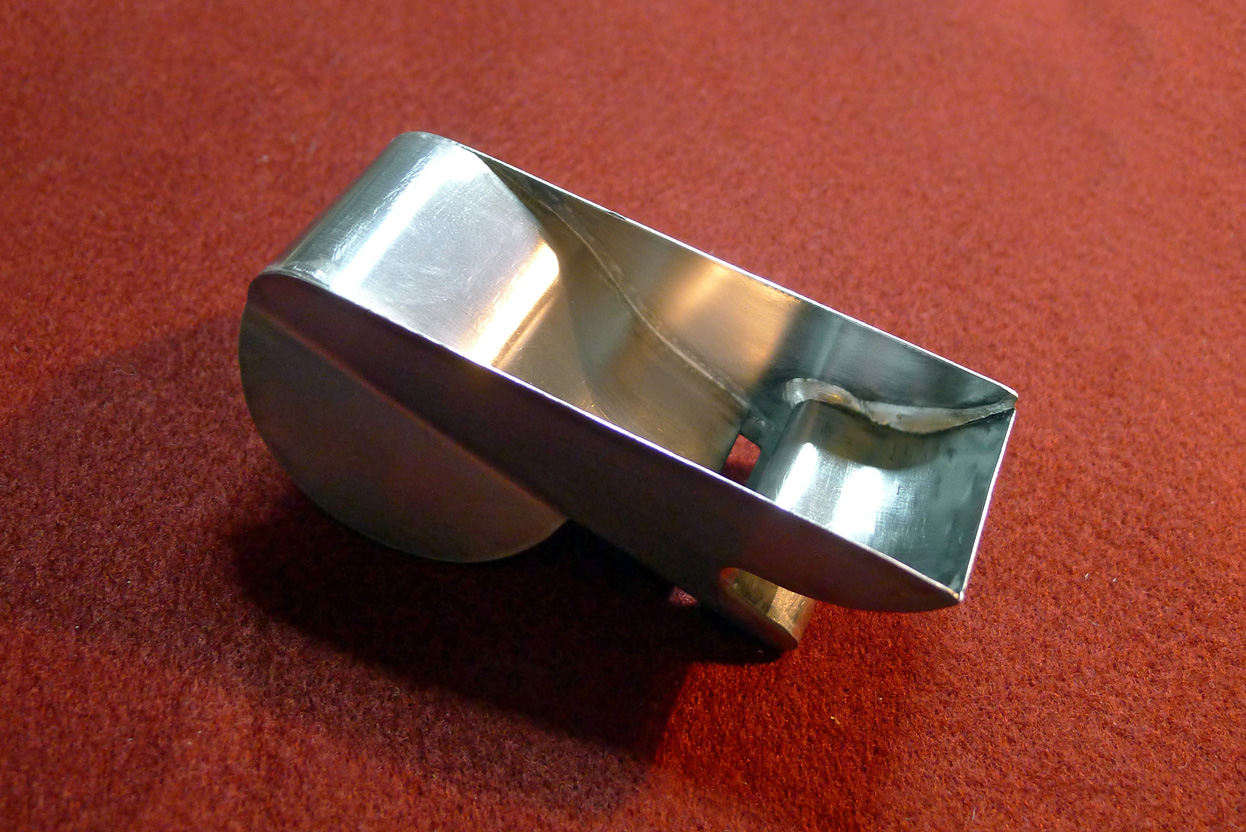
But now, thanks to Mr. Brian B., we have one in our hand, and in a very nice condition! Take a look at that beauty!

It is stamped PAT. ALLOWED 1899, which perfectly corresponds to the Couchois patent No. US31,876, registered Nov. 21, 1899. Indeed, the Couchois' nose flute is the 2nd urban nose flute in history, following Carter's Nasalette [1892] (and from which it flattens the nose hood into a nose saddle and rounds the square mouth tube), and before the Magic Nose Flute [±1902], which will improve the Couchois with a mouth shield instead of the mouth tube.


Coincidentally, and by a curious chance, Mr. Brad G. very recently posted a comment on this blog to tell he had found a Couchois too. He kindly sent us a couple of phot, and yes, it is absolutely the same instrument, despite the repair Brad's nose flute got at the neck :


As you can see, it had been necessary to weld solidly the saddle and the neck. Indeed, mine shows frailty at the same point, and I suppose there was a real weakness at this point, as I had noticed with the difficult welding I had to make on the replica.


Brad wrote me: « On the front of the air tube is a patent date that says "PAT. 189" due to the repair the full date is unreadable as is another word that follows "PAT. that starts with "AL ».
This is interesting, because if you look on mine, a repair would have not make disappear the same part of the stampings, and so, we can state that, contrarywise to a Humanatone for instance, the stampings were made by hand (sometimes one way, sometimes the other...)

Now, was I right with my replica and the corrections I made on the inconsistent patent drawings? Well, I must say I was not totally wrong... but my replica is a bit taller, the mouth hole that I reduced was a wrong interpretation, and following the size of the air entrance deduced by the patent was a mistake (since it got wider in the poduction).

But Couchois' drawings wre not accurate neither, compared to the real nose flute. So, I don't really feel guilty :)


And big thanks to Brad G. for sharing your pictures, and if your have other public (or not!) performances, please try to have someone to shoot a video!

--

Apr 1, 2013

Piet Visser's Cello-Phone: The Making of

Last week, we showed the short video made by Mr. Piet Visser while testing his Cello-Phone replica. But on the footage, one can hardly see that Piet made a stunning work...
Here are some pictures of the making, sent by Mr. Visser via Mr. Mei.

It seems that the building needed some different attempts in order to get the right curve with the brass rod.

« These pictures are about bending the brass tube, which is the hardest part of the whole of the Cello-Phone. The trick is to keep a natural curve and a fluent line. It is essential to 'anneal' the brass tube first. This is a heat treatment, which alters the microstructure of the brass material and causes changes in its properties. That allows the material to be worked and bent. Annealing is required before the next step can be applied before it can be bent, which is filling the tube with shell lime. I continuously press this shell lime firmly into the tube, which is very important: only then will the tube be fully supported from the inside, so that it won't crack or disfigure. When the tube is fully filled and firmly pressed, I seal the end of the tube by means of a wooden plug. Now the bending process can begin, which needs to be done very carefully. If not, the tube will break, which has happened on my first tries in making the Celllo-Phone. »
[thanks to Maikel Mei for the translation]


And here the work with a blowtorch, sawing and drilling:


Mar 24, 2013

Cello-phone replica, by Piet Visser

Do you remember the Cello-phone? Piet Visser, the dutch whistle collector just built a replica of this incredibly baroque nose flute. It seems he totally made it in brass.

Dec 8, 2012

Historic Nose Flutes - Grierson's Whistle: Review

Some historic nose flutes have totally disappear or haven't even been produced or commercialized. Our goal, here, is to reconstruct them, as close as possible to the original, with the help of the patent drawings and descriptions.

[Sequel of the posts Grierson's Whistle: Drawing a template and Building the flute ]

Last step before the review, I nickel plated the Grierson's whistle. My replica was far from being perfect, and my electroplating is in accordance: a bit unveven :)


Here is the nose flute:

The Grierson's whistle is a huge piece. It is heavy and tall, which is rather unusual for a nose flute of the 1920's. But it also shows other singularities.
The large "hollow" front face has never been seen before, and will never feature again on another instrument.
But the most interesting novelty is the flute "elephant profile", with a rounded heel that need to be inserted in the mouth, just behind the lower lip. It is not uncomfortable, but it doesn't help "freeing" the mouth for sound effects, or even to reach sharp notes.


The Grierson has also an upper lip rest, with a more classical shape but rounded. I carefully sanded mine not to wound my lip, but one can reasonably wonder how harmful it could have been, stamped from the mouth hole, when (whether) industrially produced...


Despite these two lip rests, the Grierson is not a handsfree nose flute. It is too heavy and needs a hand or a rubber band to be retained tightly under the nose.

The front is hollow because Grierson wanted to create a amplification effect: indeed, the air duct top and the rounded base of the flute form a kind of horn shape, like a ear trumpet.

I am not sure that this feature is really efficient, and I must admit that the Grierson whistle is not a good nose flute.

The tonality range is rather limited and the sound is weak. I may have not been precise enough when building it, or have not respected the specifications... but anyway, there is no beveled labium but just a flat blade to split the air, like on the metal Humanatone. And we know this is not a performance solution. More, I really think that the bottom curves of the horn amp is a bad solution. At the "heel" (lower lip rest) place, they shape a front double chamber...
Finally, because of the air entrance design, half of the air blown leaks.

But as an historic item, the Grierson whistle is very interesting, particularly by it's design and shapes.


Here is a short sample in which you can notice the weakness, dullness and windiness of the sound.


And here a little stupid video, as usual:


PS: the template has been updated and is downloadable in PDF format.

And it's worth the (very alert) koala look!


---

On the same topic :

- Historic Nose Flutes - The Nasalette: Template
- Historic Nose Flutes - The Nasalette: Building
- Historic Nose Flutes - The Nasalette: Review
- Historic Nose Flutes - Couchois' Whistle: Template
- Historic Nose Flutes - Couchois' Whistle: Building
- Historic Nose Flutes - Couchois' Whistle: Review
- Historic Nose Flutes - Grierson's Whistle: Template
- Historic Nose Flutes - Grierson's Whistle: Building
- Historic Nose Flutes - Grierson's Whistle: Review

---

Dec 6, 2012

Historic Nose Flutes - Grierson's Whistle: Building

Some historic nose flutes have totally disappear or haven't even been produced or commercialized. Our goal, here, is to reconstruct them, as close as possible to the original, with the help of the patent drawings and descriptions.

[Sequel of the post Grierson's Whistle: drawing a template]

In his patent, Alexander Roxburgh Grierson specified his whistle was made of metal sheet. So I used (again) a 0.5mm thick tin plate, and glued my template.


I roughly cut the piece with a pair of shears, and began by the easiest: rounding the upper lip rest around a pencil :) Whether it had been manufactured, the Grierson's whistle would have been stamped, and this lip rest would have been the the "positive" of the mouth hole. I'm not able to stamp tin sheets, so I cut a separate part that I will solder at the right position.


Then I shaped the parts more precisely with a file. I also used a metal punch to cut the narrow curve of the wings, and also to remove metal from the mouth and nose holes, before finishing them with the file.

And I got all my parts ready for bending...


Bending the longest part was a very difficult task. I used pencils and rods of different diameters.


Then I began the soldering, and noticed 1mm was lacking at the very end of the curves. I had suspected that those curves would have "eaten" some length, but my cardboard model was made of a thinner material than the tin sheet, and I made this little mistake...


Finally, I soldered the upper lip rest.


Then I filed and sanded the instrument. It is far from being perfect... But it's been the most difficult replica I made so far. And I'm not proud of the quality of my solderings...


To be continued!

---

On the same topic :

- Historic Nose Flutes - The Nasalette: Template
- Historic Nose Flutes - The Nasalette: Building
- Historic Nose Flutes - The Nasalette: Review
- Historic Nose Flutes - Couchois' Whistle: Template
- Historic Nose Flutes - Couchois' Whistle: Building
- Historic Nose Flutes - Couchois' Whistle: Review
- Historic Nose Flutes - Grierson's Whistle: Template
- Historic Nose Flutes - Grierson's Whistle: Building
- Historic Nose Flutes - Grierson's Whistle: Review

---