Mr. Hiroshi Tachibana dug out two great german Nasenflöte videos. In the first one, the musician plays a Schwan nose flute and a classical (flamenco) guitar.
---
The second one is a duet playing the Monthy Python song Always look on the bright side of life, on a pair of heart-shaped nose flutes.

Showing posts with label Germany. Show all posts
Showing posts with label Germany. Show all posts
Oct 9, 2017


Oct 1, 2017
A Beautiful and rare PABRU Nasenflöte

I recently found a beautiful PABRU nos... let's start it all over : Recently, a beautiful PABRU nose flute found me! Indeed, I was contacted by the owner of this flute, who was about to throw it in the garbage, but finally felt the duty of making a search about this instrument, and was driven to this blog. Uff!
I know the existence of only one other PABRU nose flute, and it is part of the Metropolitan Museum of Art collection, in New York. The Met website doesn't show any picture of the flute, just a notice that allows to identify it through the trademark:

The nose flute we got from Mr. Lance Baker is beautifully preserved, and — that's very precious to us – has a known history... Mr. Baker kindly took the time to write it down for our greatest pleasure:
What we know about the Paul Brunner “PABRU” stamped nose flute and how it may have arrived in the United States.
The history of this particular “PABRU” – Paul Brunner “nasenflöte” made in Germany, is only based on speculation of how the instrument arrived in the United States, or the question also arises, was it sold in the United States?
This instrument was found in a box of various possession of my great aunt, Ruth E. Werner, who was born in Hamburg, Iowa. Miss Werner came from a long line of Werners, who migrated from Hamburg, Germany and settled in the Hamburg, Iowa area and surrounding communities of the American Midwest. We suspect this PABRU nose flute may have traveled with one of these family members that migrated from Germany. Miss Ruth E. Werner passed away in 1995 at the age of 92.
We know that she enjoyed music, playing the piano, guitar, violin, and ukulele. So to find this item among her possessions, and understanding that it was a musical instrument was not a surprise.
An interesting find, that could have ended in disaster!
While going through the last of her possession in August of 2017, this PABRU nose flute was discovered, and I knew it had some significance, as the PABRU name and trademark symbol was stamped on it, but more importantly the words “Made In Germany” as well. However, I assumed it may have been part of some other item, or was a small piece of some larger fixture which had been thrown out already. Thus, not knowing what it was, I was very close to throwing it in the trash bin.
In one last effort to find out what this item was, I searched the PABRU name extensively on the Internet, and stumbled across this website, Noseflute.org !!! Success – the mystery was solved, and a great German musical instrument was saved from the trash-bin.
Provided from the estate of Ruth E. Werner.
In care of her great-nephew Lance A. Baker of Mesa, Arizona.
---
I just had to pratice a gentle ultrasonic cleaning, redress and flatten the "double bend" that is often found on vintage nose flutes, and which is the result of players who wanted to adapt the shape to their own physiognomony. Then I applied a thin coat of "jade oil" (this protective mineral oil).


The instrument itself is a very typical German vintage nose flute, with rectangle flaps without rivets, but with an end bent and inserted in a slit.


Our sample is in a stunning good condition, with its original nickel plating very well preserved. There are no rust spots, but only wears on the corners.
 | |
 |  |
 | |
 | |
And have a look inside: most of the nickel plating is still there, which is very rare, as this place generally is a nest of rust for many vintage nose flutes!

The global shape of the PABRU is smaller than the Humanatone, yet comparable to the generic Nasenflöten that were available in German catalogs. I first thought that these were "unbranded" PABRUs, but a quick comparison show that I was wrong.
The comparison with a Humanatone is stunning as it is obvious the two instruments are absolutely different! The Humanaone is taller and more narrow, has a longer airway, a bigger mouth shield, and for sure, a different closing system, with rivets stamped on the flaps.
 | |
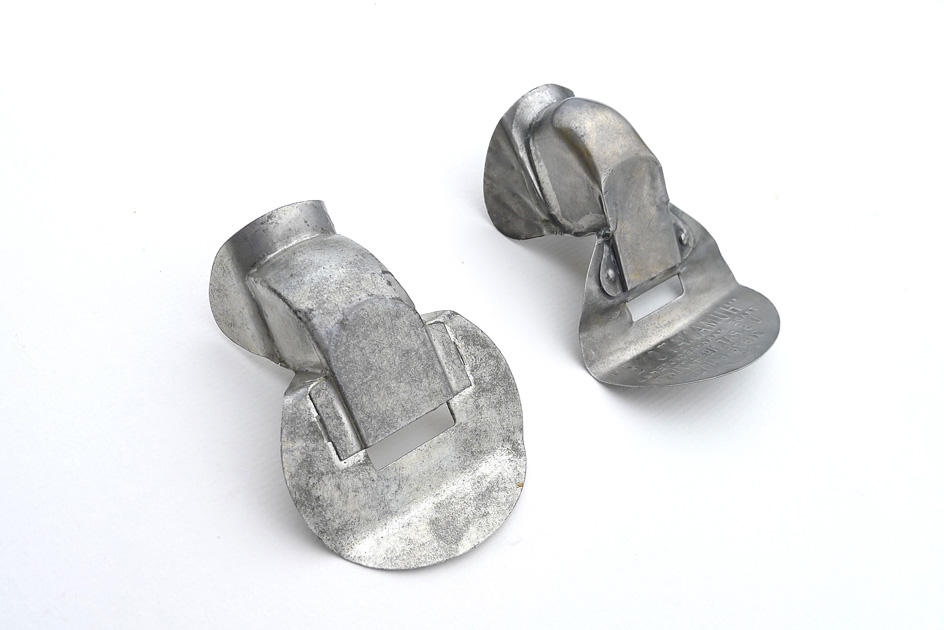 |  |
But the comparison with a generic German Nasenflöte – the ones from the Meinel & Herold, Gebrüder Schuster, Max Adler... catalogs – is very interesting too. The half bottoms of the flutes are similar, same shape, same flaps, ... But the tops are very different, with a large collar around the nose craddle on the PABRU, while almost nonexistent on the generic ones. Also, the shape of the nose hole is different. So, the generic Geman Nasenflöte *was not* an unbranded PABRU.
 | |
 |  |
 | |
---
Now, take a look at the beautiful stamping with the trademark, described as « an oval enclosing a water pump flanked by "Trade Mark"; (Beneath the oval stamped) "Made in Germany" »...
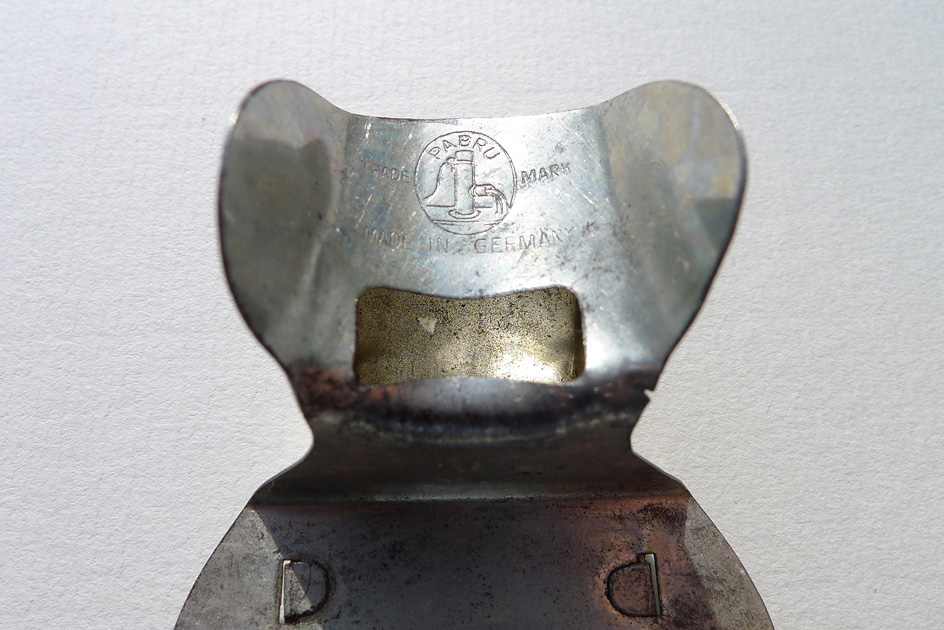

The brand is stamped in an unusual yet very logical place, the nose hood. It's the first time I see a nose flute with the mark on this part. It shows a "water pump" and was stamped on any "PABRU" instrument and was a multiple rebus!


Indeed, the brand PABRU is the abbreviation of the name of the founder and owner of the company: Paul Brunner. And « Brunner » is very close to « Brunnen », which means... « fountain », or « source » in German!
More, Paul Brunner's manufacture was settled in a German region very near Czechia, the Vogtlandkreis (the area for wind musical instruments companies at this time), and particularly in Reichenbach, then in the small town of Brunndöbra, suburb of Klingenthal. The Brunndöbra is the little river that becomes the Döbra after it is joined by the Steindöbra. So, the name Brunndöbra means « the source of the Döbra ».
His own name and his town name: really two good reasons for Paul Brunner to chose a fountain as his logo!
It seems that Paul Brunner began his activities in 1923. In 1925 he is settled in Reichenbach, 10 miles from Klingenthal. Was the company already named PABRU ? Has it already a water pump as emblem ?
1925 Reichenbach phone book:

View of Reichenbach:

I don't know when Paul Brunner moved to Brunndöbra, but according to the musicologist from Klingenthal Dr. Kurt Kauert (Akkordeon-, -Harmonika- und Mundharmonikafirmen im vogtländischen Musikwinkel nach Dr. Kurt Kauert), the company should have settled to Brunndöbra in 1935.
1935 Brunndöbra phone book:

Brunndöbra in 1935:

Some PABRU instruments are present in the 1938 Johnson Smith & Co. novelty catalog (USA), in which we can see the kazoos that are findable in Brunner's own catalog. In the same page of the Johnson Smith, there is an advertisement for the Magic Flute – aka the Humanatone – which was the monopolistic nose flute in the USA. So, to answer Mr. Lance Baker: I really doubt that the PABRU Nasenflöte has ever been sold on the American continent.

Page from the PABRU catalog (1930s):

The last trace of the PABRU company I found dates of 1950, in the Johnson Smith & Co. catalog, but still without the nose flute.

The last appearance I know of a Nasenflöte in a German musical instrument catalog dates of 1936 (Meinel und Herold), and it seems that the small instrument has been declared not welcome anymore (by authorities?).
---
Finally, remember that Brunndöbra was also the place where Otto Weidlich was settled (since 1873), and that he was the grandfather (or father?) of Kurt Weidlich, who patented and launched the "Schwan logo" plastic Nasenflöte in 1954, in Göttingen (DE), in association with Günter Lohse [please see this post]

---
To complete this very long article, I would like to thank Mr. Lance Baker for having provided a beautiful PABRU Nasenflöte to our little museum, and also all the info and help he was able to supply. Did Miss Ruth E. Werner buy this instrument before 1935 ? It is likely (according to Mr. Baker). So, Paul Brunner should have used the « water pump trademark » before settling in Brunndöbra, and this nose flute should come Reichenbach.
Jun 7, 2016
Häisd'n'däisd...vomm mee!

Häisd'n'däisd...vomm mee! is a German folk and regionalist band. They perform in their region — the Franconia – which is located in the northern Bavaria.
Häisd'n'däisd...vomm mee!, in Franconian dialect, means 'Hüben und drüben... vom Main!' in German, i.e. 'On both sides… of the Main river!', which a geographical description of the Franconia.
The band has recorded several CD, amongst which, in 2013, 'Nä, ich hald mei Goschn ned' ('No, I don't shut my mouth') featuring 24 (!) songs. The #6 is named 'Concertino für 3 Nasenflöten' (in German. Schade! I would have liked to learn how to say 'nose flute' in Franconian...)


The piece is played with three wooden nose flutes, an accordion and percussions. After a short intro, there is an a capella sung stanza (Big thanks to the Nosy Diva for the translation!):
Sicher staunt und fragt ihr euch
Warum blast ihr net auf Schläuch
Oder gar auf langen Rohren
Dafür seid ihr doch geboren
Weil wir euch beweisen wollen
Nasen sind viel mehr als Knollen
Und das ist ja grad das Schöne
Uns’re produzieren Töne.
which means:
Surely you are wondering
Why are you not blowing (on) hoses
Or even (on) long rods
Because you are born for that.
The reason is that we want to prove to you
Noses are much more than conks
And that is the beautiful part
Ours produce sounds.
Fränkischer Tag, Mar. 25, 2013:

Here an excerpt of the Concertino (just a shorty, for copyright reasons. The total piece is 3'25" long):

Here is another excerpt found on Youtube:
You can order the CD from Häisd'n'däisd...vomm mee website or from Zachmuzic-shop
Jun 3, 2016
Krautrock und Nasenflöte

Pirx is a music duo from Berlin and Cologne (DE), composed of Marion Wörle and Maciej Sledziecki. Describing their music is a bit difficult, as they use as well conventional rock instruments, electronics, noises and 'unconventional' instruments, like musical saw, flutes and percussions. A kind of experimental concrete band, fighting against the idea of structure itself.

In their 2011 album Sie Sind Hier Jetzt (available here), there is a revisited Krautrock tune, called... Unkraut, featuring layers of noisy Nasenflöte.
The German online magazine Taz published an article in which we can read:
« Der Auftaktsong ihres neuen Albums heißt "Electric Sheep" und setzt mit den schon erwähnten Kuhglocken ein, die zu Schafsglocken umfunktioniert werden. Dazu meint man ein Schafsblöken zu hören. Es verwandelt sich im Laufe des Stücks in ein Wechselspiel von Gitarren- und Kazoodrones. Auf die elektrischen Schafe folgt "Unkraut", das Krautrockanleihen mit Nasenflöte kombiniert - nicht nur die Vorstellung dieser Kombination ist kurios. »
that is :
« The opening song of their new album is called "Electric Sheep" and begins with the cow bells already mentioned, converted into sheep bells. More, we are meant to hear a sheep bleat. It changes in the course of the tune into an interplay of guitar and kazoos. After Electric Sheep follows "Unkraut" that combines borrowed Krautrock riffs and Nasenflöte - not only the idea of this combination is curious. »
You can listen to Unkraut here, the nose flute begins at 1'21":
May 29, 2016
How to craft a wooden nose flute

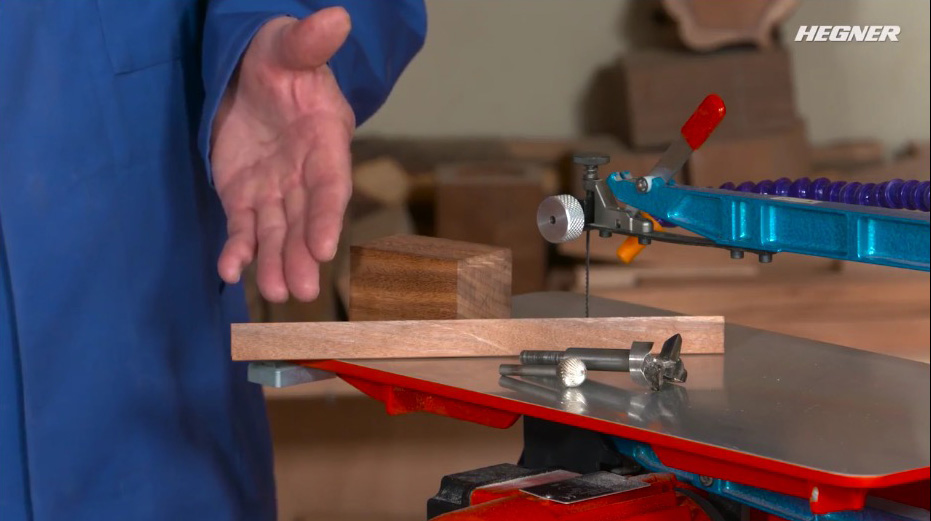
Hegner GmbH is a German company based in Villingen-Schwenningen (Baden-Württemberg) which produces precision machines for woodwork. To help selling their products, "Hegner TV" regularly publishes videos in which Gerhard Fleig, a cool senior demonstrates how to build this or that, using the Hegner machines. Here is the very interesting last video released, showing how to build a Nasenflöte.
 |  |  |  |
 |  |  |  |
 |  |  |  |
 |  |  |  |
 |  |  |  |
 |  |  |  |
It is funny to notice a poem by the carpenter Gerhard Fleig, added in the video 'description' on the YT channel:
| Gebrauchsanweisung zur Nasenflöte Ein mancher hat gewisse Nöte, bis er seiner Nasenflöte einen guten Ton entlockt, denn anfangs scheint sie wie verstockt. Geduld heißt deshalb die Dewise, auf dass die Nasenluft stets fliesse in das Loch durch’s Labium, ansonsten bleibt die Flöte stumm. Damit der Ton klanglich auch rund, formt man diesen mit dem Mund, der sich an das Holz anschmiegt, weil man sonst kein Ton rauskriegt. Um den Ton gut zu gestalten und Intervalle zu entfalten, braucht’s das Zwerchfell und die Lunge und ein wenig auch die Zunge. Nur Mut, bleib dran und du wirst sehen, nach einer Weile wird es gehen. Und nun viel Spass beim Einstudieren zum Nasenflöten - Musizieren. geschrieben von G. Fleig | Instructions for Nose Flute One may have trouble, until his nose flute a good sound elicits, because at first it seems like obdurate. Therefore patience is the motto, so that the nose breath may always flow in the hole by the labium, otherwise the flute remains silent. Thus a pleasant and round sound can be made with the mouth, which huddles against the wood, because otherwise no sound gets out. To make a sound good and develop intervals, one needs the diaphragm and the lungs and a bit of the tongue. Cheer up, stay tuned and you'll see, after a while it will go right. And now have fun rehearsing with nose flutes - making music. written by G. Fleig |
Subscribe to:
Posts (Atom)