This blog is dedicated to the sublime instruments called nose flutes and which produce the most divine sound ever. We have chosen to discard all the native models from S. Pacific and Asia, for they need fingering to be played. We'll concentrate on "buccal cavity driven" nose flutes : the well patented and trademarked metal or plastic ones, plus, by a condemnable indulgence, some wooden craft or home-made productions.
NoseFlute.Org was honoured by the visit of Mr. Will Grove-White (and family), respectable member of the Ukulele Orchestra of Great Britain (UOGB) and reknowned nose flute enthousiast! Very proud of this unmerited honour, Noseflute.org associated with the incomparable Nosy Diva to take a fluty selfie with Will's pair of young bodyguards, in front of the Neptune fountain (Nancy, France).
Here, at Noseflute.org, we regard the Nose Flute day as the perfect moment to spread nosefluting, and particularly to initiate someone to our noble art. That's the reason we decided to make a specific little nose flute for our C.E.O., my cat Patafix.
I also wanted to test a new device I received (I intend to use it at School of Architecture): it is an extrusion pen. You plug it on USB, stuff it with a ABS plastic wire, and the pen melts the wire while extruding the plastic. With it, one can build (literally 'draw') small (and fragile) little structures.
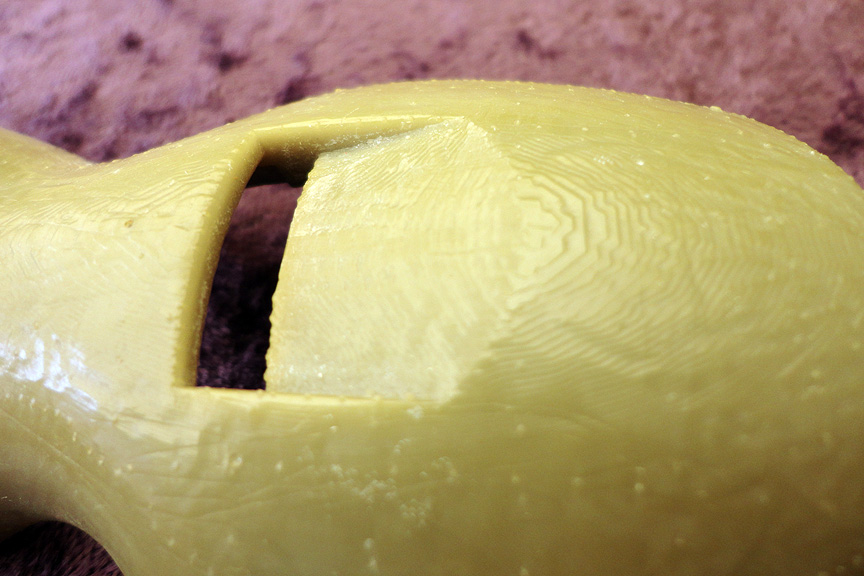
So, I wanted to see if it was possible to build a small nose flute for Patafix. I chose 'glow in the dark' ABS wire to do so, and began to draw a basic shape, then to fill it. It is rather difficult to master the pen and I was not able to produce a regular shape. I felt like drawing with a pastry bag disgorging custard.
Then I created the inner airway (very uggly, uh?), and a nose hood adapted to Patafix' snout:
Finally, I sharpened the labium and sanded the flute as I could to smooth the surfaces, added an elastic cord with 2 pink beads (Patafix is a girl, don't forget it!):
Yoohooh! It glows in the night!
At first, the moustachioed C.E.O. of noseflute.org was a bit reluctant in trying the instrument...
But after a while, Patafix adopted the nose flute and played a beautiful music piece (unfortunately, I hadn't my recorder with me at this moment...). Anyway, she will mostly use it as a bird call…
You certainly remember UkeVal (aka LuthVal), the great and prolific ukulele and luth player, beacause we published here several of his nose flute videos (here, for instance).
Mr. Valéry Sauvage is not only a musician, he is also a painter, a poet and a writer! And this multi-artist just published Pantins, Lutins, Nains de jardin… (et autres billevesées), a 223 pages book containing 12 beautiful and funny tales. They mix fairy stories with modernity, with ingenuity and humour. Because — if you hadn't understood yet — UkeVal is a kind of leprechaun himself…
The last tale, entitled 'La Flûte de nez enchantée' ('The Magic Nose Flute') certainly captured our attention! It tells the story of Blondehilde. She's a tall musician-fairy of germanic origins, mastering the nose flute. Another character of this tale is Charles-Antoine, a kind of fat and black-dressed genie with a 'fume-étincelles' ('sparks smoking pipe'), used by him to materialize shapes. In order to comfort Blondehilde, whose cat Franzi had left for the cats paradise, Charles-Antoine begins a quest to find the most incredible nose flute for her… Any resemblance to actual individuals or events is certainly not coincidental.
I really encourage you to read the rest of the story, as well as the other tales. Fun and pleasure guaranteed!
Pantins, Lutins, Nains de jardin… (et autres billevesées)
by Valéry Sauvage
Les Editions de Pied Pouzin
ISBN 9781530863471
3D printers, 5 axis CNC mills, 3D scanners, laser cutters... All these high and new tech machines are more and more becoming parts of our environment and common ways of production (at least for prototypes or unique pieces). And... what about nose flutes ?
The plastic Humanatones and Schwans were born too long ago to have gotten the benefit of a computer-improved design. Which were the first nose flutes designed, improved, tested, produced or even reproduced by new technologies?
2008/2009, then 2013/2014: The Bocarina®
Chris Schuermans is probably the first having had a nose flute printed. He designed the Bocarina® with 3D softwares, then used 3D printers to test different shapes.
First 3D print grown in a Stratasys Dimension machine using FDM (fused deposi1on modelling) from ABS filament:
Very creative, Chris designed then a Bocarina® body able to receive inserts, in order to test different fipple shapes: « I then experimented with this design - and realised that it was too expensive to grow the whole Bocarinas each time.... So I designed the airways to snap into the body»
« Then I made some enlarged models for making ceramic moulds», wrote Chris:
« I experimented with clay Bocarinas and changed the design.»:
Experiments with the new design:
« Using the refined shape I enlarged the model to make a model for making a ceramic mould. This print was also made in a Stratasys Dimension machine using FDM (fused deposi1on modelling) from coloured ABS filament. This model was polished with sand paper.»:
« After conducting some more experiments with clay I refined the fipple and finalised the design to make the final prototype in an EnvisionTEC technologies machine using SLA (selective laser acrylic) with photo-sensi1ve resin» (see below).
« The Bocarina mould was made using the CAD data of the 3D model used for this 3D print.».
As you can see, the design process has not been an easy and sweet path...
And as you can see in this post, a whole process began again some short years aftermath, with the Bocarina® Pro...
2010: The Pfaff Nasenpfeife
The patent for the Pfaff Nasenpfeife was filed in May 2010, and I assume this model was tested with 3D printing (in 2009?), but I do not have any evidence of it.
2012: Fuppi
Fuppi, the Japanese mass produced plastic hanabue, was born in 2014, but prototypes had already been made at the end of 2012 (see this post). The original model was the Adachi nose flute designed by master Kunio Katada, Fuppi's two parts mould and its inner design (with the purpose of being openable for cleaning) was, without any doubt, created on a computer. It's more than likely that first Fuppi prototypes were 3D printed (particularly in this hi-tech country).
2014-03: CRAI at ENSA Nancy
Here, we are not dealing with the design of a new nose flute, but with a joke/training/experiment lead by some of my former students. After their studies at Nancy (FR) National School of Architecture, some of them integrated the CRAI (our lab specialized in modelization). There, they had access to 3D scanners, 3D printers, etc. As a training with those hi-tech tools, they decided to copy a Bocarina® (sorry Chris... I wasn't aware of those funny pirates at the time...), in order to modelize it and be able to personalize it and make a surprise for me. I assume they wanted to recreate the external shield as a human face. Unfortunately, most of them left the lab before the achievement of this funny project. Anyway, Julien M., still there while completing his PhD., sent me the remaining files:
The toolpath vizualization:
2015-03: Nose Flute by Mark Brocklebank
March 2015 is the first (known) date for a home designed and 3D printed nose flute. I found it on Thingiverse, the 3D printing open community. The Mark Brocklebank's nose flute is very simple, basic and coarsely printed, but it works! His creator even posted a video on his YT channel:
One interesting feature, on Thingiverse, is that what is published is offered to the community. So, anyone can download the files and make a home printed version of the object. That's what did two people, who also published a picture of their own "make"… Same file, but different printer and plastics:
2015-05/06: Nose Flutes by Maikel Mei
in May 2015, Maikel Mei sent me an email with pictures: « I have been working on the design of a 3D-printed nose flute. Today I collected the 3rd batch of the experiment, of which this is the most successful. It works, yet is far from perfect. It was printed in PLA. The proper version will be first printed in nylon in one piece. I am also thinking of liquid wood etc. The design is a combination of the W&L flute together with my own ideas and holds several innovations such as the extended chin shield and the reed holder.»
It's very interesting: Maikel Mei chose to print a 2 parts nose flute, longitudinally and symmetrically cut!:
The next month, Maikel had made a 3D printed copy of his silver Schwan-shaped Nasenflöte: « A new maker made a 3D-replica of my silver W&L. It contains a few tweaks that should make it a better instrument when printed in metal or ceramics. I will go for another few tweaks next week that will make it the best possible instrument. The print in the pictures was made in an hour from bronze ABS-string, just to have a result. Even without a proper labium it works nicely, better than the ones made by the first maker! »
Sadly, one side is not as clean as the other...
2015-11: Nose Whistle by Bob Taylor
Another nose flute appeared on Thingiverse last November. Bob Taylor designed and published this (more than) simple nose flute, but there is no picture of a 3D printed instrument, so we don't know if it was realized for real. Anyway, it would not have been able to whistle, having no air way!!!