This blog is dedicated to the sublime instruments called nose flutes and which produce the most divine sound ever. We have chosen to discard all the native models from S. Pacific and Asia, for they need fingering to be played. We'll concentrate on "buccal cavity driven" nose flutes : the well patented and trademarked metal or plastic ones, plus, by a condemnable indulgence, some wooden craft or home-made productions.
Showing posts with label boxes. Show all posts

Jul 13, 2016

Back on the restored Humanatone

Now that we have restored that vintage Humanatone (see here), let's take a look at it.


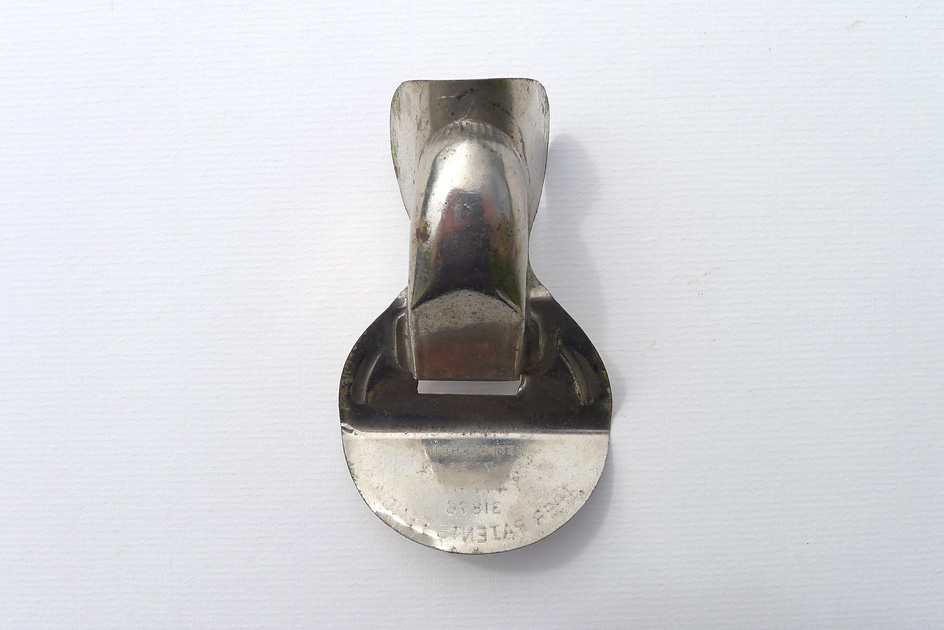
Well, the nose flute itself shows no particularity. It's a classic tin Humanatone, with the (half) pear shape flaps (which I think to be the latest version), and very light and barely readable stampings, that I believe to be rather early. So — I may be wrong – I would date it from the early 1920s or even a bit before.

In comparison, here are what I call strong and visible stampings (from the 30s?):


But what is interesting is the box itself. I had seen no such box before this catch, although I have got two samples of soft boxes that show similarities... Before to reshape and reglue the box, I cared to make a scan.


The first one is from an early Humanatone. This box is rather different that today's one: the volume is not the same, the 'brick' is less flat. The drawings and typographics are simpler. More, the nose flute is different: it was an earlier version, with rectangular flaps, the rounded air cover, the mention "other patents pending" and the name 'Humanatone' in between the two words 'Trade' and 'Mark'.


The other one is very similar to today's box, almost identical. The nose flute itself is a carbon copy of the one I just restored: same flaps, same stampings, same everythings.


So, the instruments and the boxes are very similar, and should date of the same period of time, and later than the simpler thick box, which is probably from the 1910s. But besides the difference of color, there are some interesting details that differ. Now, when I remount the parts of the red box as the restored one:


Every single details are similar, shape, size, typographics, drawings, texts... excepted for five of them. Three are of no specific interest…

1.- The color (the red box is printed 'negatively')
2.- The typographics of the mention "Open on this end" on the lateral flaps
3.- The not printed stripes on the flaps (helpful for the printer?)

… but the two others bring more fun:

4.- The restored box relates to an 'Improved O" model, while the red one is for a "Style O"

Well... what can be an improvement on the restored flute? It is probably the pear-shaped flaps and maybe the marked plane of the air cover (I do not see any other possibilities). But the flute from the red box also has the same feature. Indeed, I suppose that the model became "Improved O" at the beginning of the use of pear flaps, then the denomination came back to the simple "Style O", like it was before on earlier models. It's like the "new taste" or "new formula" mentions on food or cosmetic products: they disappear after a while, when the novelty has become normal and regular.
If I'm right, the fancy red one is later than the ecru one. So should be the nose flutes themselves, but anyway, the instruments are strictly identical.

Last difference:

5.- The small logo printed on one flap of the restored box


I found some info about the Bogota Folding Paper Box Co. Bogota is a New Jersey city, and it seems that it was specialized in paper industry.

Excerpt of the Industrial Directory of New Jersey - 1918:


Unfortunately, the 'Bogota Folding Paper Box Co.' mention appears in the city directories from 1902 to 1922 and we are not much helped in dating this Humanatone. Well, at least, we know it was made prior 1922.

Last info (from this site): « All of Bogota’s paper mills had one feature we would be proud of today. The major “furnish” (the raw material from which the new paper product was made) was waste paper materials. Perhaps the rest of the country did not take recycling seriously until the 1990′s but in Bogota we were serious about recycling in the 1890′s. »

Indeed, our box looks made of recycled paper, but not the red one (which doesn't wear the B.F.P.B. Co. logo)


Jul 11, 2016

Restoration of a Vintage Humanatone

Once you've accepted that miracles are not possible, the restoration of a damaged 'object', whether it is a marble Greek temple or a humble tin Humanatone, is mostly a matter of choices. Yes, skill and craft also weight on the balance, particularly in art restoration, but when trying to renew a common vintage nose flute, the potential damages won't change the face of the world nor fill the newspaper front pages, as it was the case with the dramatic but hilarious Christ of Borja restoration.

A matter of choices because, most of the time, the "keep" and the "kill" are so inextricably associated than you can't remove one without loosing the other. Rust and Patina. Remove the rust and you kill the patina. Keep the patina and the rust will slowly digest your beloved collector. Some people refuse to touch to the patina, or even to clean the object: the dust is part of history.

On my side, I have no ready made philosophy or religion on the topic. I just decide case after case, depending on the condition of the nose flute, its rarity, what I'm sure (or not) to achieve decently, etc.

---

I got a totally wrecked Humanatone and decided to restore it, with my simple means. The nose flute was deeply rusted, and the box, according to the seller, « was run over by a horse, stuck to a bicycle tire and ended up on the front of a train! (Kidding, of course) It's a mess! ». Hahaha! No humour there, simply the truth! :)


1.- The Nose Flute

This is a very common vintage Humanatone, so the loss would not be enormous in case of failure. On the other hand, the rust on the airway cover is impressive, thick and hard, softly killing the Hum, like a daily dose of lead in the kidneys. There is also rust at the base of the flaps, here and there, and also a lot inside the air intake... Yes, there is also a smooth mate grey patina... that will vanish when the rust is removed. Hamletian choices, to clean or not to clean...


First I used a soft metal brush then very fine steel wool (0000), both in conjunction with WD40. I very gently rubbed the nose flute, particularly the air cover, during about one full hour, regularly using a new piece of steel wool and adding drops of WD40. I got a first promising result: most of the rust was removed (patina too...). The air cover surface appeared to be rather deeply gnawed and ulcerous.


It was the time for a bath... I put the Humanatone in a warm Rustyco solution during an hour (I'm not a share holder, but this product is very helpful. It turns rust into black and stabilized oxide).


Then I rubbed again the instrument with 0000 steel wool, rinced and dried the flute, and finally coated it with a not stinky mineral oil.


The result, far from being perfect, is acceptable on the balance between cleaning/preservation and respect of the 'vintageness'. Even the interior has been de-rusted (I also used many Q-tips to rub into there).


2.- The Box

The box is a real wreckage. It is torn, crumbled, and many little parts are bristling on the angles...


But the box is complete! No big part missing, and better — if I can say it – it has been torn all along a side, allowing to spread it flat. That's what I did, and began to soften the cardboard by steaming it over a boiling pot of water. The thick cardboard must not get soaked. So the process took several minutes on both sides, with a gentle steam flow, to reach and soften the inside of the cardboard.


Then and immediately, I ironed the box between flat carboard and a sheet of paper (iron set at max). Then I returned the cardboard and applied the iron the same way. I did the process twice (steam and iron again).


Finally, I placed the box under a pile of books during the cooling and drying time.


Then came the time of the reshaping. I began with a careful gluing of the little splinters back to where they belong, using the minimum instant glue possible.


After all the splinters were in place, I folded the box back to a parallelepiped, and glued the edge along where it was torn. The result certainly doesn't look mint, but the box is complete and has gotten some stiffness back.


Et voila!!


--


Jul 2, 2016

Another Classic Humanatone


I found another vintage Humanatone, with its box and paper, in very good shape. It's a nickeled No.20, but is interesting at least on one point: it features a specific detail that I had never seen before on a Humanatone...


1.- The Box

The box is a very classic Humanatone box, with the beautiful typographics and the Stivers' lion design (dating of 1905) that we found to be a rebus (see here). In this version, the label is anthracite and the cardboard box brick.

Here it is, compared to the two other similar ones we know:


As you can see, the label is dark grey as the one of the bottom left pictures, which belongs to an instrument we dated between 1908 and 1911 (check here). But the label shows the 'style' and the $1.00 price, like the box in the third picture. The nose flute itself has got rectangular flaps - like the one related to the 3rd pic. - while the 1908-11 has 'end of ice cream stick' shaped ones. So, our new classic 'Hum' could be an in-between model (?).


2.- The Manual

The user manual is very similar to the one of the 1908-11 Humanatone, besides it is printed on bistre color paper, and has a back also printed.


Compared to the older one, the header typographics have slightly evolved, but it is mostly the bottom of the page that is different, with a new design for the trademark Humanatone, the place 'New York' instead of the street address, and the presence of a nose flute:


The details are more finely printed too:


The back of the page is rather funny, with advertisements promoting a book with an hilarious title ('The Bright Side of Kissing and the Dark Side')...


… and another one ('Flashlights on Human Nature'), but also a bunch of soaps, balms, emulsions and unguents to be (or stay) the most healthiest and attractive person. Prepare for kissing, courting, calling!


I was astonished how the man of the advertisement looks very alike David Crosby 'Almost Cut My Hair'!:


3.- The Nose Flute

The instrument itself is a beautiful classic nickeled Humanatone specimen, with rectangular lateral flaps (rather early production).


As said earlier, and as you can see it, there is a unique detail on this Humanatone, that I never saw before: It is a pair of embossed circular arcs, dedicated to strengthen the mouth shield. The only comparable feature, but as a full circle, can be seen on the Wunderflöte drawn in 1941 Wolfe's book and visible among Piet Visser's collection:


Now, here is our Humanatone:


As I'm certain this nose flute is not part of the super early production, nor the late one, it means that the 'strength bow' appeared on, then disappeared from the Humanatone. My opinion is that this features didn't last so long, as it is the very first and only time I saw it.