This blog is dedicated to the sublime instruments called nose flutes and which produce the most divine sound ever. We have chosen to discard all the native models from S. Pacific and Asia, for they need fingering to be played. We'll concentrate on "buccal cavity driven" nose flutes : the well patented and trademarked metal or plastic ones, plus, by a condemnable indulgence, some wooden craft or home-made productions.
Showing posts with label bands and musicians. Show all posts

Nov 11, 2016

Leonard Cohen (1934-2016)


This morning turned very sad when I learned the passing of our beloved Leonard Cohen. Up to then, he was the *only* living member of the Nose Flute Hall of Fame. Finally, yesterday, he decided to quit his constant infringement and to comply with the NFHoF rules.

Leonard had been inducted for the last notes of Tonight Will Be Fine (Songs From A Room (1969)), clumsily played at the nose flute.


So long, Leonard...

Jun 7, 2016

Häisd'n'däisd...vomm mee!


Häisd'n'däisd...vomm mee! is a German folk and regionalist band. They perform in their region — the Franconia – which is located in the northern Bavaria.

Häisd'n'däisd...vomm mee!, in Franconian dialect, means 'Hüben und drüben... vom Main!' in German, i.e. 'On both sides… of the Main river!', which a geographical description of the Franconia.

The band has recorded several CD, amongst which, in 2013, 'Nä, ich hald mei Goschn ned' ('No, I don't shut my mouth') featuring 24 (!) songs. The #6 is named 'Concertino für 3 Nasenflöten' (in German. Schade! I would have liked to learn how to say 'nose flute' in Franconian...)


The piece is played with three wooden nose flutes, an accordion and percussions. After a short intro, there is an a capella sung stanza (Big thanks to the Nosy Diva for the translation!):

Sicher staunt und fragt ihr euch
Warum blast ihr net auf Schläuch
Oder gar auf langen Rohren
Dafür seid ihr doch geboren
Weil wir euch beweisen wollen
Nasen sind viel mehr als Knollen
Und das ist ja grad das Schöne
Uns’re produzieren Töne.


which means:

Surely you are wondering
Why are you not blowing (on) hoses
Or even (on) long rods
Because you are born for that.
The reason is that we want to prove to you
Noses are much more than conks
And that is the beautiful part
Ours produce sounds.


Fränkischer Tag, Mar. 25, 2013:


Here an excerpt of the Concertino (just a shorty, for copyright reasons. The total piece is 3'25" long):


Here is another excerpt found on Youtube:


You can order the CD from Häisd'n'däisd...vomm mee website or from Zachmuzic-shop

Jun 4, 2016

Haydn Trumpet Concerto on a Vintage Næse Fløjte


How could I have missed such a masterpiece!?! This Danish video, dating of 2013, is a rarity on several points. First of all, 'næse fløjte' videos from Denmark are rather scarce. But also classical music played with a nose flute, and particularly when the musician uses props like a tuxedo in the vid. "Haydns trompetkoncert på næsehorn" ('Haydn Trumpet Concerto on a Nose Horn' [næsehorn means rhinoceros in Danish]). And even rarer, when the piece is played on a vintage instrument!

Indeed, the title page shows the instrument, and it clearly is a German oldie, with its pair of folded flaps (no rivets). In fact, it is exactly the same instrument than the first German vintage nose flutes I acquired some years ago, from a... Danish antiquarian.


My German vintage Nasenflöten (Paul Brunner's?):
Here is the video, from Hans Wendelboe Bøcher's YT channel:

Jun 3, 2016

Krautrock und Nasenflöte


Pirx is a music duo from Berlin and Cologne (DE), composed of Marion Wörle and Maciej Sledziecki. Describing their music is a bit difficult, as they use as well conventional rock instruments, electronics, noises and 'unconventional' instruments, like musical saw, flutes and percussions. A kind of experimental concrete band, fighting against the idea of structure itself.


In their 2011 album Sie Sind Hier Jetzt (available here), there is a revisited Krautrock tune, called... Unkraut, featuring layers of noisy Nasenflöte.

The German online magazine Taz published an article in which we can read:

« Der Auftaktsong ihres neuen Albums heißt "Electric Sheep" und setzt mit den schon erwähnten Kuhglocken ein, die zu Schafsglocken umfunktioniert werden. Dazu meint man ein Schafsblöken zu hören. Es verwandelt sich im Laufe des Stücks in ein Wechselspiel von Gitarren- und Kazoodrones. Auf die elektrischen Schafe folgt "Unkraut", das Krautrockanleihen mit Nasenflöte kombiniert - nicht nur die Vorstellung dieser Kombination ist kurios. »

that is :

« The opening song of their new album is called "Electric Sheep" and begins with the cow bells already mentioned, converted into sheep bells. More, we are meant to hear a sheep bleat. It changes in the course of the tune into an interplay of guitar and kazoos. After Electric Sheep follows "Unkraut" that combines borrowed Krautrock riffs and Nasenflöte - not only the idea of this combination is curious. »

You can listen to Unkraut here, the nose flute begins at 1'21":

May 31, 2016

Jupiter (G. T. Holst), by Mosurin


This is a very unusual piece of the repertoire that sensei Mosurin recorded in a video: Jupiter, from The Planets, by Gustav Theodore Holst. Gustav Holst (1874-1934) was an English composer who get the fame with The Planets. This work is composed of seven movements, one for each planet and its corresponding astrological character as defined by Holst. Jupiter, the Bringer of Jollity dates of 1914.

As usual, sensei Mosurin's nose flute is precise, clear as cristal, and the master creates a crescendo in power and sharpness (listen at 1'57"!!), to reach a real summit of pure playing. Really beautiful.

May 18, 2016

Mosurin / The Nose Flute Angels in Oita

A great video shot in Hiji, Oita Prefecture, Japan. The first half shows sensei Mosurin demonstrating the superiority of the Hiroaki Sasaki hanabue over the American plastic Humanatone and beautifully plays several tunes, and in the second part, the Angels of Nose Flute Smile ('天使の鼻笛スマイル笑会'), lead by their founder 'Ojii-san' (野崎 眞歓 / Nozaki Makoto Yorokobi) for a couple of joyful songs.


And a documentary of the NHK channel about the performance:

May 16, 2016

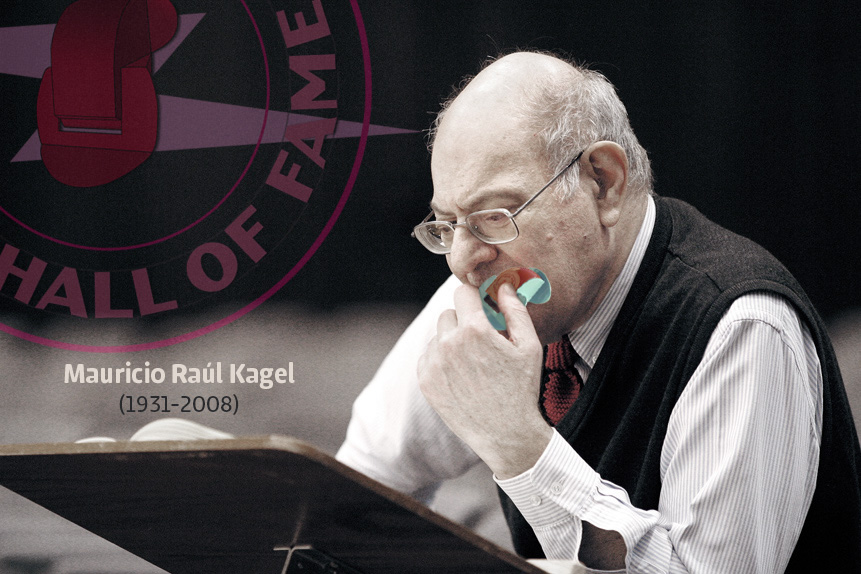
Mauricio Kagel (1931-2008) : Hall of Fame!

Born in Buenos Aires in 1931, Mauricio Kagel moved to Cologne, Germany, in 1957 where he became one of the greatest post-second world war avant garde composers.

« Among the contemporary composers Mauricio Kagel more than any other explored the instrument concept and expanded it. Especially in the sixties and seventies, he created works in which in addition to conventional musical instruments, vacuum cleaners, rubber tubes, walkie-talkies and turntables were used. » [source: Der Schall, Mauricio Kagels Instrumentarium, PFAU, 2008]

Mauricio Kagel in 1968 and 1985:


Among his prolific work, one piece of 1968 particularly retained our attention: Der Shall ('The Sound'). Indeed, and as you can imagine, it contains some nosefluting. Der Schall is a ±40 minutes long piece, written for 54 instruments, played by 5 musicians. [You can listen to the whole piece here, or go directly to the nose flute part here.]

Here is the text written by M. Kagel and printed on the back cover of the LP. You can notice that the nose flute is part of the instruments of group V, played originally by Christoph Caskel:


And here, the front cover, and a portrait of the percussionist Christoph Caskel, who played the Nasenflöte on the record:


In 2007, the Music R&D dept. of the University of Basel (Switzerland), 'reactivated' the original sound objects (kept at Basel Historical Museum) or some replicas in a performance in which the musicians recreated Der Schall. They recorded their experiment, and the CD was published along with the book Der Schall, Mauricio Kagels Instrumentarium, PFAU, 2008. This books contains lots of info and reproductions of original documents.

The font cover already shows a Nasenflöte in a box (rather well hidden though :):


The books is subtitled 'Mauricio Kagels Intrumentarium', and is an opportunity to show in detail the list of the instruments originally used (and preserved at Basel museum). They are categorized in several sections: Conventional Instruments, Historic Instruments, Extra-European/Exotic Instruments, Special/Non Classical Instruments, Percussion/Home Made Instruments and Signal Instruments.

That's among the Special Instruments that one can find a nice paragraph (p.81) about the nose flute…


… which says something like (edited Google translation):

« The nose flute perhaps constitutes the most striking example of the aforementioned contrast between the modern Western European form and the Asian or South American forms of the same instruments. While the variants from Southeast Asia, Oceania and Polynesia are usually whistle-like tubes made of natural materials that are blown with air from one nostril, the breath of the nasal air has a special symbolic meaning as the bearer of the soul, the Western European Nasenflöte is a quaint, almost funny-looking structure made of plastic (see photo inventory p.98). It is found to be extremely effective in many toy stores music, hardly anyone knows then, however, how the nose flute has to be played. The upper gap is for nose air entrance, while the lower opening stands for the lips, so that the pitch and timbre can be determined by the opening of the mouth and tongue. The nose flute can therefore be quite compared with the Jew's harp, with the difference that the pitch is changed freely and the sound is similar to a whistle. The plastic nose flute therefore requires a radical reconsidering of wind instrument players for unfamiliar tongue-mouth-acrobatics. Like the cuckoo clock Kagel gives a solo passage in which come the special capabilities of the instrument to bear. »

And page 98, between a tortoise shell and a straight mute:


Well, well well... Look at the bright and shiny red on this Schwan... This definitely is not the original Kagel's Nasenflöte, but a new one (the reference # begins by 2005...). I suppose the vintage one has not been preserved in Basel museum... Schade!

The book also offers lots of copies or original notes and execution sheets in which the Nasenflöte part is specified:


We can also find some great pictures of the 2007 'musical happening', and see the Schwan nose flute on the right desk of Matthias Würsch, the percussionist in charge of section V:

---

Now, it is very interesting to compare the 1968 and the 2007 interpretations and recordings. I isolated the two 2 minutes nose flute parts:

1968 excerpt:


2007 excerpt:


Which one do you prefer ?

---

It is very rare to find some nose flute in the work of a serious composer, that is, used as a real instrument, and not regarded as a carnival toy.

For having included a nose flute as a real instrument in his 1968 composition Der Schall, Mauricio Kagel has been inducted to the Nose Flute Hall of Fame, in the 'Promoters' section!


May 13, 2016

Archie Sweet, Plastic Humanatone Early Adopter

The Don McNeill's Breakfast Club was a radio variety show, that ran from 1933 to 1968, at early morning.


Amongst the artists performing in the program, 'Archie Sweet', allegedly the Breakfast Club 'janitor' in 1943-44, was a one-man band. He proclaimed himself the 'World's Greatest One-Man Ban', and was challenged in a 'murderous musical struggle' by 'Panhandle Pete', with Paul Whiteman as commentator.

Lincoln Sunday Journal, Anniston Star and Indianapolis Star of the 5th and 6th of March, 1944 :


What is interesting for us is that Archie Sweet « hopes on victory on the humanaphone » (sic):


We don't know what is a 'singa-tinga'(a jews harp?), but the so-called 'Humanaphone' was definitely a 'Humanatone'! It was even one of the first plastic Humanatones, produced by Gretsch since (Autumn?) 1943. Indeed, we found a photo of Archie Sweet. It is very rare to find vintage pictures showing nose flute players with their instrument, so we are glad!

May 10, 2016

Joyful Japanese Quartet!

A great and funny video on Yoshiki Matsuno YT channel, by a Japanese nose flute quartet, allegedly playing the Danse Folâtre ('Exhuberant Dance', by Claude Thomas Smith, 1987), and "宝島" ('Treasure Island'), with a very free, fresh and experimental style. The video directing is high quality, the performers classily dressed, and the happening stood in a beautiful (but empty:) concert hall. Apparently, the nose flutes are Bocarinas® (one of each colour). Enjoy!


Apr 23, 2016

Leonard Solomon & the Bellowphone


Leonard Solomon is a musician and performer, but before all, he's the inventor of the Bellowphone. «In 1983, in his Cambridge basement, Len built the Majestic Bellowphone, and he took it to the streets along with his 5-ball juggling routine, taking his place among the ranks of classic Harvard Square street acts. » The Bellowphone is a multi-instrument, being composed of many single wind and percussion instruments and activated by a foot pump, the bellow. It is a beaufitul and funny organ. Great job, Len! We love the Bellowphone!

In this video, "Stars and Stripes Forever", Len majestically plays the Bellowphone. A kazoo drives the melody in the first part, but from 1'54 you can hear a few nose flute notes (as explained at 0'15). [Visit the Bellowphone YT channel with many other great videos]

Dec 16, 2014

L. Mozart (well, no) Toy Symphony


Our friend Herman Vandecauter just released a new video in which he plays the Leopold Mozart's Toy Symphony (Kindersinfonie). In fact, « Recent research on a newly found manuscript suggests the Austrian benedictine monk Edmund Angerer (1740–1794) to be the author. » (wiki).
In this video, Herman made a nice arrangement for tenor ukulele, nose flute, canary whistle, chinese xu, tambourine and water whistle!

Nov 28, 2014

Dadaistic Funeral March and Christmas Song


"Marschner Jürgen" aka Jogi - is a multi talented and very creative musician from Berlin. Jogi composes and plays what I dare to call a very typical Berliner music, kind of very creative light-electronic-dadaistic melodies with a serious/dramatic counterpoint (low percussions or a bass distorted voice...). He plays the out-of-tune ukulele as well as Casio keyboards, samplepad, percussions, and... Nasenflöte!

Here is the Nosepipe-Ukulele Funeral March he sent me the link to. I couldn't resist laughing before his mastering of the delicate shifts to the out-of-tune world. Great work!


Jogi seems to have been very inspired by Christmas this last week, and produced no less than four videos on the theme. « I missed a Noseflute Christmas Song in the archive », he wrote me, and added in the video description « I think it's worldwide the first Nosepipe Christmas Song ». Well, there already were (check our here for instance), but this one is my prefered one:


There are many other little treasures that you should watch and listen to on Marschner Jürgen Youtube channel.

Nov 3, 2014

The End (The Doors) by the Nosy Diva at Jim Morrison's grave

Noseflute.org had the opportunity to guide the Nosy Diva in her sightseeing visit in Paris. The Diva wanted to play a little homage to Jim Morrison and we went to the Père Lachaise cemetery, where is buried the Doors' leader. It was a piece of luck to be able to shoot the video in rather quiet conditions, since tourists buses pour out a constant flow of international visitors, greedy to hail the poet's memory.

The Diva played The End (1967) with her mini uke (iuke) and a Handler noseflute.


For sure, it is not the only place that the Diva visited, and here are some pictures of the Noseflute.org tour, among many other places and monuments she went to.

At the Tampographe Sardon's workshop:


At the Chocolate Factory (exhibition by artist Paul McCarthy):
At the Fondation Louis Vuitton by architect Frank Gehry), and in front of the Moulin Rouge:
And in Pigalle! oohlalah!

Oct 23, 2014

Concertos for Nose Flute

As far as we now, there has been 4 concertos composed for nose flute:

Concerto for Nose Flute and Muted Saxophone (1926?)

George Antheil (1900-1959), performed by Edmund Dulac (1882-1953)

George Antheil was a very famous composer in the Avant-Garde years. When in Paris, he was used to frequenting James Joyce, Ezra Pound, Man Ray, Erik Satie, Fernand Léger and many other. His most famous work is Ballet Mécanique.


Edmund Dulac was a french (British naturalised in 1912) famous illustrator. Besides his orientalist drawing and paintings for books, he also created stamps, notably the ones with king George VI effigy or this great one to commemorate the Coronation of Queen Elizabeth II. But Edmund Dulac was also a nose flute player, who performed in many occasions. Unfortunately for us, it appeared quickly in our research that Mr. Dulac was used to playing traditional kinds of nose flutes, notably from Malay Archipelago.

In June 1926, Mr. Dulac performed the Concerto for Nose Flute and Muted Saxophone, composed by George Antheil. We didn't find the music sheet.


---

Gross Concerto for Divers Flutes (1961)

Peter Schickele (born in 1935), with the pseudonym P.D.Q. Bach

Peter Schickele is the famous American composer who invented the fictional and humorous character of P.D.Q. Bach, alleged last J.S. Bach's son. The whole P.D.Q.'s story has been published in 1976 by Schickele, in a hilarious book: The Definitive Biography of P.D.Q. Bach


In the book, the nose flute is said to appear in P.D.Q.'s musical life through Thomas "Peeping Tom" Pollex, a young nose flute virtuoso. Soon after, Bach's "only forgotten son" composed the Gross Concerto.


In the section dedicated to P.D.Q.'s works, a double page exposes the Gross Concerto history and the "divers flutes" used to perform it. And at the right bottom corner of the picture, we can see a plastic Humanatone.


And in the book glossary, a small article describes the nose flute with a certain dose of humour:


But as usual in Peter Schickele's work, while P.D.Q. Bach's story is fictional, the Gross Concerto is real. It is a real concerto composed in 1961 and performed many times (and at least until 1993) by Schickele's ensemble, with the composer playing himself the "divers flutes".


I have not been able to find a recording of one of those performances, nor a video. In the DVD The Abduction of Figaro (by P. Schickele), the bonus contains very short excerpts of the Gross Concerto, but none with the maestro at the nose flute. But then, the bonus features a 1972 interview of Peter Schickele by Gordon Hunt for his TV program Hour Glass (Canadian Broadcasting Corp.).


A real archive, with Peter Schickele presenting the nose flute principle, with a shiny red Humanatone in his hand.

Note that the Gross Concerto is not the only work featuring a nose flute in Schickele's work. At least another piece, from the CD Portrait of P.D.Q. Bach (Vanguard ed.), named Angus Dei (no typo there:) is played with many instruments including nose flutes. Anyway, I was not able to clearly discern their notes in the ensemble.


---

Concerto for Bassoon and Nose Whistle (1966)

Warrick L. Carter (born in 1942)

This is the most mysterious nose flute concerto: I don't know nothing about it. Its composer, Dr. Warrick L. Carter made a great career. Starting with musical teaching and composing at University of Maryand in the late 1960's, Dr. Carter successively became Dean of Faculty and Provost at Berklee College of Music, Director of Entertainment Arts at Walt Disney Entertainment, President of Columbia College in 2000, among many other functions.


According to his biography published on Answers.com, Warrick Carter composed a Concerto for Bassoon and Nose Whistle in 1966. I tried to reach Dr. Carter to get more info, but nobody answered my requests to be put in touch with him...


---

Concerto Pomposo (2000)

Ulrich Nehls (born in 1959), with the pseudonym Jean-Marie Hottetotte

I will not much say about this concerto since I already did in this post.

Let's just say that the Concerto Pomposo is the most documented concerto for nose flute. Indeed, not only Ulrich Nehls generously published the sheets on imslp.org (and thus in public domain), answered all of our questions about this work, but the concerto was performed by the Brethren Bass ensemble, but also by Kentucky T. Dutchersmith and the Maple City Chamber Orchestra: