This blog is dedicated to the sublime instruments called nose flutes and which produce the most divine sound ever. We have chosen to discard all the native models from S. Pacific and Asia, for they need fingering to be played. We'll concentrate on "buccal cavity driven" nose flutes : the well patented and trademarked metal or plastic ones, plus, by a condemnable indulgence, some wooden craft or home-made productions.

Jun 17, 2012

Sunday amusement...

It's Sunday, and I feel like being allowed to produce some stupid amusement. The idea came with a comment by Mr. Job Te Pas : « Playing it and feeling the forms of the Bocarina... Jaguar E-type! ».


Maikel Mei's metal flutes: Brass!

The third metal nose flute Maikel Mei counts in his collection is a beautiful brass "swan" shaped one.


This instrument has got several particularities. The first one is that the flute can be disassembled, with its removable air duct cover.

« The reason for making the removable air duct cover was not only because I was naive in wanting to have an exact copy of the plastic flute, but also that we felt the need to be able to clean the instrument...! »


The other singularity is a square aluminium plate set on the bottom of the air chamber.

« Notice the 'groove' and the 'inlay' within the brass flute: (...) The extra inlaid aluminium part was done because the sound wasn't sharp enough, as the body was made from 1 piece and therefore had to be bent: this bend made the entrance to the labium too big, somehow, which was corrected by adding the aluminium bit that narrowed down the entrance. »


On the topic of this aluminium inset and the explanations provided by Maikel Mei, I must admit I'm quite perplex. I cannot understand how such an appendice could sharpen the tonality range of the flute. I thought the only way was to lessen the height of the mouth hole. Narrowing the airway exit would increase precision and power, but not work on the tonality, wouldn't it ?


[edit : I got a precision from Maikel Mei : by "sharp" he meant "precise and with some attack", not "sharp in tonality". So, my last comment is null and void.]

--

Once again, the result didn't reach the high standards expected by Maikel Mei, leading him later to order his silver flute.

« The only disappointment with this flute for me was that it couldn't produce any 'whisper tones', which I can with any of the plastic nose flutes. Fortunately, the silver flute can also produce them! I am sure the Bocarina also should be able to do that. In trying to reach this desired effect, the maker --against my wishes-- went a little too far in tuning the labium 1 time too many, which afterwards couldn't be restored, for otherwise the material would certainly break. The result of having overtuned slightly is that the flute lost its clarity considerably, which somehow I knew would happen: I felt at a certain point that it could not be further improved. Before it was 'overdone', it sounded just like a trumpet, which I was quite content with! I have never actually used this nor the other flute, for their lack of basic tone quality, sadly. »

Jun 16, 2012

A beautiful picture!

On 13th of June, the Hanshin Nose Flute Friends Japanese Association played live at the "Chicken George" in Kobe, Japan.

The sound was recorded : here and here
The image too : here (the sequence starts at 28'00" and the music at 32'30").

On the Facebook page, you can see this great picture of the band, among all members one can recognize : Mister Sho Hirasawa with its 2 ISE flutes by Takuma Ikeyama, Miss Shoko Mihira with a On-Lak hanabue, Miss Jasmine Sakamoto with her purple Humanatone, and Mr Kato Hideo with a clay flute by Hiroaki Sasaki around the neck, and its red Bocarina by Chris Schuermans on the nose!

Video : Fanfare band in Netherlands

A dutch fanfare band stops to play the brass to make a "neusfluit" pause, with 7 noseflutists (at 0'45")!

Maikel Mei's metal flutes: Copper!

Before to have his jewel silver nose flute made by the goldsmith Jelle Hogenhuis, Maikel Mei had several attempts of having make on demand a "swan" shaped metal nose flute. One of them was made in copper, and he sent those pictures to us. Thank you!


« The copper flute was made for me by an artist/copper worker while I was in Russia at the time. »

It is signed by a monogram and engraved with what I suppose to be the fabrication date, April 15, 1996. It's a quite rough nose flute, with its apparent pewter weldings, but is not deprived of a certain charm. The result, on the sound side, did not reached the level expected by Maikel, and that is the reason he kept on in his metal quest...


Jun 15, 2012

The Topps nose flute

The Topps Chewing Gum Company was founded in 1938, and from 1951, began to sell baseball cards that become its specialty. But the company continued to produce candies, and also some toys. Here is a Topps nose flute, found on The Topps Archives blog. According to the keeper of this blog and Wikipedia, the flute can be dated "after 1965", since the header card mentions Duryea as location for the company.


This nose flute clearly is a Humanatone, although I don't think it is stamped with this brand, which was still owned by the Fred Gretsch Mfg. Co. at this time (I cannot read what written on the flute itself...). However, it looks of a much better fabrication than the contemporary (end of the 60s) spin-off "Hum-a-tune" and its branded version Bullwinkle's Hum-a-Tune (1969), which were produced in Hong-Kong.

The Topps nose flute presents 2 features from the Humanatone that do not appear on the Hum-a-Tune : the small "true tremolo" hole on the right wing, and the lip-rest heel at the bottom (as did the late Gretsch Humanatones). The (yellow) plastic of this Topps looks more like the new Humanatones (consistent and not marbled).

I guess I can read on the header: « ©TOPPS CHEWING GUM, INC. / DURYEA, PA. 18642 / MADE & PRTD. IN U.S.A. » and I suppose this model was a "real Humanatone" by Gretsch (or already by Grover ?), but specially branded for the Topps Co. A physical examination would be necessary to be certain.

Nose Flute and... Spanish Laud !

The Spanish laúd is a long neck bandurria : 12 metal strings (6 pairs), and sound a bit like a large mandolin. In this video, Gaiteromagno plays it associated with a hands-free "Swan" nose flute. And he even sings with the flute on. It is called Canción de narices ("Nose song") :

Jun 14, 2012

Floyd Blue ... the Real!

For the International Nose Flute Day (yes, you were numerous to agree with my proposal), Mr. FloydBlue made a special video with his blue Bocarina :

Interaction, again! - II

Yesteday, we published a post called Nose Flute and Poetry, in which we mentioned this Haiku by Seitei (1680) :

Source : Robin D. Gill, Cherry Blossom Epiphany - The Poetry and Philosophy of a Flowering Tree.

After having read the post, Miss Kanae Miyazaki helped us to understand what exactly is involved in this nose/blossom flute poem. She wrote :

« I think that 花笛 means 桜笛 (Sakura-bue).
It's a children's theatrical play in Japan.


Sakura (cherry-tree flower) is a special flower for the Japanese.
It reminds us some passed Spring, especially when the flowers fall.
It is a very colorful scene, but provides a little lonely feeling.

太夫桜 (Tayuu-zakura) is a famous old cherry-tree in Iimoriyama (飯盛山) Fukushima (福島).
»

---

Indeed, Sakura Zensen 桜前線 (The Cherry Blossom Front) is a famous and well awaited event in Japan. People go out to watch the cherry blossoms (Hanami), including at night (yozakura). I remember beautiful lines written by Sei Shōnagon (清少納言) in her Pillow Book, and you may be interested of this chapter of Genji Monogatari, by Murasaki Shikibu.

---

Kanae Miyazaki concludes :

« This Haiku probably represents the transience of human life.

山嵐 (Yama-arashi)is "Kigo", indicating that early summer is coming soon.
»

Interaction, again! - I

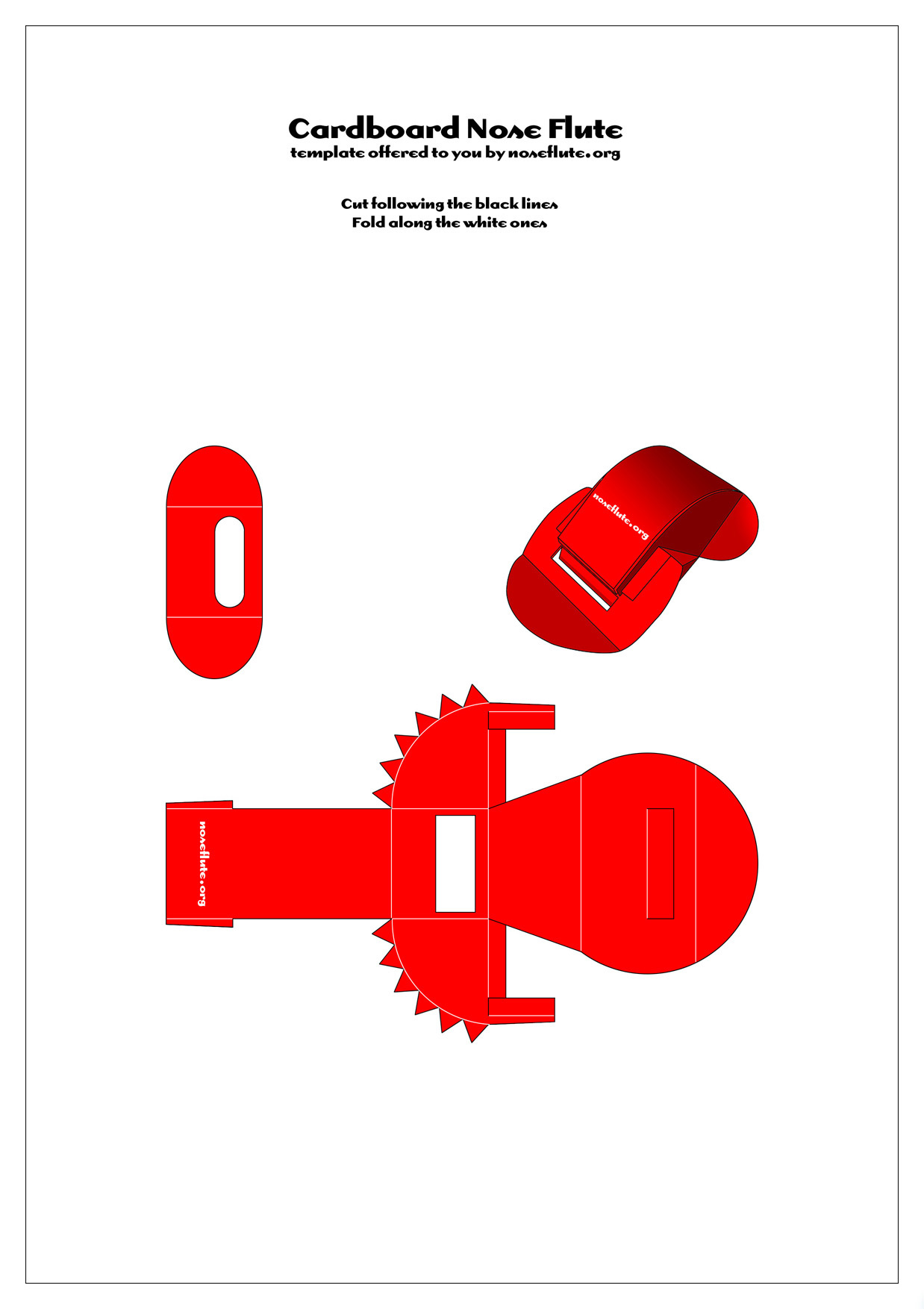
On June 9 (last Friday) we published a post about Don Luis and his nose flutes. And Yesterday, Don Luis posted the following video, in which he shows 2 nose flutes and plays one, made according to our "cardboard template".

[You can download this template here and print it on a A4 (210 x 297 mm) cardboard sheet. Pictures of the way to mount it can be found here and a video that could help you here].

Happy International Nose Flute Day, Don Luis!

International Nose Flute Day ?

Today, dear fellows in nosefluting, is the 120th anniversary of the registration of the patent US477167. On Jun. 14, 1892, William Carter's Nasalette patent was acted. Yes, the document was filed earlier (1891), and the instrument was invented even earlier. But on that 14th of June, the first modern nose flute got an official existence and a full juridic anteriority. Happy Birthday Nasalette!

So, I propose to choose today's date for the International Nose Flute Day !
What's your opinion?

Jun 13, 2012

Nose Flute & Poetry

In August, we published a beautiful haiku by Seitei, 1680, playing with a pun between "blossom" and "nose", which, in Japanese, are written differently, but are homophonic.

But the modern nose flute also inspires modern poets!

Jun Tanioka, aka Hanabue114, is used to post Haikus or small poems on his Facebook page. And some of them are related to nose flutes, like this one :


Well, I do not read the Japanese, and I'm a poor English/Globish writer...
I tried any of the automatic translators available online (Google, Babelfish, Systran, Babylon,...), and I hope I'm not too wrong with this approximative translation (but if someone can correct me, welcome!) :

Hey, did I cut down on you ?
Are your holidays over?
Pip Pip!
Also tired of the nose flute.
Or fell in love with the nose flute ?
Bad ? Good ?

Charly Fasano
, is a musician, painter and a poet but, as far as I know, had not dedicated a writing to our beloved instrument.

Maikel Mei, our inexhaustible resource, sent us a poem he wrote in 1993, during his plain nose fluting activity :


Last Goodbye


Memories scorned and torn
Souls hushed and shrunk
Identities dumped and abandoned
Hopes shoved underground

Beliefs besieged by desperate decay
Dreams dragged into desolate demise
Truths seized by careless forgetfulness
Realities fiercely faded

Decisions left with perfected imperfection
Resolutions led by unconvincing frailty
Beginnings startled by unending endings
Closures marked with muddled complexity

Certainties collapsed and ceased to exist
Opportunities disintegrated and fully exhausted
Possibilities destroyed and indifferently discarded
Chances inevitably ruled out

Emotions wiped out in feeble hopelessness
Intentions fraught with crippled helplessness
Feelings wrecked by spinelessness revealed
Meanings wholly hollowed out

Energy drained and irreversibly jaded
Vigour evaporated and ultimately disengaged
Resistance weathered and weakened
Resilience beaten and betrayed

Stern weary stillness over children's graves
Sole survivors lost in this world
Old men playing faraway blues
Lamented echoes on the nose flute


Please tell me : is it a fate for the nose flute to drive poets to beautiful but totally depressed writings ?

An adorable nose flute by YW

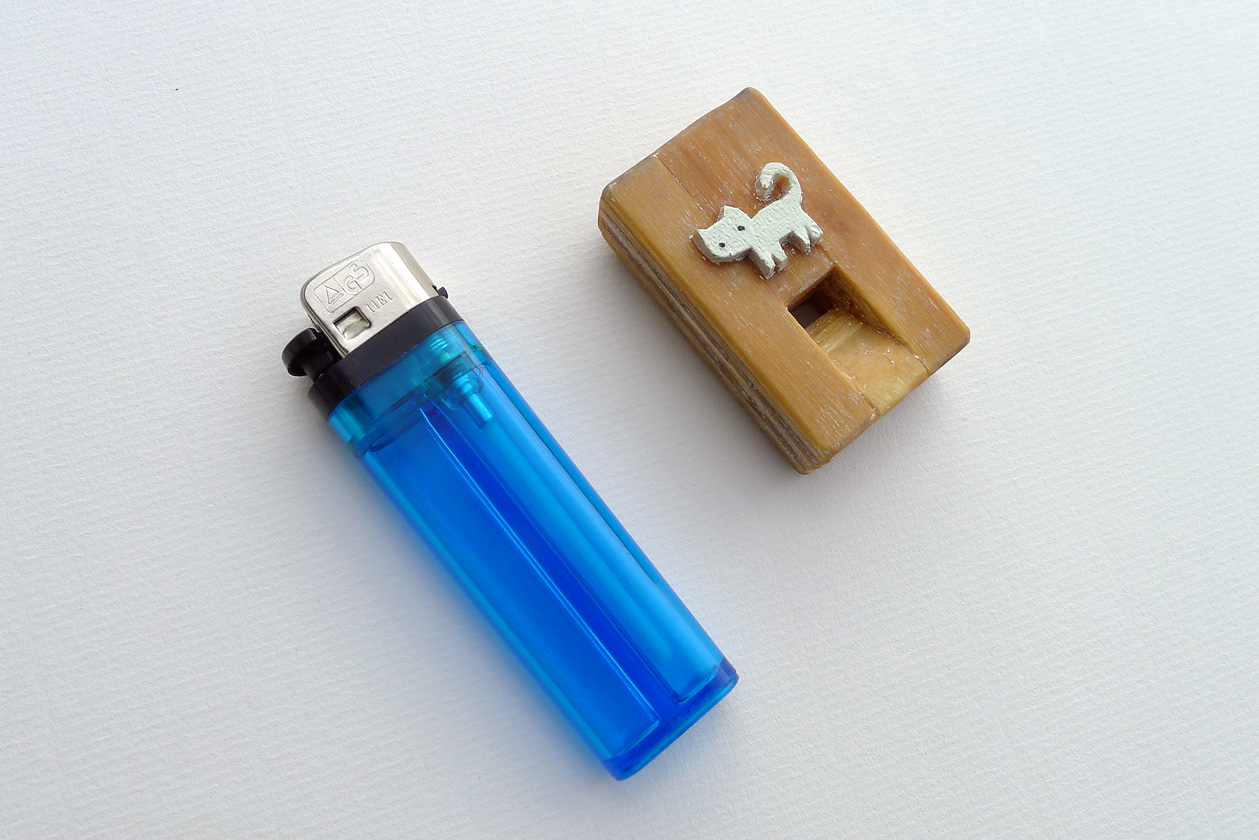
Do you remember YW ? Shuen Ping Chiou (YW) is a Taiwanese graphic designer and amateur nose flute maker. We posted there an interview with him. YW builds very tiny nose flutes with a simple yet efficient concept : gluing together several sheets of wood. Then, he steeps them in a mixture of oil.

Shueng Ping sent me a new (gorgeous) little flute, as tiny as the first he offered to me, but with a improvement in the specifications, and ornated with an adorable white kitty! (According to what I can see on Facebook, many nose flute players are cat lovers...)


Shuen Ping added a message in the little parcel, with a really funny and quite realistic drawing (I've added his picture to compare) :


In his message, his says : « I changed the lip of my nose flutes. And I have this specification to create all my new nose flutes. they will be easier to play and the sound will be cleaner »

Indeed, when you compare the old and the new versions, both the place of the mouth hole and the fipple shape have changed: The length of the air duct has been shortened, providing an upper mouth hole, and the angle of the labium (thus it's length) was sharpened.


The nose saddle stayed unchanged, and very tiny :


The nose flutes by YW are a bit difficult to play for my occidental nose, because of the very small air entrance. However, I can displace my nose and use the flute as a "one-nostril-blown nose flute" and, clogging the other nostril and the part of my mouth on the opposite side (not when I hold the camera at the same time :), I can then get the sound ! Look at this beautiful and sexy picture, and you'll catch what I mean :


Thank you very much, YW, I love your tiny and funny nose flutes!

- Visit the YW's blog
- Reach YW on Facebook

---

Translucent Swan - II

Internet interaction is so good... Yesterday, I wrote about the translucid Swan flute : « I think they are brand new » ... I was totally wrong!

Immediately I received a comment from the Guns'n'Noses orchestra (from which facebook page I borrowed the picture shown yesterday) : « No, I have to disappoint you... I have had this nose flute for probably a year. »

More, I also received a mail from Maikel Mei :

« Hereby I send you 2 pictures of my 'crystal clear' flute, which happened to be in the bag of 50 that I bought in 1998 (...) The concept of the translucent body is from around 1997-1998. How can I be so sure? From 1994 to 1997 I contacted each toy store and music shop around in the Netherlands, Belgium and Germany, asking them about 'plastic nose flutes' on a regular basis. »

OK... the translucent body dates from 97/98. But I had never seen one.
(by the way, if someone wants to trade one with me, (s)he is welcome :)


Jun 12, 2012

Translucent Swan

Have you ever seen a (half) translucid Swan ? Me not.. until today! I think they are brand new... Things move in the nose flute world.

[edit : please read the sequel of this topic]

From the Guns'n'Noses facebook page :


Long live and prosper!

Back to one of the best instruments combination : Ukie & Snoozie! In this video, Will Grove-White, gentle member of the famous Ukulele Orchestra of Great Britain plays a black Bocarina to whistle the Star Trek theme. A gorgeous video! You loved his James Bond theme video, you will adore his Star Trek version!

Hottetotte : The Concerto for Nose Flute


Folks, what is following deserves all your attention :

On the Brethren Brass website, one can read :

« A contemporary of Franz Joseph Haydn, Jean-Marie Hottetotte considered himself "France's Haydn" although the French public actually despised his music. Hottetotte was intensely jealous of the success of Haydn's Trumpet Concerto and attempted to write a trumpet concerto himself, but was unsuccessful at securing a trumpet player who would even look at the score. The only musician that would associate with Hottetotte at all, was a classical nasenfloete player (the only known such player in the world) named Ulrich Nels from the remote village of Rhone-Alpes. Nose flutes had been used for centuries in Africa to call birds, but such a musical undertaking took two years for Nels to perfect. A public premiere of Hottetotte's “Concerto Pomposo” for Nasenfloete and Orchestra was heavily publicized for May 21, 1755, but was abruptly canceled due to it being the height of the hay fever season in France. Ulrich Nels was simply unable to play the nose flute during this unfortunate period. What few friends and investors Hottetotte had, pulled their support and had Hottetotte tarred and feathered. The public humiliation drove Hottetotte to live out the rest of his life in a home for the mentally ill. He died a peasant in 1781. Unfortunately, one score of “Concerto Pomposo” survived. »

And the website propose two mp3 recordings, of the 1st and 3rd movements of the Concerto Pomposo, unfortunately played with a 'modern' shepherd's crook cornet, not on a nose flute.


The Brethren Brass explains the reason of the missing second movement :

« Trumpeter Robert Miller has tempted fate, and has premiered “Concerto Pomposo” on the 'modern' shepherd's crook cornet. Although Hottetotte had completely rewritten the concerto to take full advantage of the effects of the nose flute, Miller was able to make a somewhat indifferent effort at some of the unusual motifs and was fairly successful at performing the first and last movements. The second (remaining) movement was so irritating and poorly written that Miller refused to even read the part. Cadenzas in the other movements were not attempted because they exisisted only as opportunities for the nose flutist to empty his nasal cavities into a small clay pot that sat next to the conductor's podium. In a tribute to Hottetotte and Nels, Miller chose to silently empty his spit valves during these short pauses in the music. »

But hopefully, we know a real nose flute version of this eighteen-century major work, already presented in this blog, and interpretated by Mr. Kentucky T. Dutchersmith and the Maple City Chamber Orchestra :


---

Well, you already understood it, all of that is an international farce!
Jean-Marie Hottetotte is a fictitious composer and the Concerto Pomposo for nose flute is a joke... But where did it come from ? It has been, contrarywise, really composed and written somewhere by someone!


Ulrich Nehls (with a "h" after the "e") is a (real) german musician and composer, born in 1959 in Husum. Nehls studied church music in Heidelberg and Berlin. In 1986 he won the first prize in the improvisation training centers contest of Frankfurt.

In 2000, he invented the fictitious composer Jean-Marie Hottetotte :

« All of that was strongly influenced by Schickele's book 'the definitive biography of P.D.Q. Bach' which contains a lot of funny stories about (supposed) contemporarians of P.D.Q. Bach (who himself is, of course, a fictional figure.) And I wrote that music myself, yes. »


« I have written some more pieces under the name of P.D.Q. Bach. (...) One of the biggest successes in those concerts was, by the way, another piece we foisted on P.D.Q. Bach - a so called "Aria con publico". We took reference to the often unpleasant soundings of auditors during concerts - you know what I'm talking about - all that rustling, whispering, talking, grabbing in handbags, cell phone sounds and the like, and thought we might integrate all those annoyances in a baroque piece by P.D.Q. Bach. »

When I reached Ulrich Nehls by mail, he told me he didn't know the existence of the Brethren Brass nor Kentucky T. Dutchersmith's existences. Even less, so, of the recordings and videos of his concerto for nose flute. « I didn't know about that orchestra performance from the USA - believe me, I heard that piece the first time since our 2003 performance (...) Our first performance of it was in spring 2000. »

However, Ulrich Nehls has put this work in the public domain, and the music sheets for all the instruments (Flute, Oboe, 2 Tromboones, 2 Trumpets, Nose flute, Strings) can be freely downloaded on IMSLP library.

Here is the nose flute part :

---
Where did the name Hottetotte come from ?

« It is an innuendo to both the name of composer Hotteterre and the african tribe of the 'Hottentotten' (Hereros; Germans know that name because Namibia used to be a german colony decades ago. Unfortunately the name "Hottentotten" (which is taken from the Africaans language) seems to be a racist and derisive verb for these black people, but I didn't know that when we made these performances in 2001.) »

Unanimously with congratulations, the NFHoF jury (me and my cat Patafix) decided to welcome Jean-Marie Hottetotte in the Nose Flute Hall of Fame!


---

Links :

- Ulrich Nehls' website
- Ulrich Nehls' Youtube channel
- Ulrich Nehls' music on IMSLP library

---

Radio program excerpt

A rather stupid radio program excerpt, just for the archives. It was broadcast on KBS (South Korean international radio) and is undated. But there is a mention to the song "Cryin'" by Aerosmith, and later to the Vienna Vegetable Orchestra (Das erste Wiener Gemüseorchester) that was founded in 1998.

Okan Khamen - Part IV: Komatsuka Nae's answer

Kanae Miyazaki / Komatsuka Nae sent me this new drawing, asking me to try again to play the small Okan-Khamen hanabue that I cannot really get a sound from. Indeed, as it was an easy pleasure for me to play the large model, which is a quite good nose flute, I had serious difficulties to get sounds from the small one : too many air leaks with my nose shape.


For sure, I tried, several times, but could not get a better result. But I want to be clear, because I do not want to have been read in a bad way.

I do not feel the small Okean-Khamen is badly done! Not at all! It just doesn't fit my nose (the only thing I could criticize about it is the air entrance, which is a bit too small).

I am not a racist, and I don't want to generalize about "face types". But I know that the base of many asian noses are softer than western ones. Mine is terrible for nose flute playing : the cartilage that separates my two nostrils goes down far under the base of my nostrils, making a "V" shape as a base of my nose. That is the reason I cannot play nose flutes which have a flat nose saddle. I can sometimes correct my nose position to fit such a nose flute : that is the case for the vietnamese type, or the On-Lak nose flutes.

The Humanatones or the Bocarinas are well adapted to that morphological aspect : they have a V-shaped nose saddle.

But other western flutes may cause the same problem. For instance, with the Pfaff Nasenpfeife I have exactly the same problem to play, than with the small Okan-Khamen : a too small air entrance, and no room for my cartilage, leading to huge air leaks.


I love the Heinrich Handler's nasenflöten very much, they are made with a great precision and produce a very quick sound. But my nose does not fit them very well and I had to modify both my Handler players (for sure, I have left untouched and virginal the ones of my collection!), filing a V for my cartilage :


That is with the same spirit than I made a V shape nose saddle when I built my Nasalette :


So, what I want to say is that, according to the fact that a nose flute is well made, its playability depends a lot on the player's face and nose morphology. Regarding the small Okan-Khamen, I can see it is very well made, the clay angles are precise, the technical dimensioning is OK (the air entrance size excepted), so it should play well with any player who... fits to it. It is not my case but the responsible is not the flute, but my stupid cartilaged nose. Anyway, as I already said, I love this beautiful clay flute, but I love it as a jewel, not as an instrument for me.

---

On the same topic, please visit (chronologically) :

- Komatsuka Nae, a talented Japanese artist
- Covered with gifts
- Okan-Khamen - Part I: Covered with gifts!
- Okan-Khamen - Part II: The Parrot-Pharaoh
- Okan-Khamen - Part III: The Nose Flutes
- Okan-Khamen - Part IV: Komatsuka nae's answer

Related links :

- Komatsuka Nae's (Kozakurapon) blog
- Kanae Miyazaki's Facebook page
- A page in English about Kanae's work
- Kanae Miyazaki's works on Toumoto photo website
- Opi Toutomo's Facebook page

---