This blog is dedicated to the sublime instruments called nose flutes and which produce the most divine sound ever. We have chosen to discard all the native models from S. Pacific and Asia, for they need fingering to be played. We'll concentrate on "buccal cavity driven" nose flutes : the well patented and trademarked metal or plastic ones, plus, by a condemnable indulgence, some wooden craft or home-made productions.

Feb 15, 2013

Humanatones in the U.S. Navy during WWII

We were already aware of American soldiers playing nose flute during the WWII. Indeed, one of the first Humanatone box was especially dedicated to the Boys.


Even the famous harmonicist Larry Adler had taken the opportunity of a radio broadcast to ask for sending harmonicas and nose flutes to the fighting forces (check this post).

I just found a simple testimony that these nose flutes were really played! Indeed, in the Fighting Squadron VF-9 history report, we can read that nose flute was played during free time


Fortunately, the file was declassified :)

Feb 14, 2013

Another gravel in the wall

Just a little ad published in the Washington Post (1912/11/5), proving there was a Humanatone store in this city.

Love Flute, by Takamura

Today is Valentine, and Mr. Akio Takamura has especially shaped a pair of nose flutes for lovers!


Feb 13, 2013

Brent Ritter, singer, comedian and nose flutist

Last month, noseflute.org published a video shot at the Damon Runyon Repertory theater in Pueblo (CO), featuring Susy Bogguss and her band, plus a nice fellow nose flutist: Mr. Brent Ritter (please check this post).


Brent Ritter is a serious nose flute player, and a funny fellow. I wanted to know more about him and his playing, and with the help of people from the Pueblo Municipal Band and the Damon Runyon Repertory theater, I was able to reach Brent (he has no internet access). Thanks to the anonymous people who helped us getting in touch.


Brent sent me a long hand written letter (PDF:) with pictures, and answered all my questions.

- Please could you tell us who you are, what is your musical background?

« I am primarily a vocalist, but I derive great pleasure from playing my "vintage metal Humanatone". I was trained as an operatic baritone at the University of Texas at Dallas, in 1978 thru 1979, in Richardson, Texas. In 1979, I was accepted to study in Graz, Austria under the auspices of the American Institute of Musical Studies, based in Dallas. Having been unsuccessful in my quest to secure a position in a German or Austrian opera house, I returned to America, settling in Pueblo, Colorado.

- How and when did you discover the nose flute existence? When did you begin to play it? What is your instrument ? (on the video I guess it is a vintage metal Humanatone, but cannot see well...)

« I was shopping at a local antique store in late 1985, when I spied my Humanatone. I am afraid I took advantage of the proprietor and paid just over $5.00, as he had no idea what it was. I, however knew exactly what it was, having had a plastic one I bought at a music store.


- What do you especially appreciate in nosefluting?

« The main thing I appreciate about nose fluting is the fact that any tune one can whistle, one can play on the flute. Your repertoire is limited only by your knowledge of music. It is also easy to improvise if you have a knowledge of Jazz or Dixieland styles.


- Could you tell more about the Pueblo Municipal Band?

« I have performed on my flute with the Pueblo Municipal Band in my capacity as their vocalist. The band is enjoying its 100th year of existence this year. We perform an 8-week season each summer of free concerts at a local community college. Attendance at these concerts is very good. If you should find yourself in Pueblo on a Sunday evening during June, please come and hear us.


- Do you perform regularly ?

« I perform plays and musicals with the Damon Runyon Repertory Theater. I also am Music Director at the Wesley United Methodist Church; and I am called upon frequently to sing funeral services for local mortuaries.

- Could you tell us some anecdote that happened to you with your nose flute?

« When I first purchased my flute, the coating was worn off and I was getting a rash from the bare tin, so I took it to a music store in Denver that features instrument repair and had it re-plated with silver. Next door was an antique shop. That is where I found another vintage metal flute. I have opted to keep it in its original worn condition, but rest assured, it plays just as sweetly as its mate.


- Do you have some recordings and/or videos of your nose fluting?

« Unfortunately, I have no recordings to speak of, but would try to make one for you if you wish.

- Any fact, remark, story, or archive element you would add to this little interview would be welcome.

« I was a member of the U.S. Air Force from 1967 to 1974, working first as a baritone horn player with the Lackland AFB Band in San Antonio, TX, then 2 years as an aircraft mechanic at McChord AFB, Tacoma, Washington. WHile at McChrod, I entered the 1971 Air force Annual Talent Contest as a pop vocalist, winning the base-level, command-level, and worldwide contests. I repeated my worldwide win in 1972 and finished my Air Force career as the vocalist with the 539th AF Band at McChord. While at the 1971 contest at Norton AFB in San Bernardino, California, I was chosen to represent the Air Force on The Merv Griffin show in Los Angeles, singing the tune I won with: "What Are You Doing The Rest of Your Life".


« My favorite roles are as "Tevye" in "Fiddler on the Roof", "Tony Esposito" in "The Most Happy Fella", and Charlie Anderson" in "Shenandoah".


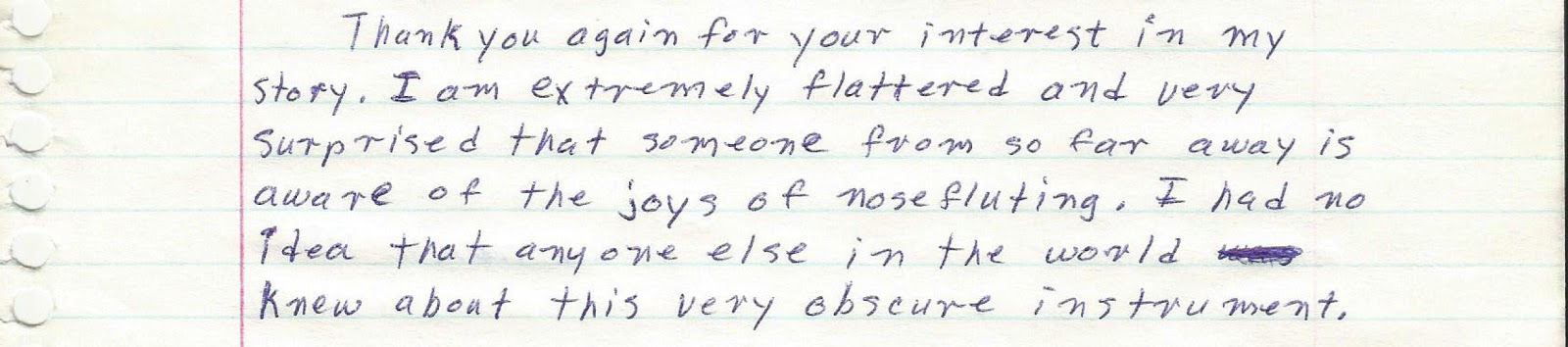
« Thank you again for your interest in my story. I am extremely flattered and very surprised that someone from so far away is aware of the joys of nosefluting. I had no idea that anyone else in the world knew about this very obscure instrument. »

Warmest regards,

Brent

Thanks a lot to you, Brent! And be sure you're not alone in the world, enjoying nosefluting...

Feb 12, 2013

Welcome to Noseflute.org!

Hello, you are here because you scanned the Noseflute.org QR Code with your cell phone.
Be welcome!


Feel free
to share or print

this QR Code!
Noseflute.org is a non-commercial blog totally dedicated to an unfairly undervalued instrument. 


Here, we publish, almost daily, news and videos from all the world, instrument reviews and technical or historic researches. All dedicated to nose flutes.

OK, but what is a nose flute? The best answer lays in these videos:


As you can see, the nose flute is a versatile instrument, able to play complex rhythms and melodies, according to the player's talent.


It's a funny, easy to begin with, pocket size and cheaply priced companion. You can find them at online resellers, at auction bays, etc.


Since the 1900's, many models were produced, in metal, wood, plastic, clay, ...
Please, check our side menu to discover the nose flute world. 
 
Any questions?
Don't hesitate to send us a mail!


Mambo Italiano

A joyful and groovy mambo – yet played with maestria – originally recorded by Rosemary Clooney then Dean Martin. Mister Swing shows all his talent and energy here, with a beautiful black'n'white video. To be listened at in a loop!

Fly me to the Moon

Fly Me to the Moon, with a guitar, a transverse flute... and sensei Mosurin. It begins slowly, then accelerate and gets more complex.Another masterpiece!

Feb 11, 2013

Froby user manual

Our friend Piet Visser found the original packaging of his Froby. He already shared with us a picture while the flute was unwrapped, but with these new scans, we can enjoy the text and drawings of the user manual, and learn abit more about the instrument. Thank you Piet!

Here is the translation:

Blowing, it's playing

The mouth is only used as a sounding cage and modulates the melody while opening more or less the lips. Place carefully opening A of the «Froby»® while pressing it under the nostrils in order to exploit a maximum of air. Place the base of the «Froby»® so the opening B gets at the same level than the mouth. The lower lip must be applied under this opening B.


Well, there is not much to be surprised with the user manual text. It is rather badly written (even a spelling mistake in "résonnance" which should get only one "n"), and does not explain the player must not blow air from the mouth. It is not said that air is blown through the nose! OK, the large drawing shows the air flows, but I doubt that a customer not aware of nose fluting was able to get quickly the right trick...

But two things got my attention. First, the symbol ® follows the brand name and thus, the name Froby should be registered in some database...

Then, at the lower left corner, one can read « Production TWE Paris ». This means that, despite a spanish patent, Froby was a French product!

I have not been able yet to find more about TWE.

There is also a codabar, and I have a little scanner on my mobile phone. But, for sure, there is noboby answering... but I sent a e-mail to the organism that manages codabars in order to ask for archives...


Feb 10, 2013

20 Frobies on stage!

Here is a great (but quite stupid) french TV video archive: 20 Frobies on stage!

On Dec. 6, 1987, as every Sundays, was broadcast the program Le Monde est à Vous ("The World is Yours"), presented by Jacques Martin, the same emcee that had already introduced Mr. Bourdin and is Narinophone/Ocariflute 5 years earlier, in 1982.

This time, Mr. Martin welcomed Les Petits Ecoliers Chantant de Bondy (The Little Singing Pupils of Bondy), a children chorale founded in 1945. Any of these 18 children had a Froby around the neck. With the nose flute of their leader "Moulinot" and the one offered to the presenter... that was a total of 20 Frobies!

No doubt on that, they were Frobies, and you can recognize them by the two long "wings" spread on each side of the nose.


Here is a transcription of what was said, because it gives some information:

— And now, an unusual show! A weird instrument, a new instrument is born, Sound the pipes, Let the trumpets play, and this instrument, as you gonna see, is played with the nose! Yes, it's one of the rare instruments, it's even the only one as far as I know, which is played with the nose. And to illustrate this instrument, the baptism of this instrument, we're going to listen to Moulinot and eighteen children of the Bondy's chorale, who will interpretate, obviously, Siffle-nez [Whistle-nose]. Please, children of Bondy, the stage is yours!

I won't transpose the whole song, but it's called Sifflenez, and was apparently especially written to launch Froby, which is also called Siffle-Nez in this show. All the lyrics deal about the different noses around the world, the magic whistle, the hapiness whistle, and exhort the people of the world to become "siffle-nez".

Sifflenez

Quelle que soit la couleur de votre nez, nez-skimo, nez-cossais,
Mon sifflet magique vous fera danser, siffler, siffler

Tous les nez du monde pourront se parler, nez-grillon, nez-palais,
Même les nouveaux nez sauront faire siffler leur p'tit bout d'nez
Du pôle Nord à l'Equateur
C'est le sifflet du bonheur

(...)

Et si tous les enfants du monde entier devenaient siffle-nez
Ça f'rait rigoler l'univers entier, quel pied de nez,
Du pôle Nord à l'Equateur
C'est le sifflet du bonheur

— Thank you. As a world premiere, the Children of Bondy just presented this weird instrument to you, which is called the ..
— The Siffle-Nez
— The Siffle-Nez! So, is it really possible to play it?
— It's a good question
— Give me a note... to check...

[The presenter plays the Froby]

— Done! Have fun with that, children, it won't hurt and it's less hazardous that smoking cigarettes! Let's applaud loudly the Children of Bondy, Thank you sir!

[Then, the presenter sends his froby to another guest, while saying "for your little daughter, not for the daddy"]


Here is the footage:


Apparently, a 45rpm was issued (with or without the Children chorale??).


Now, there are several interesting facts to point out here. First, all the Frobies are fluo green, and I suppose that if there had been different colors available, in such a motley group, they would have chosen to spread the whole range.

Then, this video is dating of Dec. 1987, and it seems to be the "official" launching of Froby (Mr. Martin speaks about "world premiere", "baptism", ...). This could be an help in chronology. Let's draw it in 2 points:

1987-12-06: Froby's launched on french TV
1988-03-07: the Papeleria Informal files its patent for... Flapi!

Was the Flapi born *after* the Froby, contrariwise to what I thought? Or is it just due to a long delay to "build" the patent (with lawyers, and so...). Whatever the answer is, it is now ascertained that both Flapi and Froby were launched in a very short lap of time. Flapi might have been a first version immediately followed by an "international" one, Froby.

---

For sure, I have contacted the Les Petits Ecoliers Chantant de Bondy to ask them if they still had some Siffle-Nez in their drawers, or even if some ex-singing-children (they should 31-33 years old, now) had kept the Froby, would sell it... I got a gentle answer by the current curator, but for now, no other news.

I also think I have found again "Moulinot". After some meticulous researches, I believe he is the french comedian-musician-director Philippe Cotten, also called "Phillipe Cotten dit Moulinot". I'm currently trying to get in contact with him.

---

As condescendant and over-playing he was, Jacques Martin has been (AFAIK) the only french TV presenter to introduce nose flutes on the screen. He did twice, in 1982 and here in 1987.
For this reason, I would like to propose him to the Nose Flute Hall of Fame, as simple member in the Promoters section. Please, give your opinion in the comments section.


Feb 9, 2013

Charles Fasano's new works

Charles Fasano, AKA Charly the City Mouse, poet and artist from Denver, CO, has made two short movies on Youtube. They are parts of a multimedia book of poems called "Excuse Me, I Think You Dropped Your Dreams" (Fast Geek Press).


For sure, Charly composed and recorded the soundtracks of these short movies – read poems with music — and in some of them, played the nose flute. For instance, in Turnbuckle, A Luchador Photo Essay:


Charles played also his Bocarina for the soundtrack of Record Breaker, that you can watch here. But for the music/poem in a better quality than in Youtube, you should listen to it here:


Take the time to listen to the whole recordings of this great work, and buy it at the price you've decided to pay, or get the book on Amazon. You will help a talented artist!

You also can get blockprints by Charly Fasano here.

Gangnam Ukulele Style...


Will Grove-White, honorable subject of Her Majesty and inestimable member of the Ukulele Orchestra of Great Britain had already gratified us with great covers featuring nose flute (James Bond and Star Trek themes), but also with clever and luminous compositions (check notably La Vie en Nose, from his last CD Small Fry).

Now, Mr. Grove-White, delivers his deadpan cover of the Youtube hit Gangnam Style, « Gangnam Ukulele Style, (with translated English lyrics) », with a short and dry little comment: « Ukuleles, noseflute and voices, performing an English translation of Gangnam style. Whyever not? ». [if you don't laugh here, you can't be my friend].

Well, the nose flute is just a "condiment" here, but is sufficiently audible for this recording to feature in the nose flute archives!


You can get the Small Fry album here.

---

Useful Links :

- More about Small Fry
- Will Grove-White website
- Ukulele Orchestra of Great Britain website

---

Feb 8, 2013

Beautiful bamboo inlays

Another masterpiece made by master Kunio Katada: a wooden hanabue with solid bamboo and other wood (deep) inlays. Notice, there are bamboo slices into bamboo slices... Mr. Katada first composes blocks by gluing wood brackets (see this post), then drills them and inserts bamboo sticks. Then after, he cuts the different parts of the flute, and finally carves the definitive shape. Really a stunning work, for a beautiful result!


Fakirs!

If you're a regular reader, you may remember we already dealt with fakirs. Also called fakers, those street vendors, more or less honest, were looked at with suspicion. Remember how Garrett J. Couchois was discredited when a "witness" told to the Court having seen the piano seller and nose flute designer playing a Humanatone as a fakir.


Indeed, the early Humanatone, while sold by mail-order, were also largely distributed in the streets by the fakirs. George W. Stivers, whose sons founded the Humanatone Introducing Novelties Co., was called the King of fakirs, and was used to recruit hundreds of "agents" to sell his tin novelties.


But who were exactly the fakirs? How did they look like?
I found a full page of the San Francisco Chronicle on the subject, dated of Apr. 18, 1909. This period corresponds exactly to the full-charge marketing of the Humanatone. Indeed, the new-yorker company is named.


The pictures are great, and show the real street scenes and it's easy to imagine how the Humanatones were demonstrated and sold:


One paragraph of the article is dedicated to a "first-class merchant" working for the Humanatone Co. Unfortunately, there is no further mention of nose flutes:


There is also a photograph of this Humanatone agent:


The whole text is interesting and well written, thus I recomposed it in the case you want to read it in full.

Feb 7, 2013

German TV archive

A German TV archive in which the comedian Hans-Werner Olm offers a Nasenflöte to the presenter Oliver Pocher and tries to teach him how to play. The program was called Rent a Pocher, and was broadcast from Jan. 2003 to Apr. 2006. This is an excerpt of SE01/EP06, and so probably dating of 2003.

Feb 6, 2013

The Ocariflute through its advertisements

Back to the Ocariflute, with advertisements, in order to precise dates.

The Ocariflute was invented in 1922 or 1923, and was presented to the Concours Lépine in September 1923, where his inventor, Achille Brilhault, won a silver medal.

The first ads I found were published in 1926, in two novelties catalogues, l'Echo de la Gaîté française et le Record du Rire. As you can see in the first one, the instruent is called Ocariflute (and not Oclariflute as it had been in the music instruments catalogues). But in the second ad, there apparently was a mistyping, and the flute is named "Orariflute". The nose flute is sold for 3 Francs in both books.


in 1927, the ad in the Echo de la Gaîté française is axactly the same, but the price has raised to 3 Francs 60 centimes.


In 1929, both ads have been re-composed. The text and price of the first one have not been changed (despite a typo problem in the name), but the advertisment was "downgrade" from page 7 to page 125. However, a line on the side of the page says « All the success novelties are launched by the "Ca é Française" » (with a typo problem in the word "Gaîté"). It means the Ocariflute is still regarded as a "success novelty".
The second one (in Record du Rire)has been totally renewed in a half page, with a huge title, a much longer description, and a price lowered to 3 Francs 50.


In 1930, the price is unchanged in the Echo de la Gaîté française, but the ad has again be re-organized, and downgraded again to page 395.


The 1932-33 ad in the Record du Rire got a new lay-out, and the price has increased to 4 Francs! (a bit less than the equivalent of 2 kilos of bread)


In 1936, there is no more ad for the Ocariflute in the Echo de la Gaîté française, but there's one left in the 1936-37 catalogue of the Record du Rire. The instrument is still sold 4 Francs, again with a renewed lay-out.
It seems it's the end of sales for the Ocariflute.


In conclusion, The Ocariflute was launched in 1923 and sold until 1937. During those honorable 14 years, the price increased by 25%, from 3 to 4 Francs (for the nickeled model). Was it a consequence of the 1929 crisis? Well, if one looks to the french rates, inflation increased from 1923 to 1930 (with a peak of 31,6% just for 1926!!) and then decreased (deflation) from 1931 to 1935, then took off again to tops! So the Ocariflute constantly increasing price was not directly correlated to it. But between 1930 and 1935, there was a huge activity decrease. So, it's very bizarre that an instrument that was not new, got a regurlarly increasing price until it disappeared.

Mei's History of Art - Series 2: Native Art

Maikel Mei, well known regular reader of this blog, musician and collector, is also a nose flute painter, as we already had the opportunity to show notably here, here and there.

Maikel has entered a long process and huge work: browsing the History of Art, by painting 10 series of 4 pictures (40 paintings altogether!). Each series will be exploring a selected era or culture, as a tribute to its style(s). The frames are 40x30cm large, and worked with acrylic paints.

What's the link with nose flute? Each painting will figure an elephant, and you'll discover that his head is the exact profile of a Weidlich & Lohse Nasenflöte, the famous "Swan logo" nose flute.

Maikel will probably have comments to add to each series, so, don't miss them in the "comments" part of this post, at the end of it. Also, don't hesitate to click on the pictures to magnify them, and get the full quality of the details.


---

Mei's History of Art - Series 2 : Native Art (Basic Age)


Basic Age: Australian


Basic Age: African


Basic Age: American


Basic Age: Indian


The whole series:


---

On the same topic:

- Beautiful drawings by Maikel Mei
- Nose flute paintings by Maikel Mei
- Maikel Mei's new paintings
- Bocarina painting by Maikel Mei

Mei's History of Art:

- Series 1: Rock Cave Art
- Series 2: Native Art

---

Feb 5, 2013

Intermediate plastic Humanatone

Look at these pictures from the norwegian Digitalt Museum... it's a translucent plastic Humanatone! The current Humanatones are stamped on the front with "Trophy Music Co.". Here, you can read "Trophy U.S.A.". The plastic looks like polystyrene, and not polyvinyl chloride, as it is used now.


I suppose this is an intermediate model, between the Gretsch ones and the current Grover-Trophy production. When does it date of? Difficult to say, but probably early. Indeed, the nose flutes sold by the Dr. B. B. Bumstead in the 1990's were already made in PVC and stamped "Trophy Music Co." Since I don't know when Gretsch sold the rights to Grover, I can't be much more precise. Is this nose flute from the 70's?

Feb 4, 2013

Otamatone Day + 1

Yesterday was the World Otamatone Day. You know, the Otamatone, this delightful and horrible (altogether) japanese toy, looking like a music note, with a tadpole head, and delivering out-of-tune sounds, like a primitive Atari video game running out of power...


Well, we outrageously love the Otamatone, because it is a contestation weapon: it's the best toy to grow children as real punks. That's the reason we offered one to the Nosy Diva, herself, to "punkify" her a bit.

Yesterday, whereas she was sick and in a bad shape, Miss Birdy K. got over her weakness and recorded her contribution to the Otamatone Day, as a simultaneous duet for Otamatone and nose flute, probably the first in the whole universe.

She wrote:

« Though not at my best I just had to make a little contribution.
Slight intonation variables are due to my ear infection (otitis)
(cheap excuse, I know- oh, and my nasal intonation is affected by my sinusitis...)
Next year I will do better »


« You may also say that the distortion got worse with the lessening of the batterie and that there was no time to loose for practise.... »


Divaistic excuses! Please listen to this sweet and delicate future archive:

A small archive before it disappears

Anniemal is an enthousiastic nose flutist from California. She had a MySpace page, but it seems totally abandoned now. Hopefully, there is one music track left on it, well done and mixed.
There is also a text :

« As a child I was given a funny shaped piece of plastic that I was told was a nose flute. Hmmm?, I thought.... COULD THIS BE LOVE??? I soon realized that I had a blessed talent for the beautiful instrument... Much like the greats of out past, Mozart and Beethoven. I knew that a natural ability like this should NOT be wasted. The Nose Flute, or humanitone as some like to call it, is not an easy instrument to play. It takes extreme facial precision both with your mouth and nostrals. Once I had mastered the plastic toys, I searched high and low for a nice wooden nose flute. They are harder to find than you would think. In fact the only maker of a nice wooden nose flute lives in Germany. I ordered my first wooden flute in December of 2003. The difference in quality of sound from the plastic to wooden is monumental. The wood helps make my nose air sound more rich and earthy. I am so proud to be the on call flutist of the SFV! In short, I am the Anniemal! Nose fluting is my life. I play a wooden humanitone hand crafted in Germany that has just the perfect sound. This is the first of many more glorius tunes to come. »

Here is the track:


According to the pictures, Anniemal was playing a Max Zycha nose flute.


Feb 3, 2013

Flute or Whistle: about the name

I've been asked by a french magazine to write a paper about our instrument. And the recurrent question of the right/legitimate name for it bothers me again. Particularly in French.

Nowadays, the popular usage has consecrated the nouns nose flute in English, Nasenflöte in German, and neusfluit in Dutch. A few people still use nose whistle, almost no German people say Nasenpfeife, and dutch people use neusfluit (nose flute) and not neusfluitje (nose whistle).

Indeed, in anglo-saxon countries, there had been a continuity from the 1920's until now, even if the strand has been very tiny at some periods of the 20th century. After the 1900-1930 first wave, Gretsch launched the plastic Humanatone in the 40's, and Weidlich&Lohse the Schwan in the 1950's. Those were imported in the Netherlands. And there were people to play those instruments, creating what can be called a nose flute culture. Finally and progressively, the name of the instrument has been fixed and frozen. Nose flute, Nasenflöte, neusfluit.

There is such a sparse but spread culture that the instrument received some nicknames, more or less ironical: "tin handkerchief", "snot flute", etc.

Even the japanese people say hanabue (鼻笛), and they indifferently write 笛 for whistle or flute. They still use the name they had for the traditional bamboo nose flute.


The Specificity of French

In France, there has been no continuity from the 1920's Ocariflute to... to what? There are no nose flutists in France. Well, let's say there is just a handful of players, disseminated and isolated. No way to compose a common knowledge and culture, no way to agree around a name. Worst, when some new instruments appeared on the market, they generally were called by their trade names: Ocariflute, Mellibrou, ... Bocarina!

From time to time, however, some people had to use a generic name, and were a bit embarrassed. This is the case now, while the instrument begins to be known.

The most used appellations are "flûte à nez" and "flûte de nez".
The disadvantage of the first one is a possibility of confusion. "Flûte à bec" ("flute with a beak") is the name for the beak flute, and people are used to it. So "flûte à nez" sounds like "flute with a nose".
"Flûte de nez" sounds rather filthy in French (it sounds like the flute is coming from your nose...)

Flûte nasale (nasal flute) would certainly be the most elegant version, but is generally used for the traditional nose flutes, the polynesian vivo for instance.

Only "sifflet nasal" (nasal whistle) would sound regular and would not be confusing... besides the tonal variability which is not induced by the noun whistle.

But is our instrument really a flute or is it a whistle?


The Generic Name: Flute or Whistle?

Is our instrument really a flute? There are several possible approaches to answer this question.

First, let's take a look at the Horbostel-Sachs classification (1914), which is the reference for scientists and academics.

Our instruments are aerophones, and its classification begins with the figure 4.
Then, immediately, a problem occurs. Is the vibrating air contained in the instrument? Well... partly yes, and partly no. Is the mouth cavity part of the instrument? Well, no, as the fingers do not belong to the piano. But the instrument is not comparable to a whip or a bullroarer. Let's say the air is contained in the instrument (in the airway, indeed). So, we belong to class 42.
Next step is 421 and even 421.2 ("breath is directed through a duct against an edge").
Finally, we get a 421.221 ("Single flutes with internal duct").

Then, a "fatal error" happens: either we have to decide to be a simple whistle (open flute without fingerhole), but this class (421.221.11) allocates no possibility of tonal variability, or to choose for the "stopped flute" (by the mouth) and slowly make for a piston flute!

Well, there is another possibility: 43, Unclassified aerophones.

As you can see, the Hornbostel-Sachs classification is not perfectly adapted to every instruments. What number to give to the typewriter used by Erik Satie as an instrument? Even being less extreme, other paradoxes have been reported (for instance, see: A proposed new classification system for musical instrument by J. Montagu and J. Burton)


An Answer by Randy Raine-Reusch

[Please, be sure there is no disrespect towards Mr. Raine-Reusch or his work in what follows. Mr. Raine-Reusch is an eminent ethnomusicologist and scholar, with a knowledge far above my little speculations. The lines that follows are not an attack, just a series of questions]

When I received a mail from the ethnomusicologist Randy Raine-Reusch (see this post) about the Guaranis, he began his answer by:

« Thanks for writing. First let me please make a correction. The instruments you play and are interested in are not flutes, so calling them a nose flute is not correct. They are in fact whistles and are correctly called nose whistles. »

Why did Mr. Raine-Reusch sort the instrument among whistles and not beside flutes? There are several possibilities for that:

- the usage
- the absence of finger holes
- the sound
- the shape


The Usage

The idea behind this is that a flute would produce music and a whistle a signal or a rhythm only (a percussive instrument). This would lead us to call nose flute our instrument.

Maybe Mr. Raine-Reusch was precisely dealing with the Guarani instrument, from which he wrote:

« The instrument that you play is originally from the Guaranis people used for calling birds, to my knowledge it was not used for melodies. However, this whistles along with many other native whistles became popular for use in Samba bands in Brazil, and you can easily see them at the Carnival parades. »

It occurs that a reader of this blog (Mr. Don Luis, from Mexico) found a quotation showing that the Guaranis, long before Blues and Jazz bands, used the instrument to play music, and not only to call birds:

(Nelson Gastaldi, Fairy Tales from the Grilling Fields):

« You also lived with the Guaranies Indians.

« Yes, I lived for some time in their tribe near the Brazilian border because I was interested mainly in their very rich language. (...) The Guaranies have a very special music that can be located in the field of ritual music; in fact, the relationship between the sacred, magic and music has been historically present at all times and in all civilizations. The Guaranies mainly use a nose flute, and they sing in groups gathered around the fire. Sometimes I accompanied them with a harmonica or a melodica, and they were pretty interested in the results of this musical experience. Zima, the shaman from the tribe, once said I was always with the Indians and with the dead people. »

Since they played ritual music, we may suppose that musical nose flute playing was not a modern usage for the Guaranis...

Anyway, our instrument is used for music, and even if some may blow it during carnivals, nobody would call "signals" the beautiful 1924-27 solos by Lloyd Buford Threlkeld, or the recent ones by sensei Mosurin...


The Finger holes

Has a flute to have finger holes to be a flute? As noted by Mr. Montagu, "we have already encountered the Venda and Lithuanian flute bands in which each instrument only produces one note". I would personally add a question: "how many pipes must a pan flute have to be called a flute?".

So, the question of the finger holes does not seem to be relevant.


The Sound

Any person that has already listened to a decent nose flute knows that it sounds close to a flute, and quite far from a whistle. Anyway, if you build a decent whistle, with a big "belly" in order to get a lower tonality, you can approach a flute sound. Contrarywise, take a very small flute, very sharp, and you'll get a whistle sound. So, the point is not relevant.


The Shape

Here comes probably the core question... Have a flute to be a long rod to deserve the name of flute? Does the word "flute" include a notion of tube?

In Latin, a flute is called... a tibia. That's the reason our bone is called tibia, because tibia mean stem, and induces a notion of length and hollow.

But we're not talking of a tibia, but dealing with a flute.

flute (n.)
early 14c., from Old French flaute (12c.), from Old Provençal flaut, of uncertain origin, perhaps imitative or from Latin flare "to blow;" perhaps influenced by Provençal laut "lute." The other Germanic words (cf. German flöte) are likewise borrowings from French.

Other etymological dictionaries are less hesitant about the flo,flare origin.

No reference to a long rod.

In the probable case the word comes from the latin flare, I went to check my Latin etymological dictionary (Ernout et Meillet, Dictionnaire étymologique de la langue latine):

Flo, -as, -aui, -atum, -are : souffler. (...) « fondre » (le métal pour la monnaie, aes flatum, etc.). Ancien, usuel.

That is: Flo: to blow. (...) « to melt » (metal for coins...).

So, Flute would be related to the fact of blowing and not to a shape. This is the same etymon that would have driven to flow, blow, blasen (german) or fluxus...

More, this air flow has no specific relation with the mouth. Flatus means the breath or the wind. The trivial evidence is that the word also provided flatulence.

And contrarywise, why the Hawaiian nose flute made of a gourd, with a globular shape, is called a flute? Because of its two finger holes?

---

In conclusion, I cannot see any solid reason NOT to call a nose flute a flute. But I certainly would appreciate a lot an answer from Mr. Raine-Reusch, because I'm not sure to have scanned all the points that drove him to discard our instrument from the "flute world".

On the specific "french problem" in finding the most appropriate generic name, I still have no anwer, beside nicknames like Nasalette, Narinette, etc. Well, flûte nasale is probably the best...