The first and only French patent I found dates of 1987. Filed by Patrick Huet de Froberville on 15th of June, 1987, and registered on 16th of December, 1988, under the number FR2616574, it depicts a very common nose flute in its functionning and refers explicitly to US2245432, CH253732, US 2197993 and GB214832 patents.
«In this instrument, sound is produced by the vibration of the air contained in a hollow globular body, and produced by the breath of the performer, which breaks on a bevelled edge, characterised in that it comprises a body 2, 3, 4 which is shaped so as to fit the nostrils and mouth of a user and to channel the flow of air exhaled through the nostrils of the latter onto a bevelled edge 8 of an opening 7 positioned in front of the half-open mouth of the user, whose oral cavity 17 is used as a hollow body of adjustable volume. »
« D'une façon avantageuse l'instrument suivant l'invention est réalisé en une matière plastique moulée. »
« L'instrument suivant l'invention est avantageusement réalisé en matière plastique moulée mais peut également être réalisé en métal ou autre. »
So, the nose flute is primarily planned to be made in plastics, but possibly in metal.
The novelty stands in the design of the instrument, not really appealing (to my own taste), with many useless angles, providing a kind of "Darth Vader"/stormtrooper massive look.
This blog is dedicated to the sublime instruments called nose flutes and which produce the most divine sound ever. We have chosen to discard all the native models from S. Pacific and Asia, for they need fingering to be played. We'll concentrate on "buccal cavity driven" nose flutes : the well patented and trademarked metal or plastic ones, plus, by a condemnable indulgence, some wooden craft or home-made productions.
Oct 24, 2011
Oct 23, 2011
Video : The first notes of a great beginner
LuthVal is a very fine lute, renaissance guitar and theorbo player. UkeVal is a 'ukulele player who's specialized in classical and ancient music. Both persons are the same guy. Will the third pseudo NosefluteVal appear on YouTube ? Val built a cardboard nose flute with our template, and played his first notes! Thanks to him for the video.
Check his Lute channel
Check his ukulele channel
And for the best or the worst, this little "cuckoo" video :
Check his Lute channel
Check his ukulele channel
And for the best or the worst, this little "cuckoo" video :
Libellés :
bands and musicians,
cardboard,
France,
home made,
videos
Oct 22, 2011
Video : Becapella, a stunning duet
Andi Steil and Franz Fendt are two musicians from North Germany who play mainly the hang, and play it beautifully. Hang is a modern Swiss percussion instrument re-invented by PanArt, from traditional indian istruments. They are played by hitting them on different zones producing the notes of a specific scale.
But the Becapella members also play the nose flute : « The nose flute became a standard instrument in our show. Normally, we start and end up with it ».
Andi also adds « We perform everywhere it's not too noisy around the place we perform, otherwise the PA system has to be strong ».
Here, they play the Ode to Joy by Beethoven, with their hangs and wooden nose flutes.
There is also another version here, more ...funky.
But the Becapella members also play the nose flute : « The nose flute became a standard instrument in our show. Normally, we start and end up with it ».
Andi also adds « We perform everywhere it's not too noisy around the place we perform, otherwise the PA system has to be strong ».
Here, they play the Ode to Joy by Beethoven, with their hangs and wooden nose flutes.
There is also another version here, more ...funky.
Libellés :
bands and musicians,
Germany,
videos,
wood
Oct 20, 2011
Review : Sommer Musik nose flutes
I ordered and received two Nasenflöten by Martina Sommer, at sommer-musik.de. Martin and Martina Sommer are wood instruments makers, located in Berlin, Germany. Their workshop is the one you can see in the video here.
I ordered the 2 models, adult and children sized, and was pleasantly surprised to receive the hand-free nose flutes, nicely packed and already mounted with a matching color leather cord.
I just asked Martina a dark flute and a light one, and to choose nice pieces of wood. I'm very pleased with Martina's choices : I got a dark brown adult flute, with quite angular and convex shape, made of nicely grained walnut and elm. And the smaller one, with rounded design, concave front side, light and colored (mapple and cherry).
The flutes are quite small (5.4 x 3.8 cm for the bigger one, and 5x4 cm for the children size), but are made with care and attention, nice assemblings and beveled edges. The rear is comfortable for the nose rest as for the upper lip contact zone.

The rear side is also drilled of two holes sized in order to fit the cord knot, and are coninued by a lateral hole, of the diameter of the leather lace. This is really well done and conceived, thus avoiding the ungracious rise of the knot above the surface.

The technical choices and dimensions are a bit surprising, but lead to a good result. The air duct has a quarter-rounded section as thick as 3 millimeters at its largest. The mouth hole is a perfect circular hole with a 10 mm diameter, broadening in an elliptic cone at the rear, up to 20 mm at its largest. The distance between the air duct exit and the lowest part of the (circular) labium is 12 mm, which is a very large dimension compared to other nose flutes (for instance, on a plastic Humanatone, this distance is 6.5 mm).

On the "down" side, the "mouth cone" of my child size flute is not perfectly centered, leading to a disgracious encroachment on the side. This is a detail, only known by the player (me:), since that is not visible from the outside.
However, those two flutes work pretty fine and produce a good woody sound, clear and loud. The basses are easy to get, thanks to the mouth cone, adding some "free" room to the mouth
Here is a short sound sample (Lully, the Night ballet !) :
I ordered the 2 models, adult and children sized, and was pleasantly surprised to receive the hand-free nose flutes, nicely packed and already mounted with a matching color leather cord.
I just asked Martina a dark flute and a light one, and to choose nice pieces of wood. I'm very pleased with Martina's choices : I got a dark brown adult flute, with quite angular and convex shape, made of nicely grained walnut and elm. And the smaller one, with rounded design, concave front side, light and colored (mapple and cherry).
![]() | ![]() |
![]() | ![]() |

The rear side is also drilled of two holes sized in order to fit the cord knot, and are coninued by a lateral hole, of the diameter of the leather lace. This is really well done and conceived, thus avoiding the ungracious rise of the knot above the surface.

The technical choices and dimensions are a bit surprising, but lead to a good result. The air duct has a quarter-rounded section as thick as 3 millimeters at its largest. The mouth hole is a perfect circular hole with a 10 mm diameter, broadening in an elliptic cone at the rear, up to 20 mm at its largest. The distance between the air duct exit and the lowest part of the (circular) labium is 12 mm, which is a very large dimension compared to other nose flutes (for instance, on a plastic Humanatone, this distance is 6.5 mm).

On the "down" side, the "mouth cone" of my child size flute is not perfectly centered, leading to a disgracious encroachment on the side. This is a detail, only known by the player (me:), since that is not visible from the outside.
However, those two flutes work pretty fine and produce a good woody sound, clear and loud. The basses are easy to get, thanks to the mouth cone, adding some "free" room to the mouth
Here is a short sound sample (Lully, the Night ballet !) :
Libellés :
Germany,
hands-free,
makers,
reviews,
sound samples,
wood
Downloadable template
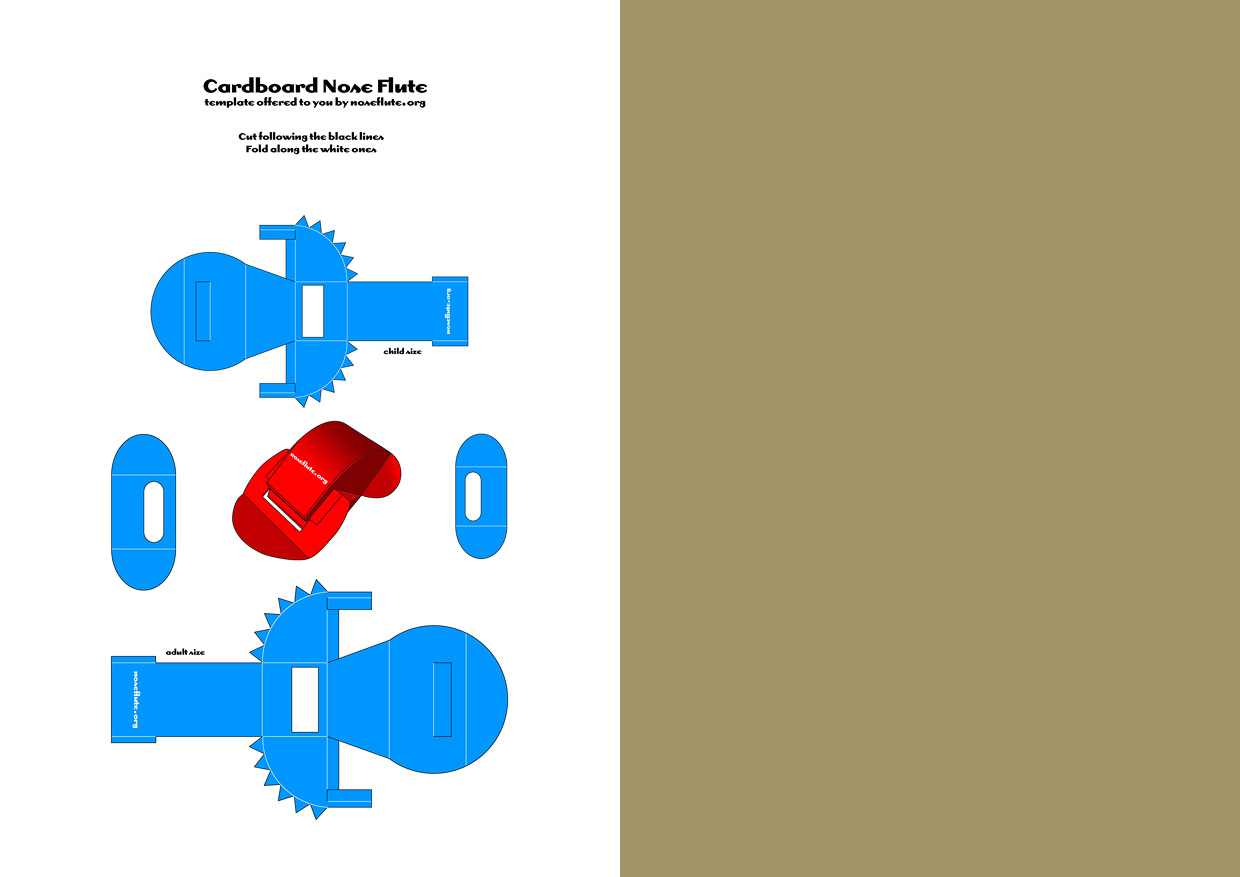
I've been asked to provide the "new" template. Here it is. Click on it to get it full size, save it, and print it on a A4 format cardboard (200g/m2 minimum). The assembling manual is here.
Libellés :
cardboard,
drawings and paintings,
Fix and build,
France,
home made,
templates
Oct 17, 2011
Nose flute workshop debriefing - part 3
I made a video during the workshop. It is a bit long (12 mn) but gives a real idea of what it was. Big thanks to Fräulein Birdy K. for having allowed us to use some of her WIP recordings as soundtrack.
Oct 16, 2011
Nose flute workshop debriefing - part 2
An excerpt of the local newspaper, with some lines dedicated to the workshop : reading the article, we could believe that I am the inventor of all nose flutes in the world. Hmm. Rather confusing...
Nose flute workshop debriefing - part 1
My nose flute workshop at the Architecture school of Nancy (France) was a great success! Yesterday, between 10AM and 17PM, 200 cardboard nose flutes (100 adult size + 100 children size) were built from the templates by the visitors (mostly) and my assitants. Parallely, we taught all the visitors how to play them (almost everybody succeded). Great fun!
Here are some pictures of the workshop :
(click here for a bigger size)
Here are some pictures of the workshop :
(click here for a bigger size)
Oct 15, 2011
Video : incredible bird forgery !
A short video with, at its beginning, great birds sound effects made with a nose flute...
Oct 14, 2011
Workshop : the second poster
I received the templates printed front and back : quality printing on thick cardboard! And I mounted one nose flute of each color. Then sprayed some varnish. Here is the result, perfect whistling cardboard nose flutes :
Thus, I was able to complete the second poster for my workshop, the assembling instructions :
And here the 2 posters together :
Thus, I was able to complete the second poster for my workshop, the assembling instructions :
And here the 2 posters together :
Oct 13, 2011
Bullwinkle's Hum-a-Tune and Humanatone
I found some vintage plastic nose flutes, dating to 1969. They were sold with the brand "Bullwinkle's Hum-a-Tune" for 29 cents, and made by Larami Corp.
The printed credits are : © P.A.T. WARD MCMLXIX (the Bullwinkle character creator) and ITEM NO 2820 LARAMI CORP .. PHILA. PA. 19107 PARTS MARKED WITH COUNTRY OF ORIGIN HONG KONG.
Bullwinkle J. Moose was a rather stupid moose, character of the 1959-1964 TV series Rocky and Bullwinkle, produced by Jay Ward and Bill Scott. Many by-products were issued, including comics, plastic figurines and toys.
Larami Corp. was founded in 1947 and was a toy company whose products ranged from 39 to 99 cents. They were rack toys, doomed to convenience stores and grocery stores. Let's say cheap and crappy toys...
I already have a Hum-a-tune, with no particular branding, that I showed here. The regular Hum-a-Tune and the Bullwinkle's are strictly the same products.
The only exception, apart of the packaging, is the quality of plastics (the regular one is made in a softer and opaque plastic material). The Bullwinkle's is rather translucent.
Now, let's compare the Bullwinkle's to a modern Humanatone ...
First, the plastic material is absolutely not the same. On a blog, it is difficult to make feel the difference, but you can figure it with these little sound samples : the first sound is a Humanatone that I dropped on my desk, and the second the Bullwinkle's dropped the same way :
The printed credits are : © P.A.T. WARD MCMLXIX (the Bullwinkle character creator) and ITEM NO 2820 LARAMI CORP .. PHILA. PA. 19107 PARTS MARKED WITH COUNTRY OF ORIGIN HONG KONG.
![]() | ![]() |
Larami Corp. was founded in 1947 and was a toy company whose products ranged from 39 to 99 cents. They were rack toys, doomed to convenience stores and grocery stores. Let's say cheap and crappy toys...
I already have a Hum-a-tune, with no particular branding, that I showed here. The regular Hum-a-Tune and the Bullwinkle's are strictly the same products.
The only exception, apart of the packaging, is the quality of plastics (the regular one is made in a softer and opaque plastic material). The Bullwinkle's is rather translucent.
Now, let's compare the Bullwinkle's to a modern Humanatone ...
First, the plastic material is absolutely not the same. On a blog, it is difficult to make feel the difference, but you can figure it with these little sound samples : the first sound is a Humanatone that I dropped on my desk, and the second the Bullwinkle's dropped the same way :
Libellés :
China,
Fred Gretsch Mfg Co.,
history,
Hong Kong,
Hum-a-tune,
Humanatone,
Larami Corp.,
packaging,
plastics,
prices,
Trophy Music Co.,
United States of A.,
user manuals
Oct 12, 2011
Free music : The Nempnett Thrubwell band
The Nempnett Thrubwell Noseflute Band is real. Well, Nempnett Thrubwell is a real village of 189 citizens located in Somerset, England. "They" also have a MySpace page on which you can listen to 4 pieces for music, highly nosefluted. And on this page, is told the history of the band. Is it for real ?
« There has been a nose flute band in Nempnett Thrubwell since 1943, when, during the war, 2 soldiers from the Peruvian National Guard were stationed in the village and passed on their skills to the bands founder member, Norman "Nosey" Cutler. Since then the band has experienced many highs, including a 1959 royal Variety performance, and a brief period in the late 1980s when former Bristol City manager and Escape to Victory star Russell Osman was a regular on the tenor flute. Those were happy days indeed, and the band acquired some high profile celebrity supporters, including former boxer and soul legend, Terence Trent D'arby. In fact, Mr D'arby was such a fan that he paid for the redecorating of the practice room in the village hall, and he often invited the band to play at his summer barbeques. Fortunes dipped somewhat for the band in the mid 1990s, until, for a period of about 3 years, the band only had one regular member - myself (Silas Burns secretary). To be honest, I was rather overindulging in cider and local cheese at the time, and my policy of only playing early Pink Floyd tunes and 14th century madrigals was probably keeping membership down. Thankfully it is cider only for me these days, and the band has recently gone from strength to strength. Nosey Cutlers great grandson Daz has recently joined up, and he brings a wealth of current pop knowledge to the mix, having narrowly failed an audition for the boy band Five on account of his hair being too ginger. Percussionist, Dave "Pieman" Plimsole is also a highly experienced performer who once used to regularly tour with a number of acclaimed pop bands (including The Joe Boxers!) until he broke both his legs in a cow tipping prank that back fired. We hope you enjoy our selection of popular melodies. For us, nosefluting is more than just making wonderful music, it is a way of life. As Noddy Holder of Slade once said: Come on, feel the nose! »
I personally recommend you those 2 songs : Song 2 and Senorita
Link : The Nempnett Thrubwell Noseflute Band page.
Libellés :
bands and musicians,
CDs and mp3s,
Great Britain
Oct 10, 2011
workshop : the first poster
I completed the first of two big size posters, to be stuck on the wall in my workshop. It firstly tells a (very short) history of nose flutes, then how to play them and how they work. Well, sorry, it's in french :)
Oct 9, 2011
Protect and cure your wooden nose flutes
You wouldn't like your wooden nose flutes to dry in the time, and have some slits appearing in the assemblings. Nor would you like them to become grey with repeted handlings. The best way is to protect them from crud and feed the wood to keep it up at its best.
For this, I use Lemon Oil (in fact : lemontree oil). It is primarily dedicated to the maintenance of guitars and other neck instruments fretboards, and can be bought in any music instrument shop.
One may use other oils, but some become rancid with time (olive oil for instance). More, the lemon oil lets a nice soft lemon aroma on your flute.
The operations are quite simple : cover the nose flute with a generous coat of oil wherever you can, wipe the excess with a paper towel, and use this excess to access the places and crannies that weren't accessible with the oil bottle cotton pad. Then, let the wood absorb the oil during several hours. Done for 6 months!
Warning : some woods may darken a little bit with this treatment, others don't.
Here with a Heinrich Handler's nose flute :
For this, I use Lemon Oil (in fact : lemontree oil). It is primarily dedicated to the maintenance of guitars and other neck instruments fretboards, and can be bought in any music instrument shop.
One may use other oils, but some become rancid with time (olive oil for instance). More, the lemon oil lets a nice soft lemon aroma on your flute.
The operations are quite simple : cover the nose flute with a generous coat of oil wherever you can, wipe the excess with a paper towel, and use this excess to access the places and crannies that weren't accessible with the oil bottle cotton pad. Then, let the wood absorb the oil during several hours. Done for 6 months!
Warning : some woods may darken a little bit with this treatment, others don't.
Here with a Heinrich Handler's nose flute :
Oct 8, 2011
Video : Sanshin and Hanabue !
Too short video ... we would have loved to have more. For non Japanese people : the instrument is a sanshin, precursor of the shamisen, and played in the Okinawa region. I personally love the music by Noborikawa Seijin, well known singer and sanshin player.
Oct 7, 2011
Cardboard workshop again...
Yesterday, a (very good) friend of mine, who is a professional printer, proposed me to print my templates on cardboard, for... free. And today, he told me they were already printed ! Done on a heavy cardboard (300g/m2), and on both sides... So, since after folding, some parts are stuck reverse-side on the front side, the flutes will be two colored. I should receive the printings in the middle of next week. To be continued...
Oct 6, 2011
Workshop : "La Folle Journée de l'Architecture"
Each year, in the School of Architecture where I teach, we organize a special day with many workshops called "La Folle Journée de l'Architecture" which means "The Crazy Architecture Day"), and invite the public to come and produce lots of things. This year I've proposed to lead a nose flute workshop, in which everybody will receive a cardboard template, tools and advices, to build a functional nose flute.
Then, I will teach how to play, and we all will try to play a song all together ...
If you are in the neighborhood of Nancy (Lorraine region, France), please come and visit us!
Then, I will teach how to play, and we all will try to play a song all together ...
If you are in the neighborhood of Nancy (Lorraine region, France), please come and visit us!
Oct 4, 2011
Video : Carl Maria von Weber
Waltz from Preciosa, by Carl Maria von Weber, played by with a wooden nose flute and a keyboard, by two austrian musicians : Ukulele4Aukekulia.
Please note how the vibrato is produced.
Libellés :
Austria,
bands and musicians,
vibrato and tremolo,
wood
Oct 3, 2011
Carl J. Aarlaht : an Estonian-Canadian nose flute
Carl Johannes Aarlaht was born in Vaivara, Estonia on 5th of May, 1924 (†04/25/1989). He emigrated to Canada and settled down in Hamilton. He was a Master Scout, member of the Estonian Society of Friends of Scout Canada (Hamiltoni Eesti Skaudisõprade Selts) and decorated of the Northern Star.
Carl J. Aarlaht registered two patents. The first one, in 1958 (US2989719), was for « Convertible Attachment Plugs » and was referenced later by numerous patents regarding similar devices.
The second one, of a better interest for us, is a nose flute. The patent (CA684140) for a « Musical Whistle » was registered on 14th of April, 1964.
« Generally the present invention consists of a simple musical instrument of the wind type which may be simply made of flat material such as metal, plastic material or the like. »
Apart of a nice angular shape design, the nose flute offers no innovation in comparison to old metal Humanatones. The only difference regards the lip rest, which is surprinsingly under the mouth hole, thus providing a rest to the lower lip.
Carl J. Aarlaht registered two patents. The first one, in 1958 (US2989719), was for « Convertible Attachment Plugs » and was referenced later by numerous patents regarding similar devices.
The second one, of a better interest for us, is a nose flute. The patent (CA684140) for a « Musical Whistle » was registered on 14th of April, 1964.
« Generally the present invention consists of a simple musical instrument of the wind type which may be simply made of flat material such as metal, plastic material or the like. »
Apart of a nice angular shape design, the nose flute offers no innovation in comparison to old metal Humanatones. The only difference regards the lip rest, which is surprinsingly under the mouth hole, thus providing a rest to the lower lip.
Oct 2, 2011
Review : a Hungarian wooden nose flute
I ordered a hungarian nose flute ("orrfuvola") from Béres kézmúves Mühely (Béres handicraft workshop). Attila Béres produces lots of wooden items since 1995 : kitchenware, furniture, buckskin shirts, soaps, massage accessories, wooden toys, elements of decoration, and ... musical instruments.
And among the instruments : Agogos, bird whistles, castagnets, drums, flappers, Guiro, kalimbas, maracas, nut rumblers, rakataks, shakers, sistrums, tambourines, shekere, and... nose flutes.
« I founded my family enterprise in 1995. The direction of my activity came natural to me as I had played percussion and loved working with wood. Our musical instruments can be easily used in musical education and music therapy and they are popular among professional musicians as well. We make not only basic percussion instruments but widen the scale with several egzotic pieces, too. We think it is our responsibility what relationship the generation just growing up has to nature and to traditional values. Our instruments and other handicraft products are made of natural materials as wood, fruits, seeds, reed, leather, brass, coconut and so on. During procedures we use old handicraft techniques. All our products are qualified by the Hungarian Department of Fine Arts. We hope we can greet you soon as a satisfied customer. »
So, I received a nose flute I paid 8 euros, hand-made, in wood. And I was rather dispointed, because of the low quality of fabrication.
The labium is a mess, the details are not clean, there is long slit between the body and the air duct cap, glue smears ...
Each flute is stamped with Mr. Béres logo :
Well it works, and it's a easy-player instrument. But because of a so unclean labium, the sound is very dull, without a good definition...
Here are some sound samples to compare with hi-class wooden nose flutes providing a clean sound (well separated harmonics) :
Attila Béres' nose flute :
And among the instruments : Agogos, bird whistles, castagnets, drums, flappers, Guiro, kalimbas, maracas, nut rumblers, rakataks, shakers, sistrums, tambourines, shekere, and... nose flutes.
« I founded my family enterprise in 1995. The direction of my activity came natural to me as I had played percussion and loved working with wood. Our musical instruments can be easily used in musical education and music therapy and they are popular among professional musicians as well. We make not only basic percussion instruments but widen the scale with several egzotic pieces, too. We think it is our responsibility what relationship the generation just growing up has to nature and to traditional values. Our instruments and other handicraft products are made of natural materials as wood, fruits, seeds, reed, leather, brass, coconut and so on. During procedures we use old handicraft techniques. All our products are qualified by the Hungarian Department of Fine Arts. We hope we can greet you soon as a satisfied customer. »
So, I received a nose flute I paid 8 euros, hand-made, in wood. And I was rather dispointed, because of the low quality of fabrication.
The labium is a mess, the details are not clean, there is long slit between the body and the air duct cap, glue smears ...
![]() | ![]() |
![]() | ![]() |
Each flute is stamped with Mr. Béres logo :
Well it works, and it's a easy-player instrument. But because of a so unclean labium, the sound is very dull, without a good definition...
Here are some sound samples to compare with hi-class wooden nose flutes providing a clean sound (well separated harmonics) :
Attila Béres' nose flute :
Subscribe to:
Posts (Atom)