This blog is dedicated to the sublime instruments called nose flutes and which produce the most divine sound ever. We have chosen to discard all the native models from S. Pacific and Asia, for they need fingering to be played. We'll concentrate on "buccal cavity driven" nose flutes : the well patented and trademarked metal or plastic ones, plus, by a condemnable indulgence, some wooden craft or home-made productions.

Nov 6, 2017

The Idler No.57 is available! With nose flute!


Our article, written in a pleasant collaboration with the uke master and nose flute enthusiast Will Grove-White, has just been published in the londonian prestigious dandy magazine The Idler, by Tom Hodgkinson. Our paper is a 11 pages presentation and history of the nose flute, with full pages pictures.


Obviously, I can't publish scans of the full paper. Anyway, you can order the Idler issue here (the 1st impression is out of stock, but copies will be back in one week).

However, by courtesy of Will Grove-White, here is the content in plain text (better for automatic translation):


ESSAY
Honkin' with your hoooter

The nose flute is not an instrument to be sniffed at, say Will Grove-White and Antoine Carolus


Over the years, many strange musical instruments have come and gone, discarded at the altar of long-established instruments like violins, pianos and trumpets. How quickly we look down our noses at newer, ‘novelty’ instruments and write them off as low-brow. But it would do us all good to reach beyond our comfort zones and embrace the unusual, the unsightly, the unpluckable. As the quote attributed to Henry Ford reminds us, “If you always do what you’ve always done, you’ll always get what you always got.”

So perhaps it is time to reconsider one of the most popular and yet most despised instruments of all time – the nose flute.

When it was launched into Western music at the turn of the 20th century, nose flute fever swept across America, Europe and the Far East. In 1920s America the instrument was heralded as “the most wonderful musical instrument ever invented” by the New York Times and went on to be championed by jazz musicians and vaudeville performers. To its shame Britain has never really embraced the nose flute in the way that other countries have – even today, most music shops in Germany still carry a good stock of nose flutes. It’s estimated that over 100 million instruments have so far been manufactured worldwide.

After the initial nose flute craze, the instrument’s mainstream popularity waned but more recently there’s been a huge resurgence in sales. In music shops from Japan to America nose flutes have been once again on the march, spreading like a heavy head cold into our lives. Nose flute ensembles and orchestras have cropped up all over the world, notably in Germany (Der Grindchor: Das Original Oberkreuzberger Nasenflötenorchester) and across Japan, where there are even ‘official’ and regional nose flute organisations. The largest of these is the Hanshin Hanabue Association who annually perform a massed nose flute rendition of Beethoven’s 9th.

The nose flute is an ingenious little instrument that is played with, of course, the nose. But it’s not a flute that you blow through your nostril (that’s a different type of instrument played mostly in the South-Pacific). Rather, it is a simple device, usually made from plastic but sometimes from metal, wood, clay or even cardboard which covers the nostrils and mouth to produce a delightful flute-like sound. Any tune in the world can be played on a nose flute, and it can be mastered in a matter of minutes. The player simply exhales through his nose and produces the notes by changing the shape of his open mouth (rather like whistling). The instrument can be either held in the hand against the face, or, if one is accompanying oneself on a guitar or ukulele, fastened with elastic around the head. A skilled player with a good nose flute can get a range of almost three octaves and it is certainly a joyful instrument: it makes people happy when you play a nose flute, and if it doesn’t, it makes them happy when you stop playing it. You can’t lose with a nose flute.

But if nose flutes are the easiest instruments in the world to learn to play, why don’t we see them everywhere? This is a difficult question to answer, given the massive success of the kazoo. Some cold-hearted people have declared that the instrument is unhygienic (in fact our noses are cleaner than our mouths) and that it makes the player look like an idiot Hannibal Lecter (hard to argue with this one), so perhaps it does have something of an image problem. But given time, and an army of bizarre-looking disciples, perhaps one day it will be held in the same high esteem as the ukulele and the Swanee whistle.

The unconventional look of the nose flute should not deter the novice player. He is in excellent company. Over the years, artists, musicians and poets have thrilled to its timbre and proved that the nose flute is not an instrument to be sniffed at.

The Godfather of the nose flute was probably the amazing Lloyd Buford Threlkeld (aka ‘Whistler’), a guitarist and singer in the early 1900s from Kentucky. Threlkeld’s big break came once he played the nose flute with Whistler and His Jug Band, the first pre-war jug band ever to be recorded on film. A master of the instrument, he proves that in the right hands the nose flute can sound as beautiful as a nightingale. You can listen to his mesmeric blowing on YouTube (Low Down Blues and Jug Band Special, both from 1927).

Across the Pacific, the nose flute would make an altogether different debut: in an opera. In 1923, Ezra Pound opened his one-act opera Le Testament de Villon with the nose flute. Perhaps unfortunately for the audience, Pound was tone deaf - the poet William Carlos Williams wrote “he knows nothing of music...”, following this with the curious statement, “That’s what makes him a musician.” After seeing the opera, composer Virgil Thomson wrote: “The music was not quite a musician's music, though it may well be the finest poet's music since Thomas Campion... Its sound has remained in my memory.” Not exactly a rave review but nevertheless Pound's Le Testament is the first and only known opera to include a nose flute.


In the right nostrils, the nose flute can sound as beautiful as a nightingale

Artists, too, have warmly embraced the honker hooter. The legendary painter, sculptor and Pataphysician Jean Dubuffet was an avid nose flautist. The inventor of Art Brut (Raw Art), he recorded a series of albums of experimental music (or ‘bald music’, as he referred to it) using the nose flute and other unusual instruments, which suited his surrealist sensibilities down to the ground.

But of course it was musicians who fought hardest to keep the nose flute torch burning. It is rumoured among Elvis Presley aficionados that the King of Rock ‘n’ Roll had plastic surgery on his nose in 1956, and this may go some way to explaining the mysterious appearance of a nose flute tootling away during his song Barefoot Ballad which he performed in one of his less memorable movies, Kissin’ Cousins. Sadly Presley didn’t get to blow the nose flute on the track; Elvis historians conclude it was played by legendary saxophonist Boots Randolph, the man who wrote and played the Benny Hill TV theme tune, Yakety Sax.

A more likely candidate for a star player was Leonard Cohen who used the nose flute on his second album, Songs From a Room, on the track Tonight Will Be Fine. It certainly is a ‘loose’ performance, very probably by Cohen himself - a lifetime outsider thumbing his nose at musical conventions by playing an unfairly marginalised instrument.

It’s also worth noting that the nose flute has become a popular shepherding tool among some farmers. Recently in Ireland, sheepdog trials champion Tim Flood used a nose flute in place of traditional whistling. He appeared on One Man and His Dog singing the praises of the nose flute and performed a short Irish reel for the audience.

So where did it all begin? Who are we to credit with the invention of this ugly/charming (delete as appropriate) instrument?

Like so many instruments, the nose flute’s precise origins are unclear. The first nose flutes were probably produced in South America; in Paraguay by the native Guarani people and in Brazil by the Pataxós. After returning from Brazil in 1817, Prince Maximilian of Wied-Neuwied wrote in his book, Reise Nach Brasilien, that “frequently, these savages [the Pataxós] imitated the voices of owls, capoeira and other birds” and ethnomusicologists like Randy Raine-Reusch confirm that this mimicry was achieved using nose flutes: when the conquistadors arrived in the Americas in the 16th century they would have found the natives using their wooden nose flutes to imitate birds and modern videos show the Pataxós still do so to this day.

But in the West, the nose flute was quite separately invented and patented by a poor Irish immigrant to America, tinsmith William Carter, who settled in Albion, New York. Whether he had encountered a South American flute is unknown, but it seems unlikely. He christened his invention “The Nasalette”. Carter patented his nose flute in 1891 but he soon sold the rights to a shady New York piano salesman and inventor called Garrett J. Couchois, a wheeler-dealer who would eventually end up in jail for infringement of copyright and blackmail.

It’s hard to determine, but it seems Couchois had become so obsessed with Carter’s nose flute that he had bought the patent for a good deal of money. Couchois would go on to launch the first commercial nose flute at a world fair - The World’s Columbian Exposition, in Chicago in 1893. He named it the “Humanatone”. Couchois enjoyed great success with this device, selling 40,000 at the 1901 Pan-American Exposition alone. He went on to design new versions including a spaceship-style nose flute and another called “The Magic Flute”.

In 1903, sensing the business potential of the instrument, a family of novelty-makers, the Stivers, bought the rights to both Carter’s and Couchois' patents, and registered the trademark “Humanatone”. It was, they promised, “The Wonder of the Musical World” and under the shrewd direction of George Stivers and his sons the nose flute enjoyed an incredible surge in popularity, most notably between about 1925 and 1935. Jazz musicians and jug bands gleefully embraced the new instrument and it became a highlight with vaudeville stars and comic song shows of the era. One of these was Syd Shipman and his Humanatone Orchestra, who toured America and Europe and regularly got rave reviews in Billboard Magazine: “To say they did big would be superfluous - just say it was one of Syd's regular successes, and you've got it... Say, boys, they can whistle!”

Its popularity in America meant that versions of the Humanatone rapidly spread across the globe - to the UK (as the Humanaphone), Germany (Wunderflöte), France (Ocariflute), Austria (Austopfon) and Belgium (Vociphone). From Holland it was exported to Bali and the Dutch colonies, as well as to Australia and New Zealand, where it was sold by Albert & Son as The Magic Flute. Regrettably the advent of World War Two forced the Stivers to stop production of tin nose flutes because of metal shortages but fortunately for us, polystyrene plastics arrived just in time to save the nose flute.

In 1943, the hard-nosed businessman Fred Gretsch (of the Gretsch guitar company) bought the Humanatone brand from the Stivers, and relaunched the nose flute in a plastic-injected design by Illinoian Ernest Davis. They were lighter and, crucially, cheap. The plastic nose flutes enjoyed a new popular revival partly because soldiers were able to take one with them to war (along with their ocarinas and mouth-harps). Gretsch even made a special edition of the plastic Humanatone in a box with a printed area in which to write the soldier’s address.

After World War Two the nose flute continued its ascendancy. In 1955, the German instrument manufacturers Weidlich & Lohse launched a plastic model which is still produced to this day in China, where it’s manufactured in its millions. The plastic Humanatone has also been massively copied (also in China as no-name spin-off models) and a variety of other plastic models were produced in the USA, Germany, Sweden and the Basque country.

Millions of these plastic Humanatones are still sold around the world but more recently a growing number of independent companies and artisans have begun to make different types of nose flute from wood, clay, cardboard, bamboo and even chocolate. With modern nose flutes now also being produced in such unlikely places as South Africa, Vietnam, Israel, Hungary, Thailand and Brazil they have become a global phenomenon.

So perhaps it’s time to get your hands on one yourself and become part of the olfactory musical revolution. In a time of too much puffed-up self importance the nose flute is guaranteed to stop you taking yourself too seriously and bring you down to earth – the more people who are willing to toot a jolly tune whilst looking like Jason from Friday the 13th the better for all of us. And it is also unexpectedly good for you– studies show that breathing though your nose leads to a longer life and a healthier body.

An excellent modern brand of nose flute is the Bocarina nose flute (available online) although there are many different varieties to experiment with. The only thing left is to consider which tunes to play. Colonel Bogey might be worth a try, or perhaps God Only Nose by the Beach Boys - just make sure you have a box of tissues ready if you ever attempt The Weather Girls’ 1982 hit, It’s Raining Phlegm.

                                                                                                             W.G.-W. & A. C.

Oct 28, 2017

Much more about William Carter - Part II

In 2012, we published all what was available to us about the nose flute inventor William Carter's life from his arrival in Lockport (NY) at the age of 5, to his death in Rochester (NY) in 1919 (here, there and there). We also made a replica of his « Nasalette » (see here, there and there).

We have nothing to retract from those pages, except one mistake: Carter's settling year in Albion (NY). Deceived by a homonym in a census sheet, we stated that William Carter made a step in Lewinston (NY) and settled in Albion around 1880. Wrong! We have discovered that Carter went to Albion as soon as 1871 or 1872. But we also have discovered much, much, much more about him.

Indeed, on one hand we found a new source of newspapers – the impressive Jim Fulton's archives – and notably the copies of
The Orleans Republican, daily newspaper published in Albion, in which many details were found. On the other one, we had the great luck to received the generous and enthousiastic help of Mr. Matthew Ballard, Historian of the Orleans County Department of History. All our warmest gratitude and kind regards go to him.


---

Much more about William Carter

Part II: William Carter in Albion

As said earlier, we have nothing to change or add to the William Carter's biography before and after his life in Albion, NY, except that he never lived in Lewinston, but went directly from Lockport to Albion in the Orleans county, in 1871 or 1872.

In a few words (for more details please check here): William Carter was born in Ireland in 1846 and immigrated to the USA in 1851 with his mother Catlaine. They first settled in Lockport, where William learned tinsmithing (very likely with/from his brother James). In 1871 or 1872, William departed from Albion, while Catlaine left for Rochester. James stayed in Lockport to build his career.

---

1. - Settling in Albion

After the American Civil War (1861-1865), Albion is a ±3,000 inhabitants city, in full expansion (the population grew of 50% between 1850 and 1870) and it is not surprising that the city is very attractive for immigrants. There is already a nice Irish and Polish community (both catholics).

We know by the census sheet that William Carter is still living in Lockport in 1870. He lives alone in a boarding house and is mentioned as a tinsmith:


But in 1872, he appears as a « young man of Albion », favoring the ticket Greeley/Brown (Liberal-Republicans unsuccessful candidates at 1872 US Presidency elections).

The Orleans Republican, July 24, 1872:


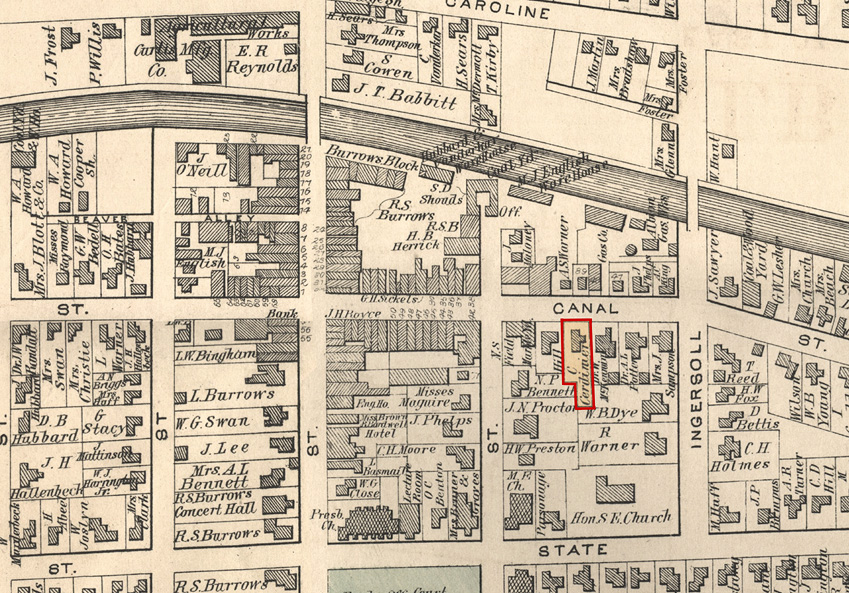
So, William Carter installed in Albion in 1871 or 1872. I don't know where he was living then, but in 1875 is boarder at Mrs Gordinier, at 35 East Bank st.


Cornelius Gordinier is a grocer, and his wife is the tenant of a boarding house, where agents (more or less cockeyed) make demonstration and sales.


Here is the house on the 1875 map (with a typo: "Cerdinier" instead of "Gordinier"):


2. - Tinsmith.

The first mention of William Carter's as a tinsmith in Albion doesn't include his name...

The Orleans Republican, Sep. 4, 1878:


But he is tinsmith for real, as specified in the 1880 census Sheet:


At this time, as we can read in the census, William is boarder at Luke Taylor's hotel. This hotel was the Orleans House, a beautiful and large building located East Bank, at the southwest corner of East Bank and Platt streets, facing the Village Hall (where is located the Fire Dept, as we'll see later).

Pictures below, by courtesy of Mr. M. Ballard, and the Orleans County Department of History

Inside, in 1920:
In 1884, William is appointed Town Scaler, and this make us think of his brother who was nominated at the same charge in 1867. This also means that William is recognized as a truthful and liable citizen.

The Orleans Republican, Jan. 23, 1884:


In April, William won a pair of roller skates (!) at the saloon of the Hotel McMann. Does it mean that he moved from Orleans House after Luke Taylor's death in 1883 ? I don't know, but probably not and was only a consumer, as the Orleans House was still open.

The Orleans Republican, Apr. 16, 1884:


More interesting is the long article published the same month about George Waterman hardware business (at 48-50 Main st.), in which « the jolly tinkers » William Carter and Frank Shears are employed. I don't know when William began to work at Geo. Waterman but he stayed there for a long time.

Excerpt and full article of The Orleans Republican, Apr. 30, 1884:


We learn here that Carter works on tin roofs as well as for general hardware, together with Frank Shears. Indeed, in 1885, William is mentioned for his craftsmanship on the shaping of an iron tank:

The Orleans Republican, May 27, 1884:


3. - Other activities

Another activity that probably helped William Carter to normalize in the Albion society was his membership at the Independent Order of Odd Fellows. The I.O.O.F was (still is) a fraternal order assembled in lodges, who aims to « improve and elevate the character of mankind by promoting the principles of friendship, love, truth, faith, hope, charity and universal justice ».

The first trace of William as member of the I.O.O.F. dates of 1882, and relates to a dedication ceremony. Carter is in the reception committee. Six years later, William is part of the band, and this is the first notice of him we know as a musician. The next year, he has been promoted 1st W(arden ?).

The Orleans Republican, May 2, 1888 and Jan. 30, 1889:


The Albion I.O.O.F. lodge around 1910 (The Carters had left for Rochester in 1909):


4. - Young America Hook & Ladder Co.

The same year, William is appointed member of the Hook and Ladder Company, showing his will of integration in the local community (remember also that James, his brother, was member of the Protective Hook and Ladder Co. in Lockport).

The Young America Hook and Ladder Company No.1 was founded in Albion in 1842. Equipped with a hand-drawn truck carrying ladders and hooks, the men — the hooks or laddies – are in charge of rescuing people in case of fire. And it is not just a hobby, as the fires are frequent in the wooden barns and houses.

The Orleans Republican, May 19, 1875 and a Hook & Ladder truck:


Reliable and ambitious, William will get more and more responsabilities in the YAH&L Co.

In 1877, he participates the organization of the firemen Thanksgiving party…

The Orleans Republican, Sept. 12 and Oct. 10, 1877:


… and at the end of the year, he's elected Assistant Foreman and treats the company with the customary oyster supper. The following years, William becomes First Assistant:

The Orleans Republican, Dec. 12, 1877 and Sep. 4, 1878:


And it is the same in the next years, commitment and recognition.

The Orleans Republican, May 21, 1879:


The Orleans Republican, May 11, 1881:


In January 1882, a great fire destroyed a whole block in north Main street (check Matt Ballard's article on the topic). Many buildings and goods where destroyed (including Geo. Waterman's store), and firemen wounded. There is no doubt Carter was at work then, but is not quoted among the wounded men.

The Orleans Republican, Jan 18, 1882:


Photos by courtesy of Mr. M. Ballard, and the Orleans County Department of History


I don't know exactly how long the Waterman's store was closed, but there is already advertisement for it in the newspaper at the end of March. Was William Carter already working for Geo. Waterman at the time of the fire ?

Anyway, Mr. Waterman launched the construction of a new building in 1883:


The new Waterman's building is one of the two places possible where the nose flute has been invented. The building burnt again in the 1980 and there had been a little "Waterman Park" in Albion then. I found also a picture of the 1950's, on which the building is still visible.

The Waterman store. Photo by courtesy of Mr. M. Ballard, and the Orleans County Department of History


What time does this photo date of ? It should be after 1890, since we can distinguish electric lines in the reflections of the windows and insulators on the wall. (1890 was the year of the electric city light installation). We can also see some tin hardware in the store windows.

Electric ware:


Tin ware:


The building in the 1950's (just in the middle of the photo), and the current square:


---

The most thrilling documents Mr. M. Ballard sent us are two pictures of fire departments...

Matt Ballard wrote : « I have two photographs of fire departments, one of the Young America Hook & Ladder which likely has Carter in the image (unfortunately the names are not listed). I also have a smaller image of a fire company that lists “Billy Carter” as one of the men. I found a typed list of names from a photograph of Warner Chemical Company No. 4 with William Carter listed, unfortunately I have not been able to locate the image as of now. »

In a later mail, with the pictures in attachment: « The photo (…) shows 21 men and two boys, but contains the names of 20 men. Unfortunately all of the men I can confirm are standing on the left and nothing to confirm Bill Carter's placement in the photograph. I am going to say that the man second from the right is marked as "Billy Carter" as the man to the far right is not visible enough and the person who labeled the photograph skipped the two boys standing with the banner (Carter is labeled as #20 but there are 21 men standing). »

The Firemen, East Bank St. By courtesy of the Orleans County Department of History


This last hypothesis by Mr. Ballard is very logical and I agree with it. So, we may have here the first known picture of William Carter (the photo was taken in front of the store of the jeweler J. D. Daniels, at the corner of Main and East Bank streets)


The picture is probably earlier than the second one. Carter was a musician, and had been very early elected Assistant Foreman or First Assistant. He has some responsabilities in the company, and the fireman of the photgraph holds a bugle, filled with flowers. The bugles were used to send signals to the company or to open the way when drawing the truck. The men used to fill them with flower for ceremonies or special occasions. So, this bugle fits well with Carter 1st Assistant. The man looks rather young, but it's very difficult to say an age. But there is more...

The other picture shows the Young America Hook and Ladder Co., at an uncertain date.

The Y.A.H.& L.Co. By courtesy of Mr. M. Ballard, and the Orleans County Department of History


Matt Ballard wrote: « The other fire department photo is the Hook & Ladder company. Based on when the photograph was taken, I think Will Carter is in the photograph. The photo of the fire department standing on E. Bank Street near N. Main Street shows William Carter with a bugle, so I'd say that the man sitting in the front third from the right looks similar to the man in the other photo, but I cannot be certain. »

Bingo! Indeed, the man sitting 3rd from right is one of the two holding a bugle. The center one is undoubtedly the Foreman/President. The two firemen behind him have placed a hand on his shoulders, as a sign of confidence and subordination. The man on the right has also one hand on the shoulder. He is rather self confident, showing some « man spreading », with the legs opened and the right foot thrown forward. He is the First Assistant, with no doubt.

We can be almost sure that we have here a beautiful picture of William Carter, inventor of our beloved instrument! This is a great day for NoseFlute.Org, a great achievement, thanks to Matt Ballard!


Still any doubts? Just take a look at the ressemblance of the two brothers, William and his big bro James:


Now, Is it possible to date this picture? The picture has been taken on the "Platt street side" of the Village Hall, at the NW corner of East Bank (formely Canal street) and Platt st (just facing the Orleans House where Carter was boarder). The building has been inaugurated in 1874 and still exists, without its tower however.


William Carter became Assistant Foreman in 1877, and 1st Assistant (same job?) in 1878. So, it fits with the dates of the building. More, the man on the picture looks around 35 years old. Carter was this age in 1880-81. I guess the picture was taken around those years, more or less 1880-82.

The livery might have helped us a bit more, since this model of fireman's hat was patented in 1882. But it was filed no less that 10 years before, in 1862, and we know that products were put on the market from their filing date, with the mention "Patent pending".


Regarding the hat topic, please notice that whether almost all men have a helmet with the initials AFD on the forehead (Albion Fire Department, I guess), only five among them – including Bill Carter – show another mention. I'm not able to formally indentify the writing, but it might allude to Canal street, where was located the Fire Dept. It looks like « CANAL C… ». Could it mean Canal Company or Canal Commandment ? What would it mean ?


>> Access Part III


---

-----

On the same topic :

- Much more about William Carter - Part I
- Much more about William Carter - Part II
- Much more about William Carter - Part III

- Nose Flute Pioneers: William G. Carter - Part I
- Nose Flute Pioneers: William G. Carter - Part II
- Nose Flute Pioneers: William G. Carter - Part III

- Historic Nose Flutes - The Nasalette: Template
- Historic Nose Flutes - The Nasalette: Building
- Historic Nose Flutes - The Nasalette: Review

-----

Oct 21, 2017

Much more about William Carter - Part I

In 2012, we published all what was available to us about the nose flute inventor William Carter's life from his arrival in Lockport (NY) at the age of 5, to his death in Rochester (NY) in 1919 (here, there and there). We also made a replica of his « Nasalette » (see here, there and there).

We have nothing to retract from those pages, except one mistake: Carter's settling year in Albion (NY). Deceived by a homonym in a census sheet, we stated that William Carter made a step in Lewinston (NY) and settled in Albion around 1880. Wrong! We have discovered that Carter went to Albion as soon as 1871 or 1872. But we also have discovered much, much, much more about him.

Indeed, on one hand we found a new source of newspapers – the impressive Jim Fulton's archives – and notably the copies of
The Orleans Republican, daily newspaper published in Albion, in which many details were found. On the other one, we had the great luck to received the generous and enthousiastic help of Mr. Matthew Ballard, Historian of the Orleans County Department of History. All our warmest gratitude and kind regards go to him.


---

Much more about William Carter

Part I: James Carter (ca1835-1907)

One of the most interesting findings made in The Orleans Repbublican was this little news (1907-04-03):


William Carter had a brother! I wasn't aware of that, since the first archives I found were about William and his mother Catlaine/Catherine only, no other Carter family member. A brother, so what ? The more I found about James, the more explanations arose regarding William choices and feats. That's why it is interesting to look a bit deeper in James' career.

---


1. - Immigration

James H. Carter was born around 1835 in Ireland. Did he emigrate with the same "famine ship" as his mother and brother ? It is difficult to know. I found no record that could fit for 1851 (immigration year of Catlaine and William), but one may exist, but an archive, prior to 1851, that is consistent with James' birth around 1935 (but once again, there may be other ones that I didn't find).

This list of passengers of the St Lawrence dates of 1848, and there is one James carter who is 14 years old, comes from Ireland and is farmer. He embarked in Liverpool and declared intending to go to Canada.


If this is the right record, James have left Ireland first, maybe as a "scout" for his relatives.

Then I found a 1850 census sheet which records a James Carter aged of 15, and occupied as a servant in Mount Pleasant (NY). This is the only record consistent with a birth around 1935 (but I found a 25 y.o. ostler in Lockport (NY))


2. - Tinsmith in Lockport

1860 is the year from which we can begin to state ascertained facts. In 1860, James, but also his mother and his brother all live in Lockport, NY. They just don't live in the same house/district, and this explains why I didn't spot James existence before. Indeed, James, 24, has already got married with Mary (from Ireland too) and is the father of the little Kate, born in 1859 in the New York state.


While Catlaine is washwoman, James is surveyed as a... tinsmith! We know that William settled in Albion (20 mi. further east) around 1872 – at the age of ±26 – and it is very likely that before, William became apprentice and learned the craft besides his brother.

---

The first pieces of archive I found about James are those little newspaper clips of 1860 and 1861, which are interesting because they mention an address:

Lockport Daily Journal, June 4, 1860 and September 12, 1861:


In 1860, Lockport is a city of 10,800 inhabitants, located in the neighbourhood of Buffalo, NY (±15 miles). James Carter lives or works (but probably both, as a tinsmith at home) at 109 Main st. This area is a bit off the center, and not dense. The 109 should be in a very new house because it doesn't appear on the 1857 map, and even not yet on the 1860 one (but #107 has been built then)

1857 Lockport map:
So, James is a "small" tinsmith working on his own, but he did all what he could to get bigger and integrate and participate the city life. In 1862, he produces extension tin cups for the irish soldiers of Capt. Maroney's company:


2. - Development and first Invention

In 1867, it seems that James Carter has acquired some acknowledgement and credibility. He is nominated as Sealer of Weights and Measures for the city.


Two months later, the Lockport Daily Journal reports an invention by J. Carter: a beer pump and cooler!

Lockport Daily Journal, June 18, 1867:


In September, he becomes an agent for the Ne Plus Ultra portable furnace.

Lockport Daily Journal, Sept. 14, 1867, and Sept. 5, 1868:


We learn that James has moved to 101 Main street (the "104" in the second paper is probably a typo), and will keep his store at this address until (at least) 1885. Indeed, James Carter is beginning to grow money. Around 1870, he buys a house at 56 Locust Street, a charming and wealthy residential district of Lockport.


Locust st. in 1917:


Lockport Daily Journal, March 20 and April 17, 1871:


James Carter and his wife lived all the rest of their lives in this house. In a 1908 map (after their death), the name "J. Carter" is still mentioned on the 56 Locust plot.


---

1871 is the period of time when William left Lockport for Albion. James was following his ascension, became member of clubs. He was a fine rifle and won contests, and a fisher — he was member of the Angler's Club – who repopulated creeks with trouts and bass... while Mrs Carter was active in the Lockport branch of the Needlework Guild.


James Carter probably understood that he would really make money with his inventions. But for that, he had to file patents.


3. - Patents, patents, patents.

There were recurrent advertisement by agencies helping to file a patent, and maybe it is through this way that James began.

Ad from the Munn & Co. June 17, 1885:


Between 1876 and 1899, it is no less than 6 patents that James filed and that were registered. Stove-pipe damper (US175663), Combined filter and cooler (US308058), Tinner's fire pot (US336893), Pressure filter (US430797), Ash sifter (US614534) and a nice Luggage carrier (US633281). Among them some had more success than others.


One of the first patents, the Combined filter and cooler (1884) was a great success, that really helped growing James' social and econimical position and status. Carter was making good business, but also began to be regarded as a serious reference in filtering and purifying water.

A small selection of the many articles mentioning Carter's filter/cooler


But it's mainly the 1890 Pressure filter patent that definitely turned James Carter to a successful business man and an expert in water filtering. In 1892, James sold this patent to the Field Force Pump Co., probably for a nice amount of money... In 1897, Frank Farnell bought the entire business of the Carter Filter Co.

Lockport Daily Journal, July 19, 1890:


4. - Wealthy life of a retired businessman

In 1894, James retired from business, and left Lockport for a leisure travel in London (did he visit Ieland too?). He crossed the sea on the magnificent S.S. Paris (formely named "City of Paris"). During the crossing and then, from London, he sent some letters that were published in the Daily Lockport Journal, for our greatest pleasure:

the S.S. Pris, in 1888:

Lockport Daily Journal, July 14, August 4 and 7, 1894:


During the end of the 1890's, the Carter's filters are growing and growing in sales, as James' expertise in water solutions, as member of the Water Board of the city. He entered a long city discussion about filtering the water from the Erie canal in order to feed the city in clean water (I will not publish those numerous and long articles here, but if someone is interested, please drop me a mail).

Now James is retired from direct business, but is the owner of different stores downtown (85 Main and 36 Market st.). He is not a tinsmith anymore, like in 1860 census sheet, nor a Hardware manufacturer, as it was mentioned in the 1870 and 1880 ones... In the 1900 census, his profession is now inventor.


It is at the occasion of a rifle shooting contest that he won, that the Buffalo Evening News published a beautiful portrait of « Uncle Jim », with an article retracing his numerous successes in shooting contests.

The Buffalo Evening News, January 5, 1904:


5. - Demise

On May 30, 1906, James' wife Mary (born Stanlan) passed away.

The Buffalo Evening News, June 1, 1904:


And on 23rd of March, 1907, Uncle Jim followed Mary in heavens. James died from a typhoid fever, in his house of Locust St.


-----


It is a bit strange to publish here a long biography of a man that had *nothing* to do with the nose flute. However, as the big brother of William Carter, this article is supposed to put in the light some facts that are directly linked – according to our own opinion – to William's invention.

First, James was probably the "scout immigrant" for the Carter family in the USA. He settled in Lockport and stayed there for the rest of his life. He became a tinsmith and we can state without any doubt that he taught the craft to William. Then, he was an inventor, patented several of his inventions, and became rich and « best-known » with them. Would it be unreasonable to think that William tried to follow the success of his brother, and that he was looking for creating his own invention, patenting it and selling the patent in order to rise from his low condition ?

I personally think that James was a model for his young brother William, and that many of William's feats can be understood through James' ones.


>> Access Part II

---

-----

On the same topic :

- Much more about William Carter - Part I
- Much more about William Carter - Part II
- Much more about William Carter - Part III

- Nose Flute Pioneers: William G. Carter - Part I
- Nose Flute Pioneers: William G. Carter - Part II
- Nose Flute Pioneers: William G. Carter - Part III

- Historic Nose Flutes - The Nasalette: Template
- Historic Nose Flutes - The Nasalette: Building
- Historic Nose Flutes - The Nasalette: Review

-----