This blog is dedicated to the sublime instruments called nose flutes and which produce the most divine sound ever. We have chosen to discard all the native models from S. Pacific and Asia, for they need fingering to be played. We'll concentrate on "buccal cavity driven" nose flutes : the well patented and trademarked metal or plastic ones, plus, by a condemnable indulgence, some wooden craft or home-made productions.

Jan 26, 2013

Achille Brilhault and the Ocariflûte

Back to the Ocariflute.

As exposed in this post, we learned that this french nose flute was probably launched and patented in 1922-23, and got a silver medal at the famous Concours Lépine in 1923.
It was sold by the "Instruments Brilhault", located 17, boulevard Rochechouart, Paris.

I wanted to know more about the instrument and its inventor. It would have been easy to get a copy of the list of the silver medallists of Concours Lépine 1923.
I wrote motivated letters, with copies of all the docs I have in my possession. No anwer. So, I called the Concours Lépine: they had "forgotten" my letter. I tried to relaunch the process, and a stupid and lazy lady finally told me her president Mr. Dorey didn't give the authorization to copy the list (is it a Top Secret classified file?). So I proposed to say a name ("Brilhault") and asked her to check if he was in the list, and what was its forename. She should have called me back... Let's make it short: Concours Lépine is a mess, and the people working there are lazy, non reliable and incompetent. Let's do without, before getting a nervous breakdown.

--

The Ets. Brilhault were located 17, boulevard Rochechouart. It was a very strategic place! At number 15 was the Gaîté-Rochechouart, which was a famous music-hall stage. Number 17 bis was a movie theater, and all the district was hosting a dozen of music hall stages with Jazz-bands.

The Brilhault shop, at the corner of the piazza:


Just beside the Brihault shop, the Gaîté-Rochechouart:


The Gaîté-Rochechoaurt Jazz-band (The "Syncopaters") in 1921-22, and a drawing called "Gaîté-Rochechouart - Dorville au Jazz-band" dated of 1921:


Those two pictures show there were different kind of Jazz-bands: "serious" ones, and much more funny ones. Indeed, all kind of shows were performed on the stages, from operetta to soldiers comical shows. The nose flutes were really at home at the Gaîté-Rochechouart!

--

I still have not been able to find the Ocariflute patent, but I found a very interesting one: a 1926 french patent for a musical saw filed by a certain... Achille Brilhault (patent FR 625,881, registered May 2, 1927).

I made some research about this instrument, and learned it was produced and was the first french musical saw. The blade was ornated with the signature "Brilhault" and a "lyra inside a sun". The lyra certainly was a symbol for Music (business), and I guess the sun was a kind of rebus: in French, "Brilhault" sounds like "brille haut", which means "shines high"...

--

Was this Achille Brilhault the one who was awarded by a silver medal for his Ocariflute? Despite the incompetency of Concours Lépine staff (who would have easily confirmed the forename "Achille"), I am able to answer.

I found that the musical saw produced by Achille Brilhault was named Flaix-Tone, and that the Flaix-Tone was sold... at 17 boulevard Rochechouart!

In Musique-Adresses Universel - Volume 11 (1929), one can read on page 2181:

Brilhault (Flaix-Tone), 17, bd Rochechouart. — Paris.

A detailed radio program announcing the song Salomé (oriental Fox-trot), with a Flaix-Tone accompaniment:


And if it was not enough, in the same music address book, on page 888:

Brilhault, 17 bd Rochechouart (9"). — (Métro, Barbés.) — Inst. à vent. — Inst., pour Jazz, Inst à lame vibrante, Instr. -Jouets. — Paris 66745

That is: Brilhault, 17 bld Rochechouart - Wind instruments - Jazz instruments, Vibrating blade instruments, Toy-instruments.

--

So, it is now definitely clear that the inventor of the Ocariflute was Achille Brilhault, who patented the first musical saw later, in 1926.

I found no biographic data about Achille, except for some genealogical ones. In the following sheet, it is noted that Achille was "restaurateur" ("restaurant owner") and was the "musical saw inventor". Achille had a brother, Jules-Henri, who was officer of the Tunisian Customs, then engineer in the railways. I found a picture of Jules-Henri, unfortunately none of Achille. Anyway, it is unlikely that Jules-Henri could have had some participation in the Brilhault instruments creation, since he died in 1922 and was apparently based in Tunisia.

Jan 25, 2013

Ah! Vous dirai-je, Maman

A rather psychedelic video by Albaire68 on DailyMotion. It is called Mozart Flûte à Nez (Mozart Nose Flute) and shows the musician playing Ah! Vous dirai-je, Maman, by Mozart, on his guitar and nose flute. Nicely played!


mozart flûte à nez par albaire68

Jan 24, 2013

Two great articles about Mister Swing!

End of December were published two press articles by Annica Müllenberg and about Hans Christian Klüver, aka Mister Swing, and the Trio Royal. And thus... two great articles about Nasenflöte playing!

The first one was published Dec. 29 in the Weser Kurier:


Here is the full text (in order to copy/paste it in Google translate, for instance...):

Näselnde Zwischentöne

Auf das „Lied zur Woche“ ist so viel Verlass wie auf das „Wort zum Sonntag“: Hans Christian Klüver erzählt das Weltgeschehen musikalisch und bereichert feierliche Anlässe mit nasalen Lauten. Der Musiker überrascht sein Publikum aber nicht nur auf der Bühne, sondern auch mal im Fahrstuhl und verzückt es dort mit der Nasenflöte.

Von Annica Müllenberg

Die Songs von Hans Christian Klüver alias Mister Swing heißen „Krise im Advent“, „Gib mir Dope Obama“ und „Wiesenhof“. Wöchentlich komponiert er diese zu aktuellen Anlässen in seinem mobilen Studio und schießt sie dann ins Internet. Wer das Weltgeschehen auf unterhaltsame Weise vermittelt bekommen möchte, hat mit dem Youtube-Kanal des Allroundtalents eine humorige Form der „Tagesschau“ gewählt. „Seit Juli produziere ich die Lieder regelmäßig“, erzählt Klüver. Bereits 5500 Fans klickten sich durch die spontan aufgenommenen Shots. Mit Panama- Hut und Sonnenbrille bringt er seine Texte zu bekannten Melodien im Halbplayback unter das Volk.
    Sein Mini-Studio besteht nur aus einem I-Pad, das auf einem Notenständer steht. Ein paar Effekte und technische Kniffe sorgen für guten Sound und die passende Bildqualität. Doch nicht nur Fußball, Politik und Fleischskandale bieten Stoff, auch sein eigenes Leben ist voll genug. So geraten einige Lieder auch gerne mal autobiografisch, gesteht der Vater zweier Kinder. Sich einen schlechten Tag von der Seele zu singen bringe einen therapeutischen Aspekt mit sich.
„Ich verstehe mich eigentlich als Entertainer“, gesteht der umtriebige Bremer, der auch als Mister Swing und Mitglied der Combo Trio Royal bekannt ist. Nicht nur das Kommentieren von Michael Schumachers Rücktritt gelingt ihm beschwingt zu der Melodie von „Strangers In The Night“, das dann zu „Schumi, Schumi Du“ mutiert, sondern auch musikalische Unterhaltung in anderer Form: Klüver ist Nasenflötist. Wie man an ein so ungewöhnliches Instrument kommt? Eines von Klüvers vielen Musikprojekten war das Trio „Feine Herren“ mit Marc Scheibe und Jan Fritsch: „Wir hatten immer einen Bauchladen bei unseren Auftritten dabei, in dem wir unter anderem Nasenflöten anboten. Die kamen sehr gut an“, erklärt er, also beschäftigte er sich irgendwann näher mit dem unscheinbaren, klemmenähnlichen Gerät, das man zwischen Mund und Nase setzt und mit dem richtigen Pfiff bedienen muss. „Meine Vorbildung im Saxofonspiel kam mir sehr gelegen.“
    Seitdem greift er gern zu dem zwitschernd klingendem Instrument, dass in jede Tasche passt und somit stets parat ist. „Mit dem Trio Royal proben wir oft unterwegs und treten auch an ungewöhnlichen Orten auf, dadurch erleben die Leute unseren Arbeitsprozess hautnah“, sagt der Musiker, der nichts davon hält, sich für Proben im dunklen Kämmerlein einzuigeln. Eine direkte Konfrontation mit Leuten, die von einer Minute auf die andere zum Publikum erkoren werden und das Aufspielen fernab von klassischen Bühnen ist eher nach seinem Geschmack. Dazu gehört gerne einmal der Friseursalon oder ein Fahrstuhl. Keine Location ist zu ungewöhnlich, kein Raum zu klein für den Nasenflötisten und seine Kollegen, Kontrabassist Ralf Stahn sowie Gitarrist Andreas Einhorn. „Der gläserne Fahrstuhl war bisher die ungewöhnlichste Bühne, auf der wir gespielt haben. Wir fuhren immer auf und ab und hatten immer neue Gäste. Das war sehr eng, aber auch skurril“, erzählt Klüver, der noch weitere Locations im Kopf hat. „Mieten kann man uns auch für einen Auftritt in der Schalterhalle einer Bank, einer Bibliothek und einer Arztpraxis. Hauptsache, es gibt einen öffentlichen Rückfluss“, sagt der Sänger. Klüvers Traum ist beispielsweise ein Swing-Event im Bundestag. Das Improvisationstalent will die Wortfetzen der Politiker direkt in eine Melodie einbetten und Debatten mit Pfiff und Augenzwinkern komponieren. Als Übung wäre auch ein Besuch in der Bremer Bürgerschaft denkbar. Gesetze in allen musikalischen Genres kämen im Volk sicherlich auch weniger trocken an.
    Eigentlich gehört die Liebe des Trios dem Swing, doch das Repertoire ist erweiterbar – von Biene Maja bis Jan Delay nimmt der Entertainer Klüver alles mit ins Programm, was erwünscht ist und Stimmung bringt. Die Auftritte seien vergleichbar mit einer Wundertüte, man wisse nie, wie lang die Abende würden und was passiere. „Wir wollen, dass die Leute Spaß haben und gut unterhalten sind, deshalb sollen sie sich auch ruhig etwas wünschen“, sagt das Improvisationstalent. Eine strikte Trennung zwischen Bühne und Publikum gibt es nicht, mitsingen und -swingen ist gerne gesehen und auch erwünscht.
    Gerade die Nasenflötenkünste von Hans Christian Klüver kommen sehr gut an und sorgen für Schmunzeln sowie Bewunderung – deshalb wurde er auch jüngst von einem Freund bestellt, der in der Vox-Sendung „Das perfekte Dinner im Schlafrock“ mitgewirkt hat. Als Shownummer zwischen Hauptgericht und Dessert verwöhnte Klüver die Gäste mit süßen musikalischen Raffinessen.
    Wer nicht auf das Glück hoffen möchte, in der Bank oder beim Zahnarzt von einer Probe der Swing-Musiker überrascht zu werden, sondern sie ganz bewusst antreffen möchte, sollte sich den 20. Januar merken. Dann ist das Trio Royal während einer musikalischen Matinée im Café K im Roten Kreuz Krankenhaus zu sehen. Dort begleiten die Musiker die Ausstellung „Stadt, Land, Kunst“ des Künstlers Tom Gefken.
    Nasale Zwischentöne sowie allerlei Komisches präsentiert der Musiker auch bald in der Bar Heartbreak Hotel. Wie und wann dieser Abend stattfinden wird, ist ungewiss. Sicher ist nur, dass er einen hohen Unterhaltunsgwert haben wird.

Hans Christian Klüver alias Mister Swing tritt am Sonnabend, 5. Januar, ab 21 Uhr in der Bar Heartbreak Hotel auf. Das Trio Royal spielt am Sonntag, 20. Januar, ab 11 Uhr zur Vernissage des Künstlers Tom Gefken, im Café K des Roten Kreuz Krankenhauses. Die Sendung „Das perfekte Dinner im Schlafrock“ wird am Freitag, 15. Februar, um 19 Uhr auf Vox ausgestrahlt. Das Lied der Woche und weitere Infos gibt es im Internet unter www.mister-swing.de.

---

The second article was published the next day (Dec. 30) in the Bremer Anzeiger :


Here is the full text (in order to copy/paste it in Google translate, for instance...):

„Schumi, Schumi Du“


Hans Christian Klüver verführt mit nasalen Tönen / Musik an ungewöhnlichen Orten und mit skurrilen Instrumenten

Von Annica Müllenberg

BREMEN. Auf das „Lied zur Woche“ ist so viel Verlass wie auf das „Wort zum Sonntag“: Hans Christian Klüver erzählt das Weltgeschehen musikalisch und bereichert feierliche Anlässe mit nasalen Lauten.

Die Songs von Hans Christian Klüver alias Mister Swing heißen „Krise im Advent“, „Gib mir Dope Obama“ und „Wiesenhof“. Wöchentlich komponiert er diese zu aktuellen Anlässen in seinem mobilen Studio und lädt sie dann ins Internet. Wer das Weltgeschehen auf unterhaltsame Weise vermittelt bekommen möchte, hat mit dem Youtube-Kanal des Allroundtalents eine humorige Form der „Tagesschau“ gewählt. „Seit Juli produziere ich die Lieder regelmäßig“, erzählt Klüver.
    Bereits 5500 Fans klickten sich durch die spontan aufgenommenen Shots. „Ich verstehe mich eigentlich als Entertainer“, gesteht der umtriebige Bremer, der auch als Mister Swing und Mitglied der Combo Trio Royal bekannt ist. Nicht nur das Kommentieren von Michael Schumachers Rücktritt gelingt ihm beschwingt zu der Melodie von „Strangers In The Night“, das dann zu „Schumi, Schumi Du“ mutiert, sondern auch musikalische Unterhaltung in anderer Form: Klüver ist Nasenflötist. Das klemmenähnliche Mini-Instrument hält er stets parat, um es zwischen Nase und Mund zu setzen, damit zwitschernde Laute entstehen.
    „Mit dem Trio Royal proben wir oft unterwegs und treten auch an ungewöhnlichen Orten auf“, sagt der Musiker, der nichts davon hält, sich für Proben im dunklen Kämmerlein einzuigeln. Keine Location ist zu ungewöhnl ich, kein Raum zu klein für den Nasenflötisten und seine Kollegen, Kontrabassist Ralf Stahn sowie Gitarrist Andreas Einhorn. „Der gläserne Fahrstuhl war bisher die ungewöhnlichste Bühne, auf der wir gespielt haben. Wir fuhren immer auf und ab und hatten immer neue Gäste“, erzählt Klüver, der noch weitere Locations im Kopf hat. „Mieten kann man uns auch für einen Auftritt in der Schalterhalle einer Bank, einer Bibliothek und einer Arztpraxis. Hauptsache, es gibt einen öffentlichen Rückfluss“, sagt der Sänger. Klüvers Traum ist beispielsweise ein Swing-Event im Bundestag. Das Improvisationstalent will die Wortfetzen der Politiker direkt in eine Melodie einbetten und Debatten mit Pfiff und Augenzwinkern komponieren.
    Eigentlich gehört die Liebe des Trios dem Swing, doch das Repertoire ist erweiterbar – von Biene Maja bis Jan Delay nimmt der Entertainer alles mit ins Programm, was erwünscht ist und Stimmung bringt. Gerade die Nasenflötenkünste von Hans Christian Klüver kommen sehr gut an und sorgen für Schmunzeln sowie Bewunderung – deshalb wurde er auch jüngst von einem Freund bestellt, der in der Vox-Sendung „Das perfekte Dinner im Schlafrock“ mitgewirkt hat. Als Shownummer zwischen Hauptgericht und Dessert verwöhnte Klüver die Gäste mit süßen musikalischen Raffinessen.

Mister Swing tritt am Sonnabend, 5. Januar, ab 21 Uhr im Heartbreak Hotel auf. Das Trio Royal spielt am Sonntag, 20. Januar, ab 11 Uhr im Café K des Rote-Kreuz-Krankenhauses. Die Sendung „Das perfekte Dinner im Schlafrock“ wird am Freitag, 15. Februar, um 19 Uhr auf Vox ausgestrahlt. Das „Lied der Woche“ gibt es im Internet unter www.mister-swing.de.


Congratulations, Mister Swing !

Jan 22, 2013

Dutch advertisements - Part II: Mainland

[Sequel of the post: Dutch advertisements - Part I: The Colonies]

It is not possible neither to be affirmative about the appearance year of the first nose flutes in the Netherlands, mainland. I found much fewer advertisements in the newspapers than in Dutch Indonesia, and I suppose the explanation is that they were more specifically localised in musical or toys catalogues, which might have been less spread in the colonies.

While the first neusfluit ad found in the indonesian papers dates of 1923, I found none in mainland press before 1927. It's a music instrument shop of Maastricht, selling nose flutes for Saint Nicholas Day. Next year, also for the same celebration, nose flutes are to be sold in Amsterdam, in a stationery.


And that's almost all. Only ads for Saint Nicholas Day. However, nose flutes are not totally absent of the press. They are found in "want ads", like in this 1928 one...


... or this wholesale one, dating of 1981:


Neusfluiten also appear in stories, serial novels or reports on jazz music. Rarely, they make an apparition in the back pages, like in the following article published on 10th of February, 1939, in the Leeuwarder Nieuwsblad:


Mr. Maikel Mei had the gentleness to translate this little gem for us, thanks a lot to him!:

A nose flute solo that ended badly.

[The original article contains Frisian as well as slang from Leeuwarden, the capital of Friesland, in the north of the Netherlands.]

Klaas K., an unemployed young man from Leeuwarden, tries to overcome his difficulties in life by playing music. He uses very simple means to do so, a nose flute. We never heard of this instrument and had always thought that the simplest of musical instruments was the so-called “onion-peel”. That was a small, flat piece of metal held inside the front of the mouth, which was used by a certain artist called “Black-haired Kobus” to accompany his violin solos at fun fairs in the area, many years ago. Even without accompaniment the nose flute itself makes enough noise to fine its player. [It is suggested here that busking was illegal].

This is exactly what happened to Klaas K., apparently a sad case. When the judge asks him “Why did you do it?” the defendant states “Well, I also had a fine left to pay here of 5 Florins, for riding my bicycle in the slipstream of a car, and I just decided to make that money by busking. I had only just started when I already had to quit again.” Charge: 3 Florins or 3 days in jail. How is K. doing today? “Just a tiny little bit of trade, but the yield is only very small these days.” “And those 5 Florins?” “I nearly have them, your honour, but I wanted to pay them in cents, that’s why.” Whether it was this wonderful resolution or his unfortunate and unsuccessful debut on the nose flute, the sentence was 1 Florin or 1 day in jail.


---

On the same topic:

- Dutch advertisements - Part I: The Colonies
- Dutch advertisements - Part II: Mainland

---

Ayano at Mount Fuji!

A funny little video showing Miss Ayano arriving to Mount Fuji by boat. Nose flute included!

Jan 21, 2013

Dutch advertisements - Part I: The Colonies

Finding out when the first nose flutes were available in the Netherlands is a difficult if not impossible task. However, at least we can date when they (first?) appeared in the newspaper advertisments.

I found many ads selling neusfluiten in the dutch press, and was surprised to discover the first ones were published in the colonies. Indeed, the Kingdom of the Netherlands had colonized numerous regions of Southeast Asia, where the locals were used to play traditional nose flutes. Well, the metal nose flutes sold there were destined to the conquerors, not to the natives.

The first ad I found dates of June 30, 1923, and was published in the Bataviaasch Nieuwsblad. The shop — Toko "De Leeuw"— was based in Weltevreden (Jakarta).


While the is no proof the item was a metal "urban type" neusfluit in this 1923 ad (it could have been a silingut or a mongurali, why not?), there is, on the other hand, no doubt that the nose flutes sold by W. Naessens & Co. in 1924 in Batavia (Jakarta), were of the modern type: they are announced after modern songs or sorted among other Jazz instruments (trumpets, xylophones, jazz-flutes, etc.)


The following ad, first published Oct. 16, 1925 in De Indische Courant (Indonesia) is very interesting by several points. First, it shows a drawing of the flute. But more, the flute is displayed beside another item — the Fanfare sing-shalm: both of these instruments (and their drawings!) coming directly from the early 1920's Max Adler international catalogue.
Note that the nose flute has no upper lip rest, and thus, looks very very similar (no evidence it is it, however) to the Wunderflöte (first version, the Goldstein's one).

De Indische Courant ad:


The Max Adler catalogue:


The first version of the Wunderflöte:


The Bataviaasch Nieuwsblad continuously hosted advertisements for neusfluiten, by different competitors. However, there is no doubt they all were selling the same items, coming from the Max Adler catalogue.
Following, ads from 1925 and 1927. In the 1927 one, it is written "Neusfluit: met handvat (nieuwste)" meaning "Nose flute: with handle (newest)"! What was this "new" nose flute with a handle? I do not know the 1927 Max Adler catalogue but, as far as I know, any nasenflöte available in german catalogues from 1925 and until (at least) 1936 were the ones made in Brunndöbra by Paul Brunner. And had no handle.
The only nose flute I know with a handle is the Cello-Phone. Was that the description of this English or American instrument? I would be surprised of that...

(Note that the Fanfare whistle was a product by Paul Brunner)


The german nasenflöte from Brunndöbra and the Cello-Phone:

---

In 1929, the flame for nose flutes was not extinguished in the colonies, and De Algemeene Muziekhandel Stiphout announced in De Sumatra Post that the shop had received again some stock.


The rhythm of ads for nose flutes decreased then, but those didn't totally disappear. Here in June 1937 (De Indische Courant) and for Saint Nicholas Day 1938 (Soerabaijasch Handelsblad, Surabaya):


As in any Western country, the metallic early nose flute sales stopped then. Gretsch launched the polystyrene Humanatone that was especially packed to be sent to the Boys at war.

Surprinsingly, on Dec. 3, 1953, the Java-Bode newspaper published an advertisement for neusfluiten, as gifts for Saint Nicholas Day. Were they plastic Humanatones? Probably. Or maybe the flat metal one produced in Japan?


>>To be continued!


---

On the same topic:

- Dutch advertisements - Part I: The Colonies
- Dutch advertisements - Part II: Mainland

---

Jan 20, 2013

New gems by Mosurin

Sensei Mosurin, the master player and only specifically nose flute professional player in the world, has just released a series of 5 new videos recorded at the YaYa Bar, in Ebisu (Shibuya, Tōkyō, Japan). Any of them is a pearl of pure sound. You can watch (and listen to!) them on Mosurin Youtube channel.

Here is one of them, The Tennessee Waltz:

Jan 19, 2013

The Göttingen University Nasenflöten

I had read in a catalogue that the Georg-August-University of Göttingen Department of Musicology hosts a collection of musical instruments, including two Nasenflöten. And thus, I wrote to ask for pictures.

Herr Dr. Klaus-Peter Brenner, the Curator, kindly took the time to make photographs and to send them to me.

There are only two nose flutes in the collection, but they are interesting. The first one is a Wunderflöte: it is a second generation Wunderflöte, the same model than the one drawn in Siegfried Wolf's book or featuring in Piet Visser's collection. The Göttingen sample is in a quite good shape, and still showing its nickel plating:


The other flute is a simple chinese plastic Swan, but it shows the rather rare particularity of a translucent airway cap. We knew some Swan Nasenflöten with a translucent part, but it was the main shield.


Jan 18, 2013

The Ocariflûte / Oclariflûte - Again

I found another french jokes-gadgets-gizmos-novelties catalogue. It was published by the Société Le Record du Rire (The Laughter Record Company), Paris. This publication dates of 1929, that is just one year before the catalogue of the Société de la Gaîté française. It offers the same kind of funny and magical items, and also some small musical instruments.


I was very glad to find, page 137, another advertisement for the Ocariflûte, with another drawing. The brand name is not mentionned but the instrument is very recognizable, with its square heel. Here, the nose flute is called La Flûte nasale magique (The Magic Nasal Flute) and is supposedly "patented in every country"...

The text says:


(patented in every country)
THE MAGIC NASAL FLUTE
anyone can play it
with no musical knowledge

The Magic Nasal Flute is an instrument really new, totally different from the others. It is entirely made of metal and weighs only a few grams. Thus, one can always have it in the pocket. Once placed as specified in the user manual provided with each instrument, only a few minutes are necessary to learn to play it. Any tone is obtained. No fingering. No need to hold the instrument.
It is capable to produce delightful modulations and any popular or classical melodies (opera, ditties, etc.)
Any animal scream imitation, and particularly birds ones (nightingale and canary) are perfectly reproduced very conveniently.
As a result of a special agreement with the manufacturer of this marvelous instrument, we provide it complete with a detailed user manual at ultra-reduced price of 3.50 Francs.
Anyone can take benefit of this precious, useful, agreeable device as well at home as in society.


Jan 17, 2013

Moulding and Casting - Part 5: Casting acrylic

It's a long time I've been wanting to experiment with casting nose flutes. As a model, I chose a Bocarina, because I love those babies, because they are easy to disassemble and because they are produced by ABS injection... in a mould.

My goal is not to forge a Bocarina, and certainly not to make a market with that (anyway, moulding and casting is much more expensive that buying the original nose flute!). Chris Schuermans had authorized me to experiment with a mould. Indeed, my goal is purely recreational.


[Sequel of the posts Part 1: Hard silicone, Part2: Casting urethane, Part 3: Low temp alloys and Part 4: Soft silicone]

--

Moulding and Casting - Part 5: Casting acrylic

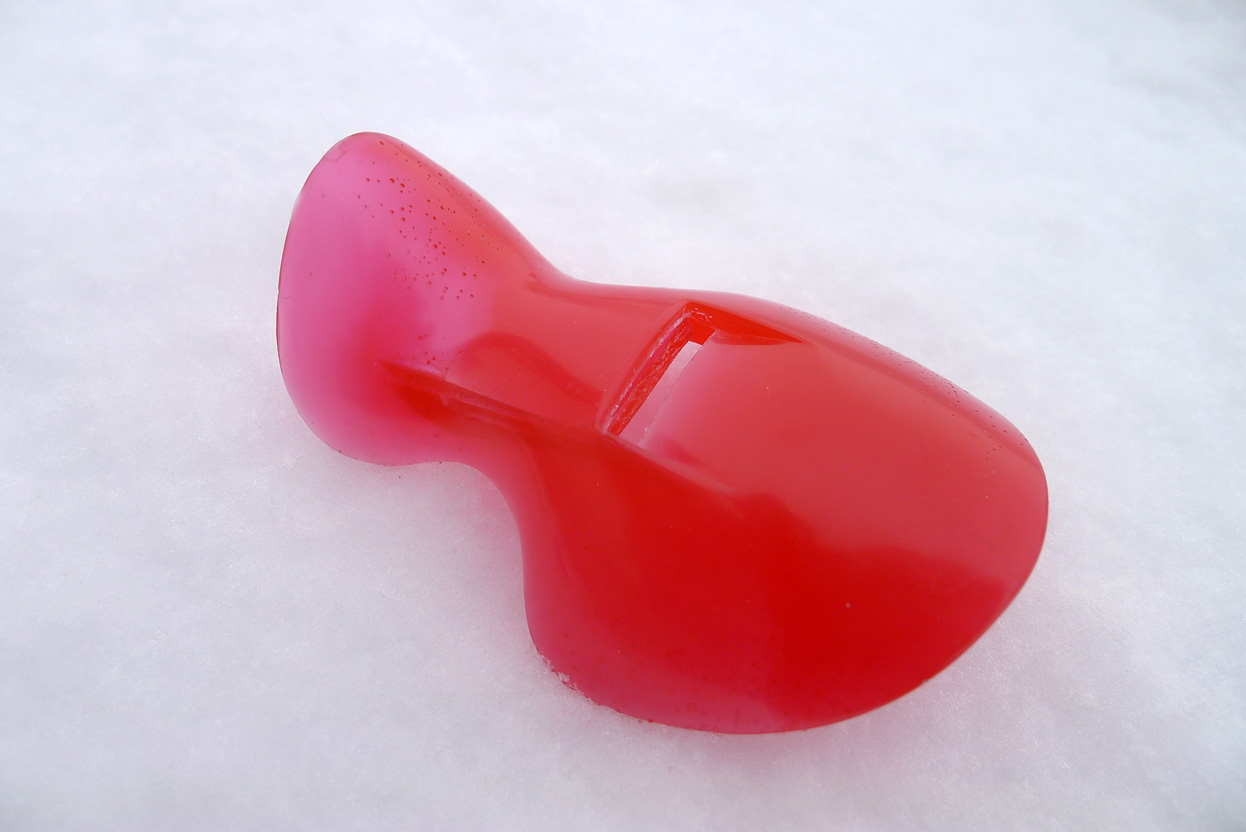
I wanted to cast also acrylic resin, in order to (try to) get a translucent Bocarina, because polyurethane is opaque. My hard silicone mould was beginning to be a bit worn, and I used my new soft mould.

The problem with such resin is that, contrarywise to the polyurethane which hardens in minutes, acrylic takes at least 24 hours to harden. In consequence, the smallest leak in the junction of the mould leads to a disaster: in 24 hours, all the content is able to flow out.

I was finally able to seal my mould with tape, and had only one refill to do after 12 hours. It took me 7 castings (one week:) to get one proper flute:


The other problem (that I have not totally been able to get rid of) is the formation of bubbles. When you cast the resin, you can lean the mould to avoid bubbles in some angles. But the acrylic resin produces bubbles during its hardening process. Micro-bubbles, but during the 24 hours, they have the time to gather in bigger ones.

For those, I had to make "patches" afterwards, that is, to re-cast resin in the little holes.

I made 2 of them, one transparent, and one that I sanded to get a "translucent glass pebble on the seashore" aspect.


I also tried with a stock colored acrylic resin, and one in which I mixed a drop of red colorant (dedicated to polyurethane)


The results are funny, but not impressive on the sound side. All are very sharp (probably due to the shrinkage), with a reather "plastic" sound. Anyway, such slow hardening resin is a real pain in the neck to work with in such silicone moulds. Won't do it again.

Some were asking how would it look with a transparent nose flute, super-cool or like wearing a medical mask on the face... Maybe a good flute to teach nose flute playing? Well, you are the judge:


-----

On the same topic :

- Moulding and Casting - Part 1: hard silicone
- Moulding and Casting - Part 2: casting urethane
- Moulding and Casting - Part 3: low temp alloys
- Moulding and Casting - Part 4: soft silicone
- Moulding and Casting - Part 5: casting Acrylic

----

Jan 15, 2013

A great page dedicated to the "9th event"

Don't miss the page published by salsica.com, about the "Ninth Symphony" event performed by the Hanshin Hanabue Association (日本鼻笛協会 阪神間友の会) on 28th of December. It was conducted by sensei Mosurin and broadcast on TV.

The black and white photographs by Mr. Matsubara Yutaka are **splendid**!

click here to access the original page
click here to access the google translated page

and here for Matsubara Yutaka facebook page with the 342 pictures!


And here, the video posted by Mosurin:


And the TV footage:


Jan 14, 2013

Froby, mint in blister!

Look what Mr. Piet Visser just found sent to us! A His Froby, when new in its package. Interesting: it's was branded for France (or a french speaking country), with the title "New, The Froby Melodic Madness". On the corner: "Seen on TV". So, there should be a TV archive (a commercial?) with the nose flute (or is was it just a fake mention...).


Piet Visser on dutch TV

Piet Visser, the famous dutch whistle collector, was seen on TV last october. He presented some of his wonderful whistles, but had also brought his "Blik", an american nose flute from the 1920's.

The nose flute part begins at 4'30", but the whole interview is interesting, even when you don't understand the Dutch language.


Jan 13, 2013

The Ocariflûte / Oclariflûte - Update

I found an original of the issue #1 of the Catalogue général de la Société de la Gaîté française and it changed a bit my thoughts about the Ocariflûte/Oclariflûte name...


This catalogue is a novelties french catalogue, proposing the same kind of joke items than the Johnson Smith did in the USA, but also some musical instruments, and notably the Bigotphone series (cardboard instruments). On the very last page, the printing date: 1930.

So, the name "Ocariflûte" was later than the original "Oclariflûte". I just amended and updated the post about this instrument, and added better images (scanned from the original catalogue).

Jan 10, 2013

The Ocariflûte / Oclariflûte

The Catalogue général de la Société de la Gaîté française, a french novelties catalogue #1, published in 1930, proposed a new little instrument called the Ocariflûte. « No need to know Music. No fingering, no need to hold the instrument, it is handsfree and one can play it along with violin, piano, accordion, etc. ». The advertisement shows, however, a man in tuxedo holding the Ocariflute in his hand.
For sure, it is a nose flute - a french one - and it is classified as a Jazz instrument.


Earlier, another (or the same...) instrument called Oclariflûte, with a "L" after the "C", had appeared in the catalogue of the Manufacture générale d'Instruments de Musique (unkn. date). It is classified as a Jazz instrument, but also as a toy ("Jazz-Jouets"). It is proposed through several versions: tin, nickel plated or luxus, for jazz.


On this lastad, we can clearly read on the flute: "Instruments Brilhault" and in-between the 2 words: "BT. SGDG", abbreviation of "Breveté Sans Garantie du Gouvernement" (patented with no government warranty). So, the baby was patented (but I found no trace of its file).

The instrument looks like a regular metal nose flute, with one specificity: the shape of its mouth shield which, contrarywise to almost any other flute, is not rounded at its bottom, but presents a kind of square heel.

There is no doubt that the Ocariflûte and the Oclariflûte were the same instruments.

On the first ad, one can guess the shape of the Oclariflûte heel...


But more: here is an newspaper article published Sep. 27, 1923, in the Figaro and about the famous Concours Lépine (inventions contest). The paper says: « L'Oclariflûte. This sensational novelty still gets a huge success at the Concours Lépine. It is very difficult to approach this booth, where the crowd makes a real rampart to listen to this little instrument. Everybody will become a musician with this novelty, unique in its type. Nickeled instrument, 6 francs, nickeled copper, 8 francs, and grand luxus item, 12 francs, in a case with user manual...»


And if you look back at the first advertisement, you'll notice the title is underwritten by « Médaille d'argent au Concours Lépine » (Silver medal at the Lépine Contest). I think this is a definitive evidence that Ocariflûte and Oclariflûte were the same.

So, a nose flute got a silver medal at the Concours Lépine, in Paris, 1923!
For sure, I contacted the current Lépine contest organization to ask if they could find something in their archives (a name, an address, an occupation... for the inventor). Unfortunately, I haven't got an answer yet.

But we know the name of the company who sold (and probably manufactured) the Oclariflûte: Ets. Brilhault, 17, boulevard Rochechouart, Paris IX. (The Figaro made a spelling mistake in the name, writing "Brilhaut" instead of "Brilhault", missing the "L").

--

Now, why the two names, with or without a L?

I am quite sure this came from a trademark issue. The nose flute was named Oclariflûte in 1923 (at Lépine Contest). Maybe the inventor wanted to name his nose flute without the L"... but there was already a wind instrument called Ocariflûte! It was metal ocarina shaped like... a flute, and patented by another musical manufacture in Paris, the Ets. Mathieu.


But in the 1930 catalogue, the nose flute is called Ocariflûte. Were the rights over the name Ocariflûte over? Or did the Ets. Mathieu sell the brand to Ets. Brilhault?

It seems that the Mathieu's ocarina was sold from the early 1890's until the beginning of the 1900s. But I also found that the brand Ocariflûte had been registered in 1901 and 1916 by:


Ch. & J. Ullmann were instruments makers and big distributors: in 1907 their catalogue is composed of 13 volumes! ... and they are the successors of Lecomte & Mathieu Co. The same Mathieu who invented the Ocariflûte-ocarina. In the 1907 catalogue, 9th part (Toys intruments), one can see the Mathieu's ocarinas, but for sure, no nose flute (they have not appeared in France yet).


So, the brand was owned by the Odeon company in 1916, but I don't know if it was registered only for recordings or also for musical instruments. Anyway, it's more than likely that the name was still registered in 1922-23, when the nose flute by Brilhault was issued.