Too short video ... we would have loved to have more. For non Japanese people : the instrument is a sanshin, precursor of the shamisen, and played in the Okinawa region. I personally love the music by Noborikawa Seijin, well known singer and sanshin player.

Oct 8, 2011


Oct 7, 2011
Cardboard workshop again...
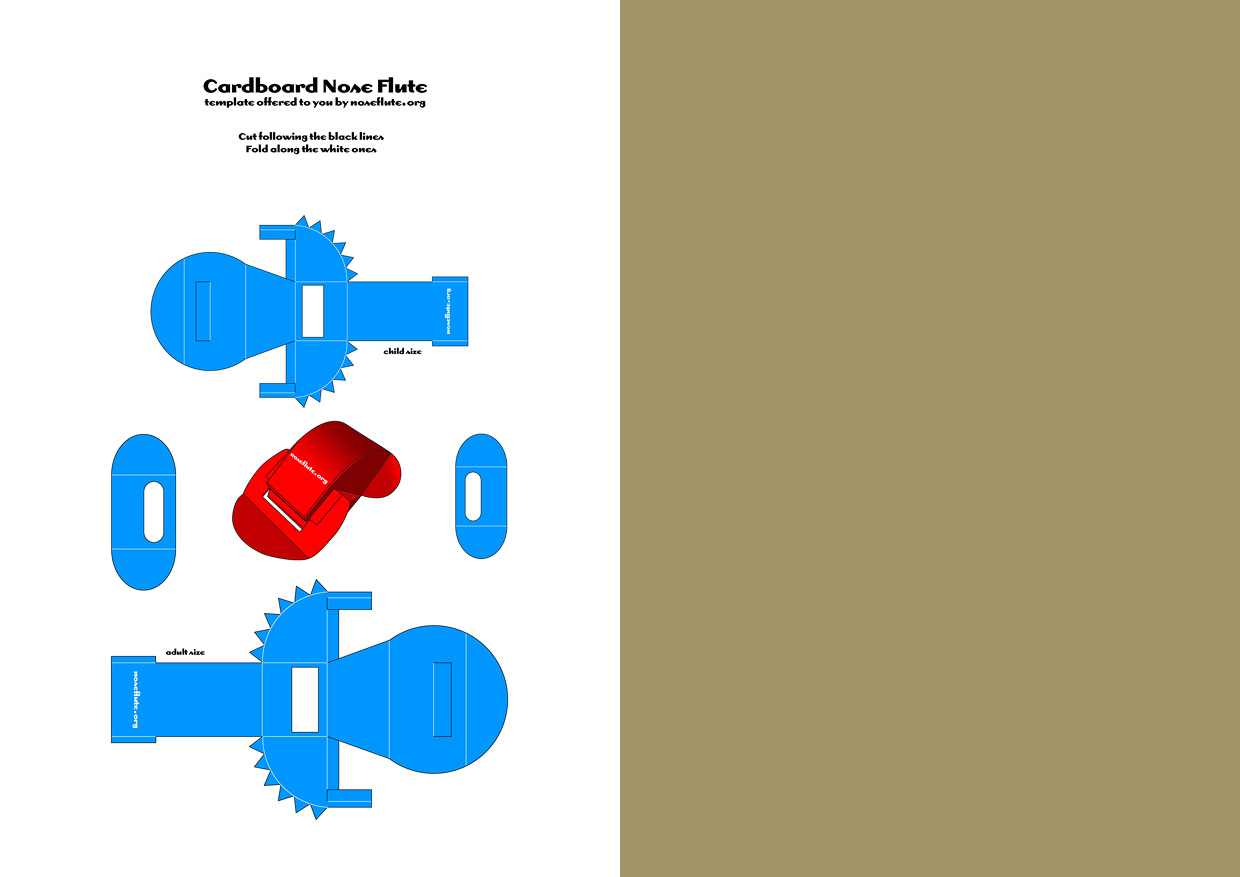
Yesterday, a (very good) friend of mine, who is a professional printer, proposed me to print my templates on cardboard, for... free. And today, he told me they were already printed ! Done on a heavy cardboard (300g/m2), and on both sides... So, since after folding, some parts are stuck reverse-side on the front side, the flutes will be two colored. I should receive the printings in the middle of next week. To be continued...




Oct 6, 2011
Workshop : "La Folle Journée de l'Architecture"
Each year, in the School of Architecture where I teach, we organize a special day with many workshops called "La Folle Journée de l'Architecture" which means "The Crazy Architecture Day"), and invite the public to come and produce lots of things. This year I've proposed to lead a nose flute workshop, in which everybody will receive a cardboard template, tools and advices, to build a functional nose flute.
Then, I will teach how to play, and we all will try to play a song all together ...
If you are in the neighborhood of Nancy (Lorraine region, France), please come and visit us!


Then, I will teach how to play, and we all will try to play a song all together ...
If you are in the neighborhood of Nancy (Lorraine region, France), please come and visit us!


Oct 4, 2011
Video : Carl Maria von Weber
Waltz from Preciosa, by Carl Maria von Weber, played by with a wooden nose flute and a keyboard, by two austrian musicians : Ukulele4Aukekulia.
Please note how the vibrato is produced.
Please note how the vibrato is produced.
Oct 3, 2011
Carl J. Aarlaht : an Estonian-Canadian nose flute
Carl Johannes Aarlaht was born in Vaivara, Estonia on 5th of May, 1924 (†04/25/1989). He emigrated to Canada and settled down in Hamilton. He was a Master Scout, member of the Estonian Society of Friends of Scout Canada (Hamiltoni Eesti Skaudisõprade Selts) and decorated of the Northern Star.
Carl J. Aarlaht registered two patents. The first one, in 1958 (US2989719), was for « Convertible Attachment Plugs » and was referenced later by numerous patents regarding similar devices.

The second one, of a better interest for us, is a nose flute. The patent (CA684140) for a « Musical Whistle » was registered on 14th of April, 1964.
« Generally the present invention consists of a simple musical instrument of the wind type which may be simply made of flat material such as metal, plastic material or the like. »
Apart of a nice angular shape design, the nose flute offers no innovation in comparison to old metal Humanatones. The only difference regards the lip rest, which is surprinsingly under the mouth hole, thus providing a rest to the lower lip.

Carl J. Aarlaht registered two patents. The first one, in 1958 (US2989719), was for « Convertible Attachment Plugs » and was referenced later by numerous patents regarding similar devices.

The second one, of a better interest for us, is a nose flute. The patent (CA684140) for a « Musical Whistle » was registered on 14th of April, 1964.
« Generally the present invention consists of a simple musical instrument of the wind type which may be simply made of flat material such as metal, plastic material or the like. »
Apart of a nice angular shape design, the nose flute offers no innovation in comparison to old metal Humanatones. The only difference regards the lip rest, which is surprinsingly under the mouth hole, thus providing a rest to the lower lip.

Oct 2, 2011
Review : a Hungarian wooden nose flute
I ordered a hungarian nose flute ("orrfuvola") from Béres kézmúves Mühely (Béres handicraft workshop). Attila Béres produces lots of wooden items since 1995 : kitchenware, furniture, buckskin shirts, soaps, massage accessories, wooden toys, elements of decoration, and ... musical instruments.
And among the instruments : Agogos, bird whistles, castagnets, drums, flappers, Guiro, kalimbas, maracas, nut rumblers, rakataks, shakers, sistrums, tambourines, shekere, and... nose flutes.
« I founded my family enterprise in 1995. The direction of my activity came natural to me as I had played percussion and loved working with wood. Our musical instruments can be easily used in musical education and music therapy and they are popular among professional musicians as well. We make not only basic percussion instruments but widen the scale with several egzotic pieces, too. We think it is our responsibility what relationship the generation just growing up has to nature and to traditional values. Our instruments and other handicraft products are made of natural materials as wood, fruits, seeds, reed, leather, brass, coconut and so on. During procedures we use old handicraft techniques. All our products are qualified by the Hungarian Department of Fine Arts. We hope we can greet you soon as a satisfied customer. »


So, I received a nose flute I paid 8 euros, hand-made, in wood. And I was rather dispointed, because of the low quality of fabrication.
The labium is a mess, the details are not clean, there is long slit between the body and the air duct cap, glue smears ...
Each flute is stamped with Mr. Béres logo :

Well it works, and it's a easy-player instrument. But because of a so unclean labium, the sound is very dull, without a good definition...
Here are some sound samples to compare with hi-class wooden nose flutes providing a clean sound (well separated harmonics) :
Attila Béres' nose flute :
And among the instruments : Agogos, bird whistles, castagnets, drums, flappers, Guiro, kalimbas, maracas, nut rumblers, rakataks, shakers, sistrums, tambourines, shekere, and... nose flutes.
« I founded my family enterprise in 1995. The direction of my activity came natural to me as I had played percussion and loved working with wood. Our musical instruments can be easily used in musical education and music therapy and they are popular among professional musicians as well. We make not only basic percussion instruments but widen the scale with several egzotic pieces, too. We think it is our responsibility what relationship the generation just growing up has to nature and to traditional values. Our instruments and other handicraft products are made of natural materials as wood, fruits, seeds, reed, leather, brass, coconut and so on. During procedures we use old handicraft techniques. All our products are qualified by the Hungarian Department of Fine Arts. We hope we can greet you soon as a satisfied customer. »


So, I received a nose flute I paid 8 euros, hand-made, in wood. And I was rather dispointed, because of the low quality of fabrication.
The labium is a mess, the details are not clean, there is long slit between the body and the air duct cap, glue smears ...
 |  |
 |  |
Each flute is stamped with Mr. Béres logo :

Well it works, and it's a easy-player instrument. But because of a so unclean labium, the sound is very dull, without a good definition...
Here are some sound samples to compare with hi-class wooden nose flutes providing a clean sound (well separated harmonics) :
Attila Béres' nose flute :
Oct 1, 2011
Addendum to "The Nose whistle gourd"
Addendum to our previous post "Theatrical contraption : the nose whistle gourd"
...
I wanted to know more... and asked the seller of this theatrical gourd nose flute. The fact is the seller is the inventor-creator, the Pipe Major Norwood Baybridge, FSA Scot, Regional Commander of the Scottish American Military Society... nothing less.

The best I can do is just pasting the story the Pipe-Major told me, since it is so well-written and full of humour :
« This instrument was made about twenty years ago just as the last freezing and canning for the winter supply was finishing. At that time, in the late 1980's, the turbo-jet-powered, supersonic passenger jet, "ConCorde", was still flying; however, the owners of the organically grown gourd were poor people and couldn't afford a ticket. So they transported the gourd to a local furniture shop via motorized, wheeled transport. Though my memory is growing dim, I believe it was a Buick.
At the furniture shop, the gourd was cleaned, interestingly, by several of the employees who were listening to a record that teaches individuals the sounds of the instruments of an orchestra. Following this cleaning, a small hole was drilled into the gourd and a self-hardening foam was pumped into it. This was to give the gourd additional strength; as well as to protect it from being later infested with the vermin that normally accompany some musicians.
Using modern, industrial machinery, an insertion point was power-chisled into the gourd for the insertion of the HumanaTone nose whistle; and, the finger holes were painstakingly drilled into the sides. It was an endeavor that put all of your senses to work, leaving men exhausted, but enthralled.
It may be stated from personal experience that the manufacture of this gourd nose whistle was much more difficult than cutting one's own hair for an important engagement.
The gourd nose whistle was played on many occasions at various fairs and country music get-togethers in makeshift bands usually composed of vagabond folk artists armed with an array of fiddles, jaw harps, tamborines, guitars, gamboozees and autoharps. »
The Pipe Major Baybridge may play for your special events, from wedding to ... funerals. You should visit his web page, clanpiper.com, full of beautiful and incredible pictures.
...
I wanted to know more... and asked the seller of this theatrical gourd nose flute. The fact is the seller is the inventor-creator, the Pipe Major Norwood Baybridge, FSA Scot, Regional Commander of the Scottish American Military Society... nothing less.

The best I can do is just pasting the story the Pipe-Major told me, since it is so well-written and full of humour :
« This instrument was made about twenty years ago just as the last freezing and canning for the winter supply was finishing. At that time, in the late 1980's, the turbo-jet-powered, supersonic passenger jet, "ConCorde", was still flying; however, the owners of the organically grown gourd were poor people and couldn't afford a ticket. So they transported the gourd to a local furniture shop via motorized, wheeled transport. Though my memory is growing dim, I believe it was a Buick.
At the furniture shop, the gourd was cleaned, interestingly, by several of the employees who were listening to a record that teaches individuals the sounds of the instruments of an orchestra. Following this cleaning, a small hole was drilled into the gourd and a self-hardening foam was pumped into it. This was to give the gourd additional strength; as well as to protect it from being later infested with the vermin that normally accompany some musicians.
Using modern, industrial machinery, an insertion point was power-chisled into the gourd for the insertion of the HumanaTone nose whistle; and, the finger holes were painstakingly drilled into the sides. It was an endeavor that put all of your senses to work, leaving men exhausted, but enthralled.
It may be stated from personal experience that the manufacture of this gourd nose whistle was much more difficult than cutting one's own hair for an important engagement.
The gourd nose whistle was played on many occasions at various fairs and country music get-togethers in makeshift bands usually composed of vagabond folk artists armed with an array of fiddles, jaw harps, tamborines, guitars, gamboozees and autoharps. »
The Pipe Major Baybridge may play for your special events, from wedding to ... funerals. You should visit his web page, clanpiper.com, full of beautiful and incredible pictures.
Sep 30, 2011
Sep 29, 2011
Theatrical contraption : the nose whistle gourd
I found this very special instrument on Ebay : a « nose whistle flute gourd ». I'm not sure his inventor filed a patent for it, but it is surely a collector's must.

The instrument is made with a vintage metal nose flute stuck to a kind of gourd ocarina. I write "kind of", because this is a theatrical instrument, meaning that the gourd is not functional, purely decorative. But the flute, indeed, works.
It is a old Humanatone, as the stamp on the mouth cap identifies it, rather dented, and coverd by thick layer of painting, black on the internal side, golden on the outside, to match the gourd color.
« It is a stage instrument and show stopper, used for variety value. It has finger holes for a person to pretend he or she is playing it mechanically; but when held up to the mouth no one can see that the musician is just using the nose whistle which has been set inside of the back of the gourd. »
The description offered by the seller was not deprived of humour :
« Traveling? It fits right in any suitcase or hamster cage. »
or better :
« Let others pull out their fiddles; their mandolins, harmonicas and washboards. They can dig through their instrument inventory for a hundred years and never pull out a nose whistle gourd. And that's because no one else has class. Those are just hardscrabble musicians who can't think beyond lemon-sesame sauce for grilled vegetables.
As an expressive musical performing artist, you will have them beat by a mile with this, caffeine free, world-leader, nose whistle flute gourd.
This is better than homemade pea soup in a Des Moines restaurant. »
Please read the sequel to this post.

The instrument is made with a vintage metal nose flute stuck to a kind of gourd ocarina. I write "kind of", because this is a theatrical instrument, meaning that the gourd is not functional, purely decorative. But the flute, indeed, works.
It is a old Humanatone, as the stamp on the mouth cap identifies it, rather dented, and coverd by thick layer of painting, black on the internal side, golden on the outside, to match the gourd color.
« It is a stage instrument and show stopper, used for variety value. It has finger holes for a person to pretend he or she is playing it mechanically; but when held up to the mouth no one can see that the musician is just using the nose whistle which has been set inside of the back of the gourd. »
 |  |
 |  |
« Traveling? It fits right in any suitcase or hamster cage. »
or better :
« Let others pull out their fiddles; their mandolins, harmonicas and washboards. They can dig through their instrument inventory for a hundred years and never pull out a nose whistle gourd. And that's because no one else has class. Those are just hardscrabble musicians who can't think beyond lemon-sesame sauce for grilled vegetables.
As an expressive musical performing artist, you will have them beat by a mile with this, caffeine free, world-leader, nose whistle flute gourd.
This is better than homemade pea soup in a Des Moines restaurant. »
Please read the sequel to this post.
Sep 27, 2011
Video : The french anthem on a japanese stage
« La Marseillaise » by Rouget de Lisle, performed by a french student with a wooden nose flute, during a student exchange, in Kyōto.
Sep 26, 2011
The Swiss patent of a Lithuanian diplomat
A Swiss patent (CH253732), filed on 12th of March, 1947, and registered on 31st of March, 1948, for a « Fischietto Nasale » (nose whistle). The author is Mr. Narcizas Prielaida, from Geneva.
« Fischietto, caratterizzato da una parte applicabile al naso e da une parte applicabile alla bocca, in modo che il naso funziona da datore di fiato, mentre che variando l'apertura della bocca e la posizione della lingua si fa variare l'altezza del suono. »
The object doesn't show any improvement upon the nose flutes from the beginning of the century. It's a metal 2-parts nose flute, with a lip rest. However, it features a very long and elegant mouth-cap, we should say a « mouth-cape ».

I don't know if the Prielaida's flute was produced, and have no further info about it. But I found a lot of data on the inventor himself, quite interesting.
[Edit : Since, I received an answer form Mrs. Prielaida, who told me the flute was never commercialized.]

Narcizas Prielaida was born on 20th of January, 1920 in Akstafoje, Azerbaijan, but was a Lithuanian citizen. His family lived in Klaipeda (Lt) where Narcizas dreamed of becoming a sailor. The family moved then to Siauliai and Narcizas began arts studies. Under the Soviet occupation, the Prielaidas moved to Switzerland.
From 1945 to 1949, Narcizas studied at Geneva Art School, became a graduated teacher, but was not allowed to work because of his nationality. So, he studied maritime law and worked in various insurance companies. He became the chairman of the Lithuanian community in Switzerland, and was appointed, in 1980, as World Lithuanian Community Board representative at the Human Rights Committee, United Nations.
In 1992, he became the first Lithuanian representative to the United Nations in Geneva, and in 2007, was awarded of the Officer's Cross of the Order for Merits to Lithuania (Ordinas Už Nuopelnus Lietuvai).

So, at the time of his patent, Narcizas was a student in Arts, not yet a diplomat. But his nose flute is definitely a diplomat's invention. It is a shame that his Wikipedia page does not mention his nose flute patent ! (If a Lithuanian reader might update it ...)
« Fischietto, caratterizzato da una parte applicabile al naso e da une parte applicabile alla bocca, in modo che il naso funziona da datore di fiato, mentre che variando l'apertura della bocca e la posizione della lingua si fa variare l'altezza del suono. »
The object doesn't show any improvement upon the nose flutes from the beginning of the century. It's a metal 2-parts nose flute, with a lip rest. However, it features a very long and elegant mouth-cap, we should say a « mouth-cape ».

I don't know if the Prielaida's flute was produced, and have no further info about it. But I found a lot of data on the inventor himself, quite interesting.
[Edit : Since, I received an answer form Mrs. Prielaida, who told me the flute was never commercialized.]

Narcizas Prielaida was born on 20th of January, 1920 in Akstafoje, Azerbaijan, but was a Lithuanian citizen. His family lived in Klaipeda (Lt) where Narcizas dreamed of becoming a sailor. The family moved then to Siauliai and Narcizas began arts studies. Under the Soviet occupation, the Prielaidas moved to Switzerland.
From 1945 to 1949, Narcizas studied at Geneva Art School, became a graduated teacher, but was not allowed to work because of his nationality. So, he studied maritime law and worked in various insurance companies. He became the chairman of the Lithuanian community in Switzerland, and was appointed, in 1980, as World Lithuanian Community Board representative at the Human Rights Committee, United Nations.
In 1992, he became the first Lithuanian representative to the United Nations in Geneva, and in 2007, was awarded of the Officer's Cross of the Order for Merits to Lithuania (Ordinas Už Nuopelnus Lietuvai).

So, at the time of his patent, Narcizas was a student in Arts, not yet a diplomat. But his nose flute is definitely a diplomat's invention. It is a shame that his Wikipedia page does not mention his nose flute patent ! (If a Lithuanian reader might update it ...)
Sep 25, 2011
New Humanatone ads
I found new Humanatone advertisements and will add them to the relative post.
The first one was published in the 1908 J. W. Jenkins' Sons Music Co (still in the Jenkins catalog in 1929) :

The second one in the 1928 Johnson Smith catalog, with a 2.5 times decreased price :

The third one comes from the 1931 Chicago Musical Instrument catalog (back to a 2.5 increased price per dozen, after 1929 crash) :

----
About metal Humanatones, check :
- Humanatone - part I : the metallic era
- New Humanatone ads
- The Two metal Humanatones
- Another metal Humanatone
- Humanatone boxes
- Another Humanatone box
- Humanatone: A very early user manual
- The Magic (Nose) Flute: only questions... .
- A Humanatone and clones chronology
- A Humanatone in 1892 ?
- Humanatone: Early promotional demos
- Another Humanatone archive
- Huma... something
- Rectification: Humanatone appearance date
- Great paper from 1903
- Nose Flute Pioneers: The Stivers - Part I
- Nose Flute Pioneers: The Stivers - Part II
- Nose Flute Pioneers: The Stivers - Part III
- Nose Flute Pioneers: The Stivers - Part IV
- Nose Flute Pioneers: The Stivers - Part V
- A Humanatone as a scientific tool
- Two other Humanatone Ads
And on later Humanatones :
- Humanatone - Part II : the Gretsch plastic era
- Humanatone - Part III : the Gretsch metal era
-----
The first one was published in the 1908 J. W. Jenkins' Sons Music Co (still in the Jenkins catalog in 1929) :

The second one in the 1928 Johnson Smith catalog, with a 2.5 times decreased price :

The third one comes from the 1931 Chicago Musical Instrument catalog (back to a 2.5 increased price per dozen, after 1929 crash) :

----
About metal Humanatones, check :
- Humanatone - part I : the metallic era
- New Humanatone ads
- The Two metal Humanatones
- Another metal Humanatone
- Humanatone boxes
- Another Humanatone box
- Humanatone: A very early user manual
- The Magic (Nose) Flute: only questions... .
- A Humanatone and clones chronology
- A Humanatone in 1892 ?
- Humanatone: Early promotional demos
- Another Humanatone archive
- Huma... something
- Rectification: Humanatone appearance date
- Great paper from 1903
- Nose Flute Pioneers: The Stivers - Part I
- Nose Flute Pioneers: The Stivers - Part II
- Nose Flute Pioneers: The Stivers - Part III
- Nose Flute Pioneers: The Stivers - Part IV
- Nose Flute Pioneers: The Stivers - Part V
- A Humanatone as a scientific tool
- Two other Humanatone Ads
And on later Humanatones :
- Humanatone - Part II : the Gretsch plastic era
- Humanatone - Part III : the Gretsch metal era
-----
Sep 24, 2011
Sep 23, 2011
Students drawings
Each year, at the first class of the first year, I'm used to ask my students (architecture school) to make a drawing, in order for me to evaluate their drawing skill (or the deepness of the lacunas...). This year, I showed them what a nose flute is, played 2 or 3 notes, and asked them to draw a self portraict as a nose-flutist.
Here are the best and/or the funniest works :
Here are the best and/or the funniest works :
 |  |  |  |
 |  |  |  |

Sep 22, 2011
Weird gizmo : The Nasenformer Zello
Well, this is a quite off-topic post... But imagine the shape of your nose does not fit your nose flute... Instead of changing your nose flute, you might use a Nasenformer Zello device.
 1. Potato Nose 2. Saddle Nose 3. Duckbill Nose 7. Wide Nose
4. Pointy Nose 5. Long Nose 6. Hook Nose 8. Slant Nose
.
1. Potato Nose 2. Saddle Nose 3. Duckbill Nose 7. Wide Nose
4. Pointy Nose 5. Long Nose 6. Hook Nose 8. Slant Nose
.
 1. Potato Nose 2. Saddle Nose 3. Duckbill Nose 7. Wide Nose
4. Pointy Nose 5. Long Nose 6. Hook Nose 8. Slant Nose
.
1. Potato Nose 2. Saddle Nose 3. Duckbill Nose 7. Wide Nose
4. Pointy Nose 5. Long Nose 6. Hook Nose 8. Slant Nose
.
Sep 20, 2011
Video : a charming duet
A nose flute duet in Austria. They are Heinrich Handler, a very good nose flute maker, and his wife Mrs. Handler.
Sep 19, 2011
Ernest W. Davis : Major improvements
After Carter's and Couchois', Davis' nose flute represents a major advancement in the design. Indeed, the shape he invented is still mass produced and is a best-seller since almost 70 years, with the brand Humanatone.
Ernest W. Davis, citizen of River Forest in Illinois, filed the patent US2245432 for a « Musical Instrument » on 22th of january 1940. The patent is registered on 10th of june 1941.
« My invention relates to musical instruments and includes among its objects and advantages an extension of the pitch range and an improvement in tone quality, especially at higher pitches, in the type of musical instrument in which pitch variation is obtained by varying the volume of a cavity defined primarily by the oral cavity of the player, and, to a minor extent, by the instrument itself. »

First, Davis' instrument is supposed to be able to produce 3 octaves :
« With an instrument according to the invention, it requires only slight practice to play three full octaves, and because the lips can be drawn together to make appropriate changes in the shape of the oral cavity as the pitch goes up, the high notes can be made quite clear and harmonious ».
More, the design features a truncated cone shaped hole on the right wing of the mouth cap, providing a « true tremolo » function, when operated with a finger :
« A specific object is to enable the player to produce a true tremolo tone at will. »
« In the right wing 14 I provide a tapered tremolo aperture 32, with its large end outermost. This makes a large enough dimple in the outer surface so that the user’s finger can readily find it. With the part of the player’s mouth in a given position and the aperture 32 open, the air in the oral cavity will vibrate at a slightly lower frequency than when the aperture is closed. Thus the user, as clearly indicated in Figure 1, may use one finger, such as the index finger 34 of the right hand, to cover and uncover the aperture 32, and when this is done rapidly as by vibrating the finger across the aperture as idnicated (sic) by arrows 36 and 38 in Figure 1, a tremolo, or periodic oscillation in pitch may be obtained, the frequency of the oscillation depending on the speed of vibration of the finger 34.It will be apparent that it is a true tremolo as distinguished from a vibrato. With the aperture 32 either covered or uncovered, the player can produce a vibrato by varying the force used to produce the sound, although with such an instrument as this, the tremolo is a much more desirable musical effect. »

But the main improvement is in that the Davis' instrument is a one single part object, thus forecast to be easily produced in cast metal (which will be done with the Japanese Humanatone), but also and mostly in injected plastics, as Fred Gretsch Mfg Co. will make the modern Humanatone, then Trophy Music (Grover), until now. (see forthcoming « Modern Humanatone » history).
« Accordingly, the device can readily be produced by casting in metal in a single piece or by molding in plastic material in a single piece. »
The Davis' patent will be referenced by several instruments, including the 1987 (reg. 1988) one by Patrick Huet de Froberville (FR2616574) and the 1993 (reg. 1996) one by Michel A. Paulus (USD368485).

Ernest W. Davis, citizen of River Forest in Illinois, filed the patent US2245432 for a « Musical Instrument » on 22th of january 1940. The patent is registered on 10th of june 1941.
« My invention relates to musical instruments and includes among its objects and advantages an extension of the pitch range and an improvement in tone quality, especially at higher pitches, in the type of musical instrument in which pitch variation is obtained by varying the volume of a cavity defined primarily by the oral cavity of the player, and, to a minor extent, by the instrument itself. »

First, Davis' instrument is supposed to be able to produce 3 octaves :
« With an instrument according to the invention, it requires only slight practice to play three full octaves, and because the lips can be drawn together to make appropriate changes in the shape of the oral cavity as the pitch goes up, the high notes can be made quite clear and harmonious ».
More, the design features a truncated cone shaped hole on the right wing of the mouth cap, providing a « true tremolo » function, when operated with a finger :
« A specific object is to enable the player to produce a true tremolo tone at will. »
« In the right wing 14 I provide a tapered tremolo aperture 32, with its large end outermost. This makes a large enough dimple in the outer surface so that the user’s finger can readily find it. With the part of the player’s mouth in a given position and the aperture 32 open, the air in the oral cavity will vibrate at a slightly lower frequency than when the aperture is closed. Thus the user, as clearly indicated in Figure 1, may use one finger, such as the index finger 34 of the right hand, to cover and uncover the aperture 32, and when this is done rapidly as by vibrating the finger across the aperture as idnicated (sic) by arrows 36 and 38 in Figure 1, a tremolo, or periodic oscillation in pitch may be obtained, the frequency of the oscillation depending on the speed of vibration of the finger 34.It will be apparent that it is a true tremolo as distinguished from a vibrato. With the aperture 32 either covered or uncovered, the player can produce a vibrato by varying the force used to produce the sound, although with such an instrument as this, the tremolo is a much more desirable musical effect. »

But the main improvement is in that the Davis' instrument is a one single part object, thus forecast to be easily produced in cast metal (which will be done with the Japanese Humanatone), but also and mostly in injected plastics, as Fred Gretsch Mfg Co. will make the modern Humanatone, then Trophy Music (Grover), until now. (see forthcoming « Modern Humanatone » history).
« Accordingly, the device can readily be produced by casting in metal in a single piece or by molding in plastic material in a single piece. »
The Davis' patent will be referenced by several instruments, including the 1987 (reg. 1988) one by Patrick Huet de Froberville (FR2616574) and the 1993 (reg. 1996) one by Michel A. Paulus (USD368485).

Sep 18, 2011
My new advertisement page
I made it to be inserted in the new french ukulele magazine Pluck (coming issue of september will be also published in English...).


Sep 17, 2011
Video : little foxtrot, but great swing !
Here is a video by Geert Leurink from Netherlands, playing a great foxtrot of his invention on the ukulele, while whistling the melody with a Humanatone nose flute.
Sep 16, 2011
Charles M. Berry : The Vocamonica
March 19, 1938 is the date of filing of a instrument by Charles M. Berry of Inglewood, California. Registered on April 23, 1940 under the number US2197993, the « Vocamonica » is a metal nose flute featuring several inventions and/or new intentions.
Indeed, if the shape is comparable to the metal Humanatone, but provides a sliding piece of metal as a labium, with the purpose, not to change the kind of sound like in the Cobia patent, but the tone itself :
« A toner gate 11 being a thin flat piece of oblong shape that may be made of wood or metal is ajustably mounted in the opening 9 by first blowing through the opening 9 and taking the fingers and moving it inward or outward to decrease or increase the opening until the required tone is reached, then it remains in this position without constantly fingering and is held in place by the members 12 and 13 that are fixed by screws 14 to the face plate 10.»

More, the invention had some hygienic intentions. The British Humanaphone existed in a celluloid « hygienic line », but the Vocamonica is the first nose flute which can be disassembled, in order to be washed.
« The lower section 2 being slidably mounted in the upper section 1 permits these sections to be easily separated so that they can be easily cleaned thus having a clean and sanitary instrument at all times ».
More ! Mr. Berry had some medical velleities that we hope to have been pure fantasy :
to scramble the brains !
« A further object of the invention is to provide a device of such character which may be easily operated and which will be simple in construction, simple and positive in operation and which will furthermore vibrate the brain of a person to exercise it. »
The Berry's patent was quoted as reference in 3 later ones, in 1946 (reg. 1949) by Virgil R. Kimple (US2463630), in 1987 (reg. 1988) by Patrick Huet de Froberville (FR2616574) and in 1993 (reg. 1996) by Michel A. Paulus (USD368485).
Indeed, if the shape is comparable to the metal Humanatone, but provides a sliding piece of metal as a labium, with the purpose, not to change the kind of sound like in the Cobia patent, but the tone itself :
« A toner gate 11 being a thin flat piece of oblong shape that may be made of wood or metal is ajustably mounted in the opening 9 by first blowing through the opening 9 and taking the fingers and moving it inward or outward to decrease or increase the opening until the required tone is reached, then it remains in this position without constantly fingering and is held in place by the members 12 and 13 that are fixed by screws 14 to the face plate 10.»

More, the invention had some hygienic intentions. The British Humanaphone existed in a celluloid « hygienic line », but the Vocamonica is the first nose flute which can be disassembled, in order to be washed.
« The lower section 2 being slidably mounted in the upper section 1 permits these sections to be easily separated so that they can be easily cleaned thus having a clean and sanitary instrument at all times ».
More ! Mr. Berry had some medical velleities that we hope to have been pure fantasy :
to scramble the brains !
« A further object of the invention is to provide a device of such character which may be easily operated and which will be simple in construction, simple and positive in operation and which will furthermore vibrate the brain of a person to exercise it. »
The Berry's patent was quoted as reference in 3 later ones, in 1946 (reg. 1949) by Virgil R. Kimple (US2463630), in 1987 (reg. 1988) by Patrick Huet de Froberville (FR2616574) and in 1993 (reg. 1996) by Michel A. Paulus (USD368485).
Sep 14, 2011
Video : a nice movie about nose flutes crafting
Documentary made in the wood workshop of Martina and Martin Sommer, instruments makers in Berlin, Germany. The movie is in German, but the images are international.
Sommer's website is here
Sommer's website is here
Home made : the experiment of a reader
Mister Ralf P. of Leimen (Germany), regular reader of this blog, lead some experiments using the template I designed. He got a good (and working) result with cardboard and polystyrol, but experienced, as we did, problems with can tin, breaking when bent (on that matter : thin aluminium breaks when bent *because* of the heat provided by the bending, and it would be interesting to try to bend it while dipped in cold water with ice cubes...). Anyway, congratulations to him!
 |  |
 |  |
Sep 13, 2011
Mosurin : a Japanese master
Mosurin (モスリン) is the most famous japanese nose flutist. His pseudonym is a transcription for « muslin », and indeed, the master plays with a very smooth and harmonious style.

Born in 1951 in Katsushika-Ku (Saitama prefecture, near Tokyo), Mosurin met Mr. Sasaki Hiroaki and his clay nose flutes in 2007. Since then, accompanied with his guitar, Mosurin performs in numerous concerts, and leads nose flute workshops during which he teaches the playing but also some elements of history of our beloved instrument.
Four CDs were released, called « Hanabue no Hibiki » (meaning « Sound Of The Nose Flute »), produced by Studio Ghibli Sakuhin-Shuu. The last one, number 4, dates from June 2011, and contains 12 songs chosen among Japanese culture (Princess Mononoke, Toki No Uta, My Neighbor Totoro, ...) but also from the international repertoire (Take Me Home Country Roads, Le Temps des Cerises, ...).

The arrangements are simple but neat (a guitar or a keyboard), and Mosurin's nose flute is very sweet and smooth, always harmonious and precise.
You can listen samples here.
To play with his guitar, Mosurin uses a wooden nose flute stand, which supports the "funny mask" clay instrument by Sasaki.

Notes taken by a participant to Mosurin's workshop (Nose flute functioning and history of the modern Humanatone):
Some links :
Mosurin's original webpage (Japanese)
Mosurin's webpage translated by Google
Mosurin's YouTube channel
Mosurin's original MySpace page (Japanese)
Mosurin's MySpace page translated by Google

Born in 1951 in Katsushika-Ku (Saitama prefecture, near Tokyo), Mosurin met Mr. Sasaki Hiroaki and his clay nose flutes in 2007. Since then, accompanied with his guitar, Mosurin performs in numerous concerts, and leads nose flute workshops during which he teaches the playing but also some elements of history of our beloved instrument.
Four CDs were released, called « Hanabue no Hibiki » (meaning « Sound Of The Nose Flute »), produced by Studio Ghibli Sakuhin-Shuu. The last one, number 4, dates from June 2011, and contains 12 songs chosen among Japanese culture (Princess Mononoke, Toki No Uta, My Neighbor Totoro, ...) but also from the international repertoire (Take Me Home Country Roads, Le Temps des Cerises, ...).

The arrangements are simple but neat (a guitar or a keyboard), and Mosurin's nose flute is very sweet and smooth, always harmonious and precise.
You can listen samples here.
To play with his guitar, Mosurin uses a wooden nose flute stand, which supports the "funny mask" clay instrument by Sasaki.

Notes taken by a participant to Mosurin's workshop (Nose flute functioning and history of the modern Humanatone):
 |  |
Mosurin's original webpage (Japanese)
Mosurin's webpage translated by Google
Mosurin's YouTube channel
Mosurin's original MySpace page (Japanese)
Mosurin's MySpace page translated by Google
Subscribe to:
Posts (Atom)