A French man imitates the amazon forest birds with a wooden nose flute.

Sep 24, 2011


Sep 23, 2011
Students drawings
Each year, at the first class of the first year, I'm used to ask my students (architecture school) to make a drawing, in order for me to evaluate their drawing skill (or the deepness of the lacunas...). This year, I showed them what a nose flute is, played 2 or 3 notes, and asked them to draw a self portraict as a nose-flutist.
Here are the best and/or the funniest works :
Here are the best and/or the funniest works :
 |  |  |  |
 |  |  |  |

Sep 22, 2011
Weird gizmo : The Nasenformer Zello
Well, this is a quite off-topic post... But imagine the shape of your nose does not fit your nose flute... Instead of changing your nose flute, you might use a Nasenformer Zello device.
 1. Potato Nose 2. Saddle Nose 3. Duckbill Nose 7. Wide Nose
4. Pointy Nose 5. Long Nose 6. Hook Nose 8. Slant Nose
.
1. Potato Nose 2. Saddle Nose 3. Duckbill Nose 7. Wide Nose
4. Pointy Nose 5. Long Nose 6. Hook Nose 8. Slant Nose
.
 1. Potato Nose 2. Saddle Nose 3. Duckbill Nose 7. Wide Nose
4. Pointy Nose 5. Long Nose 6. Hook Nose 8. Slant Nose
.
1. Potato Nose 2. Saddle Nose 3. Duckbill Nose 7. Wide Nose
4. Pointy Nose 5. Long Nose 6. Hook Nose 8. Slant Nose
.
Sep 20, 2011
Video : a charming duet
A nose flute duet in Austria. They are Heinrich Handler, a very good nose flute maker, and his wife Mrs. Handler.
Sep 19, 2011
Ernest W. Davis : Major improvements
After Carter's and Couchois', Davis' nose flute represents a major advancement in the design. Indeed, the shape he invented is still mass produced and is a best-seller since almost 70 years, with the brand Humanatone.
Ernest W. Davis, citizen of River Forest in Illinois, filed the patent US2245432 for a « Musical Instrument » on 22th of january 1940. The patent is registered on 10th of june 1941.
« My invention relates to musical instruments and includes among its objects and advantages an extension of the pitch range and an improvement in tone quality, especially at higher pitches, in the type of musical instrument in which pitch variation is obtained by varying the volume of a cavity defined primarily by the oral cavity of the player, and, to a minor extent, by the instrument itself. »

First, Davis' instrument is supposed to be able to produce 3 octaves :
« With an instrument according to the invention, it requires only slight practice to play three full octaves, and because the lips can be drawn together to make appropriate changes in the shape of the oral cavity as the pitch goes up, the high notes can be made quite clear and harmonious ».
More, the design features a truncated cone shaped hole on the right wing of the mouth cap, providing a « true tremolo » function, when operated with a finger :
« A specific object is to enable the player to produce a true tremolo tone at will. »
« In the right wing 14 I provide a tapered tremolo aperture 32, with its large end outermost. This makes a large enough dimple in the outer surface so that the user’s finger can readily find it. With the part of the player’s mouth in a given position and the aperture 32 open, the air in the oral cavity will vibrate at a slightly lower frequency than when the aperture is closed. Thus the user, as clearly indicated in Figure 1, may use one finger, such as the index finger 34 of the right hand, to cover and uncover the aperture 32, and when this is done rapidly as by vibrating the finger across the aperture as idnicated (sic) by arrows 36 and 38 in Figure 1, a tremolo, or periodic oscillation in pitch may be obtained, the frequency of the oscillation depending on the speed of vibration of the finger 34.It will be apparent that it is a true tremolo as distinguished from a vibrato. With the aperture 32 either covered or uncovered, the player can produce a vibrato by varying the force used to produce the sound, although with such an instrument as this, the tremolo is a much more desirable musical effect. »

But the main improvement is in that the Davis' instrument is a one single part object, thus forecast to be easily produced in cast metal (which will be done with the Japanese Humanatone), but also and mostly in injected plastics, as Fred Gretsch Mfg Co. will make the modern Humanatone, then Trophy Music (Grover), until now. (see forthcoming « Modern Humanatone » history).
« Accordingly, the device can readily be produced by casting in metal in a single piece or by molding in plastic material in a single piece. »
The Davis' patent will be referenced by several instruments, including the 1987 (reg. 1988) one by Patrick Huet de Froberville (FR2616574) and the 1993 (reg. 1996) one by Michel A. Paulus (USD368485).

Ernest W. Davis, citizen of River Forest in Illinois, filed the patent US2245432 for a « Musical Instrument » on 22th of january 1940. The patent is registered on 10th of june 1941.
« My invention relates to musical instruments and includes among its objects and advantages an extension of the pitch range and an improvement in tone quality, especially at higher pitches, in the type of musical instrument in which pitch variation is obtained by varying the volume of a cavity defined primarily by the oral cavity of the player, and, to a minor extent, by the instrument itself. »

First, Davis' instrument is supposed to be able to produce 3 octaves :
« With an instrument according to the invention, it requires only slight practice to play three full octaves, and because the lips can be drawn together to make appropriate changes in the shape of the oral cavity as the pitch goes up, the high notes can be made quite clear and harmonious ».
More, the design features a truncated cone shaped hole on the right wing of the mouth cap, providing a « true tremolo » function, when operated with a finger :
« A specific object is to enable the player to produce a true tremolo tone at will. »
« In the right wing 14 I provide a tapered tremolo aperture 32, with its large end outermost. This makes a large enough dimple in the outer surface so that the user’s finger can readily find it. With the part of the player’s mouth in a given position and the aperture 32 open, the air in the oral cavity will vibrate at a slightly lower frequency than when the aperture is closed. Thus the user, as clearly indicated in Figure 1, may use one finger, such as the index finger 34 of the right hand, to cover and uncover the aperture 32, and when this is done rapidly as by vibrating the finger across the aperture as idnicated (sic) by arrows 36 and 38 in Figure 1, a tremolo, or periodic oscillation in pitch may be obtained, the frequency of the oscillation depending on the speed of vibration of the finger 34.It will be apparent that it is a true tremolo as distinguished from a vibrato. With the aperture 32 either covered or uncovered, the player can produce a vibrato by varying the force used to produce the sound, although with such an instrument as this, the tremolo is a much more desirable musical effect. »

But the main improvement is in that the Davis' instrument is a one single part object, thus forecast to be easily produced in cast metal (which will be done with the Japanese Humanatone), but also and mostly in injected plastics, as Fred Gretsch Mfg Co. will make the modern Humanatone, then Trophy Music (Grover), until now. (see forthcoming « Modern Humanatone » history).
« Accordingly, the device can readily be produced by casting in metal in a single piece or by molding in plastic material in a single piece. »
The Davis' patent will be referenced by several instruments, including the 1987 (reg. 1988) one by Patrick Huet de Froberville (FR2616574) and the 1993 (reg. 1996) one by Michel A. Paulus (USD368485).

Sep 18, 2011
My new advertisement page
I made it to be inserted in the new french ukulele magazine Pluck (coming issue of september will be also published in English...).


Sep 17, 2011
Video : little foxtrot, but great swing !
Here is a video by Geert Leurink from Netherlands, playing a great foxtrot of his invention on the ukulele, while whistling the melody with a Humanatone nose flute.
Sep 16, 2011
Charles M. Berry : The Vocamonica
March 19, 1938 is the date of filing of a instrument by Charles M. Berry of Inglewood, California. Registered on April 23, 1940 under the number US2197993, the « Vocamonica » is a metal nose flute featuring several inventions and/or new intentions.
Indeed, if the shape is comparable to the metal Humanatone, but provides a sliding piece of metal as a labium, with the purpose, not to change the kind of sound like in the Cobia patent, but the tone itself :
« A toner gate 11 being a thin flat piece of oblong shape that may be made of wood or metal is ajustably mounted in the opening 9 by first blowing through the opening 9 and taking the fingers and moving it inward or outward to decrease or increase the opening until the required tone is reached, then it remains in this position without constantly fingering and is held in place by the members 12 and 13 that are fixed by screws 14 to the face plate 10.»

More, the invention had some hygienic intentions. The British Humanaphone existed in a celluloid « hygienic line », but the Vocamonica is the first nose flute which can be disassembled, in order to be washed.
« The lower section 2 being slidably mounted in the upper section 1 permits these sections to be easily separated so that they can be easily cleaned thus having a clean and sanitary instrument at all times ».
More ! Mr. Berry had some medical velleities that we hope to have been pure fantasy :
to scramble the brains !
« A further object of the invention is to provide a device of such character which may be easily operated and which will be simple in construction, simple and positive in operation and which will furthermore vibrate the brain of a person to exercise it. »
The Berry's patent was quoted as reference in 3 later ones, in 1946 (reg. 1949) by Virgil R. Kimple (US2463630), in 1987 (reg. 1988) by Patrick Huet de Froberville (FR2616574) and in 1993 (reg. 1996) by Michel A. Paulus (USD368485).
Indeed, if the shape is comparable to the metal Humanatone, but provides a sliding piece of metal as a labium, with the purpose, not to change the kind of sound like in the Cobia patent, but the tone itself :
« A toner gate 11 being a thin flat piece of oblong shape that may be made of wood or metal is ajustably mounted in the opening 9 by first blowing through the opening 9 and taking the fingers and moving it inward or outward to decrease or increase the opening until the required tone is reached, then it remains in this position without constantly fingering and is held in place by the members 12 and 13 that are fixed by screws 14 to the face plate 10.»

More, the invention had some hygienic intentions. The British Humanaphone existed in a celluloid « hygienic line », but the Vocamonica is the first nose flute which can be disassembled, in order to be washed.
« The lower section 2 being slidably mounted in the upper section 1 permits these sections to be easily separated so that they can be easily cleaned thus having a clean and sanitary instrument at all times ».
More ! Mr. Berry had some medical velleities that we hope to have been pure fantasy :
to scramble the brains !
« A further object of the invention is to provide a device of such character which may be easily operated and which will be simple in construction, simple and positive in operation and which will furthermore vibrate the brain of a person to exercise it. »
The Berry's patent was quoted as reference in 3 later ones, in 1946 (reg. 1949) by Virgil R. Kimple (US2463630), in 1987 (reg. 1988) by Patrick Huet de Froberville (FR2616574) and in 1993 (reg. 1996) by Michel A. Paulus (USD368485).
Sep 14, 2011
Video : a nice movie about nose flutes crafting
Documentary made in the wood workshop of Martina and Martin Sommer, instruments makers in Berlin, Germany. The movie is in German, but the images are international.
Sommer's website is here
Sommer's website is here
Home made : the experiment of a reader
Mister Ralf P. of Leimen (Germany), regular reader of this blog, lead some experiments using the template I designed. He got a good (and working) result with cardboard and polystyrol, but experienced, as we did, problems with can tin, breaking when bent (on that matter : thin aluminium breaks when bent *because* of the heat provided by the bending, and it would be interesting to try to bend it while dipped in cold water with ice cubes...). Anyway, congratulations to him!
 |  |
 |  |
Sep 13, 2011
Mosurin : a Japanese master
Mosurin (モスリン) is the most famous japanese nose flutist. His pseudonym is a transcription for « muslin », and indeed, the master plays with a very smooth and harmonious style.

Born in 1951 in Katsushika-Ku (Saitama prefecture, near Tokyo), Mosurin met Mr. Sasaki Hiroaki and his clay nose flutes in 2007. Since then, accompanied with his guitar, Mosurin performs in numerous concerts, and leads nose flute workshops during which he teaches the playing but also some elements of history of our beloved instrument.
Four CDs were released, called « Hanabue no Hibiki » (meaning « Sound Of The Nose Flute »), produced by Studio Ghibli Sakuhin-Shuu. The last one, number 4, dates from June 2011, and contains 12 songs chosen among Japanese culture (Princess Mononoke, Toki No Uta, My Neighbor Totoro, ...) but also from the international repertoire (Take Me Home Country Roads, Le Temps des Cerises, ...).

The arrangements are simple but neat (a guitar or a keyboard), and Mosurin's nose flute is very sweet and smooth, always harmonious and precise.
You can listen samples here.
To play with his guitar, Mosurin uses a wooden nose flute stand, which supports the "funny mask" clay instrument by Sasaki.

Notes taken by a participant to Mosurin's workshop (Nose flute functioning and history of the modern Humanatone):
Some links :
Mosurin's original webpage (Japanese)
Mosurin's webpage translated by Google
Mosurin's YouTube channel
Mosurin's original MySpace page (Japanese)
Mosurin's MySpace page translated by Google

Born in 1951 in Katsushika-Ku (Saitama prefecture, near Tokyo), Mosurin met Mr. Sasaki Hiroaki and his clay nose flutes in 2007. Since then, accompanied with his guitar, Mosurin performs in numerous concerts, and leads nose flute workshops during which he teaches the playing but also some elements of history of our beloved instrument.
Four CDs were released, called « Hanabue no Hibiki » (meaning « Sound Of The Nose Flute »), produced by Studio Ghibli Sakuhin-Shuu. The last one, number 4, dates from June 2011, and contains 12 songs chosen among Japanese culture (Princess Mononoke, Toki No Uta, My Neighbor Totoro, ...) but also from the international repertoire (Take Me Home Country Roads, Le Temps des Cerises, ...).

The arrangements are simple but neat (a guitar or a keyboard), and Mosurin's nose flute is very sweet and smooth, always harmonious and precise.
You can listen samples here.
To play with his guitar, Mosurin uses a wooden nose flute stand, which supports the "funny mask" clay instrument by Sasaki.

Notes taken by a participant to Mosurin's workshop (Nose flute functioning and history of the modern Humanatone):
 |  |
Mosurin's original webpage (Japanese)
Mosurin's webpage translated by Google
Mosurin's YouTube channel
Mosurin's original MySpace page (Japanese)
Mosurin's MySpace page translated by Google
Oscar Cobia : interchangeable labia
The Patent US2073922, filed Oct. 19, 1936 and registered March 16, 1937 by Oscar Cobia of Los Angeles, describe a « Bird And Sing Whistle ». The shape is well-known, with a rounded nose-cap like the metal Humanatone or the Magic Nose Flute...
But there is a real innovation : a set of interchangeable "U" or "V" shaped pieces of metal, to be inserted in the air duct and offering different labium shapes (« different tuning appliances can be inserted exchangeably »), and thus, different intonations or quality of sound.
The description suggests the usage of a finger to modulate the sound :
« With a device as described here, and, particularly, by means of the tuners, an operator is able to whistle, warble, chirp, and create a great many different sounds, simulating different birds, such as canaries, and mocking birds, and also simulate whistling and singing of different people, and, by inserting a finger between mouth and plate, create different variations, as by shaking and vibrating the inserted finger. »
Here is the full patent claim :
« a device of the class described having a nose-cap with an aperture to align with the nostrils of an operator, a mouth-plate extending downwardly from the nose-cap and having an aperture to align with the mouth of the operator, a chamber securely mounted over the back of the nose-cap and having a portion extending back of the mouth-plate so as to form a narrow channel closely related to the mouth aperture, and a tuning member having a cut-out and being shiftably inserted into the channel so that a portion of the cut-out aligns with the mouth aperture. »

But there is a real innovation : a set of interchangeable "U" or "V" shaped pieces of metal, to be inserted in the air duct and offering different labium shapes (« different tuning appliances can be inserted exchangeably »), and thus, different intonations or quality of sound.
The description suggests the usage of a finger to modulate the sound :
« With a device as described here, and, particularly, by means of the tuners, an operator is able to whistle, warble, chirp, and create a great many different sounds, simulating different birds, such as canaries, and mocking birds, and also simulate whistling and singing of different people, and, by inserting a finger between mouth and plate, create different variations, as by shaking and vibrating the inserted finger. »
Here is the full patent claim :
« a device of the class described having a nose-cap with an aperture to align with the nostrils of an operator, a mouth-plate extending downwardly from the nose-cap and having an aperture to align with the mouth of the operator, a chamber securely mounted over the back of the nose-cap and having a portion extending back of the mouth-plate so as to form a narrow channel closely related to the mouth aperture, and a tuning member having a cut-out and being shiftably inserted into the channel so that a portion of the cut-out aligns with the mouth aperture. »

Sep 12, 2011
Video : the great little Nosefluter
Nosefluter is a young British girl who plays (well!) the nose flute, the uke and the piano. She plays really clear and loud, and apparently likes to make little videos in her living room, but also at Macchu Picchu or while swimming in the sea of Montenegro !
Check her YouTube channel.
Here is a duo nose flute / ocarina shot in Peru :
Check her YouTube channel.
Here is a duo nose flute / ocarina shot in Peru :
Sep 11, 2011
Tupa Art : cool and fun nose flutes
Tupa Art is a website where you can find cool wooden instruments. Among those, Roi Bitton makes bamboo nose flutes. Located in Tel Aviv, Israel, he sells his productions at the Nahalat Biniamin market, but from his website too.

I ordered two nose flutes from Tupa Art, and received them quite quickly. They are not expensive (9 euros) but are really unique and cool (Roi proposes to paint the flute on demand, with your wished pattern or design).
Roi's flutes (חליל אף in Hebrew) are not high end « western » objects, no. Here, the bias is to make cool, nice and original nose flutes, with a traditional look, and not to engage a technical challenge. And they are cool.
And the design is rather clever, using a single piece of bamboo with the node as a separation and nose rest. The air duct is created by sticking a piece of translucent material covering the flute. Then the piece of bamboo is coated with a thick and irregular layer of varnish, accenting the raw and rough aspect.
Finally, the instrument is painted. A technique Roi Bitton is used to is bright colors dots patterns. I thought it was an Australian aborigen reference, but Roi told me he learned this art in Africa.

Tupa Art nose flutes are really pleasant to play, very easy too, with the nose rest. They sound quite well. So, if you look for a high end flute, precise in the construction and made out of precious exotic woods, uh... you are not at the right address. But if you'd like a pretty and cool instrument, handy and strong, cheap priced but painted on demand, drop a mail to Roi !
Here is a sound sample :

 |  |
Roi's flutes (חליל אף in Hebrew) are not high end « western » objects, no. Here, the bias is to make cool, nice and original nose flutes, with a traditional look, and not to engage a technical challenge. And they are cool.
And the design is rather clever, using a single piece of bamboo with the node as a separation and nose rest. The air duct is created by sticking a piece of translucent material covering the flute. Then the piece of bamboo is coated with a thick and irregular layer of varnish, accenting the raw and rough aspect.
 |  |
 |  |

Tupa Art nose flutes are really pleasant to play, very easy too, with the nose rest. They sound quite well. So, if you look for a high end flute, precise in the construction and made out of precious exotic woods, uh... you are not at the right address. But if you'd like a pretty and cool instrument, handy and strong, cheap priced but painted on demand, drop a mail to Roi !
Here is a sound sample :
Sep 9, 2011
Humanaphone : All British Make
The Humanaphone was a metal "all british" nose flute. The name must not be mixed up neither with Humanatone, nor with Humanophone, which was a « human organ » invented by Georges Ives, in which each person was commanded to sing only the same single note.
I don't know which year the Humanaphone was issued by, but it features as a novelty in the 1925 Keith Prowse & Co. catalog, London.

The Humanaphone was a tin nose flute, but it appears that there was also a celluloid version, more « hygienic », as it appears in the 1930 Jedson & Mastertone Musical catalog.

I don't know which year the Humanaphone was issued by, but it features as a novelty in the 1925 Keith Prowse & Co. catalog, London.

The Humanaphone was a tin nose flute, but it appears that there was also a celluloid version, more « hygienic », as it appears in the 1930 Jedson & Mastertone Musical catalog.

Sep 8, 2011
Sep 7, 2011
Master Katada : the most creative among makers
Master Katada Kunio, a.k.a. Ki Kanban, is probably the most creative among the nose flute makers. Not only he is used to produce « hanabue » in a large range of materials, like wood, bamboo, copper, brass, tin plate, ... but he has also invented and designed numerous new shapes, from classical to modern. More, Katada-san is a researcher who drives experiments, notably in order to get the best dimensions in the technical parts of the nose flute.
But Kunio Katada is also a very generous man who reveals all what other would call secrets in his blog, sharing all the fabrication details.
So, yesterday morning, I received an incredible present from Master Katada : a sample box with no less than 12 nose flutes, very representative of the variety of his production. I was speechless...

The pack contains 3 bamboo flutes, 1 in what I suppose to be boxwood, one in copper, one in brass, 2 fancy in can tin, 2 in single wood and 2 in wood mix.
Mr. Katada sent me 3 different models. Two are made in a very smooth and regular bambo : one is a compact pebble and the other one has got an angled nose-cap.
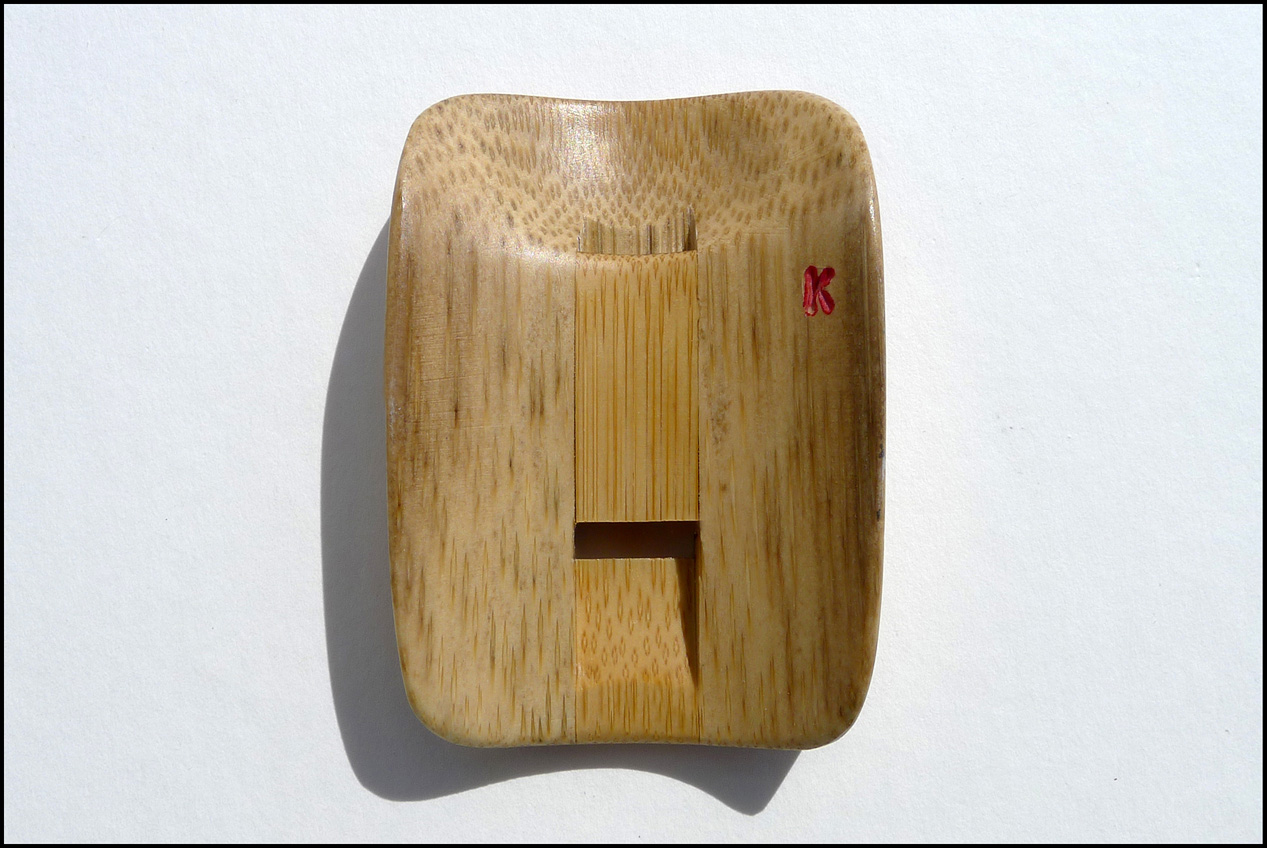
The third one has a more « traditional » look, with its almost raw spotted bamboo, and using the node as a decorative line. This one is painted in green on its internal side.

This one has an incredible design. It's a thick wood slice, with a raw band of bark as a contour. One side is flat, showing the wood rings, and the other is a real ergonomic wood carving. Awesome.
There is a copper one, and a brass one. Both are made almost on the same design, but the brass one has got a shorter air-duct, thus forming a taller mouth-cap. The design of these flutes is incredible : absolutely « technical » (nothing superfluous), but at the same time in a pure Japanese design tradition. The very small oval nose air-hole, the air-duct, circular at one end, and tappered at the other, the curves and the angle... everything is perfectly drawn, and looks like an ikebana flower.
Those two are the fruit of an experiment by Master Katada. The deal was to make a flute with everyday life materials and simple tools, and thus, offering the possibility to everyone to build a nose flute « in the kitchen » (the template and technique was diffused on Ki Kanban's blog). Hence, those flutes are made on tin plate, a plastic straw for the air-duct, and then recovered by flower pattern thin fabric or a playing card.
I don't know which wood are these two flutes made of, but they are very light. The light color one is incredibly featherlight (19g). They are simple, but really well made, with a nice carving work in the inside.
The shape of those is quite the same than the single wood flutes one. But they use beautiful exotic woods. The « checkerboard » one is absolutely stunning, and offers amazing patterns when carved...
All the flutes by Katada Kunio are stamped with a « K », oftenly enhanced with a touch of red color.

Now, it is time to say that Master Katada is a « sensual engineer ». He is an engineer, because the technical part of his flutes is remarkably precise and well done. The air ducts are very thin, and the double cutaway labiums (labia?) are sharp and hard, leading to very precise and loud nose flutes.
But Master Katada's hanabue are also pure sensual objects. The ergonomic carving is doubled by a sharp « shape feeling ». The little instruments look like wooden pebbles in you hand.
Added to a special care given to the choice of the materials, and you understand why Mr. Katada is a master.
Just take a look (click to enlarge!):


For sure, the nose flutes by Katada Kunio sound very well...
[some sound samples will be posted quite soon]
Ki Kanban's blog (in Japanese)
Ki Kanban's blog (translated by Google Translate)
A previous post of this blog about Ki Kanban's blog

But Kunio Katada is also a very generous man who reveals all what other would call secrets in his blog, sharing all the fabrication details.
So, yesterday morning, I received an incredible present from Master Katada : a sample box with no less than 12 nose flutes, very representative of the variety of his production. I was speechless...
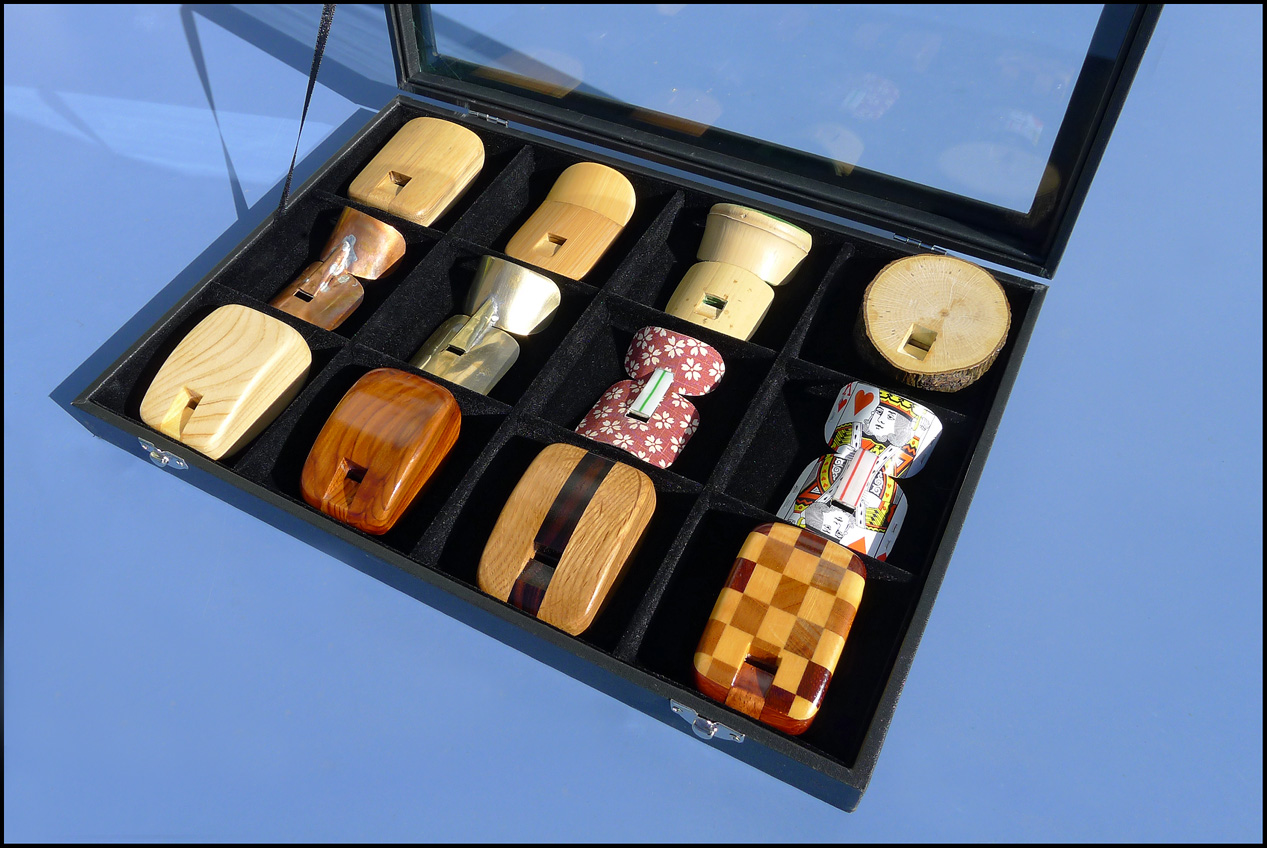
The pack contains 3 bamboo flutes, 1 in what I suppose to be boxwood, one in copper, one in brass, 2 fancy in can tin, 2 in single wood and 2 in wood mix.
The bamboo flutes
Mr. Katada sent me 3 different models. Two are made in a very smooth and regular bambo : one is a compact pebble and the other one has got an angled nose-cap.
The third one has a more « traditional » look, with its almost raw spotted bamboo, and using the node as a decorative line. This one is painted in green on its internal side.

 |  |
 | |
 |  |
 | |
 |  |
 | |
The Boxwood flute
This one has an incredible design. It's a thick wood slice, with a raw band of bark as a contour. One side is flat, showing the wood rings, and the other is a real ergonomic wood carving. Awesome.
 |  |
 | |
The metal flutes
There is a copper one, and a brass one. Both are made almost on the same design, but the brass one has got a shorter air-duct, thus forming a taller mouth-cap. The design of these flutes is incredible : absolutely « technical » (nothing superfluous), but at the same time in a pure Japanese design tradition. The very small oval nose air-hole, the air-duct, circular at one end, and tappered at the other, the curves and the angle... everything is perfectly drawn, and looks like an ikebana flower.
 | |
 |  |
 | |
 |  |
 | |
The fancy flutes
Those two are the fruit of an experiment by Master Katada. The deal was to make a flute with everyday life materials and simple tools, and thus, offering the possibility to everyone to build a nose flute « in the kitchen » (the template and technique was diffused on Ki Kanban's blog). Hence, those flutes are made on tin plate, a plastic straw for the air-duct, and then recovered by flower pattern thin fabric or a playing card.
 | |
 |  |
 |  |
The single wood flutes
I don't know which wood are these two flutes made of, but they are very light. The light color one is incredibly featherlight (19g). They are simple, but really well made, with a nice carving work in the inside.
 | |
 |  |
 | |
 |  |
 | |
The wood-mix flutes
The shape of those is quite the same than the single wood flutes one. But they use beautiful exotic woods. The « checkerboard » one is absolutely stunning, and offers amazing patterns when carved...
 |  |
 | |
 |  |
 | |
All the flutes by Katada Kunio are stamped with a « K », oftenly enhanced with a touch of red color.

Now, it is time to say that Master Katada is a « sensual engineer ». He is an engineer, because the technical part of his flutes is remarkably precise and well done. The air ducts are very thin, and the double cutaway labiums (labia?) are sharp and hard, leading to very precise and loud nose flutes.
 |  |
 |  |
 |  |
Added to a special care given to the choice of the materials, and you understand why Mr. Katada is a master.
Just take a look (click to enlarge!):


For sure, the nose flutes by Katada Kunio sound very well...
[some sound samples will be posted quite soon]
Ki Kanban's blog (in Japanese)
Ki Kanban's blog (translated by Google Translate)
A previous post of this blog about Ki Kanban's blog

Subscribe to:
Posts (Atom)