This blog is dedicated to the sublime instruments called nose flutes and which produce the most divine sound ever. We have chosen to discard all the native models from S. Pacific and Asia, for they need fingering to be played. We'll concentrate on "buccal cavity driven" nose flutes : the well patented and trademarked metal or plastic ones, plus, by a condemnable indulgence, some wooden craft or home-made productions.
In 5 years, Japan has become *the* country — I mean the paradise — for nose flute lovers. Many player, organizations, events like perfomances, shows, exhibitions, competitions, radio and TV broadcasts... and even more: a number of nose flute craftsmen, amateur or professional, that grows from day to day, from the first hanabue maker Hiroaki Sasaki, to the psychedelic Akio Takamura & Go Nagayama, with the inventive Kunio Katada, the carpenter Takuma Ikeyama, and a rather newcomer, Yoshihiro Sawada, aka "RON".
Yoshihiro Sawada, photo by Yu Takagi:
I contacted Mr. Sawada in 2012, I think, with the purpose of ordering some of his very recognizable clay nose flute — they've got a pair of eyes with lashes painted on them — but RON answered me something like "I'm am sorry, I'm not totally satisfied, I have to work more on them".
After I recently saw that RON nose flutes were sold at some hanabue exhibitions, I contacted Yoshihiro and asked again. I made my market among the ones that were still available, but at the moment to ask for the price, I got no answer. I tried again to ask, and was answered « these nose flutes are a gift for you ». WOW!!!! What a great gift!!! Thank you a lot Mr. Sawada!
What I received were not only the 5 initial nose flutes I wanted to order, but also 16 more nose flute, ingeniously made from cardboard. Because Mr. Sawada has also designed several brillant (easy to build / efficient when played) cardboard nose flute templates. And besides the clay, he also works the wood...
1 - Paper Family 1
Among the numerous nose flutes I received from RON, there are several "families" of cardboard flutes. The first group looks to be named w15 and is composed of 8 different sizes — from 3 to 10 — dedicated to the different physiognomies, from little children to tall giants. In fact, Mr. Sawada, as written in the title, follows an ergonomic approach, notably regarding the distance between the nostrils and the mouth.
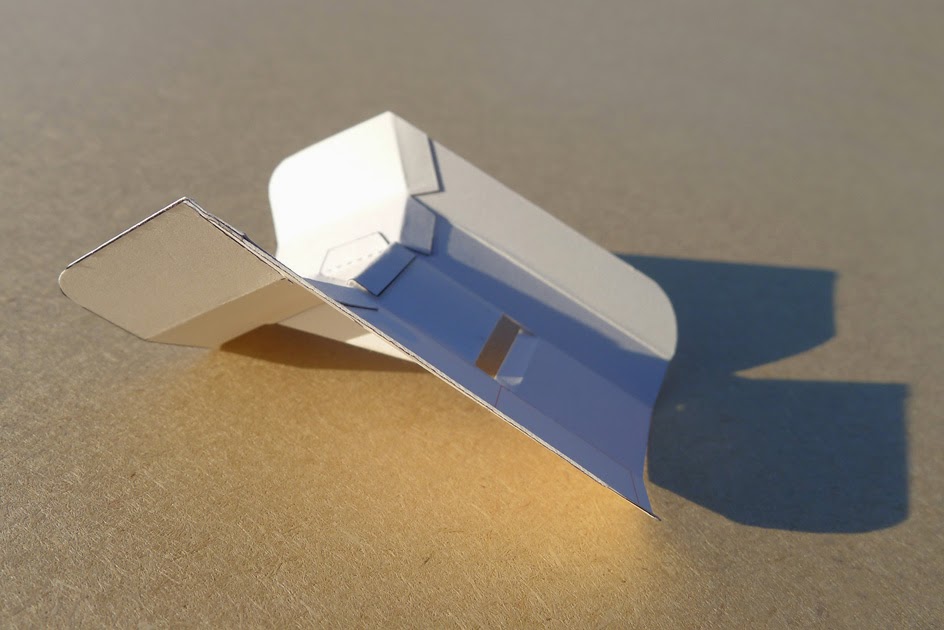
The w15 has simply been printed on cardboard (Japanese post cards!), precisely cut and glued. And As yu can see, it is a clever model, in that that it doesn't need a PhD in fine arts to mount it: it's an easy-to-build noseflute. The labium is even adjustable, the airway is prismatic — thus providing the requested Venturi effect of air acceleration —, the nose saddle is comfortable and... and it has a great and funny look with its pair of eyes!
The difference between the small and big sizes really appears on the length of the airway, as the top and bottom parts of the flutes remain the same. Thus, the angle that the airway cover makes with the body dramatically increases with the shortest sizes. Also, since the airway length varies, attack does accordingly (the shortest provides more attack). That's also the reason for an adjustable labium, since the air angle depends on the flute size. All of that was very cleverly thought and designed.
Finally, on the shorty, the space left to place the eyes is very small, just under the nose saddle, and so, the baby looks a bit angry :)
2 - Paper Family 2
Yoshiro Sawada also sent me the four sizes of an even clever cardboard nose flute he designed. Why "even clever"? Because this model is the simplest possible (I guess) template one could achieve: 2 parts, 6 foldings, 1 hole and only 2 points of gluing. It is declined in the sizes S, M, L and LL.
On this model, the airway is not "external" but "internal": it is a piece of carboard which is used to form a trapezoidal frustum shaped airway, and at the same time is used as a "bridge" to keep the nose flute in its folded shape. Once again: very clever!
3 - Other paper
On the same system but with broader lateral "wings", RON made decorated nose flutes, either printing text and images on the template, or using photos, producing beautifully customized hanabue.
Sensei Mosurin was yesterday the guest star of Club Parrhesia. As far as I understand, the Club Parrhesia is a weekly online broadcast animated by a Japanese band of musicians. It was the 169th broadcast of this program and it was 2 hours and a half long!
So, I picked the footage where Mosurin plays (beautifully, as usual) or talks about hanabue. Here it is:
It's the opportunity to show you the new Mosurin's nose flute. The sensei still uses his indestructible Sasaki hanabue (the little ceramic mask) mounted on its special stand, but also regularly plays a very peculiar wooden nose flute, with an extra-long nose (and that he, apparently, now owns in 2 versions):
This nose flute was acquired at the great Nose Flute Exhibition that was held in June in Saitama, where many nose flute makers were present. The Long Nose was made by Happy Flute. Happy Flute, once again as far as I was able to understand, seems to be a kind of funny and happy joint venture between several makers (and friends), like Akio Takamura (ceramist/potter), Go Nagayama (great painter/designer on nose flutes), and some others (notably a wood craftsman...) that I have not yet been able to identify...
Happy Flute booth at some summer market, with a framed Noseflute.org postcard (HanabuElvis!). What an honor!
I finally made the cut of 4 videos from last Summer RAOUL sessions (Rassemblement Alcoolisé Obligatoire des Ukulélistes Libertaires : "Libertarian Ukulelists Alcoholized and Mandatory Gathering"). There are nose flute playing in 3 of them, but I particularly recommend the "Part 2 : Public Concert" (an audience of... 10 people:), which opens on an excerpt with nose flute, lute and baroque viol (the Nosy Diva, LuthVal and Hélène). But Part #3, the one without nose flute, is a little gem!!!
A cool video... (well, no.. a slideshow) by ラッキー兄妹マウンテンマウス ("Lucky Brother & Sister of Yamaguchi ("the Mountain Mouth"). Nice music (Disney movie theme, totally reinterpreted), very well played nose flute, with sensibility, great guitar too... What more to say?
I just had the opportunity to buy some vintage "Swan logo" Weidlich & Lohse Nasenflöten, all the same color, never used ("New old stock"). The seller told me he found a bag full of them, in an old german warehouse that closed in the early 1980s. Compared to the other stuff left in the store, they should date, according to the seller from 1965-1975. My opinion is that they were probably produced between 1960-1970...
Don't they look like fresh Beetles waiting in front of the Volkswagen plant?
On a objective point of view, there should be no difference between a vintage and a modern Schwan nose flute: both are made of plastics and from the very same mould. So what? Do plastic nose flutes age and mature like wine or ukuleles? No. But if you take the time to look closer, there is a bunch of differences between "genuine" Weidlich & Lohse swan flutes and the current chinese production.
We previously had some discussions on this very topic on this blog, but I made some mistakes in the former posts. So it's time to make a new scan of our knowledge [please check here and here the former analysis]
Notably regarding the mould for chinese production, that I thought to be a copy of the genuine one: in fact, it's the german mould that is used in China. There are some tiny artefacts that were present originally on the W&L nose flute that still appear on the chinese one. For instance, these two tiny dents that were unintentional in the typo:
I used to think there were 3 different periods in the Schwan production, with an intermediate one between the original flutes and the chinese production. This is my first amendment: the were (at least) five! W & L closed their factory and (supposedly) left Göttingen at the end of 1959, probably in order to occupy a bigger manufacture (until then, they were based in a small workshop). But... I don't know if there were quality differences between the nose flutes produced in Golden age I and II: maybe the delocalisation didn't impact the production (same machines and moulds, same plastics...).
Also, I found there were 2 intermediate periods.
1955 - end of 1959
Golden age I - Weidlich & Lohse, Göttingen.
1960 - Late 1960s/Early 1970s
Golden age II - German prod., who ? where ?
Late 1960s/Early 1970s - Late 1970s
Intermediate I - German prod. Plastic change.
Late 1970s - 1985
Intermediate II, then end of German prod.
±1997 - current
Chinese production
Catching at a glance the differences between a early production vintage Schwan and a modern chinese one is easy: the plastics and the quality of finitions have nothing to compare!
Now, the question is a bit more subtle to differenciate (and thus dating) a Nasenflöte from the intermediate periods. Let's scan the points of comparison.
1 - Plastics
The plastic used for the german production was polystyrene (which is a good quality of material for sounding instruments). But there are several quality of PS(polystyrene), with different characteristic (sounding and resonance, weight, shrinking rate while cooling, ...), and the "intermediate periods" notably correspond to a change of PS type. If you could hold the different Schwan in your hands, it becomes obvious that the plastics are not the same. The Chinese production do not use PS at all, but probably Polypropylene (PP)or Polyethylene (PE).
The plastic used during the "Golden age" is shiny but opaque.
The plastics used during the intermediate times are rather dull - let's say "satiny" - and opaque.
The chinese flutes use a shiny but somehow translucent plastic (depending on the color).
Here is the weights measured on each model (again, I have only one type of "Golden age" flute, that I suppose to be GA II, without being 100% sure):
Golden Age
7.40g
Intermediate I
7.68g
Intermediate II
7.36g
Chinese prod.
7.34g
So, all of them weigh rather the same, with a slight difference for intermediate II. 0.3g (4% discrepancy) may look very few to ascertain a difference between InterI and InterII, but other points allow us to distinguish periods I and II, as we will see.
Here is the thickness measurements made with a Palmer at the same point of the flutes. This test helps to evaluate the plastic shrinkage (remember those flute were injected in the same mould) and thus, to determine if the plastic used is the same or not.
Golden Age
1.27mm
Intermediate I
1.10mm
Intermediate II
1.47mm
Chinese prod.
1.45mm
On the thickness test gives more visibility to discriminate between plastics. This time, the difference between InterI and InterII is huge: 33%! The same plastic injected in the same mould with the same process can't provide such a difference (Ask Mr. Schuermans!). This is the proof there really were (at least) two intermediate periods.
The ratio Weight/Thickness (kind of density test with no unit) increase the difference even more:
Golden Age
W/T = 5.8
Intermediate I
W/T = 7
Intermediate II
W/T = 5.0
Chinese prod.
W/T = 5.1
(With these figures, the InterII and the Chinese schwan look very similar, but are totally different on their visual aspect)
To differenciate the nose flute plastics, I like to use a sound test. It is very unscientific, but I think it tells a lot to any of us, because we have in mind the associations between sound and plastic quality. Here are samples, made at the same conditions: letting a nose flute falling on my desk from 10cm:
Golden Age sample:
Intermediate I sample:
Intermediate II sample:
Chinese prod. sample:
Golden Age
med/high tone - good resonance
Intermediate I
medium tone - very dull sound
Intermediate II
medium tone - medium resonance
Chinese prod.
high tone - low resonance
2 - Labium
Checking a Schwan labium is the easiest way (at a glance!) to determine which period the flute dates from, in association with a check of the "nose shield stigmata" (see next point).
Indeed, that the origin, the labium was obviously designed as a regular sharp angle, with an edge parallel to the line the mouth shield line. The mould, fresh and new in 1955 (and the good quality polystyrene injected there), was able to produce such sharp angle, with a clean result. But with the time and the millions of schwan nose flutes, the state of the mould deteriorated (I suppose the part that makes the labium is a moving part...) and the labia produced became more and more irregular. The edge of the labium lost more and more its parallelism to the shield line.
The degradation phenomenon is already visible at the Intermediate periods: a bit crappy but still parallel for InterI, crappy and with an angle at InterII, then really crappy and very unparallel and even not rectilinear in the Chinese production.
One point is interesting: the labium production small "stigmata" are *exactly* the same from intermediate periods until Chinese production. Same shape, and same 2 tiny pimples. But the Golden age flute, yet not exempt of this kind of stigmata, shows a totally different arrangement, with a group of pimples on the right side. I have no explanation. Such a constant distribution of pimples after the initial production is the sign of an artefact that didn't appear at random. Was it due to a change of production method?
Golden Age
straight and clean labium - group of pimples on the right
Intermediate I
straight labium - couple of pimples on the left
Intermediate II
flimsy labium - couple of pimples on the left
Chinese prod.
flimsy and wavy labium - couple of pimples on the left
3 - Nose shield
A second point can easily be looked over to help dating (in coordination with the labium check): the nose shield stigmata.
The inside of the Golden Age nose shield is perfect and clean of any stimata. Intermediate I too, but the top edge of the air entrance are not smooth anymore. Intermediate II has a very recognizable artefact: a tiny circular depression (corresponding to the location of a mould air-hole in the inside of the flute). InterII air hole is coarse edged too. And finally, the chinese nose shield is *systematically* torn by a tear-shape hole where the airway cover joins the nose shield (+coarse edges air hole)
Golden Age
no stigmata - smooth top edge of the air-hole
Intermediate I
no stigmata - coarse edges of the air-hole
Intermediate II
tiny round depression - coarse edges of the air-hole
Chinese prod.
tear-shape hole- coarse edges of the air-hole
4 - Venting points
I call them venting points, but I'm not sure they are; I talk of the 4mm diameter round shapes appearing twice in front of the Schwan, plus one hidden by the air cover. The air cover shows one too.
The concept of venting is simple: provide many pathways to allow trapped air and volatile gases to escape from the mold quickly and cleanly. The pathways should lead directly from the edge of the cavity image of the mold, or through ejector and/or core pin clearance holes, to the outside atmosphere surrounding the mold. These pathways need to be deep enough to let air and gases out easily, but not deep enough to allow the molten plastic to escape through them. http://www.plastictroubleshooter.com
As we can see in the picture below, the Golden Age schwan may have salient or concave venting points. On any Intermediate periods Schwan I know (including the Piet Visser's ones), the points are salient. And the chinese factory produce almost flat points, sometimes slightly convex, sometimes slightly depressed.
Golden Age
both convex and concave venting points
Intermediate I
convex venting points
Intermediate II
convex venting points
Chinese prod.
hardly convex or hardly concave venting points
5 - Edges
As for the labium, the edges seem to get coarser and coarser with the time. The Golden Age ones are smooth and clean, and immediately from the first intermediate period, they become rough. The chinese ones look even worse because of the glue in excess that overflow the plastic and even make bubbles.
Golden Age
smooth edges
Intermediate I
coarse edges
Intermediate II
coarse edges
Chinese prod.
coarse edges and glue
---
It is now possible to draw a Dating chart for the Schwan: