This blog is dedicated to the sublime instruments called nose flutes and which produce the most divine sound ever. We have chosen to discard all the native models from S. Pacific and Asia, for they need fingering to be played. We'll concentrate on "buccal cavity driven" nose flutes : the well patented and trademarked metal or plastic ones, plus, by a condemnable indulgence, some wooden craft or home-made productions.

Jul 15, 2014

R. Crumb & G. Shelton: Two of Us!!

Our friend Will Grove-White – honorable member of the UOGB and fellow in nosefluting – had the opportunity to offer a Bocarina and initiate to our instrument the two most famous American underground and psychedelic comics authors: Robert Crumb and Gilbert Shelton!


Gilbert Shelton, among many other characters, is known as the father of The Fabulous Furry Freak Brothers and Fat Freddy's Cat adventures.


Robert Crumb became famous with Fritz the Cat and Mr. Natural. He drew a huge quantity of albums. We already had the opportunity to publish here the portraits R. Crumb made of Lloyd Buford Threlkeld and his Jug Band.


So, thanks to Mr. Grove-White, the Noseflutistan is honored by the initiation of two new honorable fellows! Will Grove-White had no opportunity to immortalize the Gilbert Shelton's first notes, but made a video with the kind complicity of Robert Crumb. Here it is, with Big Thanks to Will! Congratulations to the new noseflutists!

Jul 13, 2014

Schwan Special Colors

As mentionned earlier, the "Swan logo" nose flute was patented and produces by Weidlich & Lohse, in Göttingen, from 1955. The German production stopped around 1985 and started again in China (probably for Stölzel, Germany) from around 1997.
The moulds seem to be still the original ones (as we saw here), but type of plastics has changed (the overal quality has really decreased) and the vintage colors have been replaced by 6 flashy ones : white, yellow, purple, green red and dark blue.

However, when they change the colors in production at the factory, it always happens that a series of rare colors are produced, resulting of the mix of the former PVC pellets and the new ones. Sometimes, even rarer, some great swirled marblelized colors appear (see this beautiful sample owned by Mr. Mei). Instead of throwing the parts away, as rejects, the factory assemble those rare Nasenflöten. And when you buy a big bag (100 or so) of the regular flutes, you may get one or two of those collectors.

I found a German "source" where they put aside those little monsters when they appear in their shop, and they kindly accepted to sell their stock of intermediate colors at the regular price.

I was so glad to discover a yellow-translucent body and a swirled red top!


Look at this gradation from yellow to red (there is no orange color in the regular production):


Indeed, the regular Swan color chart is very poor, flashy, vulgar (exhaustive chart):


Now look at those intermediate production colors (just a sample):


Very near the vintage Schwan tints, aren't they? (just a sample here too):


---

On the same topic :

- About the "Swan logo"... Part I
- About the "Swan logo"... Part II
- About the "Swan logo"... Part III
- "Swan logo"... Identity revealed!
- Much more about the Swan!
- Schwan Special Colors
- Vintage Schwan - Forensics and Dating

---

Jul 12, 2014

Fuppy and the book "鼻笛って楽しいね" - PARTS 2 & 3


Sequel of the post Fuppy and the book "鼻笛って楽しいね" - PART 1

PART 2 - The CD

As we already wrote in the first part, the CD contains 26 tracks, split in 3 sections: songs 1-7 are for "nose flute training in the mood for a walk", selected to be played "while dancing". The 8-13 are dedicated to "Nutrition - nose flute relaxes the mind" (google translation:). All of them supervised by sensei Mosurin, for sure. And the last 14-26 songs form a selection of tunes in a nose flute karaoke mode. They were recorded by the famous japanese band Begin.

The CD songs are obviously dedicated to a young public.

1 The Echo
2 C-D-E Song
3 Chiyorachi
4 The Bear in the Forest
5 The Toy Chiyachiyachiya
6 Under the Trees of a Large Chestnut Grove
7 Summer Memories
8 El Condor Pasa
9 Edelweiss
10 Home
11 Beach Song
12 Tears
13 Koyake Sunset

14-26 Karaoke mode


The CD got the benefit of a high quality production, with elaborated arrangements (with a bad sounding synthesized flute, though) and very good recordings. You certainly wouldn't listen to it alone, but it surely provides a great accompaniment for practicing your nosefluting. The first tunes begin with some step noises as rhythm indications. Yes, music for children, but really not so cheesy, thanks to the rock'n'roll soul of Mr. Higa SakaeNoboru the sanshin/guitar player of Begin.

Here is a short excerpt:


As announced, the 8 to 13 songs are intended for mind relaxation, and are no more especially "children oriented".

Here is the beginning of El Condor Pasa :


Finally, the songs 14-26 are the tracks of the 13 songs without the flute melodies, in order to play nose flute over them, in a karaoke mode:


PART 3 - Fuppy

Fuppy is the sweet little name given to the child-sized ABS plastic nose flute embedded with the book. It is also called "Begin nose flute", as it is more or less endorsed by the Japaese band Begin, or "Adachi nose flute" from the place near Tokyo it was designed by Mr. Katada [please refer to this post for more info].

From the prototypes Mr. Mosurin had sent to us, only the color changed. When you buy the Happy Nose Flute book, you can set your choice on a white/very light grey Fuppy, or a dark chocolate one (the prototype was ivory/butternut).

As we previously shown in the prototype review, the main innovation in Fuppy's design is its ability to be easily opened in order to clean it. I guess this is a very important feature for parents buying a "nose" flute to their child (so few people know that our nose is much more cleaner, on a bacterial point of view, than is our mouth...).


On the sound side, as we wrote in our review (nothing has changed!): the Adachi-beginner reveals itself to be a great player! The tonality range is equilibrated, sharp oriented though. It is easy to produce precise sounds. The airway is short, and the notes are neat, the changes, immediate. Adachi is very sensitive, allowing series of quick notes. Very few air is needed to make the instrument whistle. Any effect, like tremolos or vibratos, are really easy to produce. I must say that this flute is a hi-end instrument.

Here is some sound samples:


Jul 1, 2014

Fuppy and the book "鼻笛って楽しいね" - PART 1

It's been a long long time I wanted to get and review the japanese book entitled 鼻笛って楽しいね!~だれでも吹けて、心もカラダも元気になれる不思議な楽器~, which can be translated, more or less, by Nose flute is fun! ~ Anyone Can Blow A Strange Instrument And Be Able To Get Well In The Mind And The Body. It is accompanied by a CD and a small plastic nose flute.

It was not so easy. I had to find a webshop in Japan that was "Google translatable" and that accepted foreign orders and easy payment. I didn't find. So I had to subscribe to a japanese shipping redirection company, in order to get a japanese address (Tenso.com) Then I had to scan all the pages, and compute them with an OCR software, and then translate the paragraphs one by one within Google. Ouch. I cannot say I was able to understand more than the global topics :)

---

Nose flute is fun! was originally published on May 1, 2013, by Amuse Co., Ltd (Tokyo) and has no official unique author: it's a corporate book produced by a team of redactors, designers, photographers, illustrators and experts. Its 48 pages are definitely "children oriented" (the size of the nose flute too) but contains lots of very interesting topics for adult players.

The pack book/CD + nose flute comes bundled with a cellophane band gathering a cardboard box and the book. The box displays the nose flute through a little window, so you can choose the colour you want : white or brown.

PART 1 - The Book

The book is nicely printed and full of nice, clever and funny illustrations (drawings, figures and photographs). It is structured in a logical sequence: the nose flute and how to play it, interviews of nose flute musicians, techniques and exercises, other info.

Contents:

Let's blow the nose flute4
Let's play music (with the CD)6
I will teach you Fluppi secrets8
Interview: Higa SakaeNoboru10
Interview: Mosurin16
Fluppi's fellows22
Get healthy with the nose flute24
Exercises using the nose flute32
Funny and fashionable handmade nose flute bags      40
Wheel of "Happy" spreads the nose flute42
Nose flute exploration44

Let's blow the nose flute

This introductory chapter naturally explain how to get a sound from Fuppy, the sweet little nose flute provided with the book. Regular technique :

(...) First, press the nose lightly into the big recess on the inside of the whistle. Next, open the mouth in the form of when you say "Oh", and lightly apply the bottom edge of the flute over the lower lip. Nose flute is held diagonally at this moment, please be careful that there is no gap at the top of the nose flute. (...)


Let's play music (with the CD)


This part explain that the songs 1-7 are for "nose flute training in the mood for a walk", selected to be played while dancing. The 8-13 are dedicated to "Nutrition - nose flute relaxes the mind" (google translation:). All of them supervised by sensei Mosurin, for sure. And the last 14-26 songs form a selection of tunes in a nose flute karaoke mode. They were recorded by the famous japanese band Begin.


I will teach you Fuppy's secrets


Here we learn that the nice and sweet little nose flute provided with the box is named Fuppy (フッピ).
The baby is made of ABS plastic, and has been especially designed in order to be cleaned easily by opening it in to part (see Fuppy's review)


Interview: Higa SakaeNoboru


Long interview of Mr. Higa SakaeNoboru, AKA Higaeisho, from the band Begin. Begin is a very famous J-Pop band from Ishigaki island (Okinawa prefecture). Their sound contains many elements of traditional Okinawan Music, and prominently features the sanshin. The band is linked to Amuse Co., which produced this book and the nose flute.
Higa SakaeNoboru (sanshin, vocals,...) is also a nose flute player.
In the interview, Higaeisho tells how he came to nose flute, why he likes the hanabue and that he wants to spread nose flute playing.

Interview: Mosurin

"I think that it is good to spend my remaining life with nose flute". We learn that sensei Mosurin performed 200 times in 2012! His love of music began very early: they had 5 or 6 nursery rhyme books at home and the little child was used to asking every day his mother to sing. Then he became soloist athe elementary school choir.
In 2001 he met the nose blute by chance.

Then Mosurin tells a quick history of nose flutes, mentionning the metal Humanatone, then the german plastic Nasenflöte, and it seems (as far as I can understand) that Mosurin thinks that the german nose flute came from Brazil (In fact, the plastic Schwann is the direct continuation of the metal nose flute produced in Brunndöbra [see here], which was an indirect steal of the Humanatone).

Mr. Mosurin also describes other nose flutes coming from abroad, mentioning the Vietnamese production, and even a recent model produced in South Africa (the Bocarina, for sure).

We also learn that Mosurin practice nose flute 3 hours a day. Then, the master deals with students and classrooms.


Fluppi's fellows


This double page shows nose flutes made of different materials (wood, bamboo, clay, plastics), all coming from Mosurin's own collection.


Get healthy with the nose flute


This important chapter explains how "Nose flute is connected with nature" and how its practice is good for your health. It describes the breath in detail, notably putting the stress on the two kinds of breath, thoracic and abdominal. Exercises designed & Explanations: Tsuhako Hirono (health exercise guidance officer).


Captions:
It will inflate the lungs movement of intercostal muscle thoracic breathing (left)
It will inflate the lungs movement of the diaphragm abdominal breathing (right).


The conclusion is that « Advantage of thoracic breathing is that posture is improved ».
And that « The abdominal respiration, which can lower the diaphragm, to capture a lot of oxygen astride the lung, there is also a happy effect for the body.
The organization of the tip of the lung, there is a thing called alveoli shaped like a bunch of grapes. There are capillaries in the alveoli, we are to replace the carbon dioxide made in the body oxygen and therefore incorporates by breathing the "gas exchange", but that they take in oxygen a lot, from the capillaries of the alveoli component which has the effect of widening the blood vessels » (Google translation...)

The chapter is very detailed, and funnily illustrated, providing exercises to train your breath.


Captions:
Check the health of the lung
You see the difference in the measured chest circumference measure.
The difference when I exhale and when I inspire:

5 cm or more - - - - Very healthy
4 cm ~ - - - - - - - - Hey hey health
4 cm or less - - - - Chest a bit small
About 1 cm - - - - - It is recommended that you consult a doctor


Exercises using the nose flute

Thischapter is also very important (in size and in matter) and really can be useful for any nose flute player, even experimented. It describes numerous exercises *with* the nose flute, in order to improve breath and quality of sound.

Captions of the right image:
8) I train the postural muscle
To strengthen the body in the trunk and his breath

① In abdominal breathing, you can float a little back and breathe through the nose.
② Press the floor at the waist to put a force on the abdominal muscles while sounding the nose flute.
③ Repeat three times slowly back to ①.


Funny and fashionable handmade nose flute bags


This double page shows handmade pouches and bags for carrying your nose flute.


Wheel of "Happy" spreads the nose flute


Several articles relating actions that have been made in order to spread nose flute playing, notably by the Poppokopi organization. The Ninth Symphony event (with 100 nose flutists).Exposition of the different Japanese hanabue organizations.


Nose flute exploration


This part is a "scientific" exploration of the nose flute, with Q & A. For instance :

Q - How much big sound come out the nose flute?

A - (...)
① If you blow normally alone in the room : the average maximum is 60~68dB.
② If you blow wearing a mute, sound is measured at 50dB in average.
③ If you blow in the bathroom, the sound gets an average of 55dB (highest 65-69dB)
④ If you blow in the car*, the sound gets gloomy: average 43dB - highest 47dB

* However, since there is a possibility that attention may become distracted, thinking judgment becomes dull lack of oxygen, please do not wipe absolutely nose flute while driving while driving!


---

The book "鼻笛って楽しいね" is, as far as I know, the first book *entirely* dedicated to nose flute ever published. In that, it must be lauded and hailed. As especially dedicated to beginners and children, I thought my interrest would have stopped here. But whether this work is a real good initiation to nose flute for newcomers, it contains a huge bunch of interesting and useful info, exercises, etc. Thus, I do recommend it to any nose flute player, even non japanese (because most of the drawings are self explanatory). More, the CD and the Fuppy nose flute are ngreat goodies (beware however: Fuppy has a small size)

---


OK. Where to find it? How much?


If you have a japanese address (or friend:), it's easy:
when you type "鼻笛って楽しいね" in Google you will find many shops which sell the book, including Amazon.co.jp or Rakuten.ne.jp.

I would recommend Asmart.jp because they are part of the project of this nose flute bundle:
http://www.asmart.jp/Form/Product/ProductDetail.aspx?shop=0&cat=600608&swrd=&pid=10005566&vid=

The raw price is (at Asmart): ¥2,571 taxes included.
to that, you have to add shipping (to Japan) ¥756 (free shipping if you buy 2)
Total cost: ¥3,327, that is around $33 / €24

If you don't have a japanese address, it's difficult:
1) you need a japanese address :) there are companies dedicated to provide a japanese address to their subscribers, and to redirect what's ordered in Japan to the rest of the world (e.g. tenso.com). This is expensive, but it works.

2) you need to google-translate the shop page

3) you'd better have a Paypal account (Asmart accept Paypal).

---

>>To Parts 2 & 3

Jun 28, 2014

Badinerie and Summertime by the Nosy Diva

Photo by Florian Graser

Two new short videos by The Incomparable Nosy Diva, who performed at Michaeliskirche in Hannover (Germany) for the concert Sommer in Michaelis, with the Instrumental ensemble Ricklinger Kantorei directed by Mr. Roland Baumgarte. After having performed as a viola player in the Vivaldi program, the Diva offered the public two pieces at the nose flute: Summertime (G. Gerschwin), with the musical ensemble, and Badinerie (J.-S. Bach), as a duet with Raissa at the cello. Great show!

Badinerie


Summertime

Jun 26, 2014

More Cardboard!

Thanks to Claudio Valente, a musician and whistle collector from the Venetia region of Italy, I got aware of the existence of a 1989 book published in English, German, Italian and French. It is called Paper Music, Papier Musik or Musique en Papier, and written by Howard Harrison (Collins for UK, Tessloff for Germany, Paoline for Italy and Gallimard for France, first published in 1987). It proposes to build 10 cardboard musical instruments among which two nose flutes.


The book contains regular paper pages with history, instructions and melodies, plus precut and printed strong cardboard pages. The deal is simple : press the shapes to get them cut, glue them together following the instructions, and play! For sure, I decided to build one, green top and red shield (the other is blue and pink, but you can mix them differently (green/pink and blue/red)

The system invented by Howard Harrison is clever : a rounded nose hood, a rounded mouth shield, and between them, a stack of 7 rectangles, precut in a different way in order to build the whistling part. Thus, the labium is made of one cardboard blade (the middle one), proeminent in the mouth hole. The cuts of the other pieces are designed in order to provide a little air windway.


I first prepared the pieces, with the help of a scalpel to get the most clean cut possible. Then I glued the stack, easy task.

I shaped the nose hood helped by the prefolded embossed lines, and glue it onto the stack. Tip : you'd better use superglue for that task, because there is some tension in the cardboard, due to the 3D shaping.

And finally, I shaped and glued the mouth shield.

I immediately chose to spray a coat of varnish, in order to protect the flute and get it more rigid (including the fipple). The result is very elegant!


The playability is correct, according you have opened a bit more the air entrance on the whistle stack, and that you seriously pinch the nose hood in order to lessen the air leaks. And the sound is very decent! Yet soft, but a nice woody colour


The great UkeVal / LuthVal made one too, and did this cool video:


---


The book Paper Music seems to be out of stock in English, French and Italian, but I found my english sample on Amazon, used (but complete) for €2.99.
The german version, Papier Musik, is still available new at Dan Moi, for €18.50. You can get it here : http://www.danmoi.com/musical-instruments-papercraft.html

Jun 22, 2014

Don Luis and his two hobbies

As the World Juggling Day coincides with the International Nose Flute Day (June 14), our friend and nose flute amateur from Mexico Don Luis has decided to produce a short video in which he combines the two hobbies! Saturated sound, but funny!

Jun 14, 2014

International Nose Flute Day - NFHoF nomination

Today is the 3rd INFD - International Nose Flute Day! The 14th of June was chosen as an anniversary of the registration of William Carter's Nasalette patent, the first urban nose flute. Have you planned something specific? Are you going to celebrate this day?

---

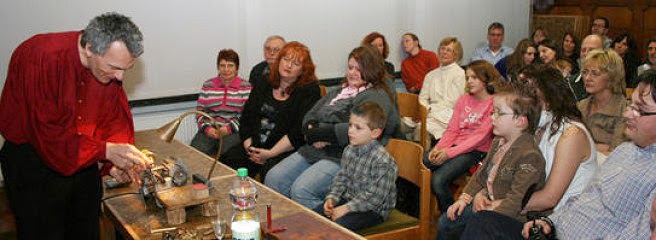
Cornelius Degen (1956-2014)

Cornelius Degen was a German storyteller and musician using nose flutes in his performances. But more than that, he was a fine craftsman - notably making wooden "magic" boxes - and an inventive nose flute builder. Cornelius built beautifully designed Nasenflöten, finely crafted, and invented a sliding air duct cover allowing one to set the global tuning of the flute, from medium to sharp. We had previously written a post about him and his work.


We just learned that Cornelius Degen passed away last February, after a long disease. We are very sad, and the nose flute world lost an active advocate of the little wind instrument. Noseflute.org has decided to nominate him as member of the Nose Flute Hall of Fame, in the "Producers" section.


The Nosy Diva, who knew him personally, wrote this little message :

I met Cornelius Degen at the Kulturelle Landpartie in the Wendland two years ago. There were always lots of people looking at the fascinating things he had made and the stories he told about them. There was a litle butterfly magically moving his wings, a little golden ball that made fairylike sound and this tall, gentle man speaking like a storyteller of the ancient times. I was so fascinated that I did not see at once he had nose flutes also, very fine, beautifully crafted instruments with interesting details.
I remember him well and I am very sad that he left us at such young age. He was a great inventor, craftsman, storyteller and a beautiful person.
Danke Cornelius to have reminded us of the magic of life and little things! For your creativity and research and craftsmanship, you absolutely deserve a place in the Nose Flute Hall of Fame!


Noseflute.org, very lately aware of the sad news, sends its whole sympathy to the family and friends.

Feb 22, 2014

Nose flute on Himalaya

A great new video shot on Himalaya (Nepal), in which Mr. Ketsuago Nyorai plays the irish song Sí Bheag, Sí Mhór with his ukulele and his wooden nose flute. Great playing, beautiful images... Note the nose flute holding system which I assume to be a modified harmonica holder