This blog is dedicated to the sublime instruments called nose flutes and which produce the most divine sound ever. We have chosen to discard all the native models from S. Pacific and Asia, for they need fingering to be played. We'll concentrate on "buccal cavity driven" nose flutes : the well patented and trademarked metal or plastic ones, plus, by a condemnable indulgence, some wooden craft or home-made productions.

Nov 20, 2012

User manuals - Part 1: Europe

Here is a series of nose flute user manuals, published either by the manufacturers/craftsmen, or by resellers. Just to have them gathered altogether. For sure, the collection is far from being complete.


Belgium

The Vociphone (François Vandervaeren) - 1912:

Enjoy the threatening Nota Bene: « Any person that would not conform to the user manual will get no sound of it. »


Switzerland

Die Schweizer Nasenflöte (Karl Wigert) - 2011:

Note that the text has been totally copied from the Handler's user manual. Even the name SchWeizer, with a capital W inside, is a reference to the Weizer Nasenflöte... (see below)


Austria

Die Weizer Nasenflöte (Heinrich Handler) - 2000:


France

Le Nasiphone/Mellibrou (René Mellier) - 2000:


La Flûte à nez (jean-Philippe Minchin) - 2000:


Germany

Nasenflöte (Max Zycha) - 1995:


Nasenflöte (Rainer Schwarze) - 2004:

Schwan Nasenflöte - From german resellers:

Bocarina - Branded by Corvus:


>>To be continued!

--

Nov 19, 2012

New german joyful duo!

Two videos by a new Nasenflöte duo! The german noseflutists, named Wallimex, just published 2 recordings, full of joy. The goal was apparently not to reach a "tonality perfection", but to enjoy fun and laughs (but it's not badly played at all!). It's a success!
Here are Bruder Jakob played in canon, then El Condor Pasa:


Nov 18, 2012

Historic Nose Flutes - Couchois' Whistle: Review

Some historic nose flutes have totally disappear or haven't even been produced or commercialized. Our goal, here, is to reconstruct them, as close as possible to the original, with the help of the patent drawings and descriptions.

[Sequel of the posts Couchois' Whistle: Drawing a template and Building the flute]

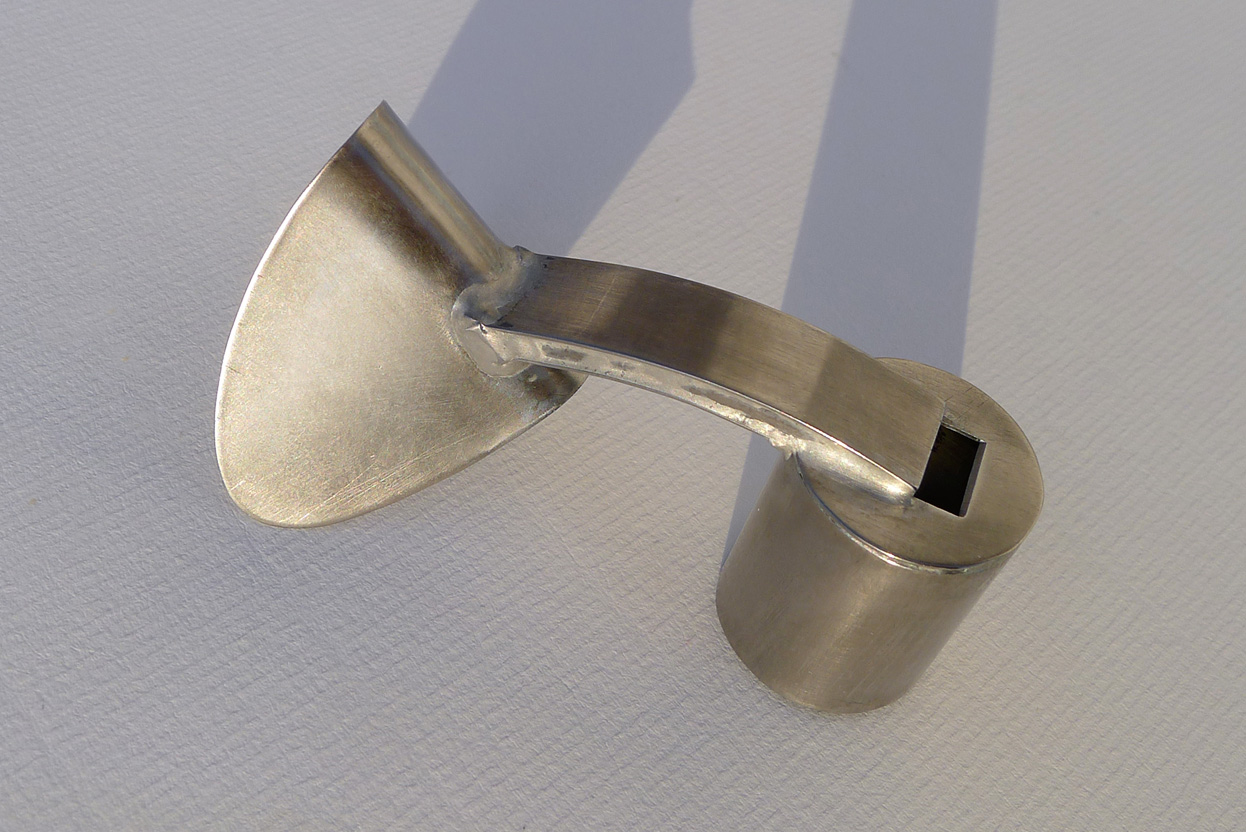
As planned, I "flashed" the Couchois' tin whistle, that is, I electroplated it with Nickel during a few minutes only. I just wanted to protect it from rust. Maybe, later I will plate it with chrome...


Well, here is the Couchois' whistle. It's a very elegant nose flute, made of 3 major parts: the nose shield, the airway and the mouth tube.


The nose shield is maybe the first of the kind. The Carter's Nasalette featured a nose hood, totally covering the nose, rather unefficient, though (air leak). Here, on the Couchois, the nose has just to rest on a saddle, which was magnifically designed. Efficient and beautiful. Looking light as a butterfly, and shaped like a flower petal, in contrast with the solid looking and simple mouth tube cylinder.
The air collector is a very small rectangle, and I was a bit doubtful regarding its functionality. I was wrong, this little square window works fine.


The air duct is great too. Because of its rounded shape, it gets thinner as it reaches the the mouth tube, and thus, accelerates the air flow, as it should be to get a clean and precise sound.


The mouth tube has been designed as a cylinder, which is much more ergonomic than the Carter's rectangular one was. However, 23mm diameter is is bit too big, according to me. As shown in the following video, this size and shape create gaps at the corner of the lips. I don't think this was made on purpose (else, Couchois would have specified it in the patent), but one can take advantage of this "feature": by quickly clogging/unclogging one of these lips gaps, it is possible to produce a tremolo.

I had to correct the dimension of the mouth hole, in order to get consistency of the patent front and side view. The front view shows a bigger hole. However, the labium is slanted (it is visible on the patent) and this was not the case on Carter's.


The overall shape, as already said, is very elegant, equilibrated and quite modern. It really could have been designed in the 1950's. The profile even looks a bit like a Star Trek starship!


--

The Sound

Partly due to the modification that I had to practice on the mouth hole, but mostly to the good-sized mouth tube which creates a big "first chamber": the Couchois' whistle has a quite sharp range.
The short airduct, thinner at its end, plus the slanted labium... all of these features produce a clear, clean and loud whistling. The Couchois' is easy to drive! On the other hand, whether you try to reach basses, the sound gets weak and doubled by unwanted whistlings.

All in all, this nose whistle is a good instrument, elegant, rather ergonomic, easy to play, with a clean sharp sound. It certainly represents a progress upon the Nasalette.

Here is a short sound sample (When I am Prime Minister, by Markos Vamvakaris):


And here a short video review:


---

On the same topic :

- Historic Nose Flutes - The Nasalette: Template
- Historic Nose Flutes - The Nasalette: Building
- Historic Nose Flutes - The Nasalette: Review
- Historic Nose Flutes - Couchois' Whistle: Template
- Historic Nose Flutes - Couchois' Whistle: Building
- Historic Nose Flutes - Couchois' Whistle: Review
- Historic Nose Flutes - Grierson's Whistle: Template
- Historic Nose Flutes - Grierson's Whistle: Building
- Historic Nose Flutes - Grierson's Whistle: Review

---

Nov 16, 2012

Snoot class!

A cool music class led by Mr Jas Ingram, AKA CaptainUkeHandles, and his mate Steve. During the session, the 2 musicians perform guitar, ukulele and... the snoot flute! Great job, guys! Don't miss the second part featuring a musical saw.

Historic Nose Flutes - Couchois' Whistle: Building

Some historic nose flutes have totally disappear or haven't even been produced or commercialized. Our goal, here, is to reconstruct them, as close as possible to the original, with the help of the patent drawings and descriptions.

[Sequel of the post Couchois' Whistle: drawing a template]

Again, I used repositionable glue to fix the template on a sheet of 0.5 mm tin plate, then cut the pieces and drilled the holes. However, I kept one of the airway side uncompletely cut, in order to have it staying stable (not deformed) for the soldering.


Then, I began the soldering. First the airway.

Next, folding the nose shield around a 11 mm diameter tube (a pen) in order to form approximately a 90° angle. Then, soldering it to the airway.


Now, making the 23 mm diameter tube. I could have looked for metal tube of the right diameter, like a broom handle for instance. But it would have been made in another type of metal, and certainly would not have had the same thinness that my plate. So I made it by myself, rounding the rectangle around the cap of a plastic cap, and finishing the circle with small flat pliers. Finally I soldered it.

I filed the labium...


.. and soldered the disk to the mouth tube:


Last but not least, I made the most difficult soldering to comple the flute:


The Couchois' replica is not completed yet: I want to electroplate it!


Go to next part

---

On the same topic :

- Historic Nose Flutes - The Nasalette: Template
- Historic Nose Flutes - The Nasalette: Building
- Historic Nose Flutes - The Nasalette: Review
- Historic Nose Flutes - Couchois' Whistle: Template
- Historic Nose Flutes - Couchois' Whistle: Building
- Historic Nose Flutes - Couchois' Whistle: Review
- Historic Nose Flutes - Grierson's Whistle: Template
- Historic Nose Flutes - Grierson's Whistle: Building
- Historic Nose Flutes - Grierson's Whistle: Review

---

Nov 15, 2012

Joyful video review from Japan

Funny video of a japanese man, iizka3, discovering the nose flute and saying to be hooked by his new Bocarina.

Nov 14, 2012

Historic Nose Flutes - Couchois' Whistle: Template

Some historic nose flutes have totally disappeared or haven't even been produced or commercialized. Our goal, here, is to reconstruct them, as close as possible to the original, with the help of the patent drawings and descriptions.


Couchois' Whistle: Drawing a template


Oct. 21, 1899, Garrett John Couchois filed a Design patent for a "Whistle". The very elegant shape is registered one monyh later, on 21st of November. Indeed, it is a nose flute, based on the same principle that the Nasalette, but with some improvements: the mouth tube has become circular, which is more ergonomic than a rectangular section, and the nose hood has been replaced by a simple nose shield.


Before building a template for the replica, I analysed the drawings and, as with the Nasalette patent, found some inconsistencies in the design:

- A. The base of the airway does not correspond on side and front views. Indeed, the mouth hole looks very high on the front view.

- B. The largest part of the nose shield is not as the same height on both views.

- C. The nose shield width does not match on front and top views.


However, these are not "fatal errors" and it is easy to correct them to reach a certain consistency.
Next step was to define the dimensions. I measured the distance between the middle of my open mouth and my nostrils, and was able to evaluate the total height of the Couchois' whistle to 7 cm. Then, it was easy to deduce the other dimensions.

On the original front view, the mouth hole was really too tall, so I chose to used its dimensions on the side view, and I corrected the other mistakes.


Then, as I did for the Nasalette, I designed many templates on cardboard until I reached the perfect one (the nose shield looks different on the first picture, but it is just a matter of folding and view angle). And the cardboard model worked as an instrument!


And I was then able to draw the template:


You can download the PDF full size template here.


To be continued!


---

On the same topic :

- Historic Nose Flutes - The Nasalette: Template
- Historic Nose Flutes - The Nasalette: Building
- Historic Nose Flutes - The Nasalette: Review
- Historic Nose Flutes - Couchois' Whistle: Template
- Historic Nose Flutes - Couchois' Whistle: Building
- Historic Nose Flutes - Couchois' Whistle: Review
- Historic Nose Flutes - Grierson's Whistle: Template
- Historic Nose Flutes - Grierson's Whistle: Building
- Historic Nose Flutes - Grierson's Whistle: Review

---

Nov 13, 2012

Japanese « beginner' nose flute »

Some 9 months ago, we were wondering (in this post) if a japanese new plastic nose flute was somehow on the bench. We had found its pictures on Mr. katada's blog.

There is new info about this product, which is apparently produced on a regular basis now. On his Facebook page, Mr. Mosurin just displayed a picture of those plastic hanabue, and confirmed they are a beginner model, with dimensions especially adapted to women and children physiognomy. Sensei Mosurin uses them in schools to teach the art of the nose flute playing. We are impatient to try them.

Nov 12, 2012

Mr. Makoto, finally.

It's been several months that I'm following the videos by Mr. Makoto Ikushima (誠 生島). This japanese man from Shinjuku-ku, Tokyo, plays the nose flute and makes nose flute videos. But, he never showed himself in them, and that was the reason I hadn't yet published one of them on this blog.
But 3 weeks ago, Mr. Makoto published a video in which he sings a japanese song.
And yesterday, a nose flute video made in the Toyoma Park, in which he finally appears while playing his hanabue. Thanks to him!