This blog is dedicated to the sublime instruments called nose flutes and which produce the most divine sound ever. We have chosen to discard all the native models from S. Pacific and Asia, for they need fingering to be played. We'll concentrate on "buccal cavity driven" nose flutes : the well patented and trademarked metal or plastic ones, plus, by a condemnable indulgence, some wooden craft or home-made productions.

Sep 17, 2012

Nose Flute Pioneers: William G. Carter - Part II

With the "Nose Flute Pioneers" series, Noseflute.org enters a little cycle of research. I hope it won't be too arid for a blog, but I really think that the facts I found have to be published. The sources : Google patents, US Census and an access to newspaper archives. But also, depending on the topic, correspondence by e-mail with descendants. Let's better say : internet searching tools available for a Frenchie not able to access US real paper archives.

---

Nose Flute Pioneers: William Carter - Part II

William Carter: Tinsmith and Family Head


[sequel of Part I]

With his new money, Carter, on his mid fourties, probably felt he was ready to get married, and in 1895, William G. Carter wedded Elizabeth M. O'Brien.

Elizabeth was born around 1862 (she's 16 years younger than William), in the State of New York, from irish immigrants [Jeremiah O'Brien (1835-1880) and Mary D. Donovan (1822-1901)], who married in Albion (Dec 5, 1858). "Lizzie" is milliner.


That is also in 1895 (4th of July), that William and Elizabeth have a son : James Adelbert [this mean the child was conceived before marriage :) ]

Elizabeth has one brother, Daniel F. O'Brien (oct 1859 (Albion)-09/20/1915), who is a butcher, settled in Albion too. This is also in 1895 that Daniel marries his wife Bridget (they will have a son, Daniel, in 1903).

In 1898, William and Elizabeth have a second child : Mary Louise, born on 21st of July.
And in 1900, another daughter, Mabel Elizabeth, born on 1st of June.


The 1900 census sheet is interesting, because we learn that the Carters live in Main street. Albion Main street is - as it indicated by its name - the biggest and longest street of the town. However, 2 families before having made the survey at the Carters, the enquirer was in Liberty Street, and 5 families later, he is in Orchard street.
This helps to locate the Carters' home at the very North end of Main street, near the Erie Canal.

The following map dates of 1880, and in 1900, almost any building of this very part of Main street has been skimmed over and rebuilt in the 1880s. However, the environment stayed the same :


In 1905, the census sheet notes that William Carter is Tinsmith (at home) and in the type of activity box, adds (o.a.). I suppose it means "own activity". So, Carter works on his own and at his home. He has no shop, and I assume he is a kind of subcontractor of one or several shops/craftsmen in Albion.
Also, the census shows that Elizabeth is also milliner at home, but in the activity box, we can read Emp., meaning that Mrs Carter works for a clothing shop.


1908 is a very informative year for us. Indeed, the only Albion City directory available in the archives dates of that year, and it is also more or less the year that several postcards of Albion were published.

What is bizarre in the directory, is that William doesn't appear anywhere. Contrarywise, Elizabeth is listed twice in the regular list, as a milliner, but also through the advertisment she published! She is associated with Mrs. Julia Kirby, and their shop is located at the 1st floor of the 55 Main Street.
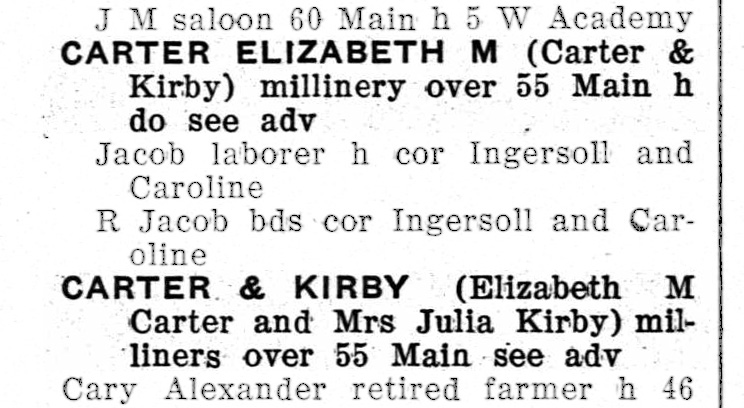


Elizabeth appears a fourth time in the directory, as 1st Vice-President of the St Joseph lodge. St Joseph is the cathotlic parish and is lead by the Rev. Francis Sullivan. On the postcard below, we even can see the Rev. Sullivan on the flight of steps of his parsonage, and the building on the left is (probably) the school of the Carter's children.


It is not immediately possible to locate the 55 main street on a current Albion map, since the street numbers have totally changed since. But I checked any line of the directory (!) and crossing it with the Street directory page, a "souvenir book" dating of 1905 and some postcards, I have been able to draw this 1908 map, with the shops and their owner/tenant.


So, the Carter living and working at the 55 (the ground level being occupied by Peter H. Peters, a harness maker), it became possible to show you their place. The first floor probably for Elizabeth's millinery shop (with the 2 white shades), and the second for William's workshop and Carter's home (currently the #125).


In the City Directory, we also learn that Daniel O'Brien's (Elizabeth's brother) shop, the Meat Market, is located 121 Main St., that is, exactly next to the Hotel McMann (probably the one where William was living when bachelor, and invented the Nasalette).


The Hotel McMann, now The Gurney's Olde Coach Inn, in which the Nose Flute may have been invented (just besides the small Meat Market of Carter's future brother-in-law):


Another interesting fact (for obsessed people like me) is this one : On an early picture, not dated but probably around 1900 or maybe earlier), we can see the shop located at 98 Main St. This shop is hold by Mr Eugene W. Wilcox, and is a hardware store.


Mr. Wilcox is an eminent member of the Executive Comittee of the Albion Chamber of Commerce, and is not all a tinsmith or a craftsman. He is a merchant. Here in 1905 :


Now, in 1907-08, the front of the shop has changed. E.W. Wilcox is still the owner, but an extra sign has been added. With just a little effort, we can read "TINSMITH" on it.


So, in 1908, Wilcox is able to accept orders of tincraft. And being not himself a tinsmith, he certainly had to subcontract the business... You see my point?

The shop still exists, and is still a hardware shop:


In 1909, the Carters moved to Rochester.


>> Access Part III


-----

On the same topic :

- Nose Flute Pioneers: William G. Carter - Part I
- Nose Flute Pioneers: William G. Carter - Part II
- Nose Flute Pioneers: William G. Carter - Part III
- Nose Flute Pioneers: Ernest W. Davis - Part I
- Nose Flute Pioneers: Ernest W. Davis - Part II
- Nose Flute Pioneers: Nelson Ronsheim
- Nose Flute Pioneers: Garrett J. Couchois

-----

Sep 15, 2012

Nose Flute Pioneers: William G. Carter - Part I

With the "Nose Flute Pioneers" series, Noseflute.org enters a little cycle of research. I hope it won't be too arid for a blog, but I really think that the facts I found have to be published. The sources : Google patents, US Census and an access to newspaper archives. But also, depending on the topic, correspondence by e-mail with descendants. Let's better say : internet searching tools available for a Frenchie not able to access US real paper archives.

---

William Carter, himself. Inventor of the first urban nose flute, through his patent (that we presented in this post) for his « Nasalette ».
It has been quite difficult to find info abour Carter. A name very common, only one patent filed, and no article in the newspapers. A very discreet an humble man.
But in the lines that follow, you'll discover little scoops...


Where to start? Well, Carter's patent says where he was living in 1892 :


So, it was mainly through US census sheets that I collected some info, but also in city directories.


Nose Flute Pioneers: William Carter - Part I

William Carter: The Irish Immigrant


William G. Carter was born in 1846 in Ireland. He immigrated in the USA at the age of 5, in 1851, with his mother Catlaine Carter. This is already a scoop! The inventor of the nose flute was not born in the USA, but in Ireland!.

When they disembark on the American ground, Catlaine was 41, and there is no trace of a father for the little William.

The Carters settled in Lockport, Niagara, NY. They are poor and live in a boardinghouse, with many other immigrants. Catlaine is "washwoman" and her personal estate is estimated at $100. William, aged of 15 in 1860, has no real occupation, but probably is already apprentice. In the 1860 census sheet, we also learn that Catlaine is a « person over 20 y'rs of age who cannot read & write »

1860 census :


In 1870, Carter lives alone in a boardinghouse of Lockport, just besides the Niagara Falls, and has become a tinsmith (second scoop!). He is citizen of US. In 1878, he resides in Lewiston, the Lockport district the nearest the Canadian border (a few hundreds of yards) :


What is interesting is that among the very few tinsmiths in Lewiston in 1878 (were there even several?), one is also named Carter, John Carter. He is probably not a William Carter's relative, since he was English. He's just 5 years older than William. Was he the one who taught his craft to Will, or a "collegue" working at the same workshop ?


In 1880, Catlaine/Catherine, already 70, is housekeeper at 40 S Ford Street, Rochester, Monroe, NY... And it's the last info about her I was able to find.


... and William, 34, has moved to Albion, Orleans, NY.


Why did William leave Lockport and settle in Albion ? Probably because this town was in full expansion and offered many opportunities.


Albion is a pretty town first settled in 1812, which grew quickly after it was decided the Erie Canal would pass through. The place was probably very inspiring since, before William Carter, two residents got great ideas there.
George Pullmann, the famous inventor and industrialist, « moved to Albion, New York, where he gained many of his ideas that made him successful » (wiki).

But funnier, Albion was the residence of Grace Bedell, a 11 yrs old girl who was at the origin of the beard of Abe Lincoln! « Grace Bedell sent him a letter from Westfield, New York, urging him to grow a beard to improve his appearance. Lincoln responded in a letter on October 19, 1860, making no promises. However, within a month, he grew a full beard. He later met with her. » (wiki)


So, in 1880, in Albion, William Carter is boarder of an hotel owned by Mr. Luke Taylor. Is he employed somewhere or does he already work on his own (in 1905, Carter will be noted as « tinsmith (at home) »). Well, it's difficult to imagine a tinsmith working in a small hotel room excepted for creating very small items (pure imagination : whistles, tin irish flutes, etc.).

Tinsmiths :

In 1880, there is another tinsmith in Albion, George Edmonds, and a "tinner", Franck Shears, from German origin.


And there are also "hardware" shops and many other craftsmen (harness makers, etc. ) capable of buying pieces made by a tinsmith. So was William already working at home or was he employed by George Edmunds or Franck Shears ? I have no clue.

Anyway, in 1891, William Carter works on his Nasalette, and files the patent in November. Why did a poor tinsmith filed a patent? Probably because he was sure to handle a great new idea.
Was Carter the inventor of the nose flute? Yes, indoubtedly.
Indeed, the Guaranis native were used to call birds with a (totally different kind of) nose whistle, but they never used it as a musical instrument. Much more : how would a tinsmith, coming from Ireland in 1851, whom mother was illiterate, how would Carter have been informed of the existence of the Guarani bird call ? No internet at this time... And such info (with no photo, no recordings) were only available in specialized ethnological society bulletins.
How did he come to invent such a device ? I don't know. Maybe just because he was already making Irish tin flutes and wanted to whistle while working with his hands ?
This is just my imagination, there no data about his motivations.


The patent is registered on June 14, 1892. That is only 7 month after the filing, which means a short procedure, with no discussion on the anteriority.

The question is what did Carter with his patent? He sold it. Remember that in 1893, there was a tin nose flute at the World's Columbian Exposition. Was it the Carter's Nasalette? Or did he sold the patent very early, and a producer launched the nose flute ? This is more than probable. Was it already James J. Stivers, of the future Humanatone Company (the brand Humanatone was used only from mid 1903) ?
How much did carter get from the Nasalette patent ? Was is a big or small amount of money ? Well, many questions still to get an answer.

In 1892, Carter is still tinsmith in Albion, and Edmunds and Shears (who is now noted as being from Belgian origin...) are still active.


>> Access Part II


-----

On the same topic :

- Nose Flute Pioneers: William G. Carter - Part I
- Nose Flute Pioneers: William G. Carter - Part II
- Nose Flute Pioneers: William G. Carter - Part III
- Nose Flute Pioneers: Ernest W. Davis - Part I
- Nose Flute Pioneers: Ernest W. Davis - Part II
- Nose Flute Pioneers: Nelson Ronsheim
- Nose Flute Pioneers: Garrett J. Couchois

-----

Sep 13, 2012

End of Summer Crop

The Summer ending seems to be favorable to nose flute video making... Here is a new nice crop.

Ukeval received a Handler flute from the Nosy Diva at the RAOUL of Pied-Pouzin has adopted it! Look :


Nosefluter makes a come back with a Charango :


The SNOR back on TV! The Swedish Nose Flute Orchestra (Sveriges Näsflöjts Orkester) is back on your screen with a triplet of näsflötists (kind of nose flute boys band). On the Lidztroom channel.


Dwayornoway, a band from Vancouver, trying a nose flute duet accompanied by a guitar :


Monster09904, newcomer on Youtube, plays some Jazz in his car :


A new video by Guns'n'Noses, La Réjouissance by Handel, with Bocarina :


And a Japanese video about a tatami for iPhone, beginning with 3 notes of nose flute, on Jetdaisuke channel :

Sep 11, 2012

Video : Job's pot

That's what we can call a real come back. Mr. NosefluteJob, from Netherlands, spent some holidays with his wife in France, in a camping lot in Castera-Verduzan. It was the opportunity for him to write a song in french about the place, its people and its activities. Madame plays the ukulele, and Job sings and whistles with his Bocarina.
The song is called Papa porte le pot d'pipi which, beside the alliteration, can be translated by "Daddy carries the tinkle pot".


Beginning of July already, Job had published a cover of Glen Miller's In the Mood, hidden behind a pair of sunglasses and a wig.

Sep 7, 2012

A video by Shoko Mihira

A new joyful video by Mrs Shoko Mihira, president of the NHK (Hanshin Hanabue Friends Association) on the Youtube channel hanabuehanshin.

Sep 6, 2012

Nose Flute Pioneers : Nelson Ronsheim

With the "Nose Flute Pioneers" series, Noseflute.org enters a little cycle of research. I hope it won't be too arid for a blog, but I really think that the facts I found have to be published. The sources : Google patents, US Census and an access to newspaper archives. But also, depending on the topic, correspondence by e-mail with descendants. Let's better say : internet searching tools available for a Frenchie not able to access US real paper archives.

---

You certainly remember the Snoot-Flute, which advertisement was presented here one year ago. Ans as we wrote at that time : « Dating of early 1960s (?), the Snoot-Flute was made by PAR Beverage Corp, Cincinnati, OH. This company was actually the predecessor of Kenner Toys (the prefix "PAR" were the initials of the company founder Joseph Steiner's associates : his brother Philip and Albert, and their cousin Robert).
PAR Beverage, and then Kenner Toys, produced many plastic toys, the Bubble-matic gun, the Give-a-Show projector, the Easy-Bake and the famous Spirograph.
»

The Snoot-Flute was designed by Nelson Ronsheim (1905-1981), and I retrieved his grandson, Mr. Michael Smith, who gently sent me a biography of Nelson, and also this picture of the actual Snoot-Flute with its packaging (Michael doesn't own himself a Snoot-Flute, and thus cannot send more pictures) :


Michael Smith also answered my question about PAR Beverage, the Cincinnati company which "signed" the Snoot-Flute : « Kenner didn't start out as Kenner, but as a number of different companies all run by Joseph Steiner, his brothers Philip and Albert and nephew Robert. These companies included PAR Beverage (Philip, Albert, Robert), Bromo-Mint, Grandpa Brands, and Cincinnati Soap Company, among others. When Kenner hit it big, they mostly were folded up, except for Grandpa, which was sold, and PAR, which my grandfather took over. PAR continued to make mostly humorous novelty items sold through the national travel chains, such as Stucky's. »

About the name "Snoot-Flute", Michael wrote :

« My grandfather, Nelson Ronsheim, was quite fond of classical music and had a large collection of recordings of Beethoven, Brahms, Mozart and Dvorak. It was with the intention, perhaps, of adding another instrument to the wind section of the orchestra that he invented the snoot flute.

Another possibility is that my grandfather "invented" this instrument as a bit of humor, he was somewhat of a jokester and enjoyed making a play on words. I'm not certain how "snoot" translates in French, Antoine, but in English it is a somewhat obsolete reference to one's nose, a bit like the word "keister" for the derriere.

However, take just one of the two "o"s out of "snoot" and you have "snot", which is a crude reference to the bodily fluid which resides in the nose and may be blown into a handkerchief. But that's not all; place an apostrophe in the word "snot" and you have "s'not", as in "s'not (a) flute" or, more clearly, "it's not a flute".
»


We do not contest Michael Smith's statement, but we would like to add that the name "Snoot-Flute" was however already used as a nickname for the nose flutes (notably for the plastic Humanatone). Here are 2 ads dating of 1950 (much earlier than the PAR Bev. Snoot-Flute) in which appears the name (Sedalia Democrat, Apr. 4 & 6+7, 1950):


Nose Flute Pioneers : Nelson Ronsheim


Nelson Ronsheim's self portrait (oct 1937)

About Nelson Ronsheim's life, the best is to quote Michael Smith writing :

Nelson Ronsheim (1905 - 1981) attended the Cincinnati Art Academy when still in elementary school, perhaps the youngest student ever to do so. After working a short while for an advertising firm, at the age of 23, Ronsheim set out on his own as a commercial artist.

Nelson Ronsheim (foreground) at the Cincinnati Art Academy (1922).

From his High School year book :


Though skilled with pen and brush, Ronsheim gravitated to photography as a means of artistic expression. From as early as 1923, he mastered the use of a complex camera to record life in Cincinnati. After acquiring additional photographic equipment in 1938, Ronsheim embarked on an intense effort to capture on film the familiar scenes of his native city. As a student of history, Ronsheim appreciated the transitional nature of the late 1930s and sought to preserve in photographs the city as he knew it, anticipating that these images would become more fascinating with time.

This period of intense photographic activity lasted just four years, brought to an end by World War II's rationing of fuel and raw material. Yet Ronsheim created roughly 800 images of Cincinnati during this time. Ronsheim entered photographs in the Master Photo Finishers of America annual contests in 1939 and 1940 and each year received several awards.


(...)

Here are some (beautiful!!) pictures by Nelson Ronsheim. You can watch at much more of them on these pages.

The Immigrant - 1938

Moonlight - 1941

Barrels of Drum - 1939

Winter on the River - 1940

As a commercial artist, Ronsheim was successful and well regarded. Baby-boomers who acquired Kenner toys in their youth may have admired Ronsheim's work, as he provided all the artwork for Kenner's packages, advertisements and instruction material. Ronsheim, in fact, is credited with naming the company, albeit unintentionally. When dispatching art proofs to the firm's office on Kenner Street, Ronsheim wrote the address "1026 Kenner St.", later shortening it to "Kenner St." and finally just "Kenner", the name that stuck. Ronsheim was mechanically minded and his tinkering resulted in a number of patents. He also authored and illustrated several children's books.

Indeed, here are 2 patents filed by Nelson Ronsheim. The first one, in collab. with Charles Metzler, for a mount for films, and the second, as assignor to Peters & Russell Inc., for a cleat :


Nelson Ronsheim in 1958 :


Fellow Cincinnatian Henry Levison, founder of Permanent Pigments Co. and developer of Liquitex high-viscosity acrylic artist's paints, invited Ronsheim to create paintings demonstrating the advantages of acrylics over traditional oil paints. Having just retired, Ronsheim accepted Levison's challenge and between 1970 and 1974 produced over 160 paintings, including the "Genesis Series" featured in the Sunday Enquirer Magazine of September 21, 1975 and a "Best of Show" winner in the 1977 Ohio governor's senior citizens art contest.

Nelson Ronsheim in 1962, and his commercial sign :
A lifelong resident of Cincinnati, Ronsheim encouraged appreciation of the city's beauty in features large and small, both natural and manmade. A script he wrote near the end of his life to accompany a photo presentation begins: "Herein speaks the camera, in phrases bright and terse; it supplants the illustrator's brush, his picturing to disperse, and supplements the author's pen, for better or for verse."


in 1976 :


Nelson Ronsheim is elected to The Nose Flute Hall of Fame !


-----

On the same topic :

- The Rare, Amazing and Ugly Snoot-Flute

---

- Nose Flute Pioneers: William G. Carter - Part I
- Nose Flute Pioneers: William G. Carter - Part II
- Nose Flute Pioneers: William G. Carter - Part III
- Nose Flute Pioneers: Ernest W. Davis - Part I
- Nose Flute Pioneers: Ernest W. Davis - Part II
- Nose Flute Pioneers: Nelson Ronsheim
- Nose Flute Pioneers: Garrett J. Couchois

-----

Sep 5, 2012

Blues Nose Flute on Stage

A live performance by our friend Floyd Blue (floydbluethereal) at Bischofsplatz in Mainz (DE), with the AllesUke-Orchestra. Only the first song, Bull Doze Blues was played with the Nasenflöte.