This blog is dedicated to the sublime instruments called nose flutes and which produce the most divine sound ever. We have chosen to discard all the native models from S. Pacific and Asia, for they need fingering to be played. We'll concentrate on "buccal cavity driven" nose flutes : the well patented and trademarked metal or plastic ones, plus, by a condemnable indulgence, some wooden craft or home-made productions.
Showing posts with label blogs and websites. Show all posts

Aug 2, 2014

RON, an Ergonomic Approach - Part III


Sequel of the posts RON, an Ergonomic Approach - Part I and Part II


6 - Clay Fat Cat Hanabue No. 511

Based on the same functional shapes than the ones used for the simple tile clay nose flutes, Yoshihiro Sawada has begun to model hanabue with different frontal look, notably fat cats flutes, like this great and funny No. 511:

Nothing more to add, since the technical aspects are the same than for the tile nose flutes. But take a look at this beautiful shadow!:


7 - Clay Double Hanabue No. 517

This is a very interesting innovation, a double nose flute. No, it is not intended to be played by a lovers'duo, nor by siamese twins. It is a double-intonation flute.


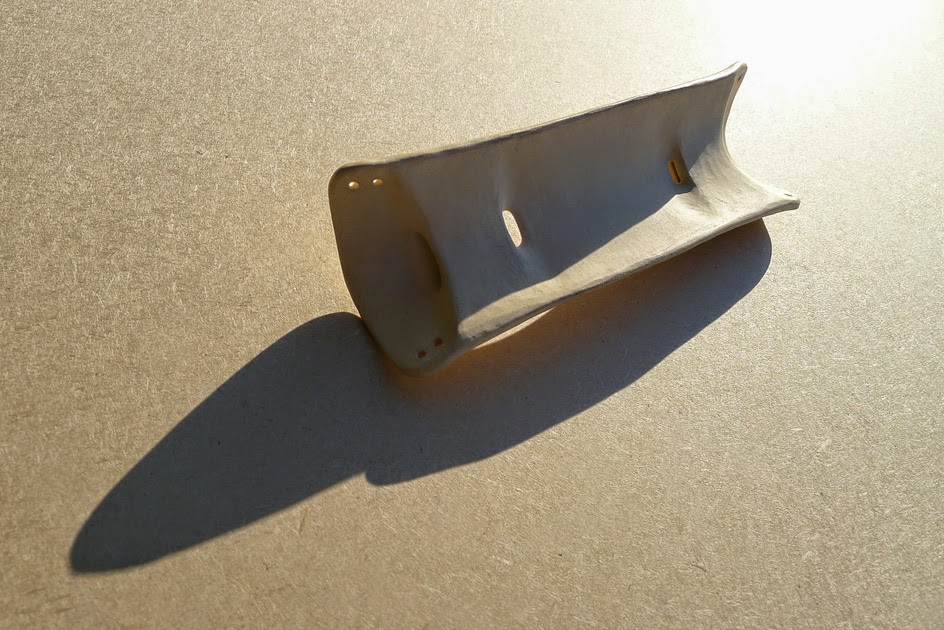
It is shaped as if it was cut in a bamboo stem, just between two nodes (竹の節 - Take no setsu)! This flute is very long, and is really modeled as if two regular tile-flutes had been merged together by their base. Thus, the two ends are two heads, no bottom.

And why this peculiar disposition? You have already guessed: it's in order to provide a double intonation. Indeed, the two fipples are different, one is smaller than the other and thus, produces a range of tones a bit sharper.

This tall double flute is obviously a bit heavy, but is also made from a thin plate of clay, and can be held with a double cord.

Doesn't it look so Japanese?:


---

Sound

Here are some sound samples I gathered altogether, in order for you to be able to compare. Please, remember that I am a nose flute lover, but I'm not a great player at all... They are just sound samples, not musical tunes.


Sophora wood hanabue:


Translucent rhodoïd hanabue:


Paper Family 1:


Paper Family 1:


Clay hanabue 508:


Clay hanabue L004:


Clay Double - Bass side:


Clay Double - Trebles side:

---

RON's blog

Mr. Yoshihiro Sawada has invented other shapes, and thus has designed other templates for his cardboard nose flutes. He's used to share his new creations on his blog (ron87bue.cocolog-nifty.com/blog), notably the mask series (nose flute covering the entire face), including a beautiful cat!


And if you want to see and hear how the Cat mask looks and sounds, no better ambassador than the master Mosurin himself!:


---

Dear Mr. Sawada, we will take great care of your beautiful nose flutes, thank you a lot!


---

Jul 30, 2014

Mosurin's Long Nose / Happy Flute


Sensei Mosurin was yesterday the guest star of Club Parrhesia. As far as I understand, the Club Parrhesia is a weekly online broadcast animated by a Japanese band of musicians. It was the 169th broadcast of this program and it was 2 hours and a half long!

So, I picked the footage where Mosurin plays (beautifully, as usual) or talks about hanabue. Here it is:


It's the opportunity to show you the new Mosurin's nose flute. The sensei still uses his indestructible Sasaki hanabue (the little ceramic mask) mounted on its special stand, but also regularly plays a very peculiar wooden nose flute, with an extra-long nose (and that he, apparently, now owns in 2 versions):


This nose flute was acquired at the great Nose Flute Exhibition that was held in June in Saitama, where many nose flute makers were present. The Long Nose was made by Happy Flute. Happy Flute, once again as far as I was able to understand, seems to be a kind of funny and happy joint venture between several makers (and friends), like Akio Takamura (ceramist/potter), Go Nagayama (great painter/designer on nose flutes), and some others (notably a wood craftsman...) that I have not yet been able to identify...

Happy Flute booth at some summer market, with a framed Noseflute.org postcard (HanabuElvis!). What an honor!


And beautiful nose flutes on the Happy Flute blog!

Jun 13, 2012

An adorable nose flute by YW

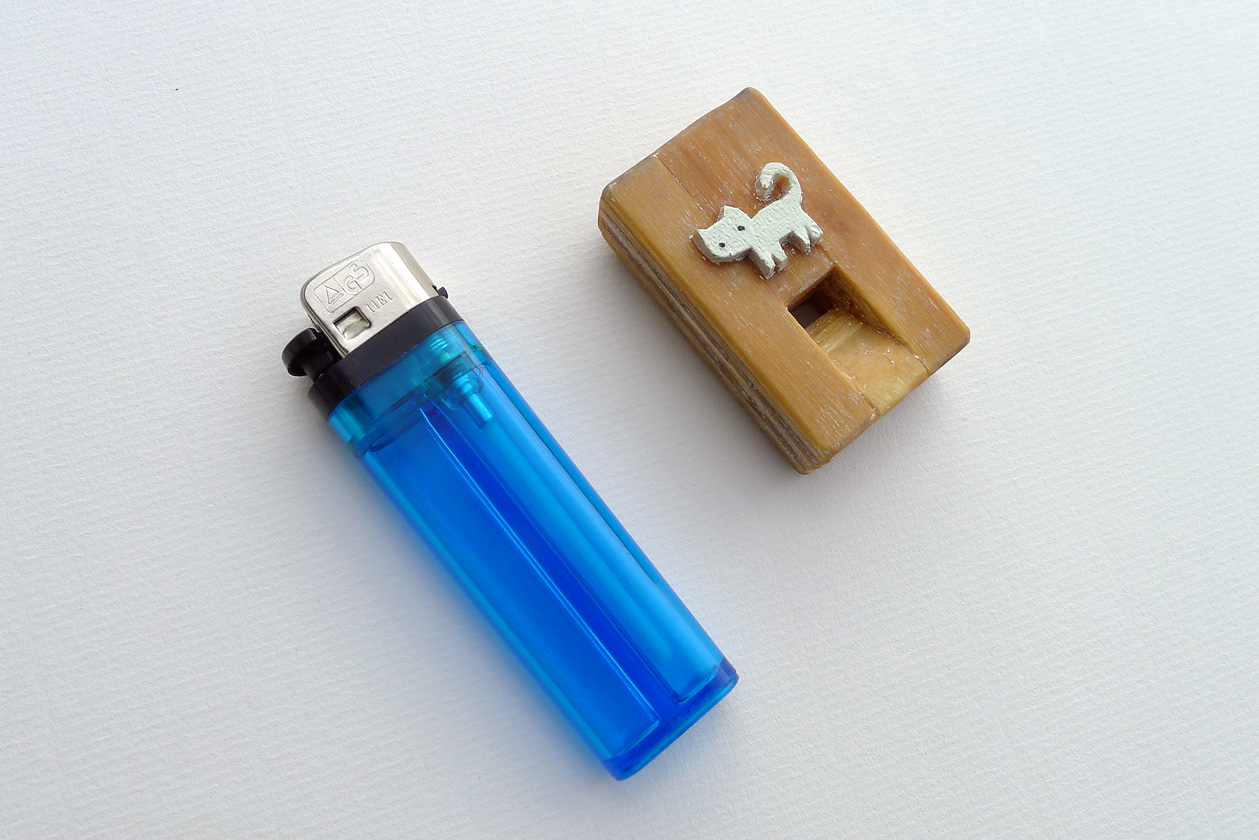
Do you remember YW ? Shuen Ping Chiou (YW) is a Taiwanese graphic designer and amateur nose flute maker. We posted there an interview with him. YW builds very tiny nose flutes with a simple yet efficient concept : gluing together several sheets of wood. Then, he steeps them in a mixture of oil.

Shueng Ping sent me a new (gorgeous) little flute, as tiny as the first he offered to me, but with a improvement in the specifications, and ornated with an adorable white kitty! (According to what I can see on Facebook, many nose flute players are cat lovers...)


Shuen Ping added a message in the little parcel, with a really funny and quite realistic drawing (I've added his picture to compare) :


In his message, his says : « I changed the lip of my nose flutes. And I have this specification to create all my new nose flutes. they will be easier to play and the sound will be cleaner »

Indeed, when you compare the old and the new versions, both the place of the mouth hole and the fipple shape have changed: The length of the air duct has been shortened, providing an upper mouth hole, and the angle of the labium (thus it's length) was sharpened.


The nose saddle stayed unchanged, and very tiny :


The nose flutes by YW are a bit difficult to play for my occidental nose, because of the very small air entrance. However, I can displace my nose and use the flute as a "one-nostril-blown nose flute" and, clogging the other nostril and the part of my mouth on the opposite side (not when I hold the camera at the same time :), I can then get the sound ! Look at this beautiful and sexy picture, and you'll catch what I mean :


Thank you very much, YW, I love your tiny and funny nose flutes!

- Visit the YW's blog
- Reach YW on Facebook

---

Jun 12, 2012

Hottetotte : The Concerto for Nose Flute


Folks, what is following deserves all your attention :

On the Brethren Brass website, one can read :

« A contemporary of Franz Joseph Haydn, Jean-Marie Hottetotte considered himself "France's Haydn" although the French public actually despised his music. Hottetotte was intensely jealous of the success of Haydn's Trumpet Concerto and attempted to write a trumpet concerto himself, but was unsuccessful at securing a trumpet player who would even look at the score. The only musician that would associate with Hottetotte at all, was a classical nasenfloete player (the only known such player in the world) named Ulrich Nels from the remote village of Rhone-Alpes. Nose flutes had been used for centuries in Africa to call birds, but such a musical undertaking took two years for Nels to perfect. A public premiere of Hottetotte's “Concerto Pomposo” for Nasenfloete and Orchestra was heavily publicized for May 21, 1755, but was abruptly canceled due to it being the height of the hay fever season in France. Ulrich Nels was simply unable to play the nose flute during this unfortunate period. What few friends and investors Hottetotte had, pulled their support and had Hottetotte tarred and feathered. The public humiliation drove Hottetotte to live out the rest of his life in a home for the mentally ill. He died a peasant in 1781. Unfortunately, one score of “Concerto Pomposo” survived. »

And the website propose two mp3 recordings, of the 1st and 3rd movements of the Concerto Pomposo, unfortunately played with a 'modern' shepherd's crook cornet, not on a nose flute.


The Brethren Brass explains the reason of the missing second movement :

« Trumpeter Robert Miller has tempted fate, and has premiered “Concerto Pomposo” on the 'modern' shepherd's crook cornet. Although Hottetotte had completely rewritten the concerto to take full advantage of the effects of the nose flute, Miller was able to make a somewhat indifferent effort at some of the unusual motifs and was fairly successful at performing the first and last movements. The second (remaining) movement was so irritating and poorly written that Miller refused to even read the part. Cadenzas in the other movements were not attempted because they exisisted only as opportunities for the nose flutist to empty his nasal cavities into a small clay pot that sat next to the conductor's podium. In a tribute to Hottetotte and Nels, Miller chose to silently empty his spit valves during these short pauses in the music. »

But hopefully, we know a real nose flute version of this eighteen-century major work, already presented in this blog, and interpretated by Mr. Kentucky T. Dutchersmith and the Maple City Chamber Orchestra :


---

Well, you already understood it, all of that is an international farce!
Jean-Marie Hottetotte is a fictitious composer and the Concerto Pomposo for nose flute is a joke... But where did it come from ? It has been, contrarywise, really composed and written somewhere by someone!


Ulrich Nehls (with a "h" after the "e") is a (real) german musician and composer, born in 1959 in Husum. Nehls studied church music in Heidelberg and Berlin. In 1986 he won the first prize in the improvisation training centers contest of Frankfurt.

In 2000, he invented the fictitious composer Jean-Marie Hottetotte :

« All of that was strongly influenced by Schickele's book 'the definitive biography of P.D.Q. Bach' which contains a lot of funny stories about (supposed) contemporarians of P.D.Q. Bach (who himself is, of course, a fictional figure.) And I wrote that music myself, yes. »


« I have written some more pieces under the name of P.D.Q. Bach. (...) One of the biggest successes in those concerts was, by the way, another piece we foisted on P.D.Q. Bach - a so called "Aria con publico". We took reference to the often unpleasant soundings of auditors during concerts - you know what I'm talking about - all that rustling, whispering, talking, grabbing in handbags, cell phone sounds and the like, and thought we might integrate all those annoyances in a baroque piece by P.D.Q. Bach. »

When I reached Ulrich Nehls by mail, he told me he didn't know the existence of the Brethren Brass nor Kentucky T. Dutchersmith's existences. Even less, so, of the recordings and videos of his concerto for nose flute. « I didn't know about that orchestra performance from the USA - believe me, I heard that piece the first time since our 2003 performance (...) Our first performance of it was in spring 2000. »

However, Ulrich Nehls has put this work in the public domain, and the music sheets for all the instruments (Flute, Oboe, 2 Tromboones, 2 Trumpets, Nose flute, Strings) can be freely downloaded on IMSLP library.

Here is the nose flute part :

---
Where did the name Hottetotte come from ?

« It is an innuendo to both the name of composer Hotteterre and the african tribe of the 'Hottentotten' (Hereros; Germans know that name because Namibia used to be a german colony decades ago. Unfortunately the name "Hottentotten" (which is taken from the Africaans language) seems to be a racist and derisive verb for these black people, but I didn't know that when we made these performances in 2001.) »

Unanimously with congratulations, the NFHoF jury (me and my cat Patafix) decided to welcome Jean-Marie Hottetotte in the Nose Flute Hall of Fame!


---

Links :

- Ulrich Nehls' website
- Ulrich Nehls' Youtube channel
- Ulrich Nehls' music on IMSLP library

---

Jun 3, 2012

Easy & Cheap Home Made Hanabue

Our friend Hiroshi Tachibana, whose website, full of experiments about nose flutes, was presented here, has invented a simple way to create home made nose flutes.
His idea is to hack a cheap plastic recorder, in order to reuse its fipple! Quite clever!
Based on the same principle, Mr. Tachibana presents 3 other hacks to make easily a nose flute.

Here is the original page in Japanese
And here is the page translated by Google.

May 10, 2012

Komatsuka Nae, a talented Japanese artist

Kanae Miyazaki, aka Komatsuka Nae, is a Japanese ceramics maker, but also a multitalented artist, gifted in drawings and painting too. She has specialized in representing birds, and that it not surprising her workshop is called Penguin Porcelain, and her office Parakeet Communication.
Komatsuka Nae produces many different things, including table ware decorated with funny penguins, but also... nose flutes! She is notably the creator of a funny and beautiful "japanese penguin" character, and made nose flutes representing it.


Here is an auto-portrait she made, showing her making a nose flute :


She could stop here, but she also created little nests or boxes for her hanabue, and draw mangas featuring the "Okan-khamen" character — a parrot wearing a pharaoh's suit – nose flute.


I cannot publish here all the Komatsuka Nae's production, so, I invite you to visit her blog, and notably those pages, which chronologically show the Okan-khamen nose flute adventures! :

http://penguin10.exblog.jp/14946132/
http://penguin10.exblog.jp/15068948/
http://penguin10.exblog.jp/15096761/
http://penguin10.exblog.jp/15112847/
http://penguin10.exblog.jp/15121337/
http://penguin10.exblog.jp/15125542/
http://penguin10.exblog.jp/15723776/
http://penguin10.exblog.jp/15779363/
http://penguin10.exblog.jp/15804472/

You also can visit this page in English, dedicated to Komatsuka Nae's work.


---

On the same topic, please visit (chronologically) :

- Komatsuka Nae, a talented Japanese artist
- Covered with gifts
- Okan-Khamen - Part I: Covered with gifts!
- Okan-Khamen - Part II: The Parrot-Pharaoh
- Okan-Khamen - Part III: The Nose Flutes
- Okan-Khamen - Part IV: Komatsuka nae's answer

Related links :

- Komatsuka Nae's (Kozakurapon) blog
- Kanae Miyazaki's Facebook page
- A page in English about Kanae's work
- Kanae Miyazaki's works on Toumoto photo website
- Opi Toutomo's Facebook page

---

Apr 17, 2012

Review : A nose flute by the Ise Association

The Japanese Ise Nose Flute Friends Association (Nihon Hanabue Kyokai Ise Tomo no Kai) is a very active organization. It was founded in December 2009 and gathers many members. Lead by their President, Mrs Emiko Sato (who is a writer and notably has created a blog dedicated to hanabue), they have playing sessions, but also travel to meet the other Japanese associations and organize ceremonies with guests.


The Ise association vice-president, Mr. Takuma Ikeyama (池山 琢馬) is a carpenter, but also crafts the wooden nose flutes branded and sold by the association.

Thanks to my good friend Sho Hirasawa (ShowNoseFlute on YouTube) who sent one to me, I was able to put the nose on a Fuu nose flute (Fuu, « wind and rain », is the brand of the Ise association nose flute workshop). Let's just say : Yeehah! and thanks a lot to Sho!

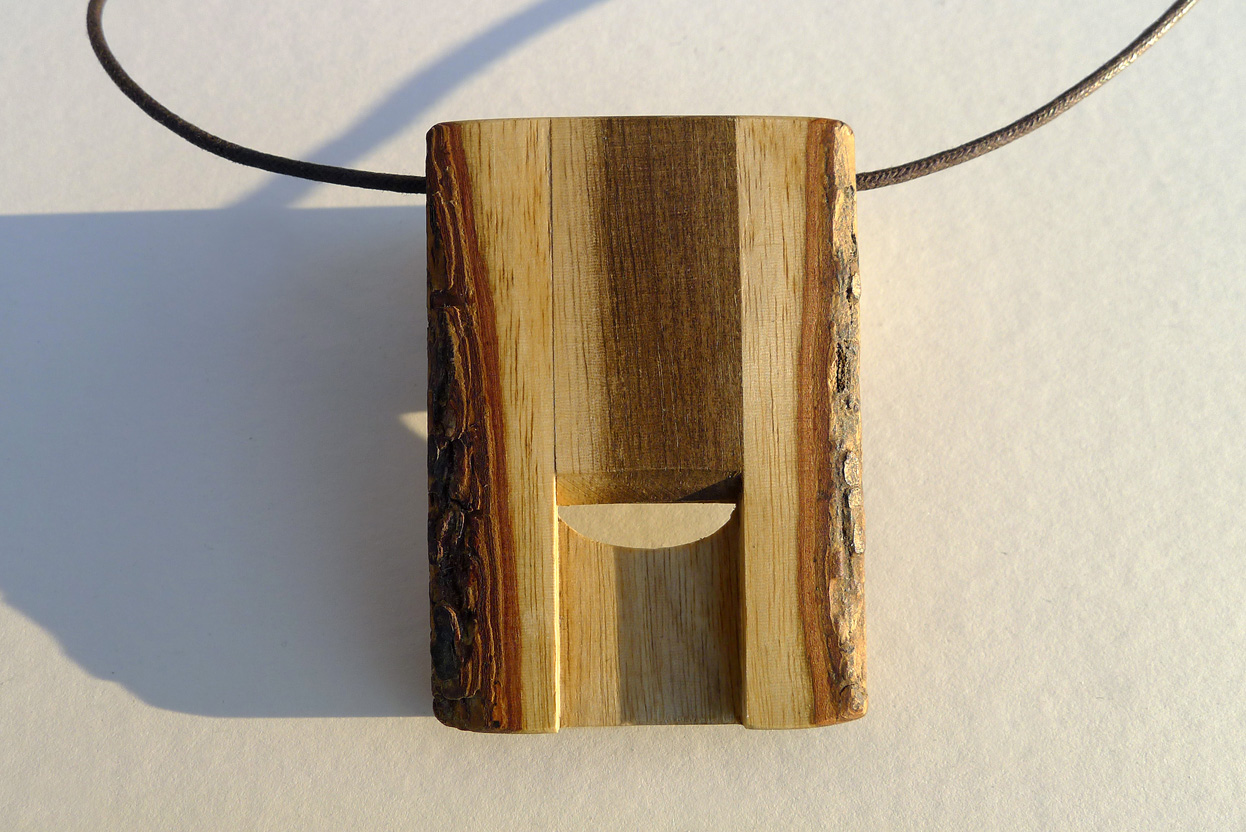
First of all : this flute is absolutely beautiful. It's been made in persimmon wood, with raw bark kept on the edges, and with a two-colored piece of wood on the front of the air duct. It has a very original design, very Japanese. It has a comfortable size (5 x 7 cm).


The second thing I noticed is that the Fuu hanabue smells very good. It has been gently oiled for protection, and the mix of wood and oil aromas is very pleasant.

The craftmanship is at a high standard, with clean edges and assembling, the finishing has been done with care, sweetly sanded, and a waxed lace has been added for handfree playing, with a simple yet efficient pair of sliding knots.


What is amazing on the Ise association hanabue, is the thinness of the air duct : it is less than 1 mm thick and faces a very sharp rounded labium, with a 5 mm gap at its farest. This provides a very powerful and precise loud sound.


The backside is of « vietnamese » type, with a half-pipe nose rest bored with a round hole. Generally, this arrangement does not fit well the western noses, oftenly ended with cartilage. But on the Fuu nose flute, the half-piped nost rest has been slanted and the problem is nonexistent (with my nose at least). The fact is this flute is very comfortable and very ergonomically designed regarding my physiognomy.
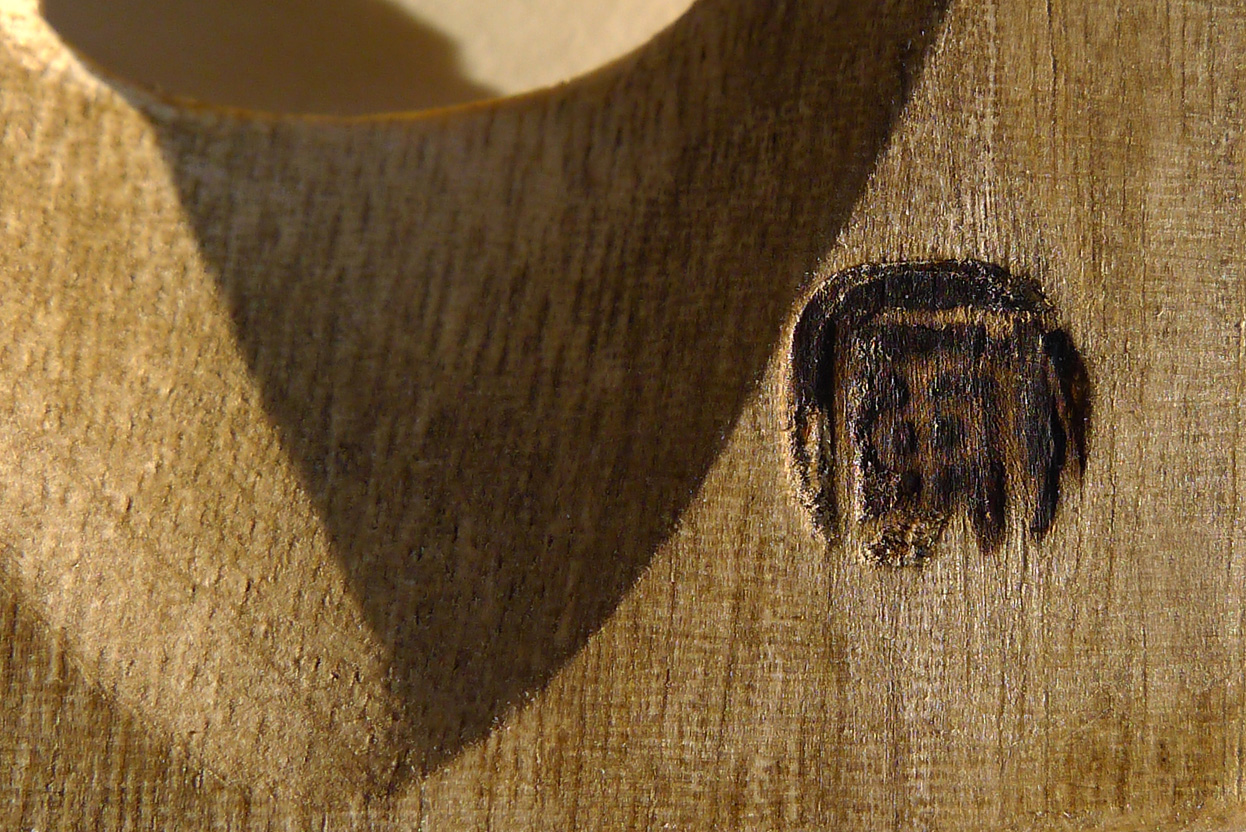
The internal side feature the round seal of the association, stamped with a hot iron.


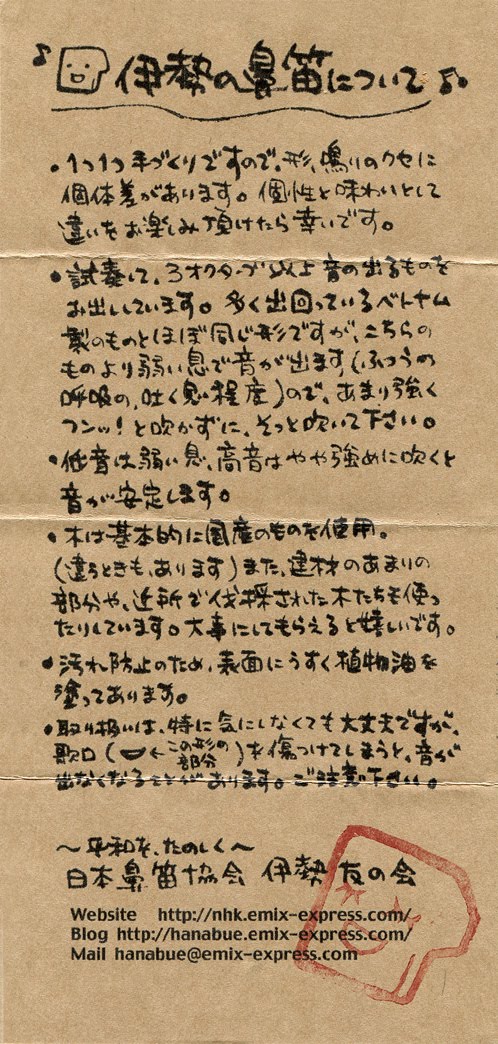
The Fuu nose flute comes along with two papers, one teaching the way to play nose flute in general, and the second about the Ise habanbue in particular, how to take care of it, etc. Thanks a lot to Sho Hirasawa for having taken the time to translate them for us :

On the sound side, I was really amazed. I generally say that a flute can be a good instrument for one player and not for another one, depending on the ergonomy, the size and so... And I think it is true. But in this case, there are also objective points : the way the technical parts are made and designed. The air duct / labium system is really efficient. Then the ergonomics and sizes fit very well my face. This flute is without no doubt my best wooden nose flute, or should I say, the one that fits me at best.

The sound is loud and very precise, and the flute is able to reach from high sharps to low bass, both clear and clean on more or less 3 octaves, depending on your buccal abilities. The Fuu flute offers a very quick answer to solicitations, thanks to the powerful air flow system, allowing very quick playing, and the precision enables easy modulation (vibratos) with the tongue.

Here is a sound sample I made (just added a pinch of reverb) :


---

Links :

>> To Japanese Ise Nose Flute Friends Association website
>> To "Emiko Sato's hanabue blog

---

And as a bonus, look at the beautifully designed postacard that Sho sent to me, and the nice little drawing on the back of the envelope... Thank you Sho!