This blog is dedicated to the sublime instruments called nose flutes and which produce the most divine sound ever. We have chosen to discard all the native models from S. Pacific and Asia, for they need fingering to be played. We'll concentrate on "buccal cavity driven" nose flutes : the well patented and trademarked metal or plastic ones, plus, by a condemnable indulgence, some wooden craft or home-made productions.
Showing posts with label reviews. Show all posts

Jul 2, 2016

Another Classic Humanatone


I found another vintage Humanatone, with its box and paper, in very good shape. It's a nickeled No.20, but is interesting at least on one point: it features a specific detail that I had never seen before on a Humanatone...


1.- The Box

The box is a very classic Humanatone box, with the beautiful typographics and the Stivers' lion design (dating of 1905) that we found to be a rebus (see here). In this version, the label is anthracite and the cardboard box brick.

Here it is, compared to the two other similar ones we know:


As you can see, the label is dark grey as the one of the bottom left pictures, which belongs to an instrument we dated between 1908 and 1911 (check here). But the label shows the 'style' and the $1.00 price, like the box in the third picture. The nose flute itself has got rectangular flaps - like the one related to the 3rd pic. - while the 1908-11 has 'end of ice cream stick' shaped ones. So, our new classic 'Hum' could be an in-between model (?).


2.- The Manual

The user manual is very similar to the one of the 1908-11 Humanatone, besides it is printed on bistre color paper, and has a back also printed.


Compared to the older one, the header typographics have slightly evolved, but it is mostly the bottom of the page that is different, with a new design for the trademark Humanatone, the place 'New York' instead of the street address, and the presence of a nose flute:


The details are more finely printed too:


The back of the page is rather funny, with advertisements promoting a book with an hilarious title ('The Bright Side of Kissing and the Dark Side')...


… and another one ('Flashlights on Human Nature'), but also a bunch of soaps, balms, emulsions and unguents to be (or stay) the most healthiest and attractive person. Prepare for kissing, courting, calling!


I was astonished how the man of the advertisement looks very alike David Crosby 'Almost Cut My Hair'!:


3.- The Nose Flute

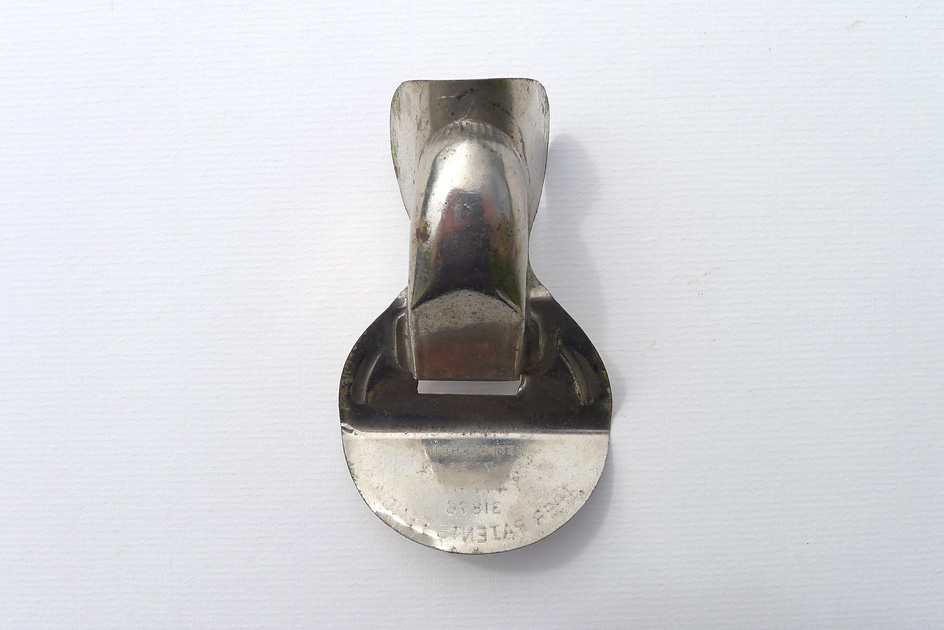
The instrument itself is a beautiful classic nickeled Humanatone specimen, with rectangular lateral flaps (rather early production).


As said earlier, and as you can see it, there is a unique detail on this Humanatone, that I never saw before: It is a pair of embossed circular arcs, dedicated to strengthen the mouth shield. The only comparable feature, but as a full circle, can be seen on the Wunderflöte drawn in 1941 Wolfe's book and visible among Piet Visser's collection:


Now, here is our Humanatone:


As I'm certain this nose flute is not part of the super early production, nor the late one, it means that the 'strength bow' appeared on, then disappeared from the Humanatone. My opinion is that this features didn't last so long, as it is the very first and only time I saw it.


Jun 11, 2016

4 Hanabue by Tida (Nobuyuki Takaba)


'太陽(てぃだ)'('Tida':'The Sun' in Okinawan dialect) is a little workshop in Tsu (Mie Prefecture), Japan, held by Mr. Takaba Nobuyuki, who began producing nose flutes December 2014.


Takaba-san has already handcrafted about 80 hanabue, and will present his work at the Saitama Nose Flute Exhibition (June 14 to 19).

M. Nobuyuki Takaba also makes interesting devices dedicated to fasten a nose flute to a mike stand:


---

I ordered four Tida hanabue. All Nobuyuki's 'Solar Nose Flutes' are crafted with much care in the choice of the woods. They are generally made with 3 pieces of wood, although early ones were composed of 4. They all are individually numbered and finished either with beeswax or a mixture of beeswax and rapeseed oil.


#23: Rosewood (cypress airway) - Oil finish

This early model was made with 4 pieces of wood. Indeed, a thin cypress shim goes along the airway and forms its inner wall on the rear side. It is a small flute (4.4 x 6.2cm), very smooth and well finished, unless the nose cavity (see below), which a bit coarse. All in all, this is a nice little nose flute, very agreable to play, sharp oriented and loud.

#32: Ebony - Oil finish

This darky is a super small baby (4.8 x 5.0cm) and is very funny. The air intake – at the bottom of the nose bowl – is a very thin cut line (less than 1 mm!!). Since the nose bowl, which is far better finished than on #23, collects the breath, the is no problem to align nostrils and intake. However, the flute is lightly squeaky in the very sharp notes.

#37: Zelkova - Oil finish

A small instrument again (5.0x5.5cm), with a slightly more woody sound. The intake is less wide, but also just a bit less thin (1mm). No squeaking problems noticed, and a rather wide tone range.

#67: Jirikote - Beeswax finish

This flute is the most recent among the four. It certainly dates of 2016, and I can notice a real improvement in the finishings. The nose bowl has now a peanut shape and is smooth and regular. It measures 4.9x5.6cm, but is a bit thicker that the other ones. The two-colored Jirikote wood is stunning, and the flute is a real little wooden jewel in the hand. Without any doubt, Takaba-san evolved in his craft, and the flute is loud, precise, quick...

Details

Each Solar Nose Flute is provided with a plastic cord, with a pair of chromed beads, and an unscrewable fastener, that allows to remove quickly the cord from the flute. Any of the Tifa hanabue is numbered, and a little wooden label is mounted on the cord, with the number engraved. Each flute comes also with its identity card, detailing the woods used, the finishing, and the serial number.

As said before, a great care is applied to the choice of the woods. Here are some details of my #67, made in a beautiful piece of Jirikote. Please notice the 'peanut' shape of the nose bowl, and its nice and smooth finish (last pic.):

Conclusion

Whether there is (always) a place for improvement – in a total perfect finishing and sound purity –, the Tida nose flutes have really quickly evolved in a good way, reaching now a good fair level of quality and playability. The woods used are beautiful and the details (cord, beads, label with sn#, id. card) make them desirable instruments.

Here is a short sound sample, please excuse my unsecure playing, it was 5:30 in the morning :)


We wish Mr. Takaba Nobuyuki a good success at Saitama Nose Flute Fair next week, and to continue to produce great and beautiful Solar hanabue!