This blog is dedicated to the sublime instruments called nose flutes and which produce the most divine sound ever. We have chosen to discard all the native models from S. Pacific and Asia, for they need fingering to be played. We'll concentrate on "buccal cavity driven" nose flutes : the well patented and trademarked metal or plastic ones, plus, by a condemnable indulgence, some wooden craft or home-made productions.
Showing posts with label books. Show all posts

Nov 6, 2017

The Idler No.57 is available! With nose flute!


Our article, written in a pleasant collaboration with the uke master and nose flute enthusiast Will Grove-White, has just been published in the londonian prestigious dandy magazine The Idler, by Tom Hodgkinson. Our paper is a 11 pages presentation and history of the nose flute, with full pages pictures.


Obviously, I can't publish scans of the full paper. Anyway, you can order the Idler issue here (the 1st impression is out of stock, but copies will be back in one week).

However, by courtesy of Will Grove-White, here is the content in plain text (better for automatic translation):


ESSAY
Honkin' with your hoooter

The nose flute is not an instrument to be sniffed at, say Will Grove-White and Antoine Carolus


Over the years, many strange musical instruments have come and gone, discarded at the altar of long-established instruments like violins, pianos and trumpets. How quickly we look down our noses at newer, ‘novelty’ instruments and write them off as low-brow. But it would do us all good to reach beyond our comfort zones and embrace the unusual, the unsightly, the unpluckable. As the quote attributed to Henry Ford reminds us, “If you always do what you’ve always done, you’ll always get what you always got.”

So perhaps it is time to reconsider one of the most popular and yet most despised instruments of all time – the nose flute.

When it was launched into Western music at the turn of the 20th century, nose flute fever swept across America, Europe and the Far East. In 1920s America the instrument was heralded as “the most wonderful musical instrument ever invented” by the New York Times and went on to be championed by jazz musicians and vaudeville performers. To its shame Britain has never really embraced the nose flute in the way that other countries have – even today, most music shops in Germany still carry a good stock of nose flutes. It’s estimated that over 100 million instruments have so far been manufactured worldwide.

After the initial nose flute craze, the instrument’s mainstream popularity waned but more recently there’s been a huge resurgence in sales. In music shops from Japan to America nose flutes have been once again on the march, spreading like a heavy head cold into our lives. Nose flute ensembles and orchestras have cropped up all over the world, notably in Germany (Der Grindchor: Das Original Oberkreuzberger Nasenflötenorchester) and across Japan, where there are even ‘official’ and regional nose flute organisations. The largest of these is the Hanshin Hanabue Association who annually perform a massed nose flute rendition of Beethoven’s 9th.

The nose flute is an ingenious little instrument that is played with, of course, the nose. But it’s not a flute that you blow through your nostril (that’s a different type of instrument played mostly in the South-Pacific). Rather, it is a simple device, usually made from plastic but sometimes from metal, wood, clay or even cardboard which covers the nostrils and mouth to produce a delightful flute-like sound. Any tune in the world can be played on a nose flute, and it can be mastered in a matter of minutes. The player simply exhales through his nose and produces the notes by changing the shape of his open mouth (rather like whistling). The instrument can be either held in the hand against the face, or, if one is accompanying oneself on a guitar or ukulele, fastened with elastic around the head. A skilled player with a good nose flute can get a range of almost three octaves and it is certainly a joyful instrument: it makes people happy when you play a nose flute, and if it doesn’t, it makes them happy when you stop playing it. You can’t lose with a nose flute.

But if nose flutes are the easiest instruments in the world to learn to play, why don’t we see them everywhere? This is a difficult question to answer, given the massive success of the kazoo. Some cold-hearted people have declared that the instrument is unhygienic (in fact our noses are cleaner than our mouths) and that it makes the player look like an idiot Hannibal Lecter (hard to argue with this one), so perhaps it does have something of an image problem. But given time, and an army of bizarre-looking disciples, perhaps one day it will be held in the same high esteem as the ukulele and the Swanee whistle.

The unconventional look of the nose flute should not deter the novice player. He is in excellent company. Over the years, artists, musicians and poets have thrilled to its timbre and proved that the nose flute is not an instrument to be sniffed at.

The Godfather of the nose flute was probably the amazing Lloyd Buford Threlkeld (aka ‘Whistler’), a guitarist and singer in the early 1900s from Kentucky. Threlkeld’s big break came once he played the nose flute with Whistler and His Jug Band, the first pre-war jug band ever to be recorded on film. A master of the instrument, he proves that in the right hands the nose flute can sound as beautiful as a nightingale. You can listen to his mesmeric blowing on YouTube (Low Down Blues and Jug Band Special, both from 1927).

Across the Pacific, the nose flute would make an altogether different debut: in an opera. In 1923, Ezra Pound opened his one-act opera Le Testament de Villon with the nose flute. Perhaps unfortunately for the audience, Pound was tone deaf - the poet William Carlos Williams wrote “he knows nothing of music...”, following this with the curious statement, “That’s what makes him a musician.” After seeing the opera, composer Virgil Thomson wrote: “The music was not quite a musician's music, though it may well be the finest poet's music since Thomas Campion... Its sound has remained in my memory.” Not exactly a rave review but nevertheless Pound's Le Testament is the first and only known opera to include a nose flute.


In the right nostrils, the nose flute can sound as beautiful as a nightingale

Artists, too, have warmly embraced the honker hooter. The legendary painter, sculptor and Pataphysician Jean Dubuffet was an avid nose flautist. The inventor of Art Brut (Raw Art), he recorded a series of albums of experimental music (or ‘bald music’, as he referred to it) using the nose flute and other unusual instruments, which suited his surrealist sensibilities down to the ground.

But of course it was musicians who fought hardest to keep the nose flute torch burning. It is rumoured among Elvis Presley aficionados that the King of Rock ‘n’ Roll had plastic surgery on his nose in 1956, and this may go some way to explaining the mysterious appearance of a nose flute tootling away during his song Barefoot Ballad which he performed in one of his less memorable movies, Kissin’ Cousins. Sadly Presley didn’t get to blow the nose flute on the track; Elvis historians conclude it was played by legendary saxophonist Boots Randolph, the man who wrote and played the Benny Hill TV theme tune, Yakety Sax.

A more likely candidate for a star player was Leonard Cohen who used the nose flute on his second album, Songs From a Room, on the track Tonight Will Be Fine. It certainly is a ‘loose’ performance, very probably by Cohen himself - a lifetime outsider thumbing his nose at musical conventions by playing an unfairly marginalised instrument.

It’s also worth noting that the nose flute has become a popular shepherding tool among some farmers. Recently in Ireland, sheepdog trials champion Tim Flood used a nose flute in place of traditional whistling. He appeared on One Man and His Dog singing the praises of the nose flute and performed a short Irish reel for the audience.

So where did it all begin? Who are we to credit with the invention of this ugly/charming (delete as appropriate) instrument?

Like so many instruments, the nose flute’s precise origins are unclear. The first nose flutes were probably produced in South America; in Paraguay by the native Guarani people and in Brazil by the Pataxós. After returning from Brazil in 1817, Prince Maximilian of Wied-Neuwied wrote in his book, Reise Nach Brasilien, that “frequently, these savages [the Pataxós] imitated the voices of owls, capoeira and other birds” and ethnomusicologists like Randy Raine-Reusch confirm that this mimicry was achieved using nose flutes: when the conquistadors arrived in the Americas in the 16th century they would have found the natives using their wooden nose flutes to imitate birds and modern videos show the Pataxós still do so to this day.

But in the West, the nose flute was quite separately invented and patented by a poor Irish immigrant to America, tinsmith William Carter, who settled in Albion, New York. Whether he had encountered a South American flute is unknown, but it seems unlikely. He christened his invention “The Nasalette”. Carter patented his nose flute in 1891 but he soon sold the rights to a shady New York piano salesman and inventor called Garrett J. Couchois, a wheeler-dealer who would eventually end up in jail for infringement of copyright and blackmail.

It’s hard to determine, but it seems Couchois had become so obsessed with Carter’s nose flute that he had bought the patent for a good deal of money. Couchois would go on to launch the first commercial nose flute at a world fair - The World’s Columbian Exposition, in Chicago in 1893. He named it the “Humanatone”. Couchois enjoyed great success with this device, selling 40,000 at the 1901 Pan-American Exposition alone. He went on to design new versions including a spaceship-style nose flute and another called “The Magic Flute”.

In 1903, sensing the business potential of the instrument, a family of novelty-makers, the Stivers, bought the rights to both Carter’s and Couchois' patents, and registered the trademark “Humanatone”. It was, they promised, “The Wonder of the Musical World” and under the shrewd direction of George Stivers and his sons the nose flute enjoyed an incredible surge in popularity, most notably between about 1925 and 1935. Jazz musicians and jug bands gleefully embraced the new instrument and it became a highlight with vaudeville stars and comic song shows of the era. One of these was Syd Shipman and his Humanatone Orchestra, who toured America and Europe and regularly got rave reviews in Billboard Magazine: “To say they did big would be superfluous - just say it was one of Syd's regular successes, and you've got it... Say, boys, they can whistle!”

Its popularity in America meant that versions of the Humanatone rapidly spread across the globe - to the UK (as the Humanaphone), Germany (Wunderflöte), France (Ocariflute), Austria (Austopfon) and Belgium (Vociphone). From Holland it was exported to Bali and the Dutch colonies, as well as to Australia and New Zealand, where it was sold by Albert & Son as The Magic Flute. Regrettably the advent of World War Two forced the Stivers to stop production of tin nose flutes because of metal shortages but fortunately for us, polystyrene plastics arrived just in time to save the nose flute.

In 1943, the hard-nosed businessman Fred Gretsch (of the Gretsch guitar company) bought the Humanatone brand from the Stivers, and relaunched the nose flute in a plastic-injected design by Illinoian Ernest Davis. They were lighter and, crucially, cheap. The plastic nose flutes enjoyed a new popular revival partly because soldiers were able to take one with them to war (along with their ocarinas and mouth-harps). Gretsch even made a special edition of the plastic Humanatone in a box with a printed area in which to write the soldier’s address.

After World War Two the nose flute continued its ascendancy. In 1955, the German instrument manufacturers Weidlich & Lohse launched a plastic model which is still produced to this day in China, where it’s manufactured in its millions. The plastic Humanatone has also been massively copied (also in China as no-name spin-off models) and a variety of other plastic models were produced in the USA, Germany, Sweden and the Basque country.

Millions of these plastic Humanatones are still sold around the world but more recently a growing number of independent companies and artisans have begun to make different types of nose flute from wood, clay, cardboard, bamboo and even chocolate. With modern nose flutes now also being produced in such unlikely places as South Africa, Vietnam, Israel, Hungary, Thailand and Brazil they have become a global phenomenon.

So perhaps it’s time to get your hands on one yourself and become part of the olfactory musical revolution. In a time of too much puffed-up self importance the nose flute is guaranteed to stop you taking yourself too seriously and bring you down to earth – the more people who are willing to toot a jolly tune whilst looking like Jason from Friday the 13th the better for all of us. And it is also unexpectedly good for you– studies show that breathing though your nose leads to a longer life and a healthier body.

An excellent modern brand of nose flute is the Bocarina nose flute (available online) although there are many different varieties to experiment with. The only thing left is to consider which tunes to play. Colonel Bogey might be worth a try, or perhaps God Only Nose by the Beach Boys - just make sure you have a box of tissues ready if you ever attempt The Weather Girls’ 1982 hit, It’s Raining Phlegm.

                                                                                                             W.G.-W. & A. C.

Aug 2, 2016

Objects of the Forest, by Andrea Bandoni

Spotted by Mirko Stagnaro on designboom, a PDF book by the Brazilian designer Andrea Bandoni de Oliveira, published in 2012. Objetos Da Floresta/Objects of the Forest is « an ebook that presents a selection of useful items found in the amazon ». This book is downloadable for free in English or in Portuguese from that page.


Paper copies are also available from this page.


In the book, seven pages are dedicated to Amazonian forest whistles, and for sure, the nose flute has not been forgotten, it even feature on the 'apitos' section cover:


The last page also provides a link to a demo video, and the nose flute part starts at 3'02"

Jul 15, 2016

Intergalactic Nose Flute

Just the mention of a nose flute, flagged by our friend UkeVal, in a Sci-Fi book. But not any book: Space Opera by Jack Vance, in 1965. The story deals with an intergalactic orchestra performing operas on different planets.

Chapter VII:


« … banjo, harmonica, washboard, kazoo, tub-bass, jug, and occasionally a nose-flute.»

This list of instruments played in the Tough Luck Jug Band sounds like a depiction of Jack Vance & friends own arsenal! Indeed, Jack Vance was famous for strumming the banjo, the ukulele and humming the kazoo. Was he also an "occasional" noseflautist ?


Jack Vance with his friend Terry Dowling, another Sci-Fi famous author!:


The french translator for 'Press Pocket' publishing, Mrs. Ariette Rosenblum, wrote a rather stupid comment in the foot notes:


« … the nose flute: blown through the nostrils of the nose regarded as an instrument »

---


But I found other occurences of a nose flute in Jack Vance's work. In 1969, in Servants of the Wankh, then renamed The Wannek beacause the original title was very comical for British people, the nose flute may be a traditional one...


… but this passage of Ecce and the Old Earth (1991) clearly depicts a modern nose flute, as we cannot imagine playing bagpipes along with a traditional nose flute (unless you have four arms, which is rather uncommon, even in Sci-Fi novels :) :


The nose flute appearing in Night Lamp (1996) may also be from a urban type: isn't the "bat vampire look" a clue for it?


Here is what can be read in the SF Encyclopedia (entry 'Music'):


---

To be noted: In Dr. Bloodmoney or How We Got Along After the Bomb (1965), Philip K. Dick invented a mutant rat playing the (tradi.) nose flute!

From the blog Death Robots from Mars:


Excerpt from the Philip K. Dick book:


---

Addendum by Don Luis (from the comments):

« Sandra McDonald mentions nose flutes in a short novel: Fleet - A Transgender Sci Fi story »

But I guess those are traditional ones, since the story deals with Philippines speaking the Tagalog:


May 25, 2016

Nose Flute Tale by Valéry Sauvage

You certainly remember UkeVal (aka LuthVal), the great and prolific ukulele and luth player, beacause we published here several of his nose flute videos (here, for instance).


Mr. Valéry Sauvage is not only a musician, he is also a painter, a poet and a writer! And this multi-artist just published Pantins, Lutins, Nains de jardin… (et autres billevesées), a 223 pages book containing 12 beautiful and funny tales. They mix fairy stories with modernity, with ingenuity and humour. Because — if you hadn't understood yet — UkeVal is a kind of leprechaun himself…


The last tale, entitled 'La Flûte de nez enchantée' ('The Magic Nose Flute') certainly captured our attention! It tells the story of Blondehilde. She's a tall musician-fairy of germanic origins, mastering the nose flute. Another character of this tale is Charles-Antoine, a kind of fat and black-dressed genie with a 'fume-étincelles' ('sparks smoking pipe'), used by him to materialize shapes. In order to comfort Blondehilde, whose cat Franzi had left for the cats paradise, Charles-Antoine begins a quest to find the most incredible nose flute for her…
Any resemblance to actual individuals or events is certainly not coincidental.

I really encourage you to read the rest of the story, as well as the other tales. Fun and pleasure guaranteed!


Pantins, Lutins, Nains de jardin… (et autres billevesées)
by Valéry Sauvage
Les Editions de Pied Pouzin
ISBN 9781530863471


The Kindle version (€2.99) can be get here: Pantins, lutins, nains de jardin...(e. version)

The paper edition (€12) is there: Pantins, lutins, nains de jardin...(paper version)

May 16, 2016

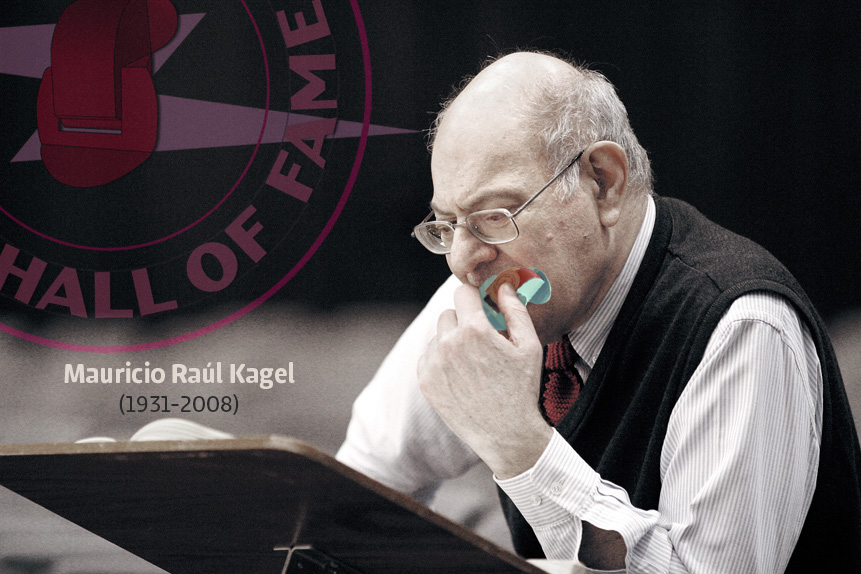
Mauricio Kagel (1931-2008) : Hall of Fame!

Born in Buenos Aires in 1931, Mauricio Kagel moved to Cologne, Germany, in 1957 where he became one of the greatest post-second world war avant garde composers.

« Among the contemporary composers Mauricio Kagel more than any other explored the instrument concept and expanded it. Especially in the sixties and seventies, he created works in which in addition to conventional musical instruments, vacuum cleaners, rubber tubes, walkie-talkies and turntables were used. » [source: Der Schall, Mauricio Kagels Instrumentarium, PFAU, 2008]

Mauricio Kagel in 1968 and 1985:


Among his prolific work, one piece of 1968 particularly retained our attention: Der Shall ('The Sound'). Indeed, and as you can imagine, it contains some nosefluting. Der Schall is a ±40 minutes long piece, written for 54 instruments, played by 5 musicians. [You can listen to the whole piece here, or go directly to the nose flute part here.]

Here is the text written by M. Kagel and printed on the back cover of the LP. You can notice that the nose flute is part of the instruments of group V, played originally by Christoph Caskel:


And here, the front cover, and a portrait of the percussionist Christoph Caskel, who played the Nasenflöte on the record:


In 2007, the Music R&D dept. of the University of Basel (Switzerland), 'reactivated' the original sound objects (kept at Basel Historical Museum) or some replicas in a performance in which the musicians recreated Der Schall. They recorded their experiment, and the CD was published along with the book Der Schall, Mauricio Kagels Instrumentarium, PFAU, 2008. This books contains lots of info and reproductions of original documents.

The font cover already shows a Nasenflöte in a box (rather well hidden though :):


The books is subtitled 'Mauricio Kagels Intrumentarium', and is an opportunity to show in detail the list of the instruments originally used (and preserved at Basel museum). They are categorized in several sections: Conventional Instruments, Historic Instruments, Extra-European/Exotic Instruments, Special/Non Classical Instruments, Percussion/Home Made Instruments and Signal Instruments.

That's among the Special Instruments that one can find a nice paragraph (p.81) about the nose flute…


… which says something like (edited Google translation):

« The nose flute perhaps constitutes the most striking example of the aforementioned contrast between the modern Western European form and the Asian or South American forms of the same instruments. While the variants from Southeast Asia, Oceania and Polynesia are usually whistle-like tubes made of natural materials that are blown with air from one nostril, the breath of the nasal air has a special symbolic meaning as the bearer of the soul, the Western European Nasenflöte is a quaint, almost funny-looking structure made of plastic (see photo inventory p.98). It is found to be extremely effective in many toy stores music, hardly anyone knows then, however, how the nose flute has to be played. The upper gap is for nose air entrance, while the lower opening stands for the lips, so that the pitch and timbre can be determined by the opening of the mouth and tongue. The nose flute can therefore be quite compared with the Jew's harp, with the difference that the pitch is changed freely and the sound is similar to a whistle. The plastic nose flute therefore requires a radical reconsidering of wind instrument players for unfamiliar tongue-mouth-acrobatics. Like the cuckoo clock Kagel gives a solo passage in which come the special capabilities of the instrument to bear. »

And page 98, between a tortoise shell and a straight mute:


Well, well well... Look at the bright and shiny red on this Schwan... This definitely is not the original Kagel's Nasenflöte, but a new one (the reference # begins by 2005...). I suppose the vintage one has not been preserved in Basel museum... Schade!

The book also offers lots of copies or original notes and execution sheets in which the Nasenflöte part is specified:


We can also find some great pictures of the 2007 'musical happening', and see the Schwan nose flute on the right desk of Matthias Würsch, the percussionist in charge of section V:

---

Now, it is very interesting to compare the 1968 and the 2007 interpretations and recordings. I isolated the two 2 minutes nose flute parts:

1968 excerpt:


2007 excerpt:


Which one do you prefer ?

---

It is very rare to find some nose flute in the work of a serious composer, that is, used as a real instrument, and not regarded as a carnival toy.

For having included a nose flute as a real instrument in his 1968 composition Der Schall, Mauricio Kagel has been inducted to the Nose Flute Hall of Fame, in the 'Promoters' section!


Nov 8, 2014

Working with a Pocket Knife

We already posted (here) a video provided as a supplement of a book dealing with making toys and instruments with a pocket knife. But now, we've go the book.


Werken mit dem Taschenmesser
("Working with a Pocket Knife") is a Swiss book, published by AT Verlag and apparently sponsored by Victorinox, the famous Swiss army pocket knife company. The idea of the author Felix Immler is to make many (twenty six) objects from wood found in the forrest and worked only with a (multi-tool) pocket knife. After a part dedicated to learning the different knife tools usage, the tutorials, range from "beginner" to "expert". This last section features a Nasenflöte.


Seven pages are dedicated to the nose flute making, but I obviously cannot publish them "full size", for copyright reasons. However, let's take the risk to show some pictures, as advertising samples.


As you can see, the tutorial is fully illustrated, with explicit pictures. The texts also are clear and precise, as far as you read German or, as I did, scan them, pass the result through an OCR tool, then stuff Google translation with. The description of the work is precise, providing dimensions etc.

Even if you don't feel the need to rush in the woods with your pocket knife with the irrepressible need to carve a nose flute, the method provided by Felix Immler can be very useful for those of you who would like to take the time to build their own wooden nose flute, in the comfort of a workshop and with the help of precise tools.


You can buy
Werken mit dem Taschenmesser
directly from the publisher (here) or cheaper from Amazon (new or used), particulary the German one.

Here is the video supplied in complement of the book:


Oct 14, 2014

Austopfon / Néo-Flûte, a Real Mystery! - PART II

Sequel of the post Austopfon / Néo-Flûte, a Real Mystery! - PART I


So, we order some photos. Indeed, this article is the most expensive of all of the posts of this blog, since I ordered specific photographs, with detailed requests for the background, the angle of view, etc. It could have certainly been cheaper to buy a real Austopfon :) But all was kindly made according to my requests.

The first interesting picture is obviously the one of the back of the nose flute, showing the stampings:


Well, there is absolutely no doubt about the brand name: AUSTOPFON. How was this name formed? Was it made from AU (Austria?), STOP and FON (for Phone, "voice" in Greek)? or AUST and OP (?) and FON? My guess (only an hypothesis) is that it has to be cut like this : AUST (Austria) TOPF (pot, cup) FON (Phon) (kind of "Austrian sounding vessel").

Then, the mysterious stamping Ö.P.O... Generally, the D.R.G.M. (Deutsches Reichsgebrauchsmuster) acronym in use from around 1900 and until 1945, was followed by the number of the patent. Sometimes, also by Gesetzlich Geschützt ( or Ges. Gesch.) meaning "legally protected". But for sure, some items were stamped only with D.R.G.M., with no more precision. But I found absolutely no other appearance of the mysterious Ö.P.O.


In fact, I looked very closely (magnifying the photo) and discovered that the transcription Ö.P.O. (mentioned in the MIM description) is wrong (as was the transcription "Nazenfloot"). Indeed, when you stare at the supposed final "O", you can notice that it is much smaller than the letters Ö and P, and that is very bizarre. More, still looking precisely, you can guess two small excrescence on the right of the letter. My guess is this stamping is not Ö.P.O. but Ö.P.a.!

Would "Ö" stand for Österreich (Austria)? It look like (the initial capital "Ö." generally stands for Austria in German) and in that case, the stamping would certainly be the acronym for Österreichisches Patent angemeldet (Austrian Patent pending), and would explain also why there is no number following "D.R.G.M." More, the initial letter of the word "angemeldet" was (and still is) oftenly stamped in small letter.


The acronym could also have stand for Österreichisches Patentamt (Austrian Patent Office), as it is used nowadays :


« Houston, we have a problem here! » It is more than likely that the Austopfon was Austrian, but (as already explained in the first part), Austria didn't exist as such before 1918. It was part of the Austro-Hungarian Empire. That is only at the very end of 1918 (November) that Austria became the Republic of German-Austria. So, the Austopfon would date of at least 1919. But Mahillon's catalog states of a German origin, and a date before 1913... but let's go further.

Another great picture shows the Austopfon... with its box!


A beautiful cardboard box, with openwork angle irons, and a great drawing on the top. This gentleman with a great moustache has definitely a huge hand, but the drawing is very neat. However, what's funny is the brand name on the box : Néo-Flute, followed by Breveté ("patented" in French). Indeed, inside the lid, there is a user manual that has been stuck, and it is written in French!


It says:

The NEO-FLUTE (Patented)
is the last creation in the musical instruments world.
The novelty consists in that the instrument is played with the nose.
Any person, without any learning, is able to play any song.
The Neo-Flute produces exactly the same sound than the concert flutes.

INSTRUCTIONS
Place the instrument on the nose, whilst applying the superior lip on the small ledge which protrude, and gently blow through the nostrils, keeping the mouth slightly open. With a piano accompaniment or in two or three Neo-Flutes sessions, the effect is magical.

Price: 0.50.


Why the heck is the box printed in French? The probable answer is that the Austopfon has been "rebranded" in order to fit a French speaking market. It is a pity that the price was not followed by the currency unit. Was that 0.50 Belgian Franc, French Franc or Goldmark, Reichmark (the German currency which became the official unit from 1914 to 1918 in Belgium).

However, in 1923, in France, the nickeled version of the Oclariflute was sold 3.60 FF- and in 1924-29 the German Gebrüder Schuster catalog was selling a tin ("Weissblech") Nasenflöte for 2 RM-, and we know that those prices had not evolved a lot. So, even earlier (the Austopfon is necessarily anterior to 1922 since it appears in the Mahillon's catalog), the price of 0.50 is not realistic for a nickeled nose flute, whether the currency was French or German.

100 BF- of 1914 equal ±478 euros of 2005
100 BF- of 1920 equal ±105 euros of 2005
100 BF- of 1930 equal ±55 euros of 2005

(source: harscamp.be)

100 FF- of 1914 equal ±297 euros of 2005
100 FF- of 1920 equal ±83 euros of 2005
100 FF- of 1930 equal ±50 euros of 2005

(source: INSEE.fr)

So, even taking in account the ratio BF- to FF-, it is not consistent that a rather similar item was sold 7 times cheaper in Belgium than it was in France. So, was it labeled in German currency? In that case, datation would not be neither before 1913, nor after 1918! Tricky, tricky, tricky... This price stays another mystery.


--

Dating

We know that the very first nose flute in Europe dates from 1912, the Wünderflöte. In his Questions of Phonetic Theory, written in 1916, William Perrett mentioned a Humanatone imitation, « in an inferior quality, and sold as the Wunderflöte. » Perrett quotes Dr. Albert Musehold who wrote his Akustik work in 1912 (see this post).
Indeed, we found Mr. Joseph Goldstein, who filed the patent for a Nasenflöte in 1912 (see this post and also this one for the full story). But it was the Wunderflöte, and not the Austopfon.
So, a nose flute was existing in 1912 in Germany. And that is probably what Victor-Charles Mahillon was aware of when he redacted his catalog. Most of the MIM instruments were acquired by donations, collected by Mahillon. What did he do between 1913 (date of the end of the listing according to Mr. Ernest Closson) and 1922 (date of the book publication)? Storing the new donations in a warehouse without opening the boxes, for a future volume VI ? Is it really impossible to think that other donations elements (the Austopfon is part of one of them), regarded as interesting, might have been lately included in the book during those 9 years? I cannot answer, I don't know the facts. I just ask.

Please, note also that there was another nose flute in Belgium, patented in 1912 by François Vandervaeren (Brussels): the Vociphone. We already exposed this instrument and its patent (check here), but not the instrument with its box. And if you look at the picture below, you can notice that the box looks very similar (same openwork angle irons) and, above all, that the Vociphone itself looks identical to the Austopfon: same nose opening, same flaps, same flap extent folded on the back... But the design of the patent is totally different (check here). What does it mean? Well, our Austrian friends might have copied an early shape/patent and and filed it in their own (new) patent office (as many did, stealing patents that were not internationally registered), or the instrument was filed for Austria by its legitimate owner...(another mystery!) Whatever the explanation, the nose flute Mr. Mahillon had in his hands was not the 1912 Belgian nose flute, but (what we think to be) a post-1918 Austrian one.


Origin

The box is printed in French, meaning that this very Austopfon was not originally bought in Germany (or Austria), but very likely in Belgium (or France). Then, it was donated to the MIM by its owner. How could Mr. Mahillon know (or suppose) it was German since there is no sign of "Germanity" on it, besides the stampings? And the stampings lead us to Austria, not Germany. But in the case Mahillon knew about "the German Nasenflöte dating of 1912", might he have chosen this origin, fitting with the D.R.G.M. stamping (but not the Ö.P.a. one...).

---

That's why the Austopfon stays a real mystery. My opinion is that it is Austrian and dates of after 1918. It might also habe been the inspiration for the Nasenflöten that were manufactured some miles North, in Brunndöbra and Klingenthal (Germany) in the 1920-25s, and which became the standard German tin nose flutes, sold in any musical instruments catalogs. Note also that we know, by Mr. Heinrich Handler (nose flute maker in Weiz, Austria) that there were already nose flutes in Austria in the 1920s.

But as usual, no evidences, no (definitive) conclusions.

---

Big thanks to Christian Steinbrecher for his kind help about Austrian knowledge.

---