This blog is dedicated to the sublime instruments called nose flutes and which produce the most divine sound ever. We have chosen to discard all the native models from S. Pacific and Asia, for they need fingering to be played. We'll concentrate on "buccal cavity driven" nose flutes : the well patented and trademarked metal or plastic ones, plus, by a condemnable indulgence, some wooden craft or home-made productions.
Showing posts with label Switzerland. Show all posts

May 16, 2016

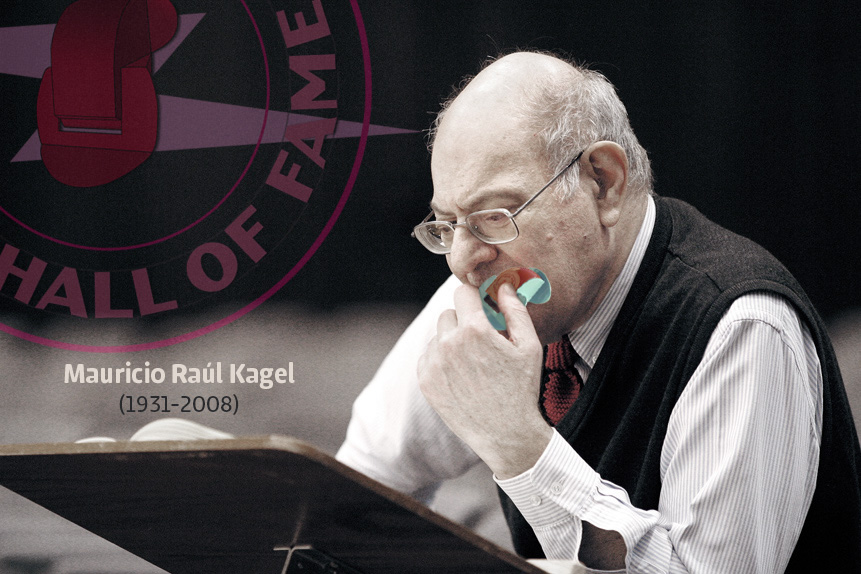
Mauricio Kagel (1931-2008) : Hall of Fame!

Born in Buenos Aires in 1931, Mauricio Kagel moved to Cologne, Germany, in 1957 where he became one of the greatest post-second world war avant garde composers.

« Among the contemporary composers Mauricio Kagel more than any other explored the instrument concept and expanded it. Especially in the sixties and seventies, he created works in which in addition to conventional musical instruments, vacuum cleaners, rubber tubes, walkie-talkies and turntables were used. » [source: Der Schall, Mauricio Kagels Instrumentarium, PFAU, 2008]

Mauricio Kagel in 1968 and 1985:


Among his prolific work, one piece of 1968 particularly retained our attention: Der Shall ('The Sound'). Indeed, and as you can imagine, it contains some nosefluting. Der Schall is a ±40 minutes long piece, written for 54 instruments, played by 5 musicians. [You can listen to the whole piece here, or go directly to the nose flute part here.]

Here is the text written by M. Kagel and printed on the back cover of the LP. You can notice that the nose flute is part of the instruments of group V, played originally by Christoph Caskel:


And here, the front cover, and a portrait of the percussionist Christoph Caskel, who played the Nasenflöte on the record:


In 2007, the Music R&D dept. of the University of Basel (Switzerland), 'reactivated' the original sound objects (kept at Basel Historical Museum) or some replicas in a performance in which the musicians recreated Der Schall. They recorded their experiment, and the CD was published along with the book Der Schall, Mauricio Kagels Instrumentarium, PFAU, 2008. This books contains lots of info and reproductions of original documents.

The font cover already shows a Nasenflöte in a box (rather well hidden though :):


The books is subtitled 'Mauricio Kagels Intrumentarium', and is an opportunity to show in detail the list of the instruments originally used (and preserved at Basel museum). They are categorized in several sections: Conventional Instruments, Historic Instruments, Extra-European/Exotic Instruments, Special/Non Classical Instruments, Percussion/Home Made Instruments and Signal Instruments.

That's among the Special Instruments that one can find a nice paragraph (p.81) about the nose flute…


… which says something like (edited Google translation):

« The nose flute perhaps constitutes the most striking example of the aforementioned contrast between the modern Western European form and the Asian or South American forms of the same instruments. While the variants from Southeast Asia, Oceania and Polynesia are usually whistle-like tubes made of natural materials that are blown with air from one nostril, the breath of the nasal air has a special symbolic meaning as the bearer of the soul, the Western European Nasenflöte is a quaint, almost funny-looking structure made of plastic (see photo inventory p.98). It is found to be extremely effective in many toy stores music, hardly anyone knows then, however, how the nose flute has to be played. The upper gap is for nose air entrance, while the lower opening stands for the lips, so that the pitch and timbre can be determined by the opening of the mouth and tongue. The nose flute can therefore be quite compared with the Jew's harp, with the difference that the pitch is changed freely and the sound is similar to a whistle. The plastic nose flute therefore requires a radical reconsidering of wind instrument players for unfamiliar tongue-mouth-acrobatics. Like the cuckoo clock Kagel gives a solo passage in which come the special capabilities of the instrument to bear. »

And page 98, between a tortoise shell and a straight mute:


Well, well well... Look at the bright and shiny red on this Schwan... This definitely is not the original Kagel's Nasenflöte, but a new one (the reference # begins by 2005...). I suppose the vintage one has not been preserved in Basel museum... Schade!

The book also offers lots of copies or original notes and execution sheets in which the Nasenflöte part is specified:


We can also find some great pictures of the 2007 'musical happening', and see the Schwan nose flute on the right desk of Matthias Würsch, the percussionist in charge of section V:

---

Now, it is very interesting to compare the 1968 and the 2007 interpretations and recordings. I isolated the two 2 minutes nose flute parts:

1968 excerpt:


2007 excerpt:


Which one do you prefer ?

---

It is very rare to find some nose flute in the work of a serious composer, that is, used as a real instrument, and not regarded as a carnival toy.

For having included a nose flute as a real instrument in his 1968 composition Der Schall, Mauricio Kagel has been inducted to the Nose Flute Hall of Fame, in the 'Promoters' section!


May 4, 2016

The Australian Magic Flute - Part III

This post is the sequel of The Australian Magic Flute - Part II

So, we were saying that the last of the four pages was very interesting... It is a full page advertisement for mouth organs by « The King of Mouth Organs ». On the harmonicas themselves, you can read « Albert's system », and a small boomerang logo for those boomerang mouth harps.

It was not difficult to find that « the King of mouth organs » was Mr. Jacques Albert, from Albert & Son, 118 King st., Sidney, Australia. As soon as 1899, one can find ads for Albert's mouth organs. Here in the Children's Newspaper (10-28-1899):


So, Albert & Son was at the origin of the Magic Flute.

Jacques Albert (1850-1914) was a Swiss horologist who immigrated in Australia in 1884 with his family (his wife Sophie [†1890] and their children Michel-François, later known as Frank, and Pauline). The next year, he established in Sidney a clock, watches and occasional violin repair business.

On the left side, at 118 King st., Albert & Son music shop :

Wikipedia details:

« Albert and his son Frank began importing and selling a wider range of musical instruments including a Boomerang mouth organ. The company trademarked the word 'boomerang' and stamped it on German manufactured mouth organs. The distinctive instruments were a run away success selling at a rate of 800 a week by 1897.

Oh-Oh! So, Jacques Albert was not the maker of the Boomerang harmonicas, but the founder of the trademark, while the instruments were manufactured in Germany.

Journalist James Cockington wrote , quoting Ray Grieve’s book, Boomerangs and Crackajacks:

« In 1896, J. Albert & Son of King Street, Sydney, introduced the first ‘home-brand’ mouth organs, the Woolloomooloo Warbler and the Kangaroo Charmer. These were made in Germany by Seydel & Son, but re-badged to suit a patriotic Australian market.»

And David Payne:
« Albert send the templates for the Boomerang to Germany by ship and he and SEYDEL management became close friends over the many years of their working relationship. (...) That relationship continued even after World War II, when SEYDEL was a nationalized company behind the Iron Curtain. Seydel continued creating Boomerang models until Albert's death in 1962. »

This is very interesting, because Seydel & Söhne was a company settled in Klingenthal, in the craddle of the German Nasenflöte (Klingenthal, Markneukirchen, Brunndöbra,...)[see here and there]. And in the early 1920s, when nose flutes began to be produced in Saxony, the Seydel may have told about the new instrument to Mr. Albert, and who nose, might have sold/send a bucket to Australia, as they did with the Boomerang harmonica during almost 70 years! There is another fact that fits with the German hypothesis, but it will be revealed in... Part V!

But there is a problem: the Magic Flute design doesn't match the German Nasenflöten templates, which were never closed by rivets, but by bent flaps:


So, the most reasonable (?) hypothesis is an American make. The Stivers may have dealt with Albert & Son, for an unstamped Humanatone-shaped nose flute, provided with a brand ("Magic Flute", owned by the Humanatone Co., after the Stivers probably bought it from Garrett J. Couchois) with the Magic Flute papers. This would explain, on one hand the drawings on the papers and the mention «… the Magic Flute which had just arrived from New York… », in the Hendersons' Magic Flute romance!

Another point on the credit of this hypothesis: « In 1919 [Frank Albert, the son] visited Europe and the United States of America…», according to this biography.

--

As seen before, Jacques Albert passed away in 1914 (at 64 of age), and it is unlikely he was himself at the origin of the Australian nose flute. Indeed, the Magic Flute might have appeared in the 1910s at earliest, but much more probably did in the early 1920 (the brand 'Magic Flute' was registered Dec. 19th(?), 1924 for Australia).


His associate and successor was his son Frank Albert (1874-1962), and he was certainly the one who launched the Magic Flute in Australia and New Zealand.

Frank Albert:


At this time, Frank has developped a very lucrative music business and is a very wealthy man. In 1926, he built a villa named 'Boomerang', from the mouth organs brand which made his fortune.


In the same years, Frank, who's a yachting enthousiast since 1900, bought a beautiful schooner that he baptized... 'Boomerang'! It was certainly not his first boat, as you can read in this very interesting blog.


Voila! We know the face of the man who launched and spread nose fluting in Australia! An elegant and successful businessman and a yachting enthusiast... For sure, the story doesn't end here, but you will have to wait for Part IV...


>> Access Part IV

---

Related links :

- The Australian Magic Flute - Part I
- The Australian Magic Flute - Part II
- The Australian Magic Flute - Part III
- The Australian Magic Flute - Part IV
- The Australian Magic Flute - Part V
- The Australian Magic Flute - Part VI
- The Australian Magic Flute - Part VII

---


Nov 8, 2014

Working with a Pocket Knife

We already posted (here) a video provided as a supplement of a book dealing with making toys and instruments with a pocket knife. But now, we've go the book.


Werken mit dem Taschenmesser
("Working with a Pocket Knife") is a Swiss book, published by AT Verlag and apparently sponsored by Victorinox, the famous Swiss army pocket knife company. The idea of the author Felix Immler is to make many (twenty six) objects from wood found in the forrest and worked only with a (multi-tool) pocket knife. After a part dedicated to learning the different knife tools usage, the tutorials, range from "beginner" to "expert". This last section features a Nasenflöte.


Seven pages are dedicated to the nose flute making, but I obviously cannot publish them "full size", for copyright reasons. However, let's take the risk to show some pictures, as advertising samples.


As you can see, the tutorial is fully illustrated, with explicit pictures. The texts also are clear and precise, as far as you read German or, as I did, scan them, pass the result through an OCR tool, then stuff Google translation with. The description of the work is precise, providing dimensions etc.

Even if you don't feel the need to rush in the woods with your pocket knife with the irrepressible need to carve a nose flute, the method provided by Felix Immler can be very useful for those of you who would like to take the time to build their own wooden nose flute, in the comfort of a workshop and with the help of precise tools.


You can buy
Werken mit dem Taschenmesser
directly from the publisher (here) or cheaper from Amazon (new or used), particulary the German one.

Here is the video supplied in complement of the book:


Nov 20, 2012

User manuals - Part 1: Europe

Here is a series of nose flute user manuals, published either by the manufacturers/craftsmen, or by resellers. Just to have them gathered altogether. For sure, the collection is far from being complete.


Belgium

The Vociphone (François Vandervaeren) - 1912:

Enjoy the threatening Nota Bene: « Any person that would not conform to the user manual will get no sound of it. »


Switzerland

Die Schweizer Nasenflöte (Karl Wigert) - 2011:

Note that the text has been totally copied from the Handler's user manual. Even the name SchWeizer, with a capital W inside, is a reference to the Weizer Nasenflöte... (see below)


Austria

Die Weizer Nasenflöte (Heinrich Handler) - 2000:


France

Le Nasiphone/Mellibrou (René Mellier) - 2000:


La Flûte à nez (jean-Philippe Minchin) - 2000:


Germany

Nasenflöte (Max Zycha) - 1995:


Nasenflöte (Rainer Schwarze) - 2004:

Schwan Nasenflöte - From german resellers:

Bocarina - Branded by Corvus:


>>To be continued!

--

Jun 23, 2012

A Nasenflöte by Karl Wigert

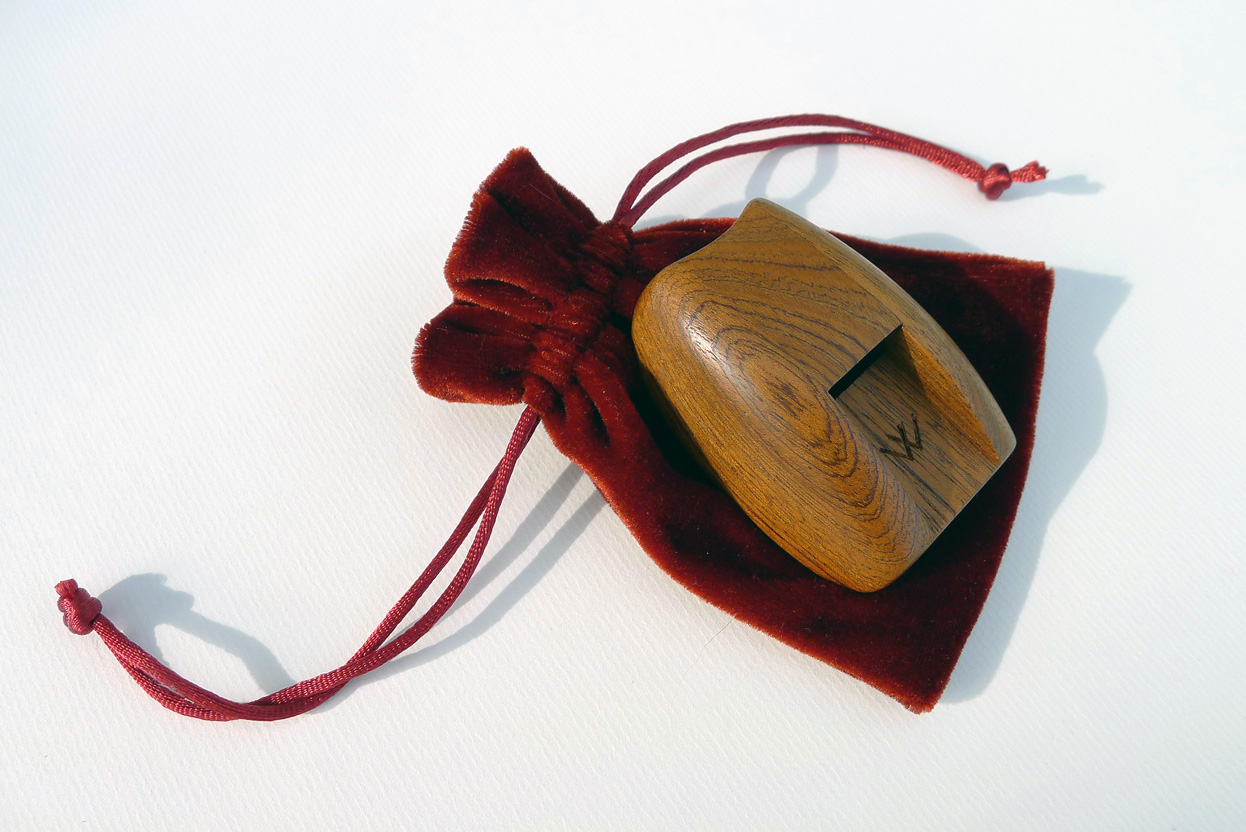
Mister Karl Wigert is a 67 years old carpenter. He lives in Uster, Switzerland, and make nose flutes. I ordered one, and received it quite quickly, packed in a very nice little bag. Inside the bag: the flute, and an user-manual.


« I've been producing nose flutes for 15 years. Before, I made different musical instruments in the percussion field. At the moment, I only make nose flutes, no other instruments. The fabrication time varies, but usually, it takes me one day per flute. Until now, I have made around 250 ones. »


The flute itself has a shape very near the "large model" by Heinrich Handler, in Austria. And since this shape was, for Mr. Handler, the result of a recomposition of the traditional Styrian nose flute from the 30s (he worked with archive photos), I thought the shape was also traditional in the Canton of Zurich, where Mr. Wigert lives. But I was wrong : « No, this flute is an unusual instrument, here too. »


The instrument gives immediately a very nice impression of precision and well-done craftsmanship. It has been well assembled, well sanded, and stained with a mate mahogany light varnish.

The flute is signed by Karl Wigert monogram, a 'W' made by four strokes of chisel.


The nose saddle is rather ergonomical, but should have been a bit more, with a more comfortable place (a scoop) for the nose bottom cartilage (yet this &#@§! cartilage...). But it's however possible to find a position with no air leaks.

The particularity of this nose flute is its whistling system. As told before, the instrument is very precisely done, and thus was open to receive sharp specifications (or it is the inverse : the will of fine settings needed a precise woodwork?).
Indeed, the mouth hole is the tiniest I've ever seen : it is 2 cm wide, by ... 2 mm high! And more : the exit of the airway is less than 1 mm thick !


Those very tiny specifications lead to a very precise nose flute, dramatically oriented to "sharp playing". Indeed, I can reach very high notes without having to bend the tongue near the palate, but fore sure, cannot go deep in the bass.
The flute is so precise, that just a light breeze make it sound. On the negative side however, blow too hard makes it produce unwanted sounds.
What I would say as a conclusion, is that I feel this very good Nasenflöte as a... recording studio nose flute : very precise but a bit weak in loudness, because you have to blow it lightly.

The Wigert Nasenflöte is a very fine instrument, needing a bit of time to accustom to it : as lightly as you blow, as precise you have to be yourself to keep the tone, because the flute is very sensitive to tongue movements. This flute is for experimented players, and absolutely not for beginners (and thus, a bit to difficult for me). It won't forgive no mistakes, but will offer in exchange an easy speed and precise playing.

Here is a quick sound test to show the sharpness of this instrument (played by Nosy Diva on my insistence as she was doing something else) :


Fortunately, Mr. Wigert has embedded 3 nice pieces on his website, played with a pair of Nasenflöten. I don't know (but I don't think so) whether they have the same specifications than mine, but I guess not, since they seem more disposed to bass playing :

Lueged vo Berg und vu Tal :


Der Mond ist aufgegangen :


Viel Glück und viel Segen... :


Last word : this nose flute review was totally supervised by the best authority, the Noseflute.org CEO herself, Miss Patafix :