This blog is dedicated to the sublime instruments called nose flutes and which produce the most divine sound ever. We have chosen to discard all the native models from S. Pacific and Asia, for they need fingering to be played. We'll concentrate on "buccal cavity driven" nose flutes : the well patented and trademarked metal or plastic ones, plus, by a condemnable indulgence, some wooden craft or home-made productions.
Trophy Music Co, subsidiary of Grover, is the producer/distributor of the famous plastic Humanatone. The company mostly sells them in bulks of units wrapped in cellophane. But there is also a department called 1st Note which distributes the Humanatone with a better packaging, with the name "1st Note Nose Flute".
What's more unusual, is to find a wooden nose flute branded by Trophy Music... That's what I found, and with the help of my friend UkesterBrown, famous ukulele player, I was able to acquire it (the seller didn't want to sell out of USA ...!). Thank you David!
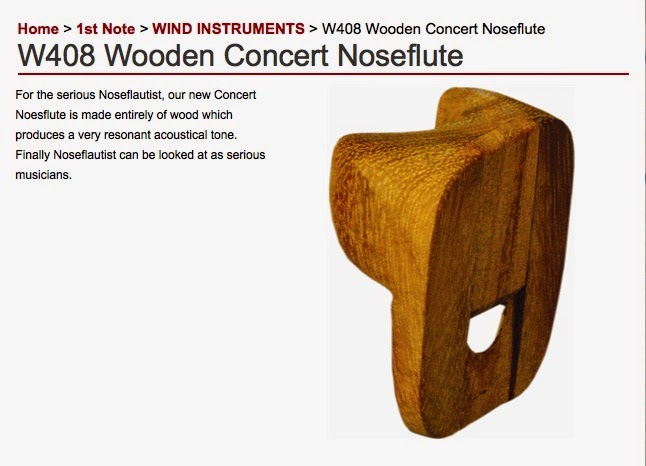
It is named "Concert Nose Flute", and is a "regular vietnamese nose flute" - I mean: not really an interesting wooden nose flute (badly and quickly made). What is interesting is the fact that Trophy distributed it. The back is printed with an "humorous" user manual, and the graphics looks like dedicated to an April Fool's Day use.
I checked the barcode (UPC-A : 0 82562 08423 0), in which 82562 refers to Trophy Music Co. and 08423 to the specific product itself, and found no occurrence, meaning that the product has been discontinued. However, the reference W408 still exist for a wooden nose flute in Trophy Music catalog, but apparently with no packaging (they probably understood that the laughing man was not compatible with their assertion Finally Noseflautist can be looked at as serious musicians (sic). So, it is not possible for me to date this nose flute, but I think it is from the 1990s. The "laughing bow tie man" graphics is the same that the former designed used to package the 1st Note Nose Flute (Humanatone).
Here are the former and the current graphics of the 1st Note Nose Flute:
To me, it was like a "rumor" to state that the "urban" shape (compact and bucal cavity driven) nose flute was used for ages by the Guarani people (check this post). They could have begun producing it for commercial reason (difficult for them to survive, nowadays) for several years only. Contrarywise, what about Vietnam? Same (or so) shapes are massively produced in Vietnam : has it been a traditional shape for long there ?
So I asked a famous ethnomusicologist, specialized in traditional flutes, Mr. Randy Raine Reusch (Ethnomusicologist, composer, musician and world-music consultant), who answered gently and quickly...
After having told me that I should not call our "urban" nose flutes "nose flutes" but "nose whistles" (I agree, but the habit has been adopted by all players...), Mr. Raine-Reusch wrote :
« The instrument that you play is originally from the Guaranis people used for calling birds, to my knowledge it was not used for melodies. However, this whistles along with many other native whistles became popular for use in Samba bands in Brazil, and you can easily see them at the Carnival parades. They play percussive parts. The western humanatone and Vietnamese instruments were copied from the Brazilian version. There is no history of these instruments at all in Vietnam, they are just made there for commercial purposes. As well there is not tradition of these instruments elsewhere in the world until the popularity of the humanatone as a novelty instrument, since that time, they can be found as novelty instruments made in a host of countries, out of plastic, wood or metal.
The brazilian instrument is the traditional shape, and there is no record of how long it has been used in Brazil, which suggests that it is longer than when Europeans made first contact. »
Dan Moi is a German wind and percussion instruments worldwide distributor. They sell a wooden nose flute probably made in Vietnam, that is available in 2 sizes : adult and child.
In fact, the shape is exactly the one of the Vietnamese nose flutes findable on Ebay, but there is one big difference... They are much much well finished that the Ebay ones (not perfect at all though). They are very well sanded, more regular (symmetric!) and some details get the benefit of a better finish.
The labium is not perfect, but is cleaner that what can be found on Ebay wooden flutes.
Thus, the sound - wooden type, obviously - is cleaner and with a nice range and power. Nothing comparable with a high-end wooden nose flute, like a Handler or a Zycha, but really a better choice (for the same price and the same shape) than the Ebay ones.
Still the problem, though, of the position of the air entrance, really not appropriate for many western noses with hard cartilage at the bottom. I'm personally forced to put the hole under one of my nostrils only to avoid air leaks, and get an asymmetric position (not fitted to hand free playing).
Kiyoshi Suzuki (スズキ キヨシ) is a Japanese musician, specialized in African percussions, an instrument maker, a music teacher and lecturer, and a performance organizer. His wife Sachie Tomioka (トミオカ サチエ) is a designer and an aromatherapy instructor. Both are very involved in environmental and human causes, and form the Kiyoshism studio, or On-lak Ichiba ("music market").
On their website (and here translated by Goggle), you can read all about their activities, and discover the instruments Suzuki makes and sells : percussions, Kalimbas, "shala-shalas" and... nose flutes.
The particularity of Kiyoshi's instruments is that they all use a funny, colored and recycled supplementary percussion system : flattened beer caps used as little cymbals! Even the On-lak nose flutes (おんらく) wear their little beer cap, coming from a Japanese, Indonesian, Hawaiian, Indonesian... beer bottle.
Mr. Kiyoshi very gently answered my questions :
- When did you begin to make nose flutes, and why ?
I began to make them about 5 years ago.
I think ... the nose flutes is "a barrier-free musical instrument". It is a communication tool, so funny and so amazing !
- How did you get the idea of adding beer caps, and why ?
The cause of that is the sound object "Okan Shala-shala." ”Okan Shala-shala” is a Kiyoshi's original item. The Japanese meaning of "Okan" is beer caps. It's a like a tambourine, and makes a sound of good noise.
- What is the meaning of the name "On-Lak" ?
We are a husband and wife unit. Kiyoshi is a musician (Percussion & Kalimba player). Tommy is a designer.
Our unit name is "On-Lak Ichiba".
The Japanese' meaning of "On-Lak" is "music".
"On" meaning is sound.
"Lak"means "enjoy, comfortable, etc."
The Japanese meaning of "Ichiba" is "market (PARCO)".
We enjoy music !!!
The On-lak nose flute
I tried to find to get one by the past, but did not succeed because the one I looked for was on Amazon.co.jp, and without a Japanese postal address, it is not possible to order from this seller. But recently, I had the luck to become friend with ShowNoseFlute, this young, fine and gentle hanabue player, and we decided to make a exchange of nose flute, since he was interested by some western ones.
So, thanks to Show, I received my first On-lak. And as a greedy collector, looking for info about it, I finally discovered the original On-lak website, and was able to... order more! (very easily, sending a english email with my colour choices at info[at]kiyoshism.com, and paying with Paypal).
The On-lak is a vietnamese type nose flute, as we know them, made in quite good grade rosewood (some show the very recognizable light-dark patterns), and, as we already know, are very playable with a nice sound (some difficulties, though, for noses with hard cartilage coming low under the base of the nose, because of the position of the air entrance on the flute).
But the On-lak is a very funny instrument with its "Okan" soft percussion cymbal. How to play it ? Well, there is a user-manual that is provided with the flute, which says (thanks to Show for the translation) :
« Sandwich the nose flute between thumb and middle finger, and put the index finger on the crown cymbals. Fit nose on dent of the top (see photo). »
So, the right use is to shake and tap cymbal, according to your skill and imagination, with the index, while you blow the flute. Or you can use it as a flute only, and then use it as a shaker. Let's say the percussive sound is not very loud, as you can expect from a single beer cap smashing a small piece of wood, but for a solitary playing or before a microphone, the okan will do the thing!
You can hear the okan effect in this recording by ShowNoseFlute, in which he uses different nose flutes : the percussion sounds come from his On-lak flute.
And I made a little stupid and quick video for you (and you already know that I'm not a good player...) :
So, if you look for a funny and original nose flute, just choose the colour you like for the cymbal and for the cord, and ask Mr. Kiyoshi!
Beside the ineluctable plastic Humanatones, one can find wooden nose flutes on Ebay. They are often the same (2 models), are said to be "ethically sourced", and cost from $8 to $12 depending on the merchant.
Those flutes are made in Vietnam. One model (the heart-shaped one) is made in rosewood and the other (classical shape) in... « fresh smelling Ethically sourced soft wood ».
What are they worth ?
Well, they play and sound quite correctly. They are not ergonomically at the top, in particular the classical one (the rosewood one has got a notch at the top which fits the base of the nose well).
The negative side is on the finishing. These pieces are made in a hurry, taking no care of the details. They surely are not made with machines, but not neither by meticulous craftsmen. The mouth hole, the duct and the labium are really not neat.
Let's say those flutes are worth their price, because there is human work on them, supposed to be "ethically paid", and that they work. But no more.
At equal price, better choose the rosewood one.