Noseflute.org is very glad to welcome an article written by Maikel Mei. Mr. Mei just visited the largest private whistle collection of the world, created, owned and maintained by Mr. Piet Visser, near Utrecht, Netherlands. [not to be confused with Mr. Bernard Visser, flute collector].
Maikel Mei wrote a long paper that will be presented in several parts in this blog. As an "editor", I have just added some footnotes for complements of info. I'll publish separately presentations of the nose flutes themselves. Photos by Maikel Mei.
Piet Visser Nose Flute Collection - Part II
The oldest plastic nose flute
The oldest plastic nose flute Mr Visser owns, is the so-called 'Simmy', in no less than three different colours. Not only does it come in different pastel colours, but this is the first time that two colours were used for the body and the air duct cover of the nose flute. Both parts were glued together. This flute is particularly interesting, as it represents the (missing) link between the metal and the 'swan logo' nose flute, most noticeably in the basic lines of the 'Simmy': they reveal that this design was based on the earlier model made out of bent sheet-metal. Mr Visser states that the 'Simmy' was first produced in 1952. Another source revealed that the 'Simmy' model was a gift inside the package of a brand of washing powder in the 1950s
[check Note 1], so this could be correct. However, there is no hard evidence to give an exact date yet, as with the Nasalette that was first registered on 14 June 1892, just over 120 years ago! The 'Simmy' produces a clear tone, similar to the later 'swan logo' model, yet it is quite a lot harder to play. The reason for this is that the lip rest is really rather on the short side. As a result of this, there is less margin to play with. The lip rest somehow must be put halfway inside the lower lip, in order to make the mouth fit properly around the labium lip.
 Three Simmy flutes from the early 1950s.
(These instruments will be detailed and studied in further posts)
The 'swan logo' nose flute from Germany
From the 'Simmy' it really isn't a big step towards the 'swan logo' nose flute, which must be the best known model amongst the nose flutes. Mr Visser states that this model was first produced in 1958. This could well be the case, but has yet to be established as a fact. The colours that were used and particularly the faded state of the colours of the nose flute that Mr Visser owns, are very '50s like. However, these '50s style colours might as well be deliberately used as to make the nose flute look archaic, in order to give it the 'cosy '50s look'. Several sources reveal that the 'swan logo' nose flute is a typical '70s novelty. Most people actually remember it from that era, the late '70s through to the early '80s. However, Mrs Visser stepped in on that and contributed considerably to backdate the first release of the 'swan logo' nose flute: she well-remembered that these flutes were inside public vending machines amongst candy and plastic toys, in the 1960s. One would put in a coin, turn the handle and a surprise item would then be dispensed from the glass container. This basically could be any of the visible items inside, which certainly triggered the imagination as well as the anticipation!

 Some of the many early 'Swan logo' nose flutes
(These instruments will be detailed and studied in further posts)
This information provided actually is new an certainly does make sense. The fact that it was made shortly after the introduction of the 'Simmy' could be explained by new developments in mould making, looking for a freer form. Also, this development may also be explained by the need to improve the shortcomings of the plastic nose flute, making it more playable!
[check note 2] Mind you: the '50s were all about creating exciting new items from modern materials in bright colours, shaking off the depressing war-period of scarcity and stagnation! We may regard them as being old-fashioned and really rather dated now, yet at the time they actually were brand new and top of the bill, the next exciting thing happening as modern life progressed! Until now, we knew that the 'swan logo' nose flute was sold at major stores and early shopping malls in the 1970s, as well as in toy shops and music stores. It appears that the 'swan logo' nose flute was really quite common and even popular to a certain extent in the Netherlands at the time. This is confirmed by the fact that the nose flute is part of the cultural awareness of the young generation of that period! Most Dutch kids would obtain a 'plastic nose flute' at children's birthday parties in the early 1980s, as the 'swan logo' nose flute would be part of a small bag filled with candy and little toys. This bag would generally be handed out when the party was over. The party indeed was more or less over for the 'swan logo' flute after 1985, when the German factory apparently closed. By that time demand for the flute had become less and less, as popular items such as the Rubic's cube and the yo-yo had stepped in and 'taken over control'.
Modern nose flutes
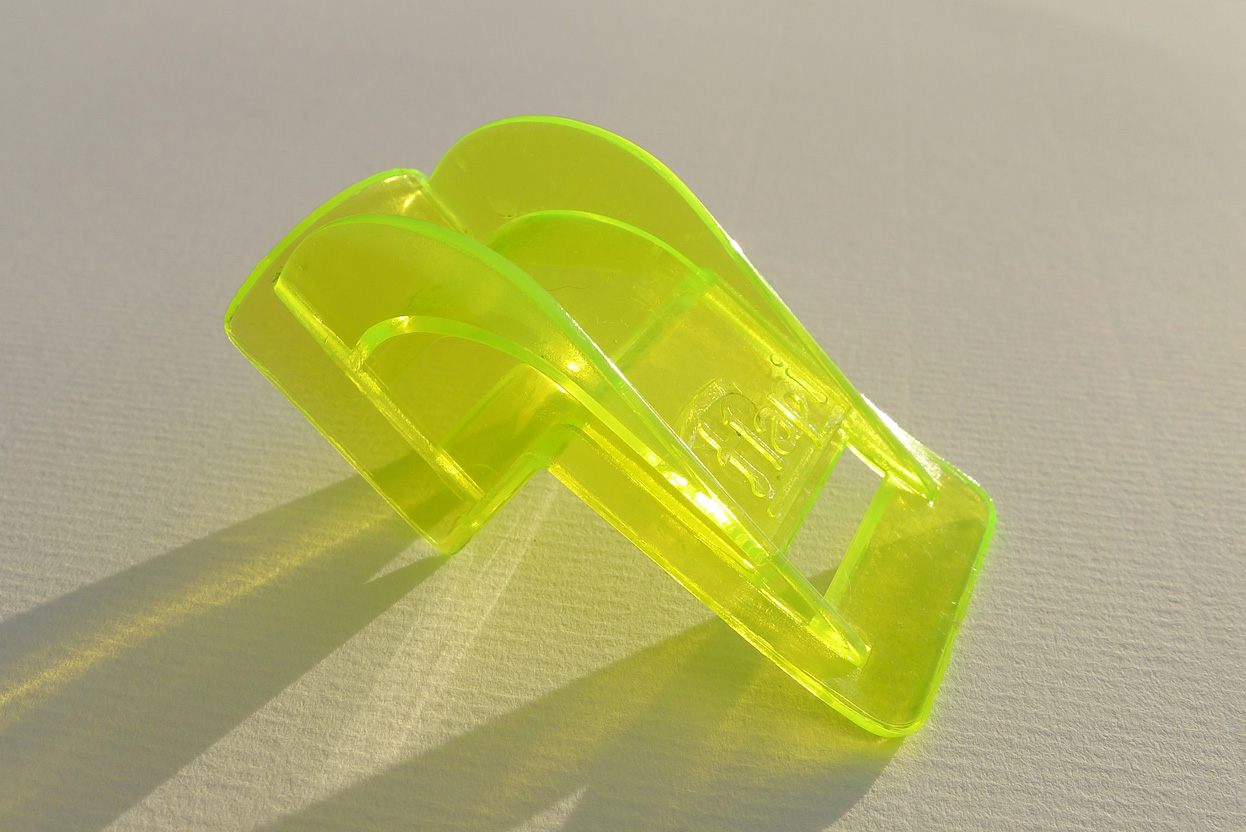
The modern nose flutes that Piet Visser owns, undoubtedly find their culmination in the Spanish 'Froby' flute made from perspex in 1988. Mr Visser purchased this item in an Antwerp shop and remembers that they were available in various colours. The 'Froby' in Mr Visser's collection is a neon-coloured, transparant nose flute of an amazingly futuristic design! It really is the next step in nose flute design! Not only is it stunning to look at, the sound certainly must be the best basic quality that was ever produced by a plastic nose flute: it not only has a precise and fine attack, but also the smoothest resonating reedy sound! It actually makes this plastic nose flute stand out as the one with the most professional instrumental qualities. Apart from the plastic nose flute being sold as a 'toy', the basic sound really is rather 'cheap', as there is no intrinsic resonance nor substantial tone quality. That makes the nose flute not only one of the very hardest instruments to master, but moreover a truly difficult instrument to put across professionally. The 'Froby' certainly attracts attention by the way it looks and sounds! Sadly, this particular nose flute wasn't continued and therefore remains a one-off...

Piet Visser soothing his Koi carp in his garden pond by playing the Froby nose flute

(The "Froby" nose flute will be detailed and studied in a further post)
The nose flutes produced after the 'Froby' are really disappointing in more than one way. In 1997, a spin-off of the American type Humanatone was lauched from China, in a softer kind of plastics and available in various soft-neon colours. It sadly lacks 'body', not only in construction but most definitely in sound as well. It was probably the first batch of mass-produced cheap plastic toys coming for China that have flooded the (Western) world since
[check note 3]. The only advantage over any other plastic nose flute is that its body and most particularly its 'wings' are bendable when the instrument has been properly 'warmed-up', after five minutes of play or so. Bending the sides of the body actually bends the air flow coming out of the labium, changing the sound. Experimenting with various techniques has revealed that some 20 different 'wind tones' can be produced this way! The downside to this is that the instrument does require proper warming-up. The real problem is that the flute body easily breaks when pushed a little too far and tends to split the air duct body, which makes it unplayable...
---
Footnotes by Mr. UkeHeidi, editor and contradictor :)
[1] - One must be very cautious with this statement. Indeed, the brands Bonux, Skip and Pax (by Cadum) were used to give a freebie plastic toy with each pack of washing powder. But Bonux was the first in Europe to do so, and the brand dates from 1960 (too late for the Simmy). More, all the moulds were "branded" and the freebies carried the brand name, as a signature. There is no such mark on the Simmy, besides the name "Simmy" itself. And I found no washing powder with this name.
[2] - The design of the "Swan logo" nose flute is much more similar to the shape of metal flutes from the 1900-1930s. I personally cannot see any design continuity from those pioneers to the Swan, which would pass through the Simmy stage. Moreover, there is no evidence of any link between the Simmy and the Swan, despite an unquestionable resemblance, including some fabrication artefacts. Not even that the Simmy would be from German origin.
[3] - There were already very cheap and bad quality plastic nose flutes from much earlier than 1998. The "Hum-a-Tune" (check
this post) and the "Bullwinkle's Hum-a-Tune" (check
this post), both from the end of the 60s and made in Hong-Kong, were very low grade copies of the Humanatone.
---
Related links :
-
The Piet Visser Collection - Part I
-
The Piet Visser Collection - Part II
-
The Piet Visser Collection - Part III
-
Piet Visser's blog
-
Marja Visser's quilt making
---