 | |
 |  |
 | |
 |  |
 | |
 |  |

Showing posts with label Fred Gretsch Mfg Co.. Show all posts
Showing posts with label Fred Gretsch Mfg Co.. Show all posts
Jun 15, 2016
Vintage Marbled Gretsch Humanatone
Today, relax, just a few pictures of an vintage marbled Gretsch Humanatone just added to the collection.


Jun 10, 2016
75th Anniversary of the plastic Humanatone!
Filed Jan. 22, 1940 by Ernest W. Davis (NFHoF), the patent of what became the plastic Humanatone (in 1943) was registered on 10th of June, 1941, exactly 75 years ago!

We all know that the 'Hum' is not the best nose flute – could I dare to say it is the worst mass produced one – but it has been much better by the past. The plastics used have evolved in a bad way: whether the 1943+ models were roughly injected in a low grade plastic (celluloid?), the Fred Gretsch Mfg Co. quickly turned to a nice polystyren, stiff and crispy, yet light, nicely sounding. But on the turn of the 1980-90s, Trophy Music Co. bought the brand and began a production in a cheap, soft and dull sounding PVC (not from the beginning however, there were polystyren Trophy Music versions, then translucent red ones, then only the PVC).
The original shape evolved a bit at the early stages: the nose scoop got sharper, the 'true tremolo' hole stopped to been chamfered, the wingspan was reduced a bit while the mouth hole made bigger, and a heal was added to the bottom of the mouth shield. All by Grestch, on their late models.
Besides the bad quality of the plastic, we all know that the main feature that turns the Humanatone to a cheap toy is the very broad mouth hole: clog the bottom third of this hole by a piece of bristol (or better: a piece of aluminium), and the Hum immediately sounds better (but sharper). This is maybe the reason of its success: a sturdy, sharp and loud instrument would have frightened the parents! Better buy a barely sounding toy, more 'windy-woody' than sharp and crisp, and better, that the kido will break after an afternoon of use.
However, in the 1940s, the Humanatone was also specially packaged to be sent to the 'buoys' fighting in the Pacific. No more dedicated to concertists, as the original metal one was, but to kids and soldiers.

The early models were incredibly psychedelic, with swirled and marbled colours! But Gretsch rationalized its catalogue and began to produce only plain color Humanatones. Red, yellow, blue, brown, black. Then Trophy Music froze the range to the current 6 tones: yellow, orange, red, purple, navy blue and green.

In the 1950-60, the Humanatone was also produced in a tin version, made in Japan.
The Hum was copied. By the Hum-a-Tune, produced in Hong-Kong in 1969, rebranded into 'Bullwinkle's Hum-a-Tune', but also by an anonymous chinese production, in the 90s. But the Humanatone continued its road, sold under different disguises, like the Topps Nose Flute version in the 1960s, the Dr. B. B. Bumpstead's Musical Respirator, the Amazing Nose Flute in 2005, or even by Trophy Music itself with the 1st Note Nose flute. It was even used as a promotional toy for a nasal spray!
The Humanatone was also the object of all my affection in my very first video, very first post of this blog on 9th of August, 2011:
---
So, despite your numerous flaws, your cheap make, your deep crappiness, you're the one with the biggest success and longevity, and this must necessarily mean something…
Happy birthday, Grandma!


We all know that the 'Hum' is not the best nose flute – could I dare to say it is the worst mass produced one – but it has been much better by the past. The plastics used have evolved in a bad way: whether the 1943+ models were roughly injected in a low grade plastic (celluloid?), the Fred Gretsch Mfg Co. quickly turned to a nice polystyren, stiff and crispy, yet light, nicely sounding. But on the turn of the 1980-90s, Trophy Music Co. bought the brand and began a production in a cheap, soft and dull sounding PVC (not from the beginning however, there were polystyren Trophy Music versions, then translucent red ones, then only the PVC).
The original shape evolved a bit at the early stages: the nose scoop got sharper, the 'true tremolo' hole stopped to been chamfered, the wingspan was reduced a bit while the mouth hole made bigger, and a heal was added to the bottom of the mouth shield. All by Grestch, on their late models.
 |  |
 |  |
However, in the 1940s, the Humanatone was also specially packaged to be sent to the 'buoys' fighting in the Pacific. No more dedicated to concertists, as the original metal one was, but to kids and soldiers.

The early models were incredibly psychedelic, with swirled and marbled colours! But Gretsch rationalized its catalogue and began to produce only plain color Humanatones. Red, yellow, blue, brown, black. Then Trophy Music froze the range to the current 6 tones: yellow, orange, red, purple, navy blue and green.

In the 1950-60, the Humanatone was also produced in a tin version, made in Japan.
The Hum was copied. By the Hum-a-Tune, produced in Hong-Kong in 1969, rebranded into 'Bullwinkle's Hum-a-Tune', but also by an anonymous chinese production, in the 90s. But the Humanatone continued its road, sold under different disguises, like the Topps Nose Flute version in the 1960s, the Dr. B. B. Bumpstead's Musical Respirator, the Amazing Nose Flute in 2005, or even by Trophy Music itself with the 1st Note Nose flute. It was even used as a promotional toy for a nasal spray!
The Humanatone was also the object of all my affection in my very first video, very first post of this blog on 9th of August, 2011:
---
So, despite your numerous flaws, your cheap make, your deep crappiness, you're the one with the biggest success and longevity, and this must necessarily mean something…
Happy birthday, Grandma!

Jun 9, 2016
Humatune… addendum
After having posted yesterday's article, I incidentally found some pictures of a pair of Humatunes that have been sold on Etsy.com (it is always easier to find when you know what to look for...). Those were still packed in a cellophane envelope, and sealed by a paper header:


The first interesting thing is the price: 10c. It doesn't ascertain nothing, but comparison with other nose flutes (sold in groceries or so) may help to give a date:
1963: Snoot-flute - 10c.
1965+: Topps (Humanatone) - 19c.
1969: Bullwinkle's Hum-a-tune - 29c.
But all three were plastic made. So, a metal nose flute should have been more expensive, or, at 10c., on the market earlier. Thus, the Humatune should probably date of the 1950's.
The second interesting point is obviously the mention Packed by "Toy-Pak" .
It was not easy to find info about this company, but I finally did through... obituary notices!
Vancouver Sun (BC):

So, Toy-Pak was founded by Stuart and Mary Whitehouse, and was 'the first wholesale toy distributor for the grocery trade in BC'. So, Toy-Pak was located in British Columbia (CA), precisely 8455 Lougheed Highway, Burnaby (Eastern suburb of Vancouver):
Sorry, I didn't find bigger:

My first thoughts were that Humatune could have been the Humanatone brand for the Canadian market... But the seller of this pair of Humatunes was in California, and the seller of mine too!
Indeed, Pak-Toy seems to have had subsidiaries in Santa Maria, California, and in Stirling, Scotland:

The Humatune looks to date of the 1950s; anyway, Toy-Pak was still existing in 1976:
Squamish Times (BC), May 20, 1976:

And if...
... if Gretsch had simply bought the brand Humatune ?
Remember, the Hum-a-tune was a kind of circular kazoo that got a good fame in the 1930s (see here). Its production probably stopped with the WWII. But the brand was reknown...
I got a late sample likely from the early 40s [according to the Junket Rennet powder box (ad on the papers) which had changed in 1943], complete and I dare to say 'pristine':


And if you see well, whether the brand is written 'Hum-a-tune' on the papers, it is stamped without the dashes on the instrument itself:


So? It is just an hypothesis, but if Gretsch had bought the brand Hum-a-tune/Humatune, it would explain why the graphic chart of the Humantune is the same that the Gretsch one, but also details like the article 'the' in 'Humatune (The Nose Flute)'. Indeed, the people already knew Hum-a-tune the kazoo, and here came the nose flute. But why not Humanatone? It could have been either to differenciate the metal flute from the plastic one, but more likely to get the benefit of a brand known in a different sector of distribution than music resellers: the grocers.


The first interesting thing is the price: 10c. It doesn't ascertain nothing, but comparison with other nose flutes (sold in groceries or so) may help to give a date:
1963: Snoot-flute - 10c.
1965+: Topps (Humanatone) - 19c.
1969: Bullwinkle's Hum-a-tune - 29c.
But all three were plastic made. So, a metal nose flute should have been more expensive, or, at 10c., on the market earlier. Thus, the Humatune should probably date of the 1950's.
The second interesting point is obviously the mention Packed by "Toy-Pak" .
It was not easy to find info about this company, but I finally did through... obituary notices!
Vancouver Sun (BC):

So, Toy-Pak was founded by Stuart and Mary Whitehouse, and was 'the first wholesale toy distributor for the grocery trade in BC'. So, Toy-Pak was located in British Columbia (CA), precisely 8455 Lougheed Highway, Burnaby (Eastern suburb of Vancouver):
Sorry, I didn't find bigger:

My first thoughts were that Humatune could have been the Humanatone brand for the Canadian market... But the seller of this pair of Humatunes was in California, and the seller of mine too!
Indeed, Pak-Toy seems to have had subsidiaries in Santa Maria, California, and in Stirling, Scotland:

The Humatune looks to date of the 1950s; anyway, Toy-Pak was still existing in 1976:
Squamish Times (BC), May 20, 1976:

And if...
... if Gretsch had simply bought the brand Humatune ?
Remember, the Hum-a-tune was a kind of circular kazoo that got a good fame in the 1930s (see here). Its production probably stopped with the WWII. But the brand was reknown...
I got a late sample likely from the early 40s [according to the Junket Rennet powder box (ad on the papers) which had changed in 1943], complete and I dare to say 'pristine':


And if you see well, whether the brand is written 'Hum-a-tune' on the papers, it is stamped without the dashes on the instrument itself:


So? It is just an hypothesis, but if Gretsch had bought the brand Hum-a-tune/Humatune, it would explain why the graphic chart of the Humantune is the same that the Gretsch one, but also details like the article 'the' in 'Humatune (The Nose Flute)'. Indeed, the people already knew Hum-a-tune the kazoo, and here came the nose flute. But why not Humanatone? It could have been either to differenciate the metal flute from the plastic one, but more likely to get the benefit of a brand known in a different sector of distribution than music resellers: the grocers.
Jun 8, 2016
Humatune ?!?
In the field of the historical research, new discoveries and findings often do not help much to achieve the puzzle or even consolidate it, but generally open new breaches in the 'global frame', and make even more fragile the facts that were regarded as ascertained. This is particularly true in nose flute historic research, and notably because there is no previous corpus to lean on.

I found a vintage nose flute that is a real mystery, the Humatune. Oh yes, it sounds like the Hum-A-Tune, the late 1960s Hong Kong copy of the plastic Gretsch Humanatone (see here for instance), but this Humatune brand wears no dashes. Yes, it has the shape of a Gretsch Humanatone, but it is made of metal. Yes, it was made in Japan, like the Gretsch metal Humanatone (see here). In fact it is the exact same flute that the Japan made metal Humanatone. Just the brand and the packaging are different.
Both Humatune and Humanatone, Japan make:
In fact, it is not the packaging which is different, but the brand, the color and the text. All the rest is identical. May we deduce that one follows the other or could have they been sold at the same time, and if so, why?
The Humatune clearly uses the same branding codes and graphic chart that the Humanatone, also declined on the 1950-60 plastic version box (see here)

So, the Humatune should be a Fred Gretsch Mfg Co. product. But there were earlier versions of the plastic Humanatone (since 1943), and the brand 'Humanatone' was already a Gretsch property. So why having used an new brand ?
As we said, the printed texts are different. It is interesting to notice the differences, notably in the titles, on one hand "The Nose Flute / A musical instrument…" and on the other hand "Nose Flute / The musical instrument…". It is sometimes possible to deduce which text is prior to another one, for instance when typo had been corrected. But here ...

Although the text is elegant and rather regular, a closer look shows that it had been hand written. Not even produced with a lettering guide... Check the differences between the letters (the size of the 'o' or the 's' for instance). This is pure meticulous hand writing:

And this was probably the same person who wrote both text. The global 'hand' is the same, but more, the little mistakes are the same! For instance, the 'kerning' mistakes regarding the just placement of the 'i' between 'r' and 'l' in NOSTRILS, etc.

(this is not a) Conclusion
The Japan make Humatune and Humanatone should probably have not been sold at the same moment. Indeed, as they were both produced by the same company and share many identities, the text should have been the same. So, my opinion is that one preceded the other. Which one first?
Points in favor of the anteriority of the Humanatone:
- The headline "The musical instrument that anybody can play" is placed on the Humanatone version just over a insertion cutting: when the instrument is on the cardboard, it masks half of the text. The Humatune version, on whish the text has been displaced, may look as a correction.
Points in favor of the anteriority of the Humatune:
- If the first metal flute had been branded Humanatone, there would have been absolutely no obvious reason to change the brand into a new and unknown brand.
- "… and first finger of hand" [Humatune] sounds like gibberish (would one have thought they could play with their foot ?). The sentence "… and forfinger of either hand" [Humanatone] sounds like a correction.
- The use of the article 'the' ('the nose flute') is a bit strange, and did not appeared on the the different boxes that packaged the plastic version. This looks like an archaïc version.
- The sentence "No opening at the corner of the mouth so air can escape" is not very clear. On the Humanatone, the last part is missing. This could have been a correction.
- "you can play" [Humanatone] sounds like a simplification of "you can learn to play" [Humatune]
- 'firmly' ("Hold the Humanatone firmly") is a word you would add, but probably not remove from a user manual. It doesn't appear on the Humatune.
- Many other little details ... "anybody"/"anyone", "hum a tune or sing"/"sing, hum or whistle a tune"… plead in favor of the Humanatone as an amended version.
So, why would have the Gretsch co. used another brand in the early version of this instrument ? Could have it been in order to avoid confusion between the metal and the plastic instruments ?
Could have Gretsch bought a competitor called Humatune, kept the name, but replaced the instrument and the graphic chart ?

I found a vintage nose flute that is a real mystery, the Humatune. Oh yes, it sounds like the Hum-A-Tune, the late 1960s Hong Kong copy of the plastic Gretsch Humanatone (see here for instance), but this Humatune brand wears no dashes. Yes, it has the shape of a Gretsch Humanatone, but it is made of metal. Yes, it was made in Japan, like the Gretsch metal Humanatone (see here). In fact it is the exact same flute that the Japan made metal Humanatone. Just the brand and the packaging are different.
Both Humatune and Humanatone, Japan make:
 |  |
 | |
 |  |
 | |
The Humatune clearly uses the same branding codes and graphic chart that the Humanatone, also declined on the 1950-60 plastic version box (see here)

So, the Humatune should be a Fred Gretsch Mfg Co. product. But there were earlier versions of the plastic Humanatone (since 1943), and the brand 'Humanatone' was already a Gretsch property. So why having used an new brand ?
As we said, the printed texts are different. It is interesting to notice the differences, notably in the titles, on one hand "The Nose Flute / A musical instrument…" and on the other hand "Nose Flute / The musical instrument…". It is sometimes possible to deduce which text is prior to another one, for instance when typo had been corrected. But here ...

Although the text is elegant and rather regular, a closer look shows that it had been hand written. Not even produced with a lettering guide... Check the differences between the letters (the size of the 'o' or the 's' for instance). This is pure meticulous hand writing:

And this was probably the same person who wrote both text. The global 'hand' is the same, but more, the little mistakes are the same! For instance, the 'kerning' mistakes regarding the just placement of the 'i' between 'r' and 'l' in NOSTRILS, etc.

(this is not a) Conclusion
The Japan make Humatune and Humanatone should probably have not been sold at the same moment. Indeed, as they were both produced by the same company and share many identities, the text should have been the same. So, my opinion is that one preceded the other. Which one first?
Points in favor of the anteriority of the Humanatone:
- The headline "The musical instrument that anybody can play" is placed on the Humanatone version just over a insertion cutting: when the instrument is on the cardboard, it masks half of the text. The Humatune version, on whish the text has been displaced, may look as a correction.
Points in favor of the anteriority of the Humatune:
- If the first metal flute had been branded Humanatone, there would have been absolutely no obvious reason to change the brand into a new and unknown brand.
- "… and first finger of hand" [Humatune] sounds like gibberish (would one have thought they could play with their foot ?). The sentence "… and forfinger of either hand" [Humanatone] sounds like a correction.
- The use of the article 'the' ('the nose flute') is a bit strange, and did not appeared on the the different boxes that packaged the plastic version. This looks like an archaïc version.
- The sentence "No opening at the corner of the mouth so air can escape" is not very clear. On the Humanatone, the last part is missing. This could have been a correction.
- "you can play" [Humanatone] sounds like a simplification of "you can learn to play" [Humatune]
- 'firmly' ("Hold the Humanatone firmly") is a word you would add, but probably not remove from a user manual. It doesn't appear on the Humatune.
- Many other little details ... "anybody"/"anyone", "hum a tune or sing"/"sing, hum or whistle a tune"… plead in favor of the Humanatone as an amended version.
So, why would have the Gretsch co. used another brand in the early version of this instrument ? Could have it been in order to avoid confusion between the metal and the plastic instruments ?
Could have Gretsch bought a competitor called Humatune, kept the name, but replaced the instrument and the graphic chart ?
May 13, 2016
Archie Sweet, Plastic Humanatone Early Adopter
The Don McNeill's Breakfast Club was a radio variety show, that ran from 1933 to 1968, at early morning.

Amongst the artists performing in the program, 'Archie Sweet', allegedly the Breakfast Club 'janitor' in 1943-44, was a one-man band. He proclaimed himself the 'World's Greatest One-Man Ban', and was challenged in a 'murderous musical struggle' by 'Panhandle Pete', with Paul Whiteman as commentator.
Lincoln Sunday Journal, Anniston Star and Indianapolis Star of the 5th and 6th of March, 1944 :

What is interesting for us is that Archie Sweet « hopes on victory on the humanaphone » (sic):

We don't know what is a 'singa-tinga'(a jews harp?), but the so-called 'Humanaphone' was definitely a 'Humanatone'! It was even one of the first plastic Humanatones, produced by Gretsch since (Autumn?) 1943. Indeed, we found a photo of Archie Sweet. It is very rare to find vintage pictures showing nose flute players with their instrument, so we are glad!


Amongst the artists performing in the program, 'Archie Sweet', allegedly the Breakfast Club 'janitor' in 1943-44, was a one-man band. He proclaimed himself the 'World's Greatest One-Man Ban', and was challenged in a 'murderous musical struggle' by 'Panhandle Pete', with Paul Whiteman as commentator.
Lincoln Sunday Journal, Anniston Star and Indianapolis Star of the 5th and 6th of March, 1944 :

What is interesting for us is that Archie Sweet « hopes on victory on the humanaphone » (sic):

We don't know what is a 'singa-tinga'(a jews harp?), but the so-called 'Humanaphone' was definitely a 'Humanatone'! It was even one of the first plastic Humanatones, produced by Gretsch since (Autumn?) 1943. Indeed, we found a photo of Archie Sweet. It is very rare to find vintage pictures showing nose flute players with their instrument, so we are glad!

Dec 14, 2014
Topps Nose Flute (Humanatone)
Two years and a half after having discovered its existence, we finally found and got one: the rare Topps Nose Flute, with its great packaging!

We will not repeat what we already wrote there about the Topps company and cheap toys. Let just say — contrarywise to what we stated in 2012 — that this flute is a *real* Humanatone, branded by Gretsch, and not a Topps dedicated version Humanatone. It dates of the second half of the 1960s.
Mine is a beautiful monochromatic mid-blue sample, and is similar at any point to the regular Gretsch Humies that were sold in cardboard boxes. I carefully removed the stapples to take pictures, and then repacked this collector for another long sleep.

As we said, the difference lays in the great packaging offered to the Topps flute. The young player looks totally enchanted by the whistlings he produces, the colors are rather flashy, and the typographics are funny.

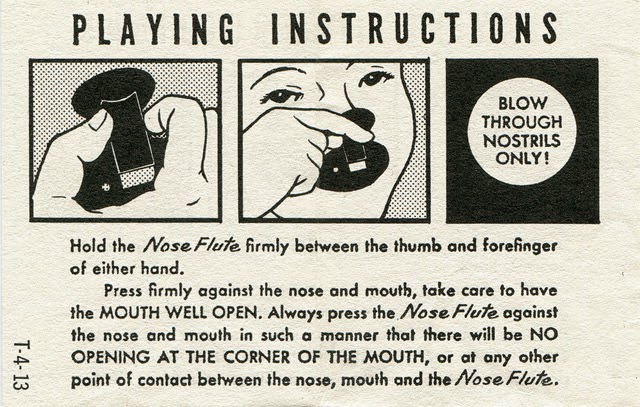
A user manual is included with the Humanatone, with no particular surprise, but showing a strip of three boxes, drawn like a triptych by Roy Lichtenstein :)

A good addition in the collection!

We will not repeat what we already wrote there about the Topps company and cheap toys. Let just say — contrarywise to what we stated in 2012 — that this flute is a *real* Humanatone, branded by Gretsch, and not a Topps dedicated version Humanatone. It dates of the second half of the 1960s.
Mine is a beautiful monochromatic mid-blue sample, and is similar at any point to the regular Gretsch Humies that were sold in cardboard boxes. I carefully removed the stapples to take pictures, and then repacked this collector for another long sleep.

 |  |

A user manual is included with the Humanatone, with no particular surprise, but showing a strip of three boxes, drawn like a triptych by Roy Lichtenstein :)
A good addition in the collection!
Sep 25, 2014
Another Transitional Humanatone
We recently published the pictures of a very early Gretsch plastic Humanatone, which appeared to be a transitional product between the famous metal nose flute and the plastic model designed by Ernest Davis (please check this post). Here is the other end of the Gretsch era: another transitional Humanatone.
Indeed, the instrument is (still) branded by Gretsch, but the user manual is printed by Trophy Music Co. So, we can state that Trophy bought from Gretsch not only the brand and moulds, but also the current stock, exactly as Gretsch had done some ±25 years before with the Humanatone Co. products. This instrument is one one the last Gretsch nose flutes.


Indeed, the instrument is (still) branded by Gretsch, but the user manual is printed by Trophy Music Co. So, we can state that Trophy bought from Gretsch not only the brand and moulds, but also the current stock, exactly as Gretsch had done some ±25 years before with the Humanatone Co. products. This instrument is one one the last Gretsch nose flutes.


Subscribe to:
Posts (Atom)