This blog is dedicated to the sublime instruments called nose flutes and which produce the most divine sound ever. We have chosen to discard all the native models from S. Pacific and Asia, for they need fingering to be played. We'll concentrate on "buccal cavity driven" nose flutes : the well patented and trademarked metal or plastic ones, plus, by a condemnable indulgence, some wooden craft or home-made productions.
Showing posts with label collections. Show all posts

Jan 28, 2013

Yet Another German Nasenflöte!

Donnerwetter! Another mistake! Well, let's be positive: another mistake corrected!

I thought that the metal Nasenflöte that was advertised in (almost) any german catalogue in the 1920-1930's was the one made by PaBru, the Paul Brunner's company in Brunndöbra.

The omnipresent no-name german metal noseflute and the Paul Brunner's one:


The no-name german Nasenflöte:


But if you look well at both engravings, you'll see the shape is not the same, particularly for the airway cap and the nose shield.

It could have been a drawing artefact. But I found a record of the Metropolitan Museum of Art for a german nose flute. There is no picture, but the record says the instrument is in metal and dates of before 1941.

Much more, the description says:


Donnerwetter (again)! The "water pump" was the PaBru trademark! The exact mark that appears of the Fanfare instrument as on the flutes and kazoos, playing with the rebus around Brunner: Brunnen means well, spring, fountain in German.


So, there was "another" german nose flute, stamped with a "water pump" and made by PaBru. The question remains to find who produced the no-name german flute, and where... Klingental district too?

Jan 19, 2013

The Göttingen University Nasenflöten

I had read in a catalogue that the Georg-August-University of Göttingen Department of Musicology hosts a collection of musical instruments, including two Nasenflöten. And thus, I wrote to ask for pictures.

Herr Dr. Klaus-Peter Brenner, the Curator, kindly took the time to make photographs and to send them to me.

There are only two nose flutes in the collection, but they are interesting. The first one is a Wunderflöte: it is a second generation Wunderflöte, the same model than the one drawn in Siegfried Wolf's book or featuring in Piet Visser's collection. The Göttingen sample is in a quite good shape, and still showing its nickel plating:


The other flute is a simple chinese plastic Swan, but it shows the rather rare particularity of a translucent airway cap. We knew some Swan Nasenflöten with a translucent part, but it was the main shield.


Jan 14, 2013

Piet Visser on dutch TV

Piet Visser, the famous dutch whistle collector, was seen on TV last october. He presented some of his wonderful whistles, but had also brought his "Blik", an american nose flute from the 1920's.

The nose flute part begins at 4'30", but the whole interview is interesting, even when you don't understand the Dutch language.


Jun 21, 2012

Piet Visser Nose Flute Collection - Part III

Noseflute.org is very glad to welcome an article written by Maikel Mei. Mr. Mei just visited the largest private whistle collection of the world, created, owned and maintained by Mr. Piet Visser, near Utrecht, Netherlands. [not to be confused with Mr. Bernard Visser, flute collector].

Maikel Mei wrote a long paper that will be presented in several parts in this blog. As an "editor", I have just added some footnotes for complements of info. I'll publish separately presentations of the nose flutes themselves. Photos by Maikel Mei.


Piet Visser Nose Flute Collection - Part III


The 'new generation' nose flutes

Piet Visser's background as a goldsmith truly came in handy as he confirmed the theory that the Chinese 'copy cats' had laid their hands on the original 'swan logo' nose flute! We compared the orginal 'swan logo' nose flutes from Mr Visser's collection to the recently required ones. After measuring it was quite noticeable that the logos differed significantly! The 'old' flutes had a distinctive clearer and deeper relief than the 'new' flutes. This alone is proof enough that the 'new generation' was copied from an 'old' flute, on which a new mould was based! A mould optimally only offers 90% detail of the original item after casting or injecting, as was the case with the plastic nose flute. Contact with the original manufacturer of the original 'swan logo' flutes around 1996-1997 proved that production had ceased in the mid-'80s. There weren't any plans to start production anew, which simply would be cost ineffective. It was thought, though, that production was somehow taken upon again after a resurgence in interest and alleged huge demand for the nose flute in the late 1990s. The demand was initially met by production of the Humanatone copy nose flute from China. This type of nose flute proved to be not the one that was asked for, as demand insisted upon the 'swan logo' nose flute instead. As a result, within a year after the introduction of the Chinese Humanatones, the 'swan logo' nose flute all of a sudden had re-appeared, out of the blue!


What already showed at the time, was that the 'new generation' of 'swans' obviously looked to have been made really rather hastily. There were some considerable imperfections in the finish of the detail, as the edges of the flute hadn't been polished and even a small hole in the nose rest was apparent. Having compared the 'old' and the 'new' versions of the same flute, it became clear as well that the two circular 'contact points' with the injecting machine were really different in relief: whilst the 'old' version has contact points with significant relief, the very little relief that the 'new' version has, actually is relief in reverse, dipping slightly into the surface! Mr Visser, however, pointed out the inside of the air duct cover, which revealed an even greater difference. Since the air duct cover is made seperately and only later joined to the flute, it has to have a contact point to the injecting machine. This contact point is located on the inside of the air duct and can be spotted through the nose opening. Whilst the 'old' version has this contact point polished down rather neatly, the 'new' version reveals that the makers --or copiers-- couldn't be bothered a bit to polish it down. The contact point inside the air duct of the 'new flute' is a crude survirvor of and a testament to the quick 'botch job' that was executed here.


The truly revealing, tell-tale sign that the 'old' nose flute was used to make a new mould for a new generation of copies from that remains the logo: no new mould was made, otherwise a new logo or no logo at all would have been included! We can be completely sure, however, that this 'new generation' was produced in China, because a German distributing contact acknowledged that they are imported from China these days! Somehow, the 'Made in Germany' still represents a quality make like no other. The irony here is that these 'copy cats' here weren't even bothered to fake a quality indicator, but simply confiscated someone else's carefully engineered product as a whole, unashamedly using their trade mark in the process! The only positive about the 'copied generation' is that the 'old' plastic nose flute has become available again.

The Chinese move onto the international market highly likely sparked off artisans from all over the world to come up with a handmade nose flute model of their own. From the end of the 1990s onwards, various artisans quite noticeably have stamped their name on nose flute making. This has resulted in the most spectacular creations during the last couple of years, particularly in Japan [check note 1]. Who knows where this may lead to?! In any case, we have been blessed with the organic continuation of the 'swan logo' style nose flute by means of the Bocarina™ from South Africa. Moreover, the Bocarina™ actually forms the synthesis of the two distinct types of modern nose flute --the European and the American--! So, we as nose flute enthusiasts should probably be thankful to the initial Chinese piracy! It certainly was a revelation to watch, feel and play the authentic nose flutes from Piet Visser's collection! However, even of greater interest is that Mr Visser, being a recently retired goldsmith, is considering to create a metal nose flute himself! Mrs Visser, being a creative force of her own, might try her talents in making her own dyes and quilts in producing a nose flute quilt! Now, how about that?! We will keep you posted! In the meantime, feel free to check out their websites.

                                                                                                         Maikel Mei


                                              << Back to Part I    -    < Back to Part II

---

Footnotes by Mr. UkeHeidi, editor and contradictor :)

[1] - This is forgetting the great flutes by Mr. Heinrich Handler (check this post), who have been making wooden nose flutes since 1980, and Maximilian Zycha, who began in 1994 (check this post). But it's true that most of the current nose flute makers began between 2000 and 2010, but not under the influence of the Japanese craftsmen : simultaneously, with synchronicity. Even the nose flutes made by Svaram in India (check this post), were impulsed by an Austrian volunteer staying in Auroville, using the shape he knew from Austria. When Chris Schuermans began designing the Bocarina™ (check this post), he began after reading about nose flutes, as René Mellier, in France, invented the Mellibrou (check this post) after having found the book Instruments à vent, by Henri Bouasse, 1929. Contrarywise, it is after a travel in the USA and having tried a Humanatone, that Hiroaki Sasaki created his famous "mask" clay hanabue (check this post). And Mr. Sasaki is probably the one who induced the "urban-type" nose flute making in Japan. So, yes, there were influences, but much more intricated. Even Mr Handler says of his Nasenflöte that he recreated the traditional 1930s Styrian (Austia) wooden nose flutes after having studied old photographs, and before improving the model to his own standards.

---

Related links :

- The Piet Visser Collection - Part I
- The Piet Visser Collection - Part II
- The Piet Visser Collection - Part III

- Piet Visser's blog
- Marja Visser's quilt making

---

Jun 20, 2012

Piet Visser Nose Flute Collection - Part II

Noseflute.org is very glad to welcome an article written by Maikel Mei. Mr. Mei just visited the largest private whistle collection of the world, created, owned and maintained by Mr. Piet Visser, near Utrecht, Netherlands. [not to be confused with Mr. Bernard Visser, flute collector].

Maikel Mei wrote a long paper that will be presented in several parts in this blog. As an "editor", I have just added some footnotes for complements of info. I'll publish separately presentations of the nose flutes themselves. Photos by Maikel Mei.


Piet Visser Nose Flute Collection - Part II


The oldest plastic nose flute

The oldest plastic nose flute Mr Visser owns, is the so-called 'Simmy', in no less than three different colours. Not only does it come in different pastel colours, but this is the first time that two colours were used for the body and the air duct cover of the nose flute. Both parts were glued together. This flute is particularly interesting, as it represents the (missing) link between the metal and the 'swan logo' nose flute, most noticeably in the basic lines of the 'Simmy': they reveal that this design was based on the earlier model made out of bent sheet-metal. Mr Visser states that the 'Simmy' was first produced in 1952. Another source revealed that the 'Simmy' model was a gift inside the package of a brand of washing powder in the 1950s [check Note 1], so this could be correct. However, there is no hard evidence to give an exact date yet, as with the Nasalette that was first registered on 14 June 1892, just over 120 years ago! The 'Simmy' produces a clear tone, similar to the later 'swan logo' model, yet it is quite a lot harder to play. The reason for this is that the lip rest is really rather on the short side. As a result of this, there is less margin to play with. The lip rest somehow must be put halfway inside the lower lip, in order to make the mouth fit properly around the labium lip.

Three Simmy flutes from the early 1950s.
(These instruments will be detailed and studied in further posts)


The 'swan logo' nose flute from Germany

From the 'Simmy' it really isn't a big step towards the 'swan logo' nose flute, which must be the best known model amongst the nose flutes. Mr Visser states that this model was first produced in 1958. This could well be the case, but has yet to be established as a fact. The colours that were used and particularly the faded state of the colours of the nose flute that Mr Visser owns, are very '50s like. However, these '50s style colours might as well be deliberately used as to make the nose flute look archaic, in order to give it the 'cosy '50s look'. Several sources reveal that the 'swan logo' nose flute is a typical '70s novelty. Most people actually remember it from that era, the late '70s through to the early '80s. However, Mrs Visser stepped in on that and contributed considerably to backdate the first release of the 'swan logo' nose flute: she well-remembered that these flutes were inside public vending machines amongst candy and plastic toys, in the 1960s. One would put in a coin, turn the handle and a surprise item would then be dispensed from the glass container. This basically could be any of the visible items inside, which certainly triggered the imagination as well as the anticipation!

Some of the many early 'Swan logo' nose flutes
(These instruments will be detailed and studied in further posts)

This information provided actually is new an certainly does make sense. The fact that it was made shortly after the introduction of the 'Simmy' could be explained by new developments in mould making, looking for a freer form. Also, this development may also be explained by the need to improve the shortcomings of the plastic nose flute, making it more playable! [check note 2] Mind you: the '50s were all about creating exciting new items from modern materials in bright colours, shaking off the depressing war-period of scarcity and stagnation! We may regard them as being old-fashioned and really rather dated now, yet at the time they actually were brand new and top of the bill, the next exciting thing happening as modern life progressed! Until now, we knew that the 'swan logo' nose flute was sold at major stores and early shopping malls in the 1970s, as well as in toy shops and music stores. It appears that the 'swan logo' nose flute was really quite common and even popular to a certain extent in the Netherlands at the time. This is confirmed by the fact that the nose flute is part of the cultural awareness of the young generation of that period! Most Dutch kids would obtain a 'plastic nose flute' at children's birthday parties in the early 1980s, as the 'swan logo' nose flute would be part of a small bag filled with candy and little toys. This bag would generally be handed out when the party was over. The party indeed was more or less over for the 'swan logo' flute after 1985, when the German factory apparently closed. By that time demand for the flute had become less and less, as popular items such as the Rubic's cube and the yo-yo had stepped in and 'taken over control'.


Modern nose flutes

The modern nose flutes that Piet Visser owns, undoubtedly find their culmination in the Spanish 'Froby' flute made from perspex in 1988. Mr Visser purchased this item in an Antwerp shop and remembers that they were available in various colours. The 'Froby' in Mr Visser's collection is a neon-coloured, transparant nose flute of an amazingly futuristic design! It really is the next step in nose flute design! Not only is it stunning to look at, the sound certainly must be the best basic quality that was ever produced by a plastic nose flute: it not only has a precise and fine attack, but also the smoothest resonating reedy sound! It actually makes this plastic nose flute stand out as the one with the most professional instrumental qualities. Apart from the plastic nose flute being sold as a 'toy', the basic sound really is rather 'cheap', as there is no intrinsic resonance nor substantial tone quality. That makes the nose flute not only one of the very hardest instruments to master, but moreover a truly difficult instrument to put across professionally. The 'Froby' certainly attracts attention by the way it looks and sounds! Sadly, this particular nose flute wasn't continued and therefore remains a one-off...

Piet Visser soothing his Koi carp in his garden pond by playing the Froby nose flute

(The "Froby" nose flute will be detailed and studied in a further post)

The nose flutes produced after the 'Froby' are really disappointing in more than one way. In 1997, a spin-off of the American type Humanatone was lauched from China, in a softer kind of plastics and available in various soft-neon colours. It sadly lacks 'body', not only in construction but most definitely in sound as well. It was probably the first batch of mass-produced cheap plastic toys coming for China that have flooded the (Western) world since [check note 3]. The only advantage over any other plastic nose flute is that its body and most particularly its 'wings' are bendable when the instrument has been properly 'warmed-up', after five minutes of play or so. Bending the sides of the body actually bends the air flow coming out of the labium, changing the sound. Experimenting with various techniques has revealed that some 20 different 'wind tones' can be produced this way! The downside to this is that the instrument does require proper warming-up. The real problem is that the flute body easily breaks when pushed a little too far and tends to split the air duct body, which makes it unplayable...


                                              < Back to Part I    -     Read part III >

---

Footnotes by Mr. UkeHeidi, editor and contradictor :)

[1] - One must be very cautious with this statement. Indeed, the brands Bonux, Skip and Pax (by Cadum) were used to give a freebie plastic toy with each pack of washing powder. But Bonux was the first in Europe to do so, and the brand dates from 1960 (too late for the Simmy). More, all the moulds were "branded" and the freebies carried the brand name, as a signature. There is no such mark on the Simmy, besides the name "Simmy" itself. And I found no washing powder with this name.

[2] - The design of the "Swan logo" nose flute is much more similar to the shape of metal flutes from the 1900-1930s. I personally cannot see any design continuity from those pioneers to the Swan, which would pass through the Simmy stage. Moreover, there is no evidence of any link between the Simmy and the Swan, despite an unquestionable resemblance, including some fabrication artefacts. Not even that the Simmy would be from German origin.

[3] - There were already very cheap and bad quality plastic nose flutes from much earlier than 1998. The "Hum-a-Tune" (check this post) and the "Bullwinkle's Hum-a-Tune" (check this post), both from the end of the 60s and made in Hong-Kong, were very low grade copies of the Humanatone.

---

Related links :

- The Piet Visser Collection - Part I
- The Piet Visser Collection - Part II
- The Piet Visser Collection - Part III

- Piet Visser's blog
- Marja Visser's quilt making

---

Jun 19, 2012

Piet Visser Nose Flute Collection - Part I

Noseflute.org is very glad to welcome an article written by Maikel Mei. Mr. Mei just visited the largest private whistle collection of the world, created, owned and maintained by Mr. Piet Visser, near Utrecht, Netherlands. [not to be confused with Mr. Bernard Visser, flute collector].

Maikel Mei wrote a long paper that will be presented in several parts in this blog. As an "editor", I have just added some footnotes for complements of info. I'll publish separately presentations of the nose flutes themselves. Photos by Maikel Mei.


Piet Visser Nose Flute Collection - Part I


The Whistle Collection

Piet Visser is the proud owner of over 3,200 different whistles, which he shares on the internet on his blog. Not only does his very extensive blog cover his life and career as a goldsmith, but it also offers many links to many great whistle collections all over the world! The reason to pay Mr Visser a visit was his batch of highly interesting nose flutes. Mr Visser started off collecting whistles some 30 years ago, as it gave him total freedom to collect an item that nobody really collected at the time. The difference between whistles and flutes is the number of notes that can be produced: a flute is a musical instrument, designed to play melodies, whilst a whistle usually produces a single tone, or a couple of notes at most. These whistles are ordinarily used as a means of signalling. The interesting thing is that the nose flute is a bit of a mix of the two: people generally regard it as a whistle, whilst it actually is a musical instrument. The difference between an ordinary flute and the nose flute is that the nose flute doesn't have any fingerholes and therefore completely depends on mouth-controlled pitch as well as 'perfect pitch'. The nose flute is a 'natural instrument', requiring intonation by applying a combination of blowing, whistling and voiceless singing.

Piet Visser amongst his very first, prized tin whistles

The very amiable Mr Visser is always very keen to show his collection to whoever is interested. He owns many interesting whistles, from ancient times through to modern times. His latest addition is the orange sportscap, made for European Football Cup supporters to the Dutch team. The shade actually contains a whistle: an interesting, far less penetrating `and functional take on the last World Cup's 'vuzuela'! Piet Visser showed me many of his prized possessions, of which some I will only mention the fact that they belong to the category of 'erotic whistles'... Mr Visser's most prized possession however is the 18th century porcelain Japanese whistle in the shape of a figure. He also owns an amazing ancient Maya clay whistle in the shape of a turkey, as well as a Chinese porcelain whistle in the shape of a shoe that dates back to 600 AD, making it the oldest whistle in his collection! These three priceless whistles are about the same size and, as tiny as they are, show remarkable detail, feel and craftmanship. Other prized possessions in the huge collection are the gigantic 'urn whistle', that actually could hold the ashes of the deceased, and the 'water whistle' in the shape of a vase, producing the most beautiful 'moving' tones imaginable. 

Piet Visser showing his rare urn whistle,
with the blow hole right at the top,
as in a chimney top.
Quite possibly the wind would make it sound, making this whistle an aerophone!
Piet Visser, together with his nose flute section, toasting a fine glass of ruby port to the nose flute blog!


Piet Visser's oldest and rarest whistles in his collection of 3,200 whistles : An ancient Mayan 'turkey' whistle in clay, the oldest in Piet Visser's collection and his favourite : the 7th century Chinese shoe whistle in porcelain and the Japanese 18th century figurine whistle in porcelain.

Piet Visser's latest additions: the Dutch team orange sportscap, with its whistle-peak, and the orange "Geluksvogel"


The Nose Flute Collection

Mr Visser states that the nose flute is one of his all-time favourites flutes `or whistles. On his blog he refers to this instrument probably being the oldest flute in the world, having been dated back to neolithic times, or the Stone Age as it is most commonly known. Some 6,000 years ago people already used the nose flute at key moments in their lives, at celebrations of life and death! The significance of the noseflute is explained by the meaning that was given to breath coming from the nose. Nasal breath represented a 'higher' kind of breath, belonging to and coming from the soul. For this reason nose flutes were put inside children's graves, for instance. Nose flutes are actually still being played at funerals in parts of Asia. This type of nose flute is the finger-played flute with key holes, originating from Asia and Oceania, though.

Piet Visser's nose flute collection

The type of nose flute Piet Visser owns several versions of, is quite another: it is the one that the noseflute.org blog is dedicated to, the instrument that uses breath coming both from the nose and the mouth simultaneously. It actually is this very unique combination of breathing and playing, combined with the free pitch and the very compact shape of the instrument that Mr Visser rightly likes so much about the nose flute. This 'compact' nose flute is said to have come from the South American Amazon region. It is the perfect 'bird call' for hunter-gatherers to take it everywhere they go, as it hangs around the neck on a string. In the Amazon rainforest the instrument would be used to lure and attract birds high up in the trees. Once they showed themselves, these birds were consequently shot by bow and arrow. The Indian tribes would not only feed on the bird meat but also adorn themselves with the colourful feathers. These jungle birds are still regarded as messengers to the gods and even spirits themselves. Using the feathers and the meat these birds have to offer --quite naturally-- represent a means of getting in touch with the spirit world. Both nose flutes therefore undoubtedly have a spiritual connection of old.


Metal nose flutes

Mr Visser owns a small, yet very interesting batch of 20th century nose flutes, which he either purchased at toy shops or at fairs where he himself exhibited his collection of whistles. His oldest modern nose flute is a metal German nose flute from 1925, painted dark brown. It already has the shape of the later plastic models that were made in Germany, with round edges and a pronounced air duct cover. Could this have been the very first European nose flute model? [check note 1] A few sources say that the American troops fighting in the Great War brought tin Humanatones with them, as each soldier supposedly was supplied with a 'gift kit' by the US army, containing a helmet --which is always handy--, a pornographic magazine, a re-usable condom --in this order!--, a packet of kinine tablets --against disease-- and a nose flute. There wasn't any cutlery provided to the troops, as this tin Humanatone would also serve as a a knife and a spoon! This might account for the old Humanatones being so rusty... The helmet would then also serve as a bowl,actually keeping the boys' heads rosy and warm after dinner... No matter how much this fantastic story would contribute to the history of the instrument, it really is far more likely that the American soldiers during WWII were given Humanatones, only after they had sent letters home in order to get some small, easy to carry and easy to play instruments sent to them. For more on this, please check this post. Couldn't it be that some traveller at some point brought an American nose flute along, after which it was recreated in another style? After all, we do see so many individuals take on nose flute design on this very blog! For instance, just have a look at the great nose flute movement in Japan, where each individual enthusiast has been able to create a totally unique nose flute design...!

A German and two US tin nose flutes from the 1925-30s period.
(These instruments will be detailed and studied in further posts)

The second oldest modern nose flute that Piet Visser owns, is a tin plate metal American nose flute from 1930. It is a bit of a mix between the 'European' style rounded type of nose flute, and the straight forward flatter 'American' type of nose flute. The most striking feature of this flute is the sharply curved edges on the side of the nose rest, that require a slender nose as well as gentle positioning...! Mr Visser repainted the flute in the original red colour, as the whole batch of ten that he bought was in a sorry, rusty state. These two flutes are both pre-war, before World War II, at a time when plastics still had to be invented [check note 2]. The kind of plastics that the nose flute as we know it is made of, non-brittle styrene, first appeared in around 1950. Therefore, the oldest plastic nose flute can be easily dated post 1950 [check note 3]. The main Olympic arena for the London Olympics of this year was actually built on the very site where the first non-brittle styrene plastic factory stood for some 60 years! 


                                                       Read Part II >


---

Footnotes by Mr. UkeHeidi, editor and contradictor :)

[1] - No, 1925 is already late, even for Europe. Whilst the French Ocariflute and the British Humanophone may have been contemporary (1925s), the Belgian Vociphone dates from 1912, and the French Cello-phone probably dates from the early 1910s.

[2] - Well, for sure plastic was already invented (1800s), and even the Polystyren (1839, by Eduard Simon, Germany) which was used to cast the plastic Humanatone by Gretsch in the 40s. But it was not totally ready to be used in industry much sooner than that. We needed to wait for WWII — and the metal requisition for weapon production – to see the plastics invade our world, from the kitchens to the garages.

[3] - Again, we do not agree : the polystyrene was industrialized in the early 1930 by I.G. Farben. Precisely from January 1947, twenty thousands of polystyrene ukuleles were produced by Mattel Inc. (the "Uke-a-Doodle") and sold to American children. I can date the first plastic Humanatone from a date between January 1940 and Autumn 1943 (check this post). But plastic nose flutes were existing from much earlier! A version of Humanaphones was made in plastic celluloid and appeared before 1930 :


---

Related links :

- The Piet Visser Collection - Part I
- The Piet Visser Collection - Part II
- The Piet Visser Collection - Part III

- Piet Visser's blog
- Marja Visser's quilt making

---

Jun 18, 2012

A Vintage french nose flute in the Netherlands

Mr. Bernard Visser is the happy curator of the FluitenMuseum in Bolsward, Netherlands. And this incredible museum stands in... a private flat.

« The one and only private flute-museum in the world! », as states Mr. Visser.


And this is not a small collection! Not at all!

« The amount of different flutes is at the moment 1091, and they all can still be played. In  other words: I play them all. I only collect flutes you can play a melody on. »


I surely cannot publish all the impressive pictures that Bernard Visser sent, here are just 2, to give you an idea of the plentiness :


Bernard Visser also invented his own model of "fluit" :

« The flutes with the "slide", called "saving-flutes" : you can only find them in Bolsward and nowhere else in the world! It's my own invention: you can save money in it and you can play on it by sliding your finger. So these flutes are not tuned and you can play with every other instrument, depending on where you start with your finger (the same idea as the nose-flute, that is not tuned as well). »

And he adds :

« I am 67 yars old and retired when I was 50 Years old, so I had a lot of time for my hobbies. »


Among all his marvels, flutes, ocarinas, pan flutes... Bernard Visser owns 4 nose flutes. One plastic Humanatone "made in China" which was used as a "business card", 2 old "Swan logo" (we'll come back in a further post on the history of those flutes made in Germany), and a tin nose flute made in france around 1920. (Following pictures by B. Visser)


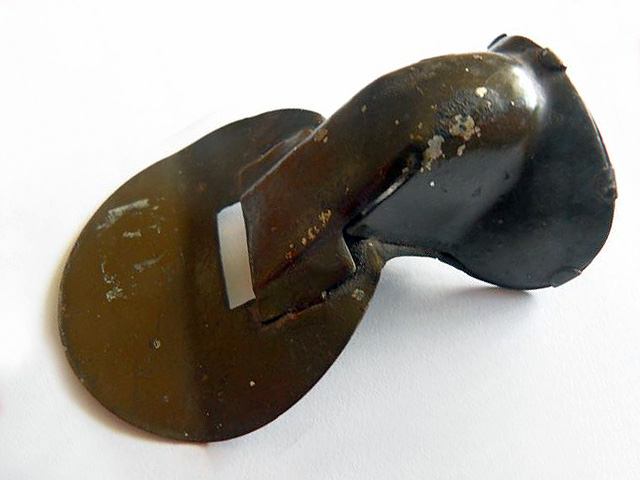
This metal flute has a shape rather similar to the Humanatone, but shows two particularities. First, it still is coated with its original paint, a kind of military-greenish color, and then, has 5 unusual small flaps that have been folded over the edge of the nose cap, in order to assemble the two tin sheets which compose it. This means a rather different shape design and fabrication, relatively to the Humanatone. Here, the nose cap is "doubled".


---

Here is a small documentary where you can see Bernard Visser and his museum.

Bernard Visser
FluitenMuseum
Boudewijnstraat 103
8701 XT Bolsward
Netherlands

bernardvisser[AT]tele2[DOT]nl
Tel. 0515 577792

---