This blog is dedicated to the sublime instruments called nose flutes and which produce the most divine sound ever. We have chosen to discard all the native models from S. Pacific and Asia, for they need fingering to be played. We'll concentrate on "buccal cavity driven" nose flutes : the well patented and trademarked metal or plastic ones, plus, by a condemnable indulgence, some wooden craft or home-made productions.
Showing posts with label Maikel Mei. Show all posts

Apr 27, 2016

Nose Flutes and 3D Printing!

3D printers, 5 axis CNC mills, 3D scanners, laser cutters... All these high and new tech machines are more and more becoming parts of our environment and common ways of production (at least for prototypes or unique pieces). And... what about nose flutes ?

The plastic Humanatones and Schwans were born too long ago to have gotten the benefit of a computer-improved design. Which were the first nose flutes designed, improved, tested, produced or even reproduced by new technologies?


2008/2009, then 2013/2014: The Bocarina®

Chris Schuermans is probably the first having had a nose flute printed. He designed the Bocarina® with 3D softwares, then used 3D printers to test different shapes.

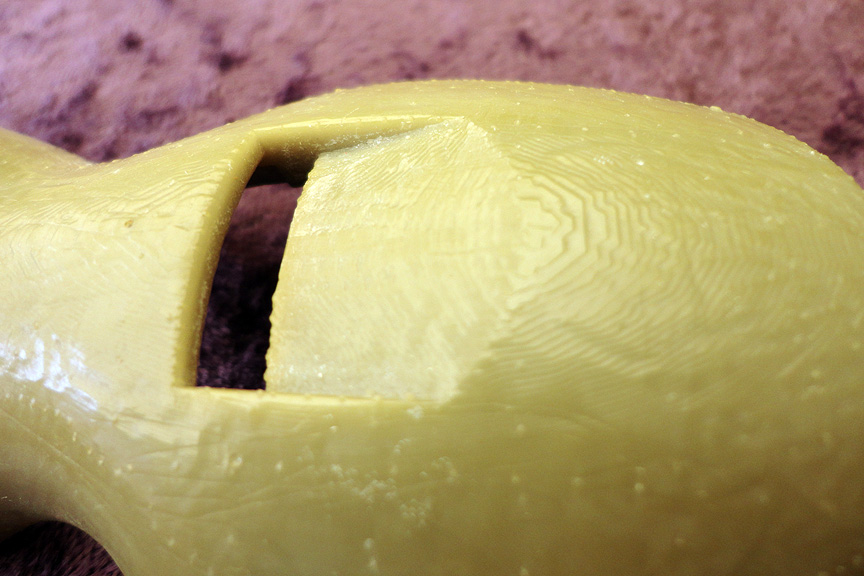
First 3D print grown in a Stratasys Dimension machine using FDM (fused deposi1on modelling) from ABS filament:

Very creative, Chris designed then a Bocarina® body able to receive inserts, in order to test different fipple shapes: « I then experimented with this design - and realised that it was too expensive to grow the whole Bocarinas each time.... So I designed the airways to snap into the body »

« Then I made some enlarged models for making ceramic moulds », wrote Chris:


« I experimented with clay Bocarinas and changed the design. »:


Experiments with the new design:

« Using the refined shape I enlarged the model to make a model for making a ceramic mould. This print was also made in a Stratasys Dimension machine using FDM (fused deposi1on modelling) from coloured ABS filament. This model was polished with sand paper. »:


« After conducting some more experiments with clay I refined the fipple and finalised the design to make the final prototype in an EnvisionTEC technologies machine using SLA (selective laser acrylic) with photo-sensi1ve resin » (see below).
« The Bocarina mould was made using the CAD data of the 3D model used for this 3D print. ».

As you can see, the design process has not been an easy and sweet path...


And as you can see in this post, a whole process began again some short years aftermath, with the Bocarina® Pro...

 
2010: The Pfaff Nasenpfeife

The patent for the Pfaff Nasenpfeife was filed in May 2010, and I assume this model was tested with 3D printing (in 2009?), but I do not have any evidence of it.


2012: Fuppi

Fuppi, the Japanese mass produced plastic hanabue, was born in 2014, but prototypes had already been made at the end of 2012 (see this post). The original model was the Adachi nose flute designed by master Kunio Katada, Fuppi's two parts mould and its inner design (with the purpose of being openable for cleaning) was, without any doubt, created on a computer. It's more than likely that first Fuppi prototypes were 3D printed (particularly in this hi-tech country).


2014-03: CRAI at ENSA Nancy

Here, we are not dealing with the design of a new nose flute, but with a joke/training/experiment lead by some of my former students. After their studies at Nancy (FR) National School of Architecture, some of them integrated the CRAI (our lab specialized in modelization). There, they had access to 3D scanners, 3D printers, etc. As a training with those hi-tech tools, they decided to copy a Bocarina® (sorry Chris... I wasn't aware of those funny pirates at the time...), in order to modelize it and be able to personalize it and make a surprise for me. I assume they wanted to recreate the external shield as a human face. Unfortunately, most of them left the lab before the achievement of this funny project. Anyway, Julien M., still there while completing his PhD., sent me the remaining files:


The toolpath vizualization:


2015-03: Nose Flute by Mark Brocklebank

March 2015 is the first (known) date for a home designed and 3D printed nose flute. I found it on Thingiverse, the 3D printing open community. The Mark Brocklebank's nose flute is very simple, basic and coarsely printed, but it works! His creator even posted a video on his YT channel:


One interesting feature, on Thingiverse, is that what is published is offered to the community. So, anyone can download the files and make a home printed version of the object. That's what did two people, who also published a picture of their own "make"… Same file, but different printer and plastics:


2015-05/06: Nose Flutes by Maikel Mei

in May 2015, Maikel Mei sent me an email with pictures: « I have been working on the design of a 3D-printed nose flute. Today I collected the 3rd batch of the experiment, of which this is the most successful. It works, yet is far from perfect. It was printed in PLA. The proper version will be first printed in nylon in one piece. I am also thinking of liquid wood etc. The design is a combination of the W&L flute together with my own ideas and holds several innovations such as the extended chin shield and the reed holder. »

It's very interesting: Maikel Mei chose to print a 2 parts nose flute, longitudinally and symmetrically cut!:


The next month, Maikel had made a 3D printed copy of his silver Schwan-shaped Nasenflöte: « A new maker made a 3D-replica of my silver W&L. It contains a few tweaks that should make it a better instrument when printed in metal or ceramics. I will go for another few tweaks next week that will make it the best possible instrument. The print in the pictures was made in an hour from bronze ABS-string, just to have a result. Even without a proper labium it works nicely, better than the ones made by the first maker! »

Sadly, one side is not as clean as the other...


2015-11: Nose Whistle by Bob Taylor

Another nose flute appeared on Thingiverse last November. Bob Taylor designed and published this (more than) simple nose flute, but there is no picture of a 3D printed instrument, so we don't know if it was realized for real. Anyway, it would not have been able to whistle, having no air way!!!


--

Who's next ?

Mar 21, 2016

The Bocarina® Pro - Part IIa : Reviews

The announcement of the birth of the Bocarina® Pro generates a lot of buzz and impatience, but also tests and trials by the lucky ones who got a prototype specimen. This is notably the case among our Japanese friends — players and/or bloggers — but also here, in Europe.

So, we decided to open our pages to other reviewers, in order to provide a full spectrum of opinions. The long time reader, participant and friend of Noseflute.org, Mr. Maikel Mei, spontaneously sent us his complete review of the new instrument. The Incomparable Nosy Diva did too, our Japanese friends have begun testing some Bocarina® Pro tuning (!) and on our side, we will provide some technical results.


Bocarina® Pro - Part II : Reviews


A - Maikel Mei


The following text is the review Mr. Mei provided. Noseflute.org just added some pictures and self-authorized some very minor typographic corrections.

A couple of years ago I received a package with a Bocarina® prototype through my dear friend Antoine Carolus. I instantly recognised the quality craftmanship as well as the possibilities of the instrument, but couldn't play it as it doesn't fit the make up of my face, i.e. my nose and cartilage. From a young age I had played the Schwan, which not only suited me but also grew onto me. I always felt it had its limitations though, which is why I started experimenting and approaching people who could help me build the perfect nose flute.

Having received the Bocarina®, it seemed to me that combining the Schwan with this new type of flute could possibly make the perfect nose flute. The Schwan had the perfect build fitting my facial structure and also allowed me to attack the labium from various angles. Exactly that allowed me to actually make music on it instead of merely notes or simply tunes. The Bocarina® had the super quality material, the meaty body, the acceleration through the narrowing air duct and the slightly reedy ringing tone I had been looking for for such a long time.

Obviously I wanted to see Mr Schuermans's take on the Schwan, incorporating the qualities of the Schwan into the Bocarina, or the other way around. When I contacted him asking him just that, I was pleasantly surprised to get his response stating that he actually considered creating a Bocarina® that would fit Caucasian cartilage configurations (how about that for a tongue twister). He also said that it would take some considerable time, effort and patience. When I collected my snail mail this week, I was jumping with joy to find a package from France containing a new type of nose flute! The hybrid concept had finally materialised.

Many thanks to my dear friend Antoine Carolus for sharing with me one of the prototypes he had received from its maker, Chris Schuermans. I would like to express my gratitude to Mr Schuermans, whom I consider the James Dyson of nose flute design, for making this new product and even incorporating a few elements championed by me. I think this new nose flute, the Bocarina® Pro, represents a significant new stage in the development of the instrument. Here is my review:


1 - The Look

I was presented a prototype in red and yellow that matches my old first Schwan, which I find a really nice thought. This classic colour combination will not be taken in production though. The Bocarina® Pro will appear in “fruity colours”, which I consider a stroke of genius. That will certainly appeal to kids of today, as it is very now. The overall Bocarina® Pro look reminds me of a swimming manta, with its meaty yet sleek design, its soft and fluid lines, its mat uncanny appearance and obviously its bendable flaps.
It certainly looks intriguing enough to give it a serious look in the shops and possibly a try. I find the combination of the look, feel and fruity colour combinations a real winner.

The Bocarina® Pro looks like a proper cross between the Bocarina® and the Schwan. The Bocarina® Pro combines the Bocarina®'s flat yet bulky body and its highly stylized, rounded fluent lines, with the Schwan's 3D-shaped thin-walled body and its square lines based on a circular concept. The truly great thing about the Bocarina® Pro is the synthesis of the Schwan's two-part design of body and air duct cover made into one, using two types of plastics. To underline this, the two components apparently chemically even bond when they are moudled. As such, the two not only appear to be but actually have become one inseparable entity. I find that really amazing. Still, both parts remain recognisable by having their own colour, texture and finish.


A highly tactile quality of the Bocarina® Pro is the bendabillity of the side flaps provided by the soft and thick outer skin. This feature incorporates and exceeds the quality of a third nose flute design, namely that of the Humanatone! The heavy duty rubbery plastic outer skin of the Bocarina® Pro allows for bending the side flaps very easily, not only around the labium but even around the nose shield. Other than the rigid and cheap plastic flaps of the Humanatone, the Bocarina® Pro flaps simply will not break.

Whereas the Humanatone needs considerable warming up and careful tweaking of the side flaps, and eventually still breaks where the side flaps connect with the air duct cover, the Bocarina® Pro has flaps that can bend all day long without any preparation or problem. It really is a major innovation, which should allow for a whole range of wind tones to be performed on the instrument. Having the possibility to incorporate those effects in the performance takes the instrument to another professional level, making the nose flute step up to becoming a proper musical instrument.

The Bocarina® Pro even has some proper additional innovations within the design of the labium, the sharp edge over which the air flow is projected in order to produce a sound. With such detail paid to the labium lip, which is the most important part of the flute, one would have to conclude that this is a pretty good flute.


2 - The Feel

The soft feel of the object is an open invitation to take, hold, touch and play with the Bocarina® Pro. The bendability must be the number one selling point of this instrument. It is unbreakable, feels and looks like a solid, heavy duty item and even looks as if it might be cleaned inside your dishwasher. It has a legit look and the feel of a proper and interesting toy. Is it a proper instrument though?

The Bocarina® Pro consists of two parts of different types of plastics, being an outer soft shell and an inner hard shell. The outer soft shell makes it a joy to hold and touch as it is very tactile. However, its brilliance lies in the fact that it lends the instrument a perfect grip. It will not slip out of your hand whilst playing and if it does, it will not break or be damaged when falling on the floor. I have always been highly conscious of a flute breaking from dropping, particularly with my first Schwan and with my silver flute. Ironically, they actually did fall on more than one occasion because of my being overly careful. The Bocarina® Pro eradicates that concern.

The inner shell of the Bocarina® Pro contains the air duct and the labium. This piece needs to be fairly rigid in order to give the instrument a quality sound. If this bit were squidgy or floppy, the flute would have a sloppy sound or possibly no sound at all. The marriage of the hard inner piece and the soft outer coating really is the key ingredient in why this design is so remarkable. 

The part of the instrument that covers the filtrum, the bit of skin between the nose and the mouth, feels too hard to my taste as I put it to the test. It hurts my teeth as I play it and it presses up against my nose cartilage as I try to make it sound properly. This bit could be a lot softer, preferably as soft as the bendable edges. The reason for it being a little hard to the touch here is that the soft outer skin covering the hard piece of plastic right underneath is probably at its thinnest here. A little thicker could do.


3 - Technical qualities

There are four main innovations that I regard as technical improvements to be seen in the labium alone.

1.
The Bocarina® Pro has a sturdy labium that significantly tapers all the way up, resulting in a razor sharp edge over which the air flow is directed. That should allow the instrument to be played easily, to hit the right notes quickly and easily. To my mind this is the first time the design of the labium has been executed perfectly, in the sense that it is a proper reed.

This proper reed is what makes the so-called 'whisper tones' on the Bocarina® Pro ever so easy to play. One would say that this is a great success, yet they sound so loud and clear so easily on this nose flute that they lose most of their flustery appeal.

2.
The labium on the Bocarina® Pro is rounded, moving around a curve, which to me is a great thing. That feat should make the embouchure easier and more flexible, so that the labium lip can be attacked from various angles, in order to be able to create various sound effects. To my taste the labium could be even rounder, curling inward toward the edges more than the air flue overhead. That discrepancy would possibly provide more options and allow for interesting instant effects.

3.
The labium is much wider on the Bocarina® Pro than on the Bocarina®, resembling the width of the Schwan labium. A wider labium to me represents a louder, more full-bodied (basic) sound, which is a good thing in my book. It allows the player to perform louder when he wants or needs to, it makes the soft tones easier to produce and provides more dynamics when combined. I also feel it allows for much more control.
I would say that is a great thing.

However, to me, the trapezoid shape of the labium on this nose flute as seen from the front should be straight or even reversed: I see four disadvantages in having a wider labium at the bottom, the base of the reed.

Firstly the side flaps cannot bend as far as I would like. That prohibits me from taking the wind tones and harmonics to the next level. With a straight or reversed outlet
the flaps' bendability can really be taken to their extremes, which will probably open up a whole new range of sound effects.

Secondly, having bent those side flaps to their extremes, I feel as if the hard edge of the fipple will eventually probably puncture the soft flaps, destroying its function and therefore its purpose. Apparently, the inner body -- the fipple -- has a perforated edge that prevent that from happening.

Thirdly, my aim has always been to project and channel a reedy flute sound instead of that of a toy whistle from the labium, both acoustically and electrically. In my opinion, a straight or reverse outlet could create a better sound in that respect. This “better sound” I always speak of what I feel makes a flute sound like a proper flute, such as reedy resonances, windy sounds, bamboo tones, over-blown effects and multiphonics

Fourthly, I feel a straight or possibly reversed trapezoid outlet would allow for more control over the tone and effects when cupping the labium with my hands, which I do quite for what I feel to be a proper and much improved sound. I feel a straight or inverted trapezoid would address all these problems and solve them.

I have come to see where the creator of the Bocarina® and Bocarina® Pro, Mr Chris Schuermans, comes from with his design, as he has informed me about a greater efficiency when having the trapezoid outlet. Apparently, a reversed outlet results in something called the “venturi effect”, which stands for back pressure whilst blowing the instrument. In my opinion this could only contribute to a type of sound I am after, as I am not really interested in the cleanest of sounds. I feel a flute should sound like most ethnic flutes do, having loads of character.

Also, I would prefer a somewhat flexible, bendable labium, preferably even the complete inserted fipple comprising the air duct cover and the labium. This, together with a possibly slightly thinner reed at the base, would improve the possibilities of embouchure. Larger side flaps might enhance these possibilities even further.

4.
The first feature that stands out from the flute would have to be the labium lip, shaped as the contour of the upper lip to a mouth. I love the idea of having a narrower as well as a broader opening simultaneously, and I do not think this has ever been done before. I love the idea of it, just as I love the idea of having two types of totally different plastics combined interacting. This nose flute appears to be all about making two different approaches work together. To me, that is the true genius of this design. However, as the proof is in the pudding, the question remains: does the labium work? To me, the moustache shape of the labium does not make much difference if any at all, sadly.

As Chris Schuermans explained to me in his very kind email, he had designed the wavy edge in such a way as to allow the air to part over the edge most efficiently. This is very similar to modern, especially supersonic airplane wings. It is also very similar to the wavy fan blades design of modern jet engines, which are specifially designed to reduce turbulence and noise. I am really impressed by Chris Schuermans's scientific approach in aiming for the most efficient or cleanest result in nose flute sound and design. However, my goal in playing the nose flute is to play it with the most credible sound and effects.


4 - The Playability

It took me just a little finding out and a bit of adjustment to find the sweet spot of the instrument's sound. It has a sweet, slightly reedy and ringing tone when played correctly. It does not go very loud, it does not have a great range in the bass. It is quite easy to hit the note, but only in a fixed position. For novices, entertainment, children, fun etcetera that would be perfectly alright. It is great fun to so easily be able to play any tune you like. In that respect it plays better than the Schwan. It certainly is way more pleasant.

The Bocarina® Pro has a direct approach and attack with instant result. However, it lets me down in wanting to do something additional with the tone, the application of dynamics and all. Its medium range also does not help, as it does not cover over three octaves I wish to perform melodies in. I need at least a bass range, which it lacks. The Schwan has over halve an octave to it there. Its soprano is either very loud and thin or very windy. It also lacks control in that department and it is quite easy to lose the tone.

The fact that the Bocarina® Pro performs whisper tones so easily and well, if not too well, indicates that this instrument is basically a well-worked out nose flute, particularly showing a fabulous labium lip.

I must say the Bocarina® Pro does not work well (enough) for me. I have to keep the flute firmly in one position as I play, otherwise I will lose the tone. It is essential to me to be able to throw the flute around whilst playing in order to change the embouchure. Otherwise, if I cannot change the tone and apply effects, I see no need in playing the instrument. It could be much better in that department. To my taste, for my way of playing and what I want to accomplish with it, the Bocarina® Pro is far from perfect. I would treat this nose flute by playing it quietly in a mid range with clear, reedy tones, though.


I would like to see the instrument have an elongated body below the labium, in order to be able to attach a pick up microphone. I could see the pick up microphone even attached to the inside of the elongated mouth shield. I would also like to see the bottom part of the instrument run through in one line, and fuse together with the upper part. This would result in a rounded convex air duct cover, lending the instrument a pebble look, a monolitic shape. It would look and feel far more substantial and even more of a musical instrument.


5 - The Upper Lip Rest

I love the fact that Chris Schuermans incorporated the upper lip rest in his Bocarina® Pro design. Some people may disapprove of it, find it unnecessary or even obsolete. I have always loved the lip rest as it is a feature on the Schwan, the one type of nose flute I learnt to play with. It assisted me to know where I was in relation to the labium lip. It also allowed me to use my teeth whilst playing and consequently change my cavity without losing position. That way I could put more expression into my play.

I agree with Antoine Carolus that the lip rest on the Bocarina® Pro is too small. It is too small to really do the trick. In fact, the lip rest meets my front teeth half way as I put my face to the instrument. Either the lip rest should be positioned 5–10 millimetres lower, or the top half of the Bocarina® and with it the air inlet should be raised about
5-10 millimetres. Additionally, I feel that by raising the air inlet by a centimetre,the overall look of the Bocarina Pro would be a little less awkward and just a little bit more balanced. To me, stylistically this lip rest is the perfect internediate shape, as a compromise between the striking lip rest of the Schwan and the liprestless Bocarina®.

In that respect I wonder if the v-shaped air inlet should be rounded. Firstly, that would require higher positioning of the nose and with it the upper lip and upper row of teeth. Secondly, the air flow originates from the nostrils and therefore a v-shape does not contribute to the air inlet. I wonder what a larger instrument would do. Could there be various sizes as in the clothing industry?


6 - Overall


Look   90%Interesting and appealing, slightly awkward proportions
Feel   100%Highly tactile, ideally suited for small hands
Novelty   100%Great for kids and novices, fabulous introduction
   
Used materials   98%A slightly more flexible inner shell for 100%
Craftmanship   100%Properly made, superb blend of styles and materials
Innovation   100%Great job, and this is only the second proper generation
   
Clarity of tone   92%When hitting the sweet spot
Entry level   80%Pretty easy to play tunes on, good response
Playability   65%I cannot perform on it the way I want it
   
Price   ??
   
Total   825/900 so far
6 - Conclusion

Overall, the Bocarina® Pro is a wonderful new design and a fabulous addition to the nose flute family. The Bocarina® Pro might very well take off and create a real resurgence of interest in the instrument. I hope that by reviewing it the design will be taken even further. Technically, it is still far away from being the perfect instrument that would allow me to perform freely on it.

My aim is to have the perfect nose flute, of which there could be more than one.
I realise that one person alone simply cannot do it, as any succesful product always requires multiple chains interacting. Hereby I would like to call out to anyone reading this to try and contribute to the best possible nose flute production, the best possible nose flute play and the best possible nose flute promotion. I am positive the nose flute has a grand future when treated well.


                                                                                       Maikel Mei,
                                                                                       The Netherlands


                                                       >>> To the Incomparable Nosy Diva's review

---

Related links :

- The Bocarina® Pro - Part I : A new star is born !
- The Bocarina® Pro - Part IIa : Reviews
- The Bocarina® Pro - Part IIb : Reviews
- The Bocarina® Pro - Part III : Prototypes
- The Bocarina® Pro - Part IV : Interview
- The Bocarina® Pro - Part V : Ceramics

---

Jan 15, 2014

Adjustable nose flute

Shuenping Chiou (YW), our friend from Taïwan who likes to invent and build special nose flutes, has produced a « range adjustable nose flute ». On this purpose, he coupled a nose flute and a big syringe, forming a slide nose whistle.

The principle is to allow a modification of the size of the resonance cavity 'by default' (increasing more or less the air volume of your mouth). So, with the same mouth opening, you would get different notes, depending on how you set the slide).


Here is the test video:


This idea was patented by Joseph Goldstein in 1926, but we don't know if the model was manufactured.


Also, Maikel Mei had tried a such a device, but a bit more complex, grafting a slide and a recorder to a nose flute.

Feb 6, 2013

Mei's History of Art - Series 2: Native Art

Maikel Mei, well known regular reader of this blog, musician and collector, is also a nose flute painter, as we already had the opportunity to show notably here, here and there.

Maikel has entered a long process and huge work: browsing the History of Art, by painting 10 series of 4 pictures (40 paintings altogether!). Each series will be exploring a selected era or culture, as a tribute to its style(s). The frames are 40x30cm large, and worked with acrylic paints.

What's the link with nose flute? Each painting will figure an elephant, and you'll discover that his head is the exact profile of a Weidlich & Lohse Nasenflöte, the famous "Swan logo" nose flute.

Maikel will probably have comments to add to each series, so, don't miss them in the "comments" part of this post, at the end of it. Also, don't hesitate to click on the pictures to magnify them, and get the full quality of the details.


---

Mei's History of Art - Series 2 : Native Art (Basic Age)


Basic Age: Australian


Basic Age: African


Basic Age: American


Basic Age: Indian


The whole series:


---

On the same topic:

- Beautiful drawings by Maikel Mei
- Nose flute paintings by Maikel Mei
- Maikel Mei's new paintings
- Bocarina painting by Maikel Mei

Mei's History of Art:

- Series 1: Rock Cave Art
- Series 2: Native Art

---

Oct 8, 2012

Mei's History of Art - Series 1: Rock Cave Art

Maikel Mei, well known regular reader of this blog, musician and collector, is also a nose flute painter, as we already had the opportunity to show notably here, here and there.

Maikel has entered a long process and huge work: browsing the History of Art, by painting 10 series of 4 pictures (40 paintings altogether!). Each series will be exploring a selected era or culture, as a tribute to its style(s). The frames are 40x30cm large, and worked with acrylic paints.

What's the link with nose flute? Each painting will figure an elephant, and you'll discover that his head is the exact profile of a Weidlich & Lohse Nasenflöte, the famous "Swan logo" nose flute.

Maikel will probably have comments to add to each series, so, don't miss them in the "comments" part of this post, at the end of it. Also, don't hesitate to click on the pictures to magnify them, and get the full quality of the details.


---

Mei's History of Art - Series 1 : Rock Cave Art (Pre-historic)


---

On the same topic:

- Beautiful drawings by Maikel Mei
- Nose flute paintings by Maikel Mei
- Maikel Mei's new paintings
- Bocarina painting by Maikel Mei

Mei's History of Art:

- Series 1: Rock Cave Art
- Series 2: Native Art

---