[edit : read the first comment please...]

Jul 28, 2012
CaptainBocarina c/o KennyMelodica !
Beautiful video by the famous Kenny (Kennymelodica), the famous CaptainLoveHandles shot in a gorgeous scenery, so vintage... (note the great Carnival plastic ukette on the wall...). Welcome (back) to nosefluting, Captain ScoobyDouche!


Custom fluted silver whistle
After the brass whistle I transformed into a nose flute with an unexpected success, and the bachelor plastic whistle customized into an obscene glow-in-the-dark-flute, I decided to attack noble metals...

I bought a solid Sterling Silver whistle on Ebay and worked it the same that I did on the brass one (filed a round hole on the belly, sanded and buffed). But this time, I rounded the air entrance (shaped it rather oval, from its flat rectangular profile) and included an extension in soft silicone that I sealed with a piece of heat-shrink tubing, used in electrical engineering. Thanks to the small ring at the bottom which provide a grip, the whistle gets totally hands-free!


The result is simply... stunning! The sound is very bright, clear and precise, the tone range is over-correct, and the whistle is quick as a lightning!! And it reacts very sensitively to any solicitations (tremolos and so). Incredible. Here is a sound sample which, despite my mediocre playing, is able to testify of the sound quality of this new baby.

I bought a solid Sterling Silver whistle on Ebay and worked it the same that I did on the brass one (filed a round hole on the belly, sanded and buffed). But this time, I rounded the air entrance (shaped it rather oval, from its flat rectangular profile) and included an extension in soft silicone that I sealed with a piece of heat-shrink tubing, used in electrical engineering. Thanks to the small ring at the bottom which provide a grip, the whistle gets totally hands-free!

 |  |


The result is simply... stunning! The sound is very bright, clear and precise, the tone range is over-correct, and the whistle is quick as a lightning!! And it reacts very sensitively to any solicitations (tremolos and so). Incredible. Here is a sound sample which, despite my mediocre playing, is able to testify of the sound quality of this new baby.
Jul 27, 2012
Did you know that...
... there are/were billionaire noseflutists who run/ran for President of the United States ? Unfortunately, at this time, YouTube didn't exist yet...
From the Aiken Standard, 12/27/1992, in 1992 Year in Review by Dave Barry :

From the Aiken Standard, 12/27/1992, in 1992 Year in Review by Dave Barry :

Jul 26, 2012
The most obscene nose flute...
The most ugly and obscene nose flute, I made it. It's just a joke, and I do not intend to play it anymore, but I am a bit embarassed to show it. However, I do it, for science! And hope you'll smile instead of being shocked.
While working at my series of modified whistles, I found a « glow-in-the-dark » whistle for bachelors (!), shaped as a cartoonesque pair of breasts.

Now, they look like another pair of something. Indeed, I filed salient little parts to get a smooth surface. Then I made a nose craddle in aluminium plate, and inserted a piece of aluminium rod to avoid air leaks at the mouth (exactly as it features on the original Nasalette, by William Carter).


Well, this is not really an elegant model and you can easily look like a pervert with it, but it glows in the dark!

And a video for the sound :
While working at my series of modified whistles, I found a « glow-in-the-dark » whistle for bachelors (!), shaped as a cartoonesque pair of breasts.

Now, they look like another pair of something. Indeed, I filed salient little parts to get a smooth surface. Then I made a nose craddle in aluminium plate, and inserted a piece of aluminium rod to avoid air leaks at the mouth (exactly as it features on the original Nasalette, by William Carter).

 |  |

Well, this is not really an elegant model and you can easily look like a pervert with it, but it glows in the dark!
 |  |

And a video for the sound :
Jul 24, 2012
Gorgeous video crop!
Summer... maybe holidays... The noseflutists around the world are very productive these days!
Nacrociochi, aka Francesco (ukulele) and Rosa (Vocals, bizarre noisemakers) just posted a cover of Summertime with a new instrument : a Bocarina™!
---
Nosefluter, who was awaited for long for a new production, made this great multi-instrument video, including a nose flute auto-duet (and check also this funny one):
---
Hckluever, aka Mister Swing, continues his Nickelodeon series, with a great jazz solo, full of tremolos and (natural) effects... gorgeous! (check also this one and this beautiful one):
---
Hanabue114 (the very prolific Mr. Jun Tanioka), leads workshops with daylight, and has great great fun at night with his friends in a karaoke:
---
Italy :
Nacrociochi, aka Francesco (ukulele) and Rosa (Vocals, bizarre noisemakers) just posted a cover of Summertime with a new instrument : a Bocarina™!
---
United Kingdom :
Nosefluter, who was awaited for long for a new production, made this great multi-instrument video, including a nose flute auto-duet (and check also this funny one):
---
Germany :
Hckluever, aka Mister Swing, continues his Nickelodeon series, with a great jazz solo, full of tremolos and (natural) effects... gorgeous! (check also this one and this beautiful one):
---
Japan :
Hanabue114 (the very prolific Mr. Jun Tanioka), leads workshops with daylight, and has great great fun at night with his friends in a karaoke:
---
Jul 23, 2012
Froby!
Froby is a rare perspex nose flute from the Piet Visser's collection. It has a very futuristic look, with its fluo color and its pair of long wings. Mr. Mei, who had the luck to test it, wrote in his article: « The 'Froby' certainly attracts attention by the way it looks and sounds! », lauding its pure tone with a frank attack.
(Photos by Maikel Mei)

Last November, before to know whether the flute had been commercialized, I found the patent (ES1004918) corresponding to Froby. So, I can state that the perspex flute is Spanish-Basque, and date from 1988, designed by Uriarte Urbina and Antonia Maria, as assignors to Papelaria Informal S.A., Donostia-San Sebastián, Guipúzcoa, in the autonomous community of the Basque Country.

One can easily see that the shape has evolved between the design for the patent and the model that was commercialized. The "nose wings" have faily grown, have been narrowed, and got 2 ledges in order to retrieve the level of the mouth shield.
(Photos by Maikel Mei)

 |  |
 |  |

One can easily see that the shape has evolved between the design for the patent and the model that was commercialized. The "nose wings" have faily grown, have been narrowed, and got 2 ledges in order to retrieve the level of the mouth shield.
Jul 22, 2012
At Sundown
Too short great little video by our canadian friend in ukulele Mctrmt (Mary-Anne McTrowe), absolutely newcomer in nose flute with her Bocarina™, but already mastering it! We hope it is the first of a infinite series!
Jul 21, 2012
Professional series - 1 : The Nose Flute Lyra
Yes, dear friends, here is the first video of a series of customizations dedicated to professional players or, at least, noseflutists performing in public. The Nose Flute Professional Lyra is based on an idea by Miss Birdy K., and was built in the Noseflute.org workshops by qualified people, under CEO Patafix-the-cat's supervision.


Jul 20, 2012
A spontaneous performance by Miss Birdy K.
Trier... the Porta Nigra... and the Nosy Diva, who got the spontaneous desire to perform the Aria of the Queen of the Night, despite the modest acoustic conditions and a ingrate audience.
Jul 19, 2012
UOGB goes nose flute!!
With the Nosy Diva, we were in Trier (Germany) for a (great) concert by the Ukulele Orchestra of Great Britain. There was an "after" in the hotel hall with our british friends. Miss Birdy K. had brought Bocarinas, and Will Grove-White, already a convinced noseflutist, attempted to convert his fellows to the nosy cause and remarkably succeeded.

Here is a video of the first tryings of many of them :

Here is a video of the first tryings of many of them :
Jul 18, 2012
New batch for the Reggi-Flauto
Felice Pantone, street musician and inventor of the nose flute holder called "Reggi-Flauto" has posted a new video to show how to form and use its hands-free system.
Jul 17, 2012
Simmy!
Here is a old lovely and sweet little plastic nose flute that Mr. Piet Visser gently accepted to trade from his collection. It is a two-colored polystyrene toy-instrument, of a rather small size.

And here the "Simmies" from the Piet Visser's collection (photo by M. Mei):

The Simmy proudly wears its name in small parchment roll on the breathplate, with a rather chaotic typo:

As far as we know, according to Mr. Visser, the first Simmy nose flutes date from 1952. They were probably european made, and could have been German. This drove Mr. Maikel Mei to hypothesize that the Simmy was the ancestor of the Swan nose flute.
Well, wether we have absolutely no piece of evidence of such a statement, it's however a real possibility. The Swan was launch in 1958, and the 1952-born Simmy should not have been produced during a very long period, else it would not be so rare.
But more : there are many resemblances between the two nose whistles... They differ by the size (Simmy is smaller) and by the shape of the mouth shield, square on the Simmy, perfectly circular on the Swan. There is no upper-lip rest on the Simmy, and the labium is not beveled as it is on the Swan. But both share subtle morphologic details.

The shape of the nose saddle is the same, with a different airway hole. Both have a trapezoid shape part that connects the nose saddle to the mouth shield. The two model have a flat mouth shield (not concave), with a bottom-lip rest (90° angled, short and rectangular on the Simmy, and rounded, with a 45° angle on the Swan).
The front shows other similarities. Both babies are two-colored, one reserved for the airway cover, which in embossed with the logo. And both show the famous "pair of injection stigamata" which help to date a Swan [like Leda??:)], however smaller in diameter on the Simmy.
There is another detail shared by both flutes that is so singular that it could almost become a piece of evidence... On both babies, the end of the air duct cover goes a bit further than the support rail, and has a short angled ending, produced in order to thin the air flow at its very exit and to orient it properly (?).


So... Is the Simmy the ancestor of the Swan? Certainly. But what's the meaning of this word and what relation do those nose flute have? Impossible to say. Was the Swan an improved model designed by the Simmy producer who was german? Or was the Swan simply "inspired" by the Simmy, but made by another factory? The first element of answer would be to know for sure in which country the Simmy was produced.
A small sound sample recorded with the Simmy, which sound is a bit "blury":

 |  |
 |  |

The Simmy proudly wears its name in small parchment roll on the breathplate, with a rather chaotic typo:

As far as we know, according to Mr. Visser, the first Simmy nose flutes date from 1952. They were probably european made, and could have been German. This drove Mr. Maikel Mei to hypothesize that the Simmy was the ancestor of the Swan nose flute.
Well, wether we have absolutely no piece of evidence of such a statement, it's however a real possibility. The Swan was launch in 1958, and the 1952-born Simmy should not have been produced during a very long period, else it would not be so rare.
But more : there are many resemblances between the two nose whistles... They differ by the size (Simmy is smaller) and by the shape of the mouth shield, square on the Simmy, perfectly circular on the Swan. There is no upper-lip rest on the Simmy, and the labium is not beveled as it is on the Swan. But both share subtle morphologic details.

 |  |
The front shows other similarities. Both babies are two-colored, one reserved for the airway cover, which in embossed with the logo. And both show the famous "pair of injection stigamata" which help to date a Swan [like Leda??:)], however smaller in diameter on the Simmy.
 |  |
 |  |


So... Is the Simmy the ancestor of the Swan? Certainly. But what's the meaning of this word and what relation do those nose flute have? Impossible to say. Was the Swan an improved model designed by the Simmy producer who was german? Or was the Swan simply "inspired" by the Simmy, but made by another factory? The first element of answer would be to know for sure in which country the Simmy was produced.
A small sound sample recorded with the Simmy, which sound is a bit "blury":
Jul 15, 2012
A nose whistle as shepherd's tool
Published in Essex Newsman, Chelmsford edition of the Saturday, October 9, 1937, this classified ad shows that nose whistles were used by shepherds to call and lead their dogs.

In this recent article about shepherd's whistles, Kathleen Ward wrote : « There are an amazing array of whistles. Made of various metals such as Stainless Steel, Aluminium, Sheet aluminium, Tin, Sterling Silver or Titanium. (...) There are references where a tobacco tin has been cut open to make a whistle. There was also a nose whistle. This obviously did not become popular. »

In this recent article about shepherd's whistles, Kathleen Ward wrote : « There are an amazing array of whistles. Made of various metals such as Stainless Steel, Aluminium, Sheet aluminium, Tin, Sterling Silver or Titanium. (...) There are references where a tobacco tin has been cut open to make a whistle. There was also a nose whistle. This obviously did not become popular. »
Jul 14, 2012
Nose flute as alarm whistle
A Japanese ecologist parade in the Yoyogi Park, Tokyo, for Earth Garden Festival.
In the picture below, taken during a recent march against the relaunch of nuclear plants in Japan, you can see a man whistling his nose flute. (Photo by Takuma Ikeyama)

In the picture below, taken during a recent march against the relaunch of nuclear plants in Japan, you can see a man whistling his nose flute. (Photo by Takuma Ikeyama)

Jul 13, 2012
Nose flute and Chapman stick
Do you know the Chapman stick? I didn't. I know guitar sticks, but this one has the particularity of being a 12 strings neck that you can separate in several fingerboards, so both hands can tap the strings, one for the bass line, and one for the melody.
Here is a video by TheFolkSinger, who plays a cool jazzy composition of its own, with a great talent. And he added nose flute too.
Here is a video by TheFolkSinger, who plays a cool jazzy composition of its own, with a great talent. And he added nose flute too.
Jul 12, 2012
Cornelius Degen's nose flutes
Cornelius Degen lives in Hamburg, Germany. He is a storyteller and is used to play the nose flute during his performances, but he is also a singer, a musician and a craftsman. Indeed, he has been a goldsmith and has been working with wood for 34 years, making fine and "magic" boxes, etc. More, Cornelius creates also his own tools, especially adapted to his production.

As double-bass player, Mr. Degen felt the need to have a smaller instrument to carry with him all day long, and since he heard of nose flutes in 2008, he first got a wooden and a plastic one to look how they were done. He first made a try by modifying a recorder, and quickly decided to produce his own Nasenflöten.
Here is a research and test sample by Cornelius. As you can see, it is made of one piece of wood plus a translucent plastic slider, which allows to see the complete technical system... and much more.


What is the reason of the slider ? It is double. First, and since the wooden labium is very sharp and thus very fragile, the closed slider protects the blade when the flute is in your pocket. But the main goal of this part is to work as a tuner! As we saw in this Korean patent (at this time we weren't well informed about those technical concerns...), the tonality range of a nose flute essentially depends on the distance between the airway exit and the labium. The smaller (in height) the mouth hole is, the sharper and more precise the nose flute will be. And contrarywise, when the distance is large, the flute will reach easily bass tones, in exchange of a more "windy" sound.
So, the nose flute by Cornelius Degen offers the ability to the whistler to "tune" his instrument. Do you want to play the Queen of the Night Aria ? Slide the tuner down and get a sharp instrument. Do you prefer to play a Bach's cello concerto ? Open the mouth window and get rich bass.
Now, how does it look on real finished flutes ?


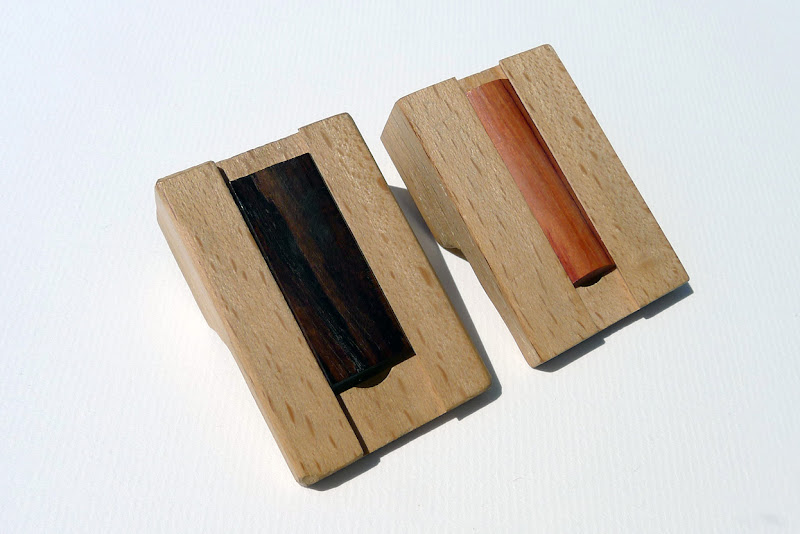
The tuning slider is a piece of hard wood finely adjusted to the body groove by a sliding dovetail joint. With the exact balance between tightness (for the tuner to stay where you set it) and looseness (to allow another setting).
Cornelius Degen loves to work with hard woods. He is a goldsmith too, and he uses the same tools for metal and wood. He is fond of rosewood and grenadilla (African blackwood) because of their stability.
I've got 2 beautiful nose flutes by Cornelius, both made in Grenadilla. One has a slider in rosewood, and the other (not yet totally finished) with a perpex tuner. Their shape is very original and very well designed. The idea was to make a nose flute as small as possible, yet comfortable. And it is a success, those flutes are very easy to play, and despite their geometric shape, quite ergonomical. For those, Cornelius had to develop and create a special tool for his milling machine, in order to mecanically shape the oval profile.


All the "technical parts" are milled or manufactured (Degen's flutes are 50% machined, 50% handmade) with a great precision, thanks to the ability and stability of the grenadilla. It is a pleasure to see the air duct, with its oblique plan, getting thinner and thinner, the more it reaches its exit. The labium is very very sharp and precisely done.


On the sound side, I must admit the Degen's flutes have reached my wooden flutes top 3. It is very precise, very confortable for me, and extremely powerful, thanks to its very hard wood. I could blast windows with its sharps, and I can set it for deep basses. I also found it so beautiful...
I'm not a good player enough to get and show all the possibilities of this instrument, but here is however a sound sample.

As double-bass player, Mr. Degen felt the need to have a smaller instrument to carry with him all day long, and since he heard of nose flutes in 2008, he first got a wooden and a plastic one to look how they were done. He first made a try by modifying a recorder, and quickly decided to produce his own Nasenflöten.
Here is a research and test sample by Cornelius. As you can see, it is made of one piece of wood plus a translucent plastic slider, which allows to see the complete technical system... and much more.


 |  |
So, the nose flute by Cornelius Degen offers the ability to the whistler to "tune" his instrument. Do you want to play the Queen of the Night Aria ? Slide the tuner down and get a sharp instrument. Do you prefer to play a Bach's cello concerto ? Open the mouth window and get rich bass.
Now, how does it look on real finished flutes ?


The tuning slider is a piece of hard wood finely adjusted to the body groove by a sliding dovetail joint. With the exact balance between tightness (for the tuner to stay where you set it) and looseness (to allow another setting).
 |  |
Cornelius Degen loves to work with hard woods. He is a goldsmith too, and he uses the same tools for metal and wood. He is fond of rosewood and grenadilla (African blackwood) because of their stability.
I've got 2 beautiful nose flutes by Cornelius, both made in Grenadilla. One has a slider in rosewood, and the other (not yet totally finished) with a perpex tuner. Their shape is very original and very well designed. The idea was to make a nose flute as small as possible, yet comfortable. And it is a success, those flutes are very easy to play, and despite their geometric shape, quite ergonomical. For those, Cornelius had to develop and create a special tool for his milling machine, in order to mecanically shape the oval profile.

 |  |


 |  |
All the "technical parts" are milled or manufactured (Degen's flutes are 50% machined, 50% handmade) with a great precision, thanks to the ability and stability of the grenadilla. It is a pleasure to see the air duct, with its oblique plan, getting thinner and thinner, the more it reaches its exit. The labium is very very sharp and precisely done.

 |  |


 |  |
On the sound side, I must admit the Degen's flutes have reached my wooden flutes top 3. It is very precise, very confortable for me, and extremely powerful, thanks to its very hard wood. I could blast windows with its sharps, and I can set it for deep basses. I also found it so beautiful...
I'm not a good player enough to get and show all the possibilities of this instrument, but here is however a sound sample.
Subscribe to:
Posts (Atom)