This blog is dedicated to the sublime instruments called nose flutes and which produce the most divine sound ever. We have chosen to discard all the native models from S. Pacific and Asia, for they need fingering to be played. We'll concentrate on "buccal cavity driven" nose flutes : the well patented and trademarked metal or plastic ones, plus, by a condemnable indulgence, some wooden craft or home-made productions.

Nov 12, 2012

Nickel electroplating restoration

When we think of a metal Humanatone, for instance, we have an inner sight more or less like that...


... which is a wrong and dull representation. Indeed, in the 1900's, the nose flutes were not oxydized, and even more, whether some were painted, some were nickel or chrome plated. Ditto for the german and british metal ones.


Some of these antique nose flutes still show traces of that plating:


I decided to restore/protect one of my german metal Nasenflöten from rust, the one in the worst shape, very rusty. The goal was not to get a mint nose flute, as if it was brand new: it would be impossible with this technique, since the coat of new metal will be very thin, and all the tin already digested by the rust would not rebuild, for sure. I thought it would be stupid to plate a coat of chrome, since it is so shiny that it would not fit with the damaged flute. With a nickel plating, it would be less shiny, a bit renewed, and protected from rust for years. That would be enough.

First, I removed all the existing rust, by dipping the instrument into a dedicated "rust removal" product (I used "Rustyco").


Then I sanded the flute with very fine steel wool and cleaned it very carefully of any possible remaining "finger grease".

The nickel plating was (and still is) made by electrolysis (electroplating), and is rather easy to do at home. The only precaution is to perfom it outside, not to breathe the gazes. On that purpose, we need one piece of nickel, to be used as an anod, and a nickel sulfate bath (NiSO4 dissolved in water). Plus some usual accessories: a pot, some wire, batteries...

Nickel sulfate:


In my case, I used an already made NiSO4 solution, found in a electronic shop, used for... nickel plating. Warning: if you do it, be sure not to ingest this poison, and avoid to touch it (nickel sulfate is cancerogen by ingestion, but not explosive nor inflamable). The best is to manipulate it outside, with gloves. I also bought a nickel anod, but I could have used any pure nickel item (a real nickel coin, for instance):


First, I build my generator, with 4 regular LR20 batteries, linking in series 2 pairs of them, each pair being connected in parallel. So, I kept a low voltage (2x1.5 V), but doubled the intensity:


I ended the wires with crocodile clips (on the pic, one is covered to avoid contact with the other):


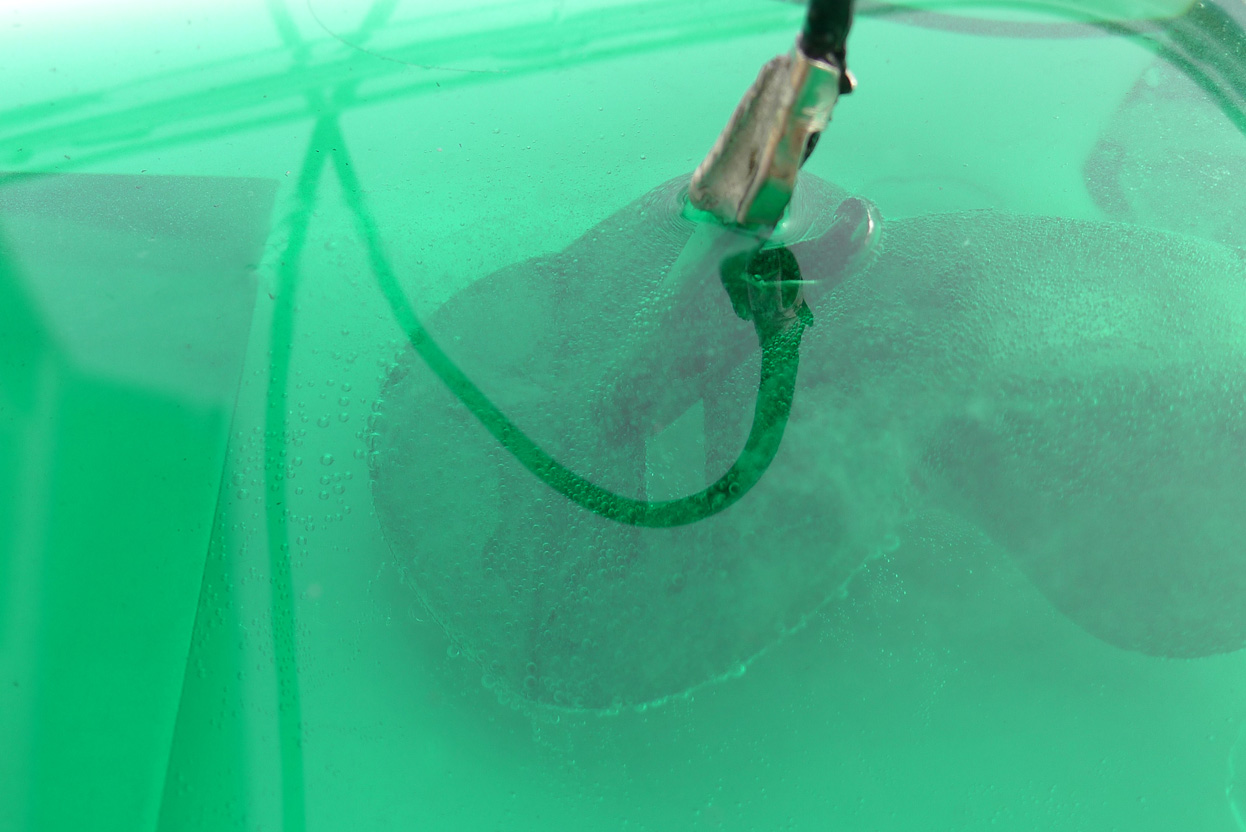
So, I placed the anod in the liquid, used the nose flute as the cathod, and connected them to the batteries.


I first made a test with a copper coin, and a light plating was visible after 30 seconds:


The plating work is much quicker while the piece to be plated is small and the electrolyte is warm. But my nose flute is a rather large piece, I want to work outside (not to inhale gazes) and the weather is very cold. So, my electroplating session will last long. I also will have to change the flute position, and also the crocodile clip location.


Immediately, many small bubbles surround the nose flute. And the closer the flute is to the anod, the more effervescent the solution gets (intensity, and thus efficiency, raises).


A short video:


After a while (30 minutes) I checked the plating. Well, the nickel had already plated some parts of the flute, but not evenly. It was the sign that I hadn't cleaned the instrument enough (the dull color is a regular result, it needs a buffing to get the nickel shiny).


So I cleaned the nose flute more carefully and dipped it again in the electrolyte.

After 2 hours, the job was done. Almost. Indeed, just out of the bath, the nose flute was very dark and dull:

But after a gentle scrubbing with a nail brush with some dishwashing liquid, then a good buffing with a soft polishing clothe, the flute was ready. Oh, the result is not as impressive as a chrome plating would look on a brand new instrument, but as I told before, this german nose flute was so digested by rust that it is more "respectful" of its venerable age not to try to get a super-shiny result.

And here it is, compared to the same german model that has only been cleaned from rust:


Nov 11, 2012

Jun Tanioka and... Keizo Nakanishi

Jun Tanioka, aka Hanabue114, was invited on stage to play his nose flute by Mr. Keizo Nakanishi, a famous japanese singer. The event was held in Hibiya Park, Tokyo.
We can hear Mr. Tanioka's hanabue from the beginning, but Jun appears on the video only at 1'28".


Nov 9, 2012

Video by Roy Bitton

Rare enough to be noticed: a video by Roy Bitton (רועי ביטון), the bamboo nose flute maker from Tupa Art, in Israel, in which he plays the guitar and one of his painted flutes. We previously presented Roy's work in this post. Hello Roy!!

Tupa art website is here
and here is its Google Translate version in English.

Nov 8, 2012

Nose Flute Pioneers: Aurion Villa Chevers

With the "Nose Flute Pioneers" series, Noseflute.org enters a little cycle of research. I hope it won't be too arid for a blog, but I really think that the facts I found have to be published. The sources : Google patents, US Census and an access to newspaper archives. But also, depending on the topic, correspondence by e-mail with descendants. Let's better say : internet searching tools available for a Frenchie not able to access US real paper archives.

---

Nose Flute Pioneers: Aurion Villa Chevers


Aurion V. Chevers was not an industrialist, nor a merchant, nor even a tinsmith, but a clerk, the Deputy City Clerk of Providence, RI.

Aurion was born in Providence, Rhode Island, in 1856, and is « the youngest son of the late George W. Chevers, who was formely rector of St Paul Church ». Aurion had one brother, T.R. Lambert and a sister, Clara G.


So, in 1880, at the age of 24, Chevers is Deputy City Clerk. He lives alone in Vernon Street, and probably already practices wind musical instrument research as a hobby.

On 1st of February, 1882, Aurion marries Miss Hattie Childs Fish, 6 years younger. They have their first son, Louis C., Jan. 25, 1883, then another one, Aurion V., Aug. 6, 1884.

In 1887, Chevers files his first patent (fil. Apr. 22, reg. Nov.8, with the number US373,012). It is a complex "pandean organ", i.e., an organ blowing pan flutes. The "pipes" are intended to be preferably built in glass.


Then, May 10, 1888, he files another patent for the specific design of the pipes used on his pandean organ.


Just after filing the patent, on 27th of July 1888, hattie has another son: Stillman White Marshall.

The patent [US445,849] is registered only February 3, 1891 and this year is the beginning of a very sad series for Aurion and Hattie. Indeed, their son Aurion V. passes away on 9th of January, at the age of 6.
On 5 of January 1893, Hattie gives birth to twin boys. They will die even before having received a surname.
And Oct. 13, 1894, it's the turn of Louis C., aged of 11.

So, in 1900, the Chevers are only 3 at home:


In 1909, Aurion Villa files another patent, for a theatrical accessory: a Musical pipe (US 951,801, fil. Mar. 29, 1909, reg. Mar. 15, 1910). In one of its declinations, the pipe-flute is blown by the nose, thanks to a dedicated flanged cap:


Aurion Chevers, with his ideas and innovations upon wind instruments, should have been boring at work, as clerk in the city hall. In 1910, he is not a clerk anymore, but is officially an "entertainer"!


I don't know what exactly is his job, but it is during this period that Chevers invents his nose flute. On Feb. 24, 1916, Aurion files a patent for a "Musical instrument or vocal flute" (pat. US1,228,532, reg. Jun. 5, 1917).


If one looks well at the instrument, he will notice that it is not exactly a nose flute as we know them. Indeed, there is no labium, but just a "funnel" which accelerates the air blown. In fact, this "vocal flute" is not a "nose whistle", but more what we could call a "nose pan flute" which variable pipe is... the mouth.


When exactly did Aurion V. stop his "entertainer" career? I don't know, but in 1918, he has become "city passenger agent" for the Colonial Line (in 1920, he works for the Steamship Co.)


However, it is in the March 1918 issue of Popular Science, that Aurion Villa Chevers gets the honour of a small article, with his portrait playing the "vocal flute":


In 1921, Aurion V. is 65 years old, and suddenly dies on 5th of March.


The only surviving Chevers' child, Stillman White Marshall, a printer, had married Julia Barry, but they had no children. Julia died in 1975, and Stillman on 8th of July, 1983, aged of 94 (almost 95).

Aurion V. Chevers was buried where he married, and where his father was rector: at the St Paul Church, Providence, RI.


Aurion V. Chevers should be honoured by a Nose Flute Hall of Fame membership!

-----

On the same topic :

- Nose Flute Pioneers: William G. Carter - Part I
- Nose Flute Pioneers: William G. Carter - Part II
- Nose Flute Pioneers: William G. Carter - Part III
- Nose Flute Pioneers: Ernest W. Davis - Part I
- Nose Flute Pioneers: Ernest W. Davis - Part II
- Nose Flute Pioneers: Nelson Ronsheim
- Nose Flute Pioneers: Garrett J. Couchois
- Nose Flute Pioneers: The Stivers - Part I
- Nose Flute Pioneers: The Stivers - Part II
- Nose Flute Pioneers: The Stivers - Part III
- Nose Flute Pioneers: The Stivers - Part IV
- Nose Flute Pioneers: The Stivers - Part V
- Nose Flute Pioneers: Aurion Villa Chevers

----

Nov 7, 2012

Marius Amiel: a french patent from 1908

December 19, 1908, Marius François Jean-Marie Amiel filed a patent for a « Sifflet autophone imitant le son de la flûte » ("Autophon whistle imitating the flute sound"). The document was registered March 15, 1909, and published May 27, 1909 [FR398,148].


What a surprise and a disappointment to realise that the Amiel's patent is a simple and pure copy of 1899 Couchois' one! The nose flute has the same shape and this cannot be coincidental. What is "funny" however, is that Amiel corrected some Couchois' drawing mistakes (the labium exagerated height for instance).

First; Amiel's design, and then, Couchois'one:


This french patent is interesting though... Indeed, it means that Couchois' flute was undoubtedly produced, and with the shape of the patent. It had not been the "Chicago flute", since it was much later, but probably the "missing link" between the Chicago nose flute (1893) and the Stivers' Humanatone/Magic Nose Fute (1903).
Was it distributed in Europe? Probably not. It is more likely that Amiel met the nose flute during a travel to New York City.

Thanks to Christian Steinbrecher for helping finding this piece of nose flute history!

Nov 6, 2012

Ayano with her Bocarina

Appearing at the "Sunny Country Social Media Summit" 2012 (晴れの国おかやまソーシャルメディアサミット) in Okayama prefecture, Miss Ayano played some nose flute.

Humanatone/Magic Nose Flute: Ultimate evidence

Was the metal Humanatone and the Magic Nose Flute the same? YES. I found the ultimate evidence in the Johnson Smith catalogs. Why didn't I notice this before?

In the following edition (1928), nose flutes appear 2 times: on page 40 and on page 273. The first one is a Magic Nose Flute and the second is a Humanatone. But... but the reference numbers are the same! So, it's the same item!


And ten years later, in 1938, it is till the same. Pages 32 and 568:


The identity of the Humanatone and the Magic Nose Flute is proven. But remains the question of the Magic Flute.


The trade-mark Magic Flute was registered in Australia and New Zealand. The flute is the exact double of the early (rounded cap) Humanatone, in any very detail... Was it a local brand for the Humanatone? It could have been...

On the Johnson Smith Co. website, one can read: « The Johnson Smith Company™ is one of America’s oldest catalogs companies. In 1905, our founder, Alfred Johnson Smith, started selling his novelties and practical jokes in Australia. The company was officially founded in the U.S.A. in 1914, when Mr. Smith shipped his first package from Chicago. »

So, the Johnson Smith Co. began its activities in Australia in 1905. Is there a link to find here?

Nov 4, 2012

New designs by Akio Takamura

Mr. Akio Takamura is a very modest nose flute maker, whose work was previously shown in this post. This imaginative and talented craftsman of the Saitama province produces clay nose flutes and paints them.


Nov 3, 2012

A Weird Double-Alien

Sinus and Cosinus at the Nasenflöte... weird! On the FreddieKrueger91527 channel.

Nov 2, 2012

Some of Mr. Katada's craft

An very interesting post on Master Katada's blog, Ki_Kanban, showing some steps of his work making composed hanabue. And for astonishing results:


Nov 1, 2012

Gorgeous series : Ode to Joy variations

It is a great honour for us to welcome in this blog the great work that Mr Kato Hideo published on his Facebook page, and that was played by sensei Mosurin. It is a series of variations of the Ode to Joy, by Beethoven. Both playing and sound are gorgeous.
Thanks to Messrs. Mosurin and Kato Hideo.

Please, wait a bit for the loading of the files :


1. Soprano (solo)


2. Alto (solo)


3. Tenor (solo)


4. Part Three ensemble


5. Soprano-Alto ensemble


6. Soprano-tenor ensemble

Oct 31, 2012

Two other Humanatone Ads

Another evidence that the Magic (Nose) Flute was the same product that the Humanatone. In this 1932 Johnson Smith novelties catalog, the picture displayed for the Magic Flute is a Humanatone, on which you can read the name. And the texts says « Magic Flute, or Humanatone », both with caps initials, because they are used as proper nouns.


Funny to notice it was presented together with the "Nose Blower" (which was a kind of nasty device called nowadays "fart whistle")

As already noticed before, the name Magic (Nose) Flute seems to be have been used in novelties and toys catalogs, while the brand Humanatone was reserved to music instruments ones. However, with the time, things became more intricated, and the novelties dealers added the name Humanatone to take benefit of its fame.

So, in the 1930's, the noun Humanatone also appears alone in pure toys catalogs. This ad in the 1931 Kindel Graham catalog was classified in the jokes section, not in the music instruments one.

----

About metal Humanatones, check :

- Humanatone - part I : the metallic era
- New Humanatone ads
- The Two metal Humanatones
- Another metal Humanatone
- Humanatone boxes
- Another Humanatone box
- Humanatone: A very early user manual
- The Magic (Nose) Flute: only questions... .
- A Humanatone and clones chronology
- A Humanatone in 1892 ?
- Humanatone: Early promotional demos
- Another Humanatone archive
- Huma... something
- Rectification: Humanatone appearance date
- Great paper from 1903
- Nose Flute Pioneers: The Stivers - Part I
- Nose Flute Pioneers: The Stivers - Part II
- Nose Flute Pioneers: The Stivers - Part III
- Nose Flute Pioneers: The Stivers - Part IV
- Nose Flute Pioneers: The Stivers - Part V
- A Humanatone as a scientific tool
- Two other Humanatone Ads

And on later Humanatones :

- Humanatone - Part II : the Gretsch plastic era
- Humanatone - Part III : the Gretsch metal era

-----

Oct 29, 2012

The Nose Flute Ukulele Brigade


I do not know anything about The Nose Flute Ukulele Brigade, besides they have a facebook page and published a nice (original) song on it, Dance War. They previously had posted a video on the same page. They should do more.


The Nose Flute Ukulele Brigade on Facebook