This blog is dedicated to the sublime instruments called nose flutes and which produce the most divine sound ever. We have chosen to discard all the native models from S. Pacific and Asia, for they need fingering to be played. We'll concentrate on "buccal cavity driven" nose flutes : the well patented and trademarked metal or plastic ones, plus, by a condemnable indulgence, some wooden craft or home-made productions.

Aug 9, 2014

An Original Couchois

I recently had the great luck to acquire an original Garrett John Couchois' whistle (read: a nose flute). We previously posted an article about this beautiful baby, which (real) existence was not ascertained yet, besides the Couchois' patent. We had made researches about uts inventor (check here please). We had even built a replica (check here, here and here please).

But now, thanks to Mr. Brian B., we have one in our hand, and in a very nice condition! Take a look at that beauty!

It is stamped PAT. ALLOWED 1899, which perfectly corresponds to the Couchois patent No. US31,876, registered Nov. 21, 1899. Indeed, the Couchois' nose flute is the 2nd urban nose flute in history, following Carter's Nasalette [1892] (and from which it flattens the nose hood into a nose saddle and rounds the square mouth tube), and before the Magic Nose Flute [±1902], which will improve the Couchois with a mouth shield instead of the mouth tube.


Coincidentally, and by a curious chance, Mr. Brad G. very recently posted a comment on this blog to tell he had found a Couchois too. He kindly sent us a couple of phot, and yes, it is absolutely the same instrument, despite the repair Brad's nose flute got at the neck :


As you can see, it had been necessary to weld solidly the saddle and the neck. Indeed, mine shows frailty at the same point, and I suppose there was a real weakness at this point, as I had noticed with the difficult welding I had to make on the replica.


Brad wrote me: « On the front of the air tube is a patent date that says "PAT. 189" due to the repair the full date is unreadable as is another word that follows "PAT. that starts with "AL ».
This is interesting, because if you look on mine, a repair would have not make disappear the same part of the stampings, and so, we can state that, contrarywise to a Humanatone for instance, the stampings were made by hand (sometimes one way, sometimes the other...)

Now, was I right with my replica and the corrections I made on the inconsistent patent drawings? Well, I must say I was not totally wrong... but my replica is a bit taller, the mouth hole that I reduced was a wrong interpretation, and following the size of the air entrance deduced by the patent was a mistake (since it got wider in the poduction).

But Couchois' drawings wre not accurate neither, compared to the real nose flute. So, I don't really feel guilty :)


And big thanks to Brad G. for sharing your pictures, and if your have other public (or not!) performances, please try to have someone to shoot a video!

--

Aug 7, 2014

Nose Day! - The Ass and the Flute

Summer... Holidays... and more: Today is the (Japanese) Nose Day! (see this post). So, I decided to allow myself to publish an almost off-topic post. Off-topic, because the finger holes on the flute in the illustrations. But the poem does not mention those holes.

Today, I want to present an old poem, written in 1792 by the french poet Jean-Pierre Claris de Florian (1755-1794). It is called « L'Ane et la Flûte » (The Ass and the Flute).


The text says (with more art than in my translation...)


The Ass & The Flute

Fools are a great people,
Finding all things easy:
It must be acknowledged, often they are happy;
Great reason to believe they are clever.
A donkey grazing in its thistles,
Was watching a swain playing under the foliage,
A flute which sweet sounds
Were attracting and charming the shepherds of the grove.
This unhappy donkey said: this world is crazy!
There they are all, gaping mouth,
Enjoying a great fool who torments himself and sweats
Blowing into a small hole.
It is through such efforts that we manage to please them
While I ... stop ... let us go from here,
Because I feel too much angry.
Our ass, thus reasoning,
Goes ahead a few steps, when on the fern
A flute, forgotten in these country areas
By any swain in love
Is found under his feet. Our donkey straightens up,
On her side sets her two big eyes;
One ear forward, slowly lowers herself,
Applies his nostril on the poor instrument,
And breathes as strong as she can. Oh! Amazing coincidence!
A pleasant sound comes out of it...
The donkey feels her great talent
And joyfully shouts while tumbling:
Eh! I can play the flute too!


Since L'Ane et la Flute was the first French poem mentioning nosefluting, I propose Jean-Pierre Claris de Florian — who seemed to have had a rather prominent nose — to the Nose Flute Hall of Fame, Promoters section.


Aug 5, 2014

Afro-American Humanatone Artist in 1944

I found this interesting paper in the Californian Eagle, Feb. 10, 1944, and felt a bit bizarre while reading things like "Mr. Vallier is the only member of the race" or "Brave Heroin of our Race"... Times have changed, fortunately (well, we hope so). Anyway, the Californian Eagle was an Afro-American made and dedicated, based in Los Angeles.


Reading this article, it seems that Mr. Joseph T. Vallier was a real Humanatone afficionado. We also learn that he had worked with Cornelius Coleridge « Dick » Campbell, who was a key figure in black theater during the Harlem Renaissance.

We already know another "Humanatonist" who was programmed on Radio: Mr. Ray C. Clarke.

Aug 4, 2014

Pic of the Day

Just a great and funny picture by Mr. Herman Vandecauter, at the harvest festivities, Ellezelles, Belgium. The nose flute is a vintage Schwan.

Aug 3, 2014

Canadian Gizmo!

Our Canadian friend Jean-François Lapierre has build a gizmo for his Bocarina™, in order for it to fit a mouth-harp holder, and be able to sing and blow the flute. He named it a Boc-Rack! A wood block and an angled metal piece. Simple to build, and efficient!

He also made a video:


---

Update

Miss Mary-Anne Mc T. just made her own one (Just a bit more elegant, I must say...:)

Pictures ©Mary-Anne Mc T.

Aug 2, 2014

RON, an Ergonomic Approach - Part III


Sequel of the posts RON, an Ergonomic Approach - Part I and Part II


6 - Clay Fat Cat Hanabue No. 511

Based on the same functional shapes than the ones used for the simple tile clay nose flutes, Yoshihiro Sawada has begun to model hanabue with different frontal look, notably fat cats flutes, like this great and funny No. 511:

Nothing more to add, since the technical aspects are the same than for the tile nose flutes. But take a look at this beautiful shadow!:


7 - Clay Double Hanabue No. 517

This is a very interesting innovation, a double nose flute. No, it is not intended to be played by a lovers'duo, nor by siamese twins. It is a double-intonation flute.


It is shaped as if it was cut in a bamboo stem, just between two nodes (竹の節 - Take no setsu)! This flute is very long, and is really modeled as if two regular tile-flutes had been merged together by their base. Thus, the two ends are two heads, no bottom.

And why this peculiar disposition? You have already guessed: it's in order to provide a double intonation. Indeed, the two fipples are different, one is smaller than the other and thus, produces a range of tones a bit sharper.

This tall double flute is obviously a bit heavy, but is also made from a thin plate of clay, and can be held with a double cord.

Doesn't it look so Japanese?:


---

Sound

Here are some sound samples I gathered altogether, in order for you to be able to compare. Please, remember that I am a nose flute lover, but I'm not a great player at all... They are just sound samples, not musical tunes.


Sophora wood hanabue:


Translucent rhodoïd hanabue:


Paper Family 1:


Paper Family 1:


Clay hanabue 508:


Clay hanabue L004:


Clay Double - Bass side:


Clay Double - Trebles side:

---

RON's blog

Mr. Yoshihiro Sawada has invented other shapes, and thus has designed other templates for his cardboard nose flutes. He's used to share his new creations on his blog (ron87bue.cocolog-nifty.com/blog), notably the mask series (nose flute covering the entire face), including a beautiful cat!


And if you want to see and hear how the Cat mask looks and sounds, no better ambassador than the master Mosurin himself!:


---

Dear Mr. Sawada, we will take great care of your beautiful nose flutes, thank you a lot!


---

Aug 1, 2014

RON, an Ergonomic Approach - Part II


Sequel of the post RON, an Ergonomic Approach - Part I


Let's follow on the unpacking of the collection that Mr. Sawada sent to me!


4 - Wooden Hanabue No. 209

When I wanted to choose one among the available wooden nose flutes, Mr. Sawada sent me a picture showing a 21 hanabue (7x3) disposal: 7 colors (7 woods), each in 3 available sizes. The size was measured between the nose air entrance and then fipple: 18, 21 or 24 mm. Once again: the ergonomic approach!

So, I measured the gap between the base of my nose and my mouth, and choose the 21 mm in sophora wood, the « Pagoda tree » (エンジュ - Enju). This "No. 209" s a pure geometric beauty. The wooden nose flutes made by RON are totally different from the cardboard or the clay ones: they are little geometric sculptures. The outside look is perfectly squared with right angles (well, they are smoothed on the edges, for sure), while the inside is designed with geometric round curves, in order to fit closely the shapes of our face.

The air entrance is a narrow slot very precisely made in a concave conic section, and the fiplle is... tiny. Indeed, it is very narrow (10mm) and the mouth hole is incredibly small (3mm high), definitely orienting the tone range to the trebles. The angle of the labium is rather sharp (somehow 23°), and the fipple itself is also very precisely done.

This model is supplied with a small ring to be hung by a cord around the neck, but has no piercings to pass a rubber for handsfree playing.


The flute has been lightly varnished with a satiny coat which raises up the beauty of the sophora wood and reveals some iridescence (the tint turns from light to dark when you change the incidence of the light)

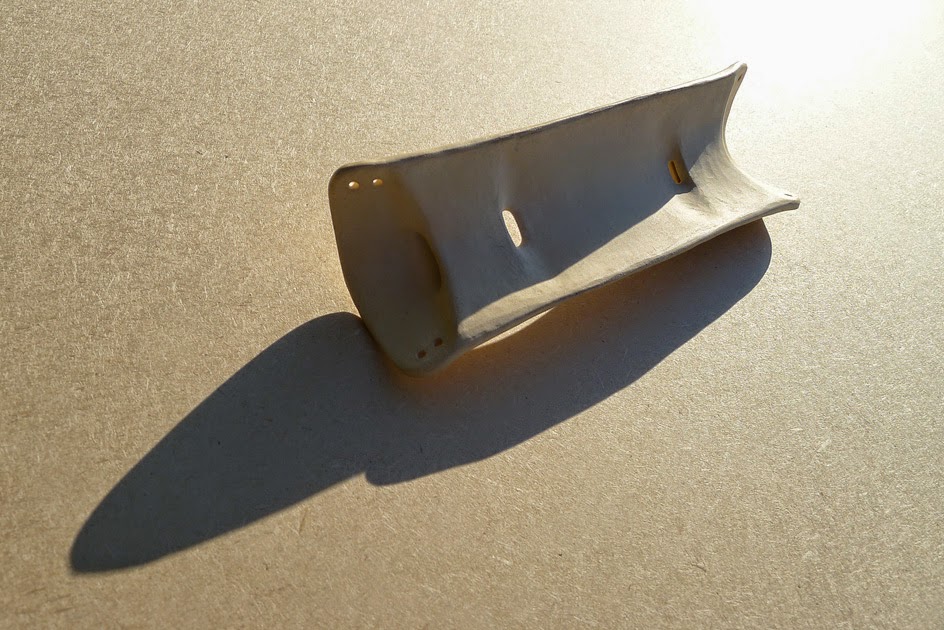
5 - Clay Hanabue No. 508 and L004

These two nose flutes, which look rather similar, are the RON "signature". Indeed, it is with such tile-shaped clay hanabue, with their very recognizable pair of black eyes, that Yoshihiro Sawada began his production and became renowned.


These nose flutes are very simple, yet nicely made, with a rounded front and a contoured inside. But they are not just "cut from a cylinder": there is a very slight counter-curve on the longitudinal axis, making them more a light "hyperbolic paraboloïd".

The inside contours show two parts, the nose saddle, which is wide and comfortable, and the mouth shield with its oval fipple hole.

Both the fipples a very small — trebles oriented — but one is even smaller (No. 508), particularly in its width, which is 1/3 less long than the L004 one. These fipple are nicely made, and knowing they are so small, it is really appreciable. On the front side, the labium angles appear to be slightly different.

Both these flutes are made with a thin clay plate. They are light and elegant.


Some details :

---

To be continued!

---