This blog is dedicated to the sublime instruments called nose flutes and which produce the most divine sound ever. We have chosen to discard all the native models from S. Pacific and Asia, for they need fingering to be played. We'll concentrate on "buccal cavity driven" nose flutes : the well patented and trademarked metal or plastic ones, plus, by a condemnable indulgence, some wooden craft or home-made productions.

Aug 24, 2012

NF.Org Holidays - Part II : RAOUL Concert in Melle

During our holidays, we gathered with some ukulelist friends in the Poitou-Charentes region, gently hosted by our friend Luthval. On Saturday evening, we all performed in a café in Melle. Quite a difficult job, since we never had played together, and the environment, although very friendly, was terrible : 100°F temperature and a lot of background noise. Anyway, a World Premiere happened : Lute and Nose flute duets, by Luthval and the Nosy Diva.
The video is quite long, but lazy listeners may like to know that the nose flute parts are located at 2'53, 7'18, 10:40 and 13:32.


We had a nice newspaper article :

Aug 22, 2012

Feed the Diva, back on your screen !

New video by Feed the Diva, with a super glow-in-the-dark Bocarina, a violin and a resonator ukulele.


The Nose flute has been home-painted with several coats of phosphorescent spray, and flooded with the light of a UV led torch.


Aug 21, 2012

NF.Org Holidays - Part I : Back home!

Yes, since the 8th of August, all the posts were pre-programed and automatically posted on the blog. Our holidays have been very noseflutey, with pictures, videos, a meeting, a concert and spreading the virus! They've been also very touristic (in France) and here are some narcissistic autoportraits made as souvenirs.

First, we celebrated the blog 1st anniversary in our hotel room in Vezelay, and I received the Jenny's Birthday Book as a present! :

so, we were...

At the Basilique in Vezelay :At the Palais Jacques Coeur in Bourges :
At our friend LuthVal in Pied-Pouzin :


At Azay-le-Rideau castle :
At the Mont Saint-Michel :

And at our friend Guy, in Normandy :


To be continued...

Aug 20, 2012

1920's Piano-bar atmosphere!

The number 36 of Mister Swing's Nickelodeons is a great collab session with a swooning sensual dancer (Aranea Peel), a pianist (Hans-Jürgen Osmers), a mute alabaster bust (Richard Wagner) and a crooner-noseflutist (Hans Christian Klüver), with a great vintage piano-bar atmosphere! Don't miss!

Aug 19, 2012

Huma... something.

It is very difficult not to confuse several early nose flute names, since many manufacturers chose on purpose very similar brands to market their product. Let's make a tour...


Humanatone

This is the name of the original tin nose flute produced by James J. Stivers and the Humanatone Co., N.Y.C. As stated by Stivers himself : « This trade-mark has been continuously used in my business since July 6th, 1903 ». The brand has since been used continuously until now, acquired by Fred Gretsch Mfg. Co. in 1947 to market the new plastic model, and later by Grover-Trophy Music Co.

But, as the Humanatone was soon (and still is) a best-seller, the name Humanatone has oftenly used as a generic name for ny nose flute. To add to the confusion, the tin design as the plastic model were both imitated — when not forged - by other makers.


Humanotone (Humantone, Human-a-tone,...)

As far as I know, this name has never been a nose flute brand. However, one can easily find it written here and there, as Humantone, Human-a-tone, Human-tone, Hum-a-tone.


Humanaphone

The Humanaphone was British, and produced in the 1925. Its a tin nose flute, very similar to the Humanatone, but offered a celluloid version regarded as a "hygienic line".


Humanophone

This nose flute would have been produced in the USA as early as 1920. Harvey Jones, Louisville jug band musician, used to play one : « The Humanophone was purchased at Lyons & Healy music store at Wabash and Jackson, Chicago, soon after Jones arrived in 1920, and when he was looking for novelty instruments. Jones knows of no one else who ever captured the technique of the Humanophone. »
However, I have never seen a picture or an ad for the Humanophone.


Humanophone/Humanaphone

But with those names (Humano- Humana- phone), problems arise : the name Humanophone has been used for other "instruments"!

Indeed, the Humanophone is an instrument invented by George Edward Ives (1845-1894), father of the famous Charles Ives, in New England, and made of a group of humans behind a curtain. Each of them sings a single note and only their heads appear, arrayed like a xylophone.

Logansport Journal (Indiana), Oct. 25, 1887 :


Ives Studies, edited by Philip Lambert, Cambridge Univ. Press, 1997 :


But Humanophone was also for a phonograph brand and Humanaphone a theater play title.
And moreover, most of the newspapers confused this "o" and that "a", even using both spellings in the same article!

So, in some cases, thanks to the context and the publishing date, there is no confusion possible. In 1886, the "instrument" is the Ives' Humanophone choir, no doubt :

Harrisonburg Rockingham Register, Jul. 29, 1886 :


Or later, when the text clearly mentions Ives' instrument (because of the presence of several musicians):

Adams County Press, May 4, 1904 :
Ada Evening News, Nov. 3, 1939 :


Idem for the theater play "Humanaphone" :

Parnell Iowa County Advertiser, May 19, 1910 :


Idem (probably) for the phonograph :

Belleville Telescope, Jan. 23, 1903 :


But, most of the time, it is not possible to know which Humanaphone or Humanophone is mentioned. However, some late articles could possibly mention the nose flute...

Bar Harbor Record, Apr. 16, 1902 (with both spellings!):


Wills Point Chronicle, Nov. 11, 1909 :

The Clintonian, Nov. 18, 1915 :

Winnipeg Free Press, Nov. 28, 1925 :


And sometimes, but rarely, we got it, for sure! (the date, the solo...) :

The Sioux City Journal, Apr. 11, 1922:

Nevada State Journal, Reno, Feb.7, 1935 :

The Twig, Raleigh, Apr. 27, 1943 :


Conclusion ?

Humanatone, despite the misspellings Humantone, Humanotone, Human-a-tone... has always been standing for ... 2 nose flutes : the Stivers' tin one, and the Gretsch's then Grover's plastic one.

Humanaphone was a British tin nose flute, marketed in the 1925's. It was also the name of an early century american theater play. The name has been oftenly misspelled into Humanophone.

Humanophone was an american tin nose flute, marketed at least from 1920. It was also the name of 1886 George Ives' choir instrument, and of a phonograph. The name has been oftenly misspelled into Humanaphone.

And it is a real mess in the newspapers archives :)

Aug 18, 2012

Nose flute and bamboo drum!

A sweet and nice video from Japan, on Motzi Youtube channel, in which a young boy plays hanabue while tapping a home made bamboo drum.

Aug 17, 2012

Alan Scott and the Bushwhackers

Alan Scott (1930–1995) was born in Caboolture, Queensland, and soon became interested in Scottish and American, then Australian folk songs. Scott was an accomplished musician, playing the concertina, tin whistle, recorder and mouth organ and was a fine singer. But he also used to play the nose flute.


« In 1954, Scott travelled to Sydney where he met the eminent Australian folklore collector John Meredith and other members of the bush music revival of the 1950s. During the same year he joined Australia's first bush band the Bushwhackers. »
(National Libray of Australia, A. Scott Biography)


Initially named The Heathcote Bushwhackers, the band was formed in Sydney in early 1952. The Bushwhackers were used to perform with traditional bush instruments. In 1955 The Bushwhackers recorded The Drover's Dream with Peter Hamilton on the newly established Wattle label, ultimately selling 20,000 records after the first pressing of 200. The Bushwhackers disbanded in 1957.


Indeed, although the sound is terrible and the nose flute is almost inaudible, it really features in the record. You can "detect" it the clearliest from 0:33, 1:11 and from 1:48 :


Bob Bolton, photographer, editorial and graphics officer, Vice-President and Editor at the Bush Music Club of Sydney, wrote in a Harry kay interview:

« The band was then booked all over Sydney. They were going for quite a while then Alan Scott came down to Sydney and he joined them. He was playing the snoz-whiz' - the nose whistle ».

And elsewhere, in a forum:

« Dare I mention it ... I just acquired, for restoration and occasional playing a real old-fashioned, tin-plated nose flute! My interest had been rekindled by coming across an early photograph of the first "Bush Band" ... that started our Australian "Folk Revival" in the Early 1950s ... The Bushwhackers Band (the 1954 - 1957 Sydney original, not the unrelated 1970s to present Melbourne one). At last i had located a picture of Alan Scott - who later played tin whistle and English concertina - playing, in performance, "the Tin handkerchief" ... the nose flute!

One of the early Australian folk revival players, the late Alan Scott of the original (1953/57) Bushwhackers Band, went on to play tin whistle and (English) concertina but started out on the Nose Flute (!) ... well-known to schoolchildren of the day as The Steel Handkerchief.

I had one of the tin-plated steel ones (also called "Magic Flute" ...?) when I was a kid ... about 45 years ago, if you disregard the chattering masses!
»

Funny aussie nicknames, aren't they? Snoz-whiz, Tin or Steel Handkerchief...


Anyway, I managed to find the picture evoked by Bob Bolton. Here it is, beautiful shot, with Alan Scott blowing in his Magic Flute :


We propose Alan Scott for Nose Flute Hall of Fame membership!

Aug 16, 2012

Aug 15, 2012

Apps for iPhone

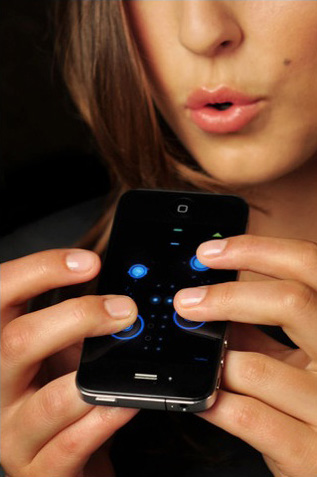
Needless to say it, there is NO nose flute application for the iPhone. I mean "no musical instrument application which pitch is driven by buccal cavity". But last weeks, 2 apps were issued with some interest for us.


The Ocarina 2

The Ocarina 2 is an e-ocarina, playable like a real ocarina, by fingering 4 e-holes, and blowing in the phone microphone. The sound is poorly settable (reverb, scale...), but you can either play along with a song or play "freely". But the interesting feature is that you can set the microphone sensivity, and thus, at max level, the Ocarina is fairly playable by blowing it with your nose.

Sound :

The sound is poorly settable, very "soft minded" and the playing is very slow.
You can have an idea of the possibilities with those 2 videos :
- here : normally played
- there : played as a nose flute

Ocarina 2 is Free.
Link to the Ocarina 2 page

-----


The Nosemonica


What's funny in this app, is that it is design from scratch to be played with the nose. It also shows great graphics. Unfortunately, you do not need to blow to play the Nosemonica, but just to slide your nose on the touch sensitive screen.

Sound :

The sound is not settable at all, but is like an correct harmonica. No choice of a scale neither (you cannot play the Blues!:/).

Here is the sound you get :


Nosemonica costs $0.99
Link to the Nosemonica page

-----

Would it be possible to create an app using nose air in the microphone (as does the Ocarina 2) and use the camera to detect the size of the open mouth to change the pitch ?

Aug 14, 2012

Bocarina as survival tool...

Well, it's certainly not the canonical use of a Bocarina, but it seems that FloydBlue had some success using his nosehorn as a shoehorn.


Aug 13, 2012

Jones' Paramount Charleston Four - Humanophone

In May 1925, the Jones' Paramount Charleston Four recorded 2 titles : Homeward Bound Blues (Paramount 12279A)and Old Steady Roll(Paramount 12279B). The musicians are Harvey Jones, Ernest Tapley (banjo/mandolin), James Turner(banjo madolin) and Eddie Vincent (trombone).

In those recordings, Harvey Jones was supposed to play the nose flute (as stated on several websites). Indeed, Jones was a noseflutist. I looked for these pieces of history for months, until I found the trace of an Ebay auction for the 78rpm, got in touch with the buyer, who gently accepted to send me mp3. Great and beautiful early jazz music, but huge disappontment : no nose flute, but a kazoo !

Homeward Bound Blues :


Old Steady Roll :


However, Harvey Jones (01/27/1902, Versailles, Ky - 1960s, Chicago)) was an entertainer and a noseflutist. In The Jug Bands of Louisville, by Fred Cox, John Randolph and John Harris and compiled by Laurie Wright in his out of stock magazine Storyville, one could read :

« An early member of Earl McDonald's Louisville Jug Band was Harvey Jones. Although Jones had been a drummer in his earlier career, the Jug Band needed pure novelty and Jones danced, sang and played novelty instruments. After the Jug Band played in Chicago in 1920 (therefore, long before they had recorded) Jones set up his own novelty group and played Kelly's Stables, Sherman House, theaters and mainly white clubs. Harvey reported that the Jones So-Different Four recorded TIGER RAG and HOMEWARD BOUND for Paramount. Obviously this is the item issued as Jones Paramount Charleston Four and the title for TIGER RAG was changed to OLD STEADY ROLL. The personnel for the date was: Harvey Jones - leader, Humanophone (a nose-whistle looking like a football nose-guard in which air blown through the nose is recirculated against the vocal chords and is given resonance and timbre in in the mouth), and Jazz Sax, a kazoo in the form of a sax. Ernest Tapley - banjo; James Turner - banjo; Sol Turner (not related) - guitar. »

This is very bizarre : the nose flute is mentioned (but not audible) and the Eddie Vincent's trombone is missing, although very recognizable in the records. Were they 2 versions of those tunes ???


Regarding the nose flute, the article mentions a « Humanophone ». In the International Association of Jazz Record Collectors Journal, Vol. 19-20, the glossary states :

HUMANOPHONE - This and kazoo used by Harvey Jones on a Paramount record in 1925. he same record also had others playing trombone, banjo and mandolin.

And back in Storyville :

« The Humanophone was purchased at Lyons & Healy music store at Wabash and Jackson, Chicago, soon after Jones arrived in 1920, and when he was looking for novelty instruments. Jones knows of no one else who ever captured the technique of the Humanophone. »

This testimony states that the Humanophone existed already in 1920.

And elsewhere in Storyville :

« Under the leadership of Harvey Jones, they organized a novelty band without a jug blower, using the name Jones' So Diffrent Four. Harvey had probably heard Whistler blowing the nose-whistle in Louisville, because he purchased one (trade name: Humanophone) at the Lyons & Healy music store, mastered it, and began featuring it with his So Diffrent Four. »

So, Harvey Jones would have bought a Humanophone after having heard Buford Threlkeld!, eminent honorary degree member of the Nose Flute Hall of Fame !

We propose Harvey Jones for Nose Flute Hall of Fame membership!

Aug 12, 2012

A correct wooden flute

I bought this "vietnamese type" nose flute at Copperman (£6-). It is a very standard African blackwood nose whistle. But contrarywise to the ones findable on Ebay, it is rather well finished, and thus, is comfortable and play rather nicely.

the problem with those flute are the nose hole position (not very ergonomical) and their lack of of speed. However, I tried a rather quick piece as sound sample, and the flute is ... better than me :) :

Aug 11, 2012

Video at Anvil Camp

A cool and fresh video by AnvilCamp4, with a guitalele, a nose flute and improvised precussions. The guitar is not well tuned, but the noseflutist plays right. Look at 0'53" the discreet sign sent to the percussionist and his (as discreet) annoyed reaction, very funny.

Aug 10, 2012

Yan Yalego... aussi!

Yan Yalego, the great guitarist, ukulelist and singer... also! Thanks to him for this beautiful and surrealistic autoportrait with his new Bocarina!


Yan Yalego website
Yan Yalego YouTube channel
Yan Yalego MySpace page

Aug 9, 2012

Happy Birthday - Part 4: Stats!

Who are you? Where are you from? Here are some interesting stats running on one year.


The Noseflute.org Blog: Figures

In one year, 366 posts were published, that is exactly 1 per day (2012 is a leap year).
Many thanks to the contributors, without whose it would not have been possible, and who provided articles, info, videos, comments...

In one year (366 days), the blog welcomed 37800 visits or so (36451 until 31st of July), that is an average of 103 per day.
But it is only an average, since during the last month, you've seen 221 pages each day!
Indeed, the growth of Noseflute.org was stunning, with more and more visits each month :


The Noseflute.org Readers: You!

You come from all around the world! With 3 main areas : USA, Asia (particularly Japan) and Europe. Here are some maps, showing your origin (info collected during 6 months only) and a "classification" by country, the first providing the most visits (these are "absolute" data, meaning that the most populated countries are over-represented regarding the % of people interested in nose flutes) :


Well... Africa is a desert for us: no interest for "urban type" nose flute or more probably lack of internet connections and computers... However, I can clearly see Mr. Schuermans in Pretoria, South Africa!