This blog is dedicated to the sublime instruments called nose flutes and which produce the most divine sound ever. We have chosen to discard all the native models from S. Pacific and Asia, for they need fingering to be played. We'll concentrate on "buccal cavity driven" nose flutes : the well patented and trademarked metal or plastic ones, plus, by a condemnable indulgence, some wooden craft or home-made productions.

Aug 29, 2014

Trophy Concert Nose Flute

Trophy Music Co, subsidiary of Grover, is the producer/distributor of the famous plastic Humanatone. The company mostly sells them in bulks of units wrapped in cellophane. But there is also a department called 1st Note which distributes the Humanatone with a better packaging, with the name "1st Note Nose Flute".

What's more unusual, is to find a wooden nose flute branded by Trophy Music... That's what I found, and with the help of my friend UkesterBrown, famous ukulele player, I was able to acquire it (the seller didn't want to sell out of USA ...!). Thank you David!

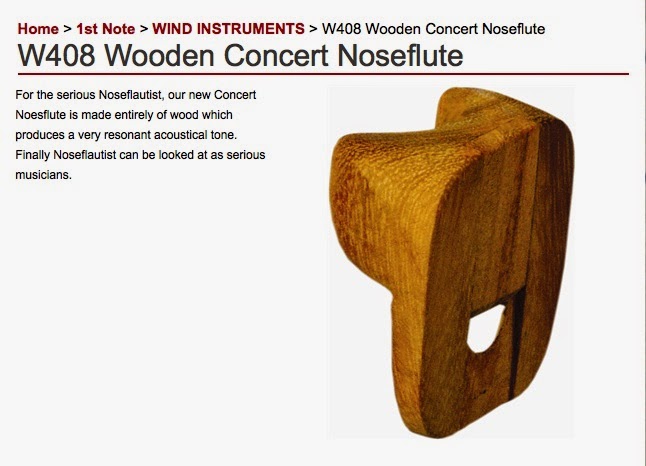
It is named "Concert Nose Flute", and is a "regular vietnamese nose flute" - I mean: not really an interesting wooden nose flute (badly and quickly made). What is interesting is the fact that Trophy distributed it. The back is printed with an "humorous" user manual, and the graphics looks like dedicated to an April Fool's Day use.


I checked the barcode (UPC-A : 0 82562 08423 0), in which 82562 refers to Trophy Music Co. and 08423 to the specific product itself, and found no occurrence, meaning that the product has been discontinued. However, the reference W408 still exist for a wooden nose flute in Trophy Music catalog, but apparently with no packaging (they probably understood that the laughing man was not compatible with their assertion Finally Noseflautist can be looked at as serious musicians (sic). So, it is not possible for me to date this nose flute, but I think it is from the 1990s. The "laughing bow tie man" graphics is the same that the former designed used to package the 1st Note Nose Flute (Humanatone).


Here are the former and the current graphics of the 1st Note Nose Flute:

Aug 28, 2014

Lloyd Buford Threlkel - Another Portrait

Just another picture of Lloyd Buford Threlkel, Honorary Degree Member of the Nose Flute Hall of Fame. It would be nice to find the original picture, since this one looks to be a multiple photocopies result.


And just for the pleasure:

Low Down Blues (Eubie Blake / Noble Sissle), 4-29-1927, St. Louis, Missouri, Okeh 8469.
(nose flute solo starting at 0'56) :

Aug 26, 2014

(Very) Early Plastic Humanatone

I found a vintage plastic Humanatone in its box which appears to be very interesting on several topics: datability, shape and Gretsch Co. politics.


The nose flute is a plastic Humanatone branded by Gretsch, with the very original shape designed by Ernest W. Davis in his 1940 patent, which is slightly different of the current shape. The flute has a great but weird marbled color, a bit like a salmon roe with nerves and veins:)

It features the famous "tremolo hole" described in the patent, wears the Humanatone branding, the patent number, but not the Gretsch stamp yet. The nose flute is very badly (I should say not at all) burnished and show many plastic burrs.

Now, if you compare this early Humanatone to a current one, you can notice many differences... Indeed, the original shape is more rounded and the current prod. shows angles. But this is not all. There was no heel at the bottom of the mouth shield. The vintage one has wings a bit larger, its nose saddle is different, the size of the mouth hole is smaller in heigth, but the airway is broader. The nose cutaway is softer, the tremolo hole is conical, the typo font is not the same, ... Many, many tiny differences are noticeable. The plastic itself is not the same (early polystyrene? or celluloid?), and is thicker on the old Gretsch.


Now, the box. The box has a graphic design rather typical of the 1940s Gretsch graphics. The top specify "IT'S A GRETSCH PRODUCT" and the user manual is printed on the back side. But... Don't you think this box is a bit big for such a flat nose flute? Look at late 1940s Humanatone packages, they are much thinner...


Indeed, have a look at the whole spread box:


The side flaps, astonishingly, show a metal humanatone, and not the plastic one! How does it come? The box is printed with "IT'S A GRETSCH PRODUCT", and so can't be a late Stivers' Humanatone box. My hypothesis — as you know, I always have an hypothesis :) — is that when Fred Gretsch bought the Humanatone brand to the Stivers, he also bought the old stock and began to sell it with a Gretsch-branded packaging. Maybe was he waiting for the production of the new plastic nose flute. Then, when the metal nose flutes stock was out, there were still boxes printed with the metal flute, but Gretsch used them for the new plastic instruments. Then, they produced an adapted and flat packaging. Indeed, in 1944, the boxes were already showing the plastic model.

So, I can state this plastic Humanatone is a from a very early production batch, very likely from 1943 (the origins). Great find, isn't it?


Aug 24, 2014

YA Humanatone advertisement

This one was difficult to find, because of the mispelling Humanatane for Humanatone :)
Nothing very special with this advertisement, but it dates from March 30, 1905, (in The Plymouth Tribune, Indiana), and that is an early advertisment campaign for this nose flute.


Aug 23, 2014

Pr. Glukoz' Amplificator

A great and funny video by our friend ProfGlukoz, presenting his Nose Flute Amplificator, and parodying with talent the "official" noseflute.org videos... We already encountered this obnoxious (but hilarious) Professor Glukoz some times ago, when he founded the CRAFAN (Comité Révolutionnaire Anti Flute A Nez) and was the infamous author of a shameful blackmail. It seems that Mr Glukoz, PhD in nonsense, has finally succumbed to the nose flute appeal! (Nose flute always wins, hehehe :)

Aug 21, 2014

Pfaff Nasenpfeife Patent

Finally, the Pfaff Nasenpfeife patent became public. The Nasenpfeife is a German nose flute put on the market by Bernd Kaltenbach, which can be also used as a whistle and a bottle opener. We reviewed it there.

Filed on May 18, 2010, for the classes B67B 7/16 and G10K 5/00, the patent was delivered on May 5, 2011, with the number DE102010029044B3 and with mentions of Manuela Schulz as the inventor, and Stephan Ebner as Applicant/Owner.

The patent top description totally ignores the *nose* whistle function:

[EN]The opener (8) has an air supply chamber (10) with an air inlet opening (12) at a rear side of a base body and an air outlet opening (14) at a front side of a rear area, where the opener is made of metal or plastic. An air tearing edge (16) is formed at a side of a passage opening (DU) of a resonance cavity such that different whistler sounds are produced by air flow from the outlet opening during opening of a bottle and/or by a mouth opening that is partially covered by a lower side of the base body, where the side is arranged opposite to the outlet opening.
However, nose whistling is shown in Fig. 9A (you need to turn your head to the left to see it in the good position). Here are the most interesting illustrations in the patent:

The trademark Nasenpfeife has also been filed by Bernd Kaltenbach Nov. 3, 2012 and was registered Jan 22, 2013, with the number 3020120577458.

Nasenpfeife trademark and Bernd Kaltenbach:

Aug 19, 2014

A nice picture of an Ocariflute

Several times, we have published posts about the Ocariflute (which used to be named "Oclariflute" at its beginnings), notably when we heard of its existence through advertisements, about its Silver Medal at Concours Lépine in 1923, when it was played on french TV or when we found the great (and too short) footage showing Jean Dubuffet and his Ocariflute in 1961...
So, we partly knew this french nose flute, but had never seen one in detail... until I found this beautiful picture coming from the Scenkonstmuseet (Swedish Museum of Performing Arts), based in Stockholm.


There is no doubt this instrument is an Ocariflute: the very typical shape of the heel is an evidence. What is interesting to notice, is that this nose flute was not stamped by a trademark or a name, contrarywise to any known and trademarked nose flutes we know. I have an hypothesis... as usual :)


On the advertisement above, the text "Instruments Brilhault - BT SGDG" (a not the name Ocariflute!) appears on an oval white background: it could be because the flute is not stamped but only got a sticker on the heel. And why not a stamping? Remember there was another instrument that was called Ocariflute at this time. "Ocariflute" was probably a better name than "Oclariflute", but was already in use. So Brilhault chose "Oclariflute" in 1922. But we know than after 1930, the nose flute finally got the name "Ocariflute" (Did Brilhault buy the trademark? Or was the name not renewed by he Ullmann company?). So, in the 20's, why would you have built a stamping machine with a trademark that you don't want to keep (Oclariflute) or are not yet allowed to use (Ocariflute). Better to glue a sticker, no?

--

The Scenkonstmuseetpossess also in its collection another metal nose flute, which appears to be a German no-name Nasenflöte, and look very similar to the German one I bought... in Danmark.


Mine:

Aug 17, 2014

Washboard with Nose Flute

I got a vintage washboard that was still full of smelly wash powder, on the purpose to transform it into a percussion instrument. But I felt the need of an integrated nose flute. I mounted a 6" splash cymbal and build a small hi-hat, with aluminium tubes and springs, that can be activated by hand. A "Jack Daniel" guitar strap, and a Bocarina™!

To mount the nose flute, I used a Reggi-Flauto, by Felice Pantone, that I transformed a bit. I pierced the boccy (with a hot metal needle) and plugged the Reggi-Flauto, in order for the boccy to be able to rotate, and thus, to fit easily the player's nose when it plunges in the nose flute. The height is adjustable.

Well... I just need to learn how to play it now !